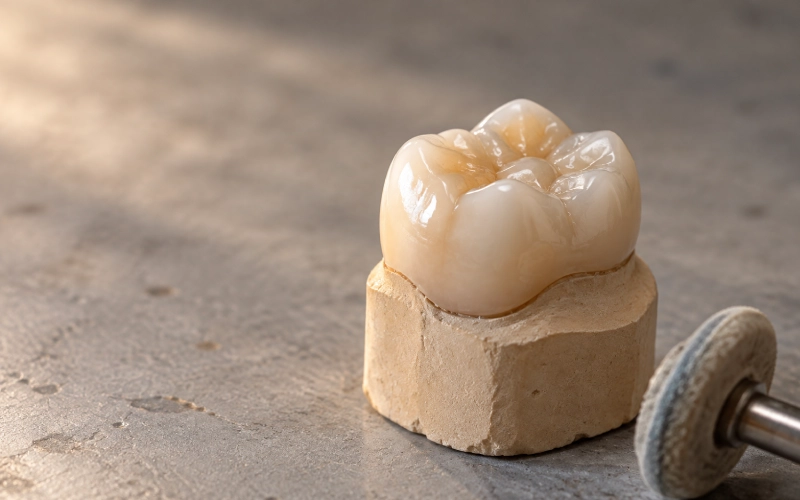
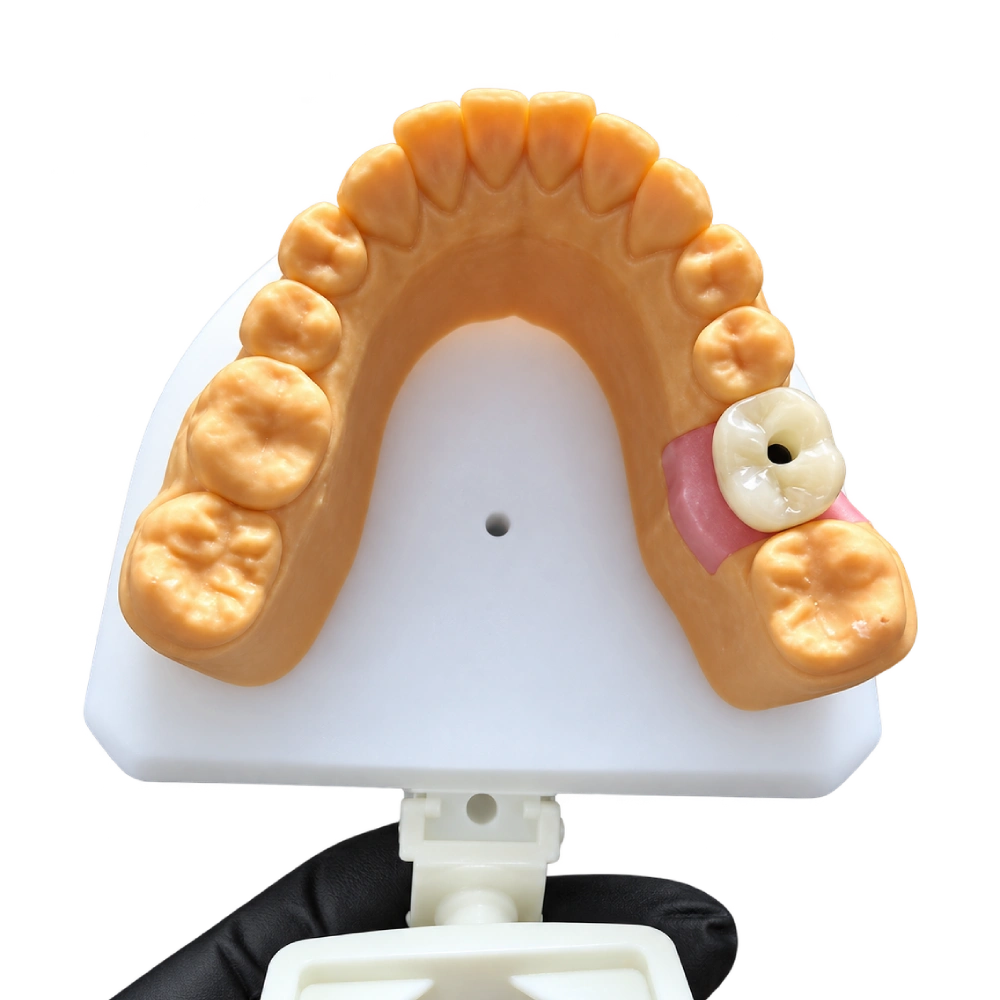
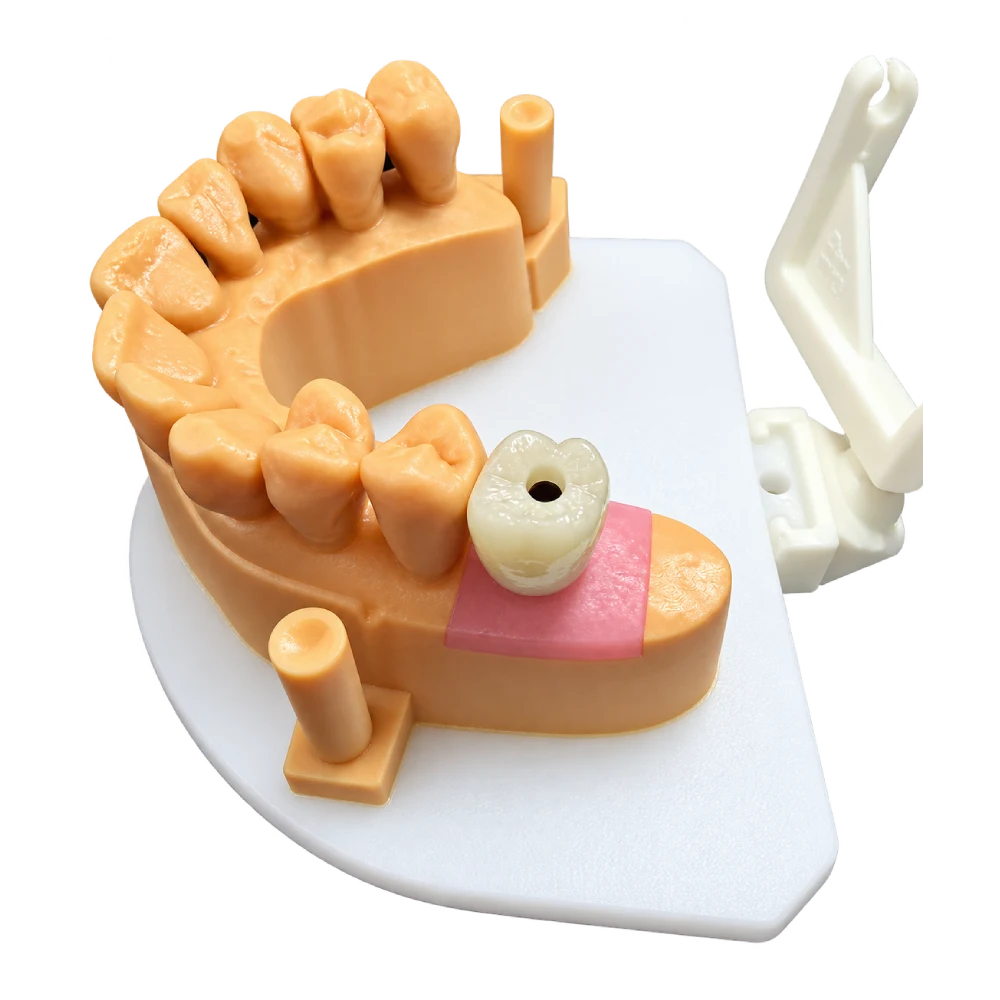
Monolithic Zirconia Crown Bridge — Posterior Multi-Unit Restoration Case
Who We Are
ASD Dental Lab is a direct manufacturing facility, founded in 2012, our facilities in Shenzhen and Huizhou handle the full workflow from digital design through CAM milling, zirconia sintering, finishing, and quality control. With approximately 100 CAD designers and dedicated ceramic departments, we complete every production step in-house.
When a dentist or clinic sends us a zirconia crown bridge case, they’re working with the team that physically designs, mills, and inspects the restoration, under one production system with traceable batch records and material IFUs on file.
Patient Case Overview
Patient Background
A 48-year-old patient presented with missing teeth at positions #29 and #30 . The teeth were lost due to advanced caries with failed endodontic treatment approximately two years prior.
The patient reported difficulty chewing on the right side and preferred a fixed prosthesis that would restore full function without requiring a removable partial denture.
Clinical Constraints
Abutment tooth condition: The second premolar (#28) and third molar (#31) both showed adequate bone support and no mobility. The premolar had undergone root canal treatment approximately six years earlier with satisfactory periapical healing. Both abutments demonstrated sound periodontal status with no active inflammation.
Opposing dentition: Natural upper molars with moderate occlusal wear facets consistent with the patient’s age. The opposing teeth were structurally sound and required only minor occlusal adjustment to achieve adequate interocclusal clearance for the restoration.
Interocclusal clearance: Measured 1.8 mm at the thinnest occlusal point after conservative abutment preparation.
Mesiodistal span: 12 mm measured from the distal surface of #28 to the mesial surface of #31.
Buccolingual width at connector sites: Approximately 8 mm at both connector locations, adequate for designing connectors with cross-sectional areas within recommended ranges for posterior 3Y-TZP fixed dental prostheses.
Why This Case Presented Challenges
The main design constraints were limited vertical clearance (1.8 mm minimum) combined with heavy posterior functional loading on a four-unit span.
A conventional porcelain-fused-to-metal (PFM) approach would have required additional occlusal reduction to accommodate both the metal substructure and the veneering ceramic. A layered zirconia design — where porcelain veneer is fired onto a zirconia framework — would similarly demand extra thickness for the veneer layer and supporting core, risking either over-reduction of tooth structure or a bulky restoration profile.
At the same time, the opposing natural dentition with moderate wear facets raised concern about potential wear if the monolithic zirconia occlusal surface wasn’t properly finished. Clinical evidence suggests that polished zirconia produces less antagonist wear than rough-adjusted surfaces, making the final polish a functional requirement, not just an esthetic preference.
The connector geometry was another decision point: with a 12 mm span and posterior loading, the connector cross-sectional area needed to meet biomechanical requirements without exceeding the available buccolingual (8 mm) and occlusogingival dimensions. Published guidance for posterior zirconia fixed dental prostheses (FDPs) suggests connector areas in the range of 9–12 mm², though these values are not universal minimums and must be verified against the specific material grade, span, design, and loading conditions per the manufacturer’s instructions for use (IFU).
Dentist’s Prescription and Lab Instructions
The referring dentist prescribed a four-unit zirconia crown bridge (abutments on #28 and #31, pontics at #29 and #30) with the following specifications:
- Material grade: 3Y-TZP zirconia.
- Rationale: The dentist prioritized fracture resistance over maximum translucency given the posterior location, heavy functional load, and four-unit span. 3Y-TZP offers the highest transformation-toughening capacity and flexural strength among common zirconia grades.
- Material background: 3Y-TZP (approximately 3 mol% yttria) offers the greatest transformation-toughening and strength among common zirconia grades, with lower translucency; 4Y-PSZ provides intermediate strength and translucency; 5Y-PSZ delivers higher translucency but reduced transformation toughening compared to 3Y, making it better suited for anterior single crowns or selected short-span anterior/premolar FDPs under favorable loading.
- Design type: Monolithic zirconia crown bridge (no porcelain veneer).
- Why monolithic: To stay within the available occlusal clearance (1.8 mm minimum) and eliminate the risk of veneer chipping or delamination, which is the typical failure mode for layered ceramic-on-zirconia designs. Monolithic designs remove the zirconia–veneer interface, allowing the restoration to function as a single solid body.
- Shade: A2 (matched to the patient’s existing lower dentition)
- Occlusal surface finish: High-gloss polish on all functional contacts.
- Clinical basis: The dentist requested polished occlusal surfaces to minimize antagonist wear. Smooth, polished zirconia has been shown to produce wear rates comparable to or better than natural enamel-on-enamel contact, while rough or unpolished zirconia can accelerate opposing tooth wear.
- Connector dimensions: The dentist noted the 8 mm buccolingual width and requested connectors with adequate cross-sectional area to resist fracture.
- Design guidance: Clinical reviews cite connector areas ranging from 6.25 mm² (for single-retainer resin-bonded bridges) to 9–12 mm² (for posterior multi-unit 3Y-TZP FDPs), but these values are not interchangeable universal minimums. The required connector size depends on the material grade, span length, loading conditions, abutment design, and product-specific validation data in the manufacturer’s IFU.
- Margin design: Light chamfer with rounded internal line angles, avoiding sharp corners that could concentrate stress.
- Cementation protocol: Conventional cementation using resin-modified glass ionomer cement. The dentist did not request adhesive pretreatment.
- Work order submission: Digital scan files (.STL format), shade photographs under natural lighting, and opposing arch scan with bite registration.
Our Manufacturing Approach
Step 1: Case Data Intake and Digital Design
Our CAD design team received the case data and evaluated:
- Preparation quality (margin clarity, reduction adequacy, internal line angles)
- Interocclusal clearance at multiple points
- Pontic space and tissue contour
- Connector site dimensions (buccolingual and occlusogingival)
We created a virtual wax-up, positioning the pontic(s) to restore occlusal anatomy while keeping connector geometry within the available envelope. Each connector was designed with:
- Cross-sectional area: Approximately 10.5 mm², exceeding the 9 mm² threshold referenced in clinical literature for posterior 3Y-TZP bridges of this span.
- Shape: Rounded or elliptical cross-section rather than sharp or notched, distributing stress more evenly and avoiding stress concentration points.
- Thickness: The framework occlusal thickness was kept at 1.5 mm, with adequate bulk at connector sites to resist flexural loading under function.
Design review checkpoint: The virtual wax-up was reviewed internally against the work order specifications before proceeding to milling.
Step 2: CAM Milling from Verified Zirconia Blank
We selected a Ivoclar Vivadent IPS e.max ZirCAD zirconia disc, grade 3Y-TZP, batch number recorded in case file, and milled the framework on a 5-axis CAM milling machine.
Material traceability: Every zirconia blank we use is logged with:
- Batch/lot number
- Yttria grade (3Y / 4Y / 5Y / multilayer)
- Manufacturer’s IFU version on file
- Sintering furnace program validated for that product
Step 3: Sintering According to Furnace Program
The milled “green-state” zirconia was placed in our sintering furnace and processed according to the validated furnace program for this disc product. Manufacturing quality control protocols recommend following the disc manufacturer’s sintering profile (time, temperature ramp, hold duration, cooling rate) to achieve the target density and grain structure.
Post-sintering inspection: After sintering, we verified:
- Dimensional accuracy against the digital design (±50 µm tolerance)
- No visible cracks, voids, or sintering defects
- Marginal integrity and connector geometry
Step 4: Finishing, Polishing, and Occlusal Surface Management
Because the prescription specified a polished occlusal surface, we followed these steps:
- Adjusted occlusal contacts based on the provided bite registration or opposing scan, ensuring even contact distribution and no premature interferences.
- Polished all functional surfaces using a staged progression of diamond polishing paste and felt wheels, bringing the occlusal table to a high-gloss finish.
Why this step isn’t optional: Clinical evidence shows that rough or unpolished zirconia can cause accelerated wear of opposing natural teeth or restorations. Polished zirconia, by contrast, produces wear rates similar to or better than enamel-on-enamel articulation. Skipping the polish step — or delivering a restoration with adjustment marks that weren’t re-polished — can turn a biomechanically sound restoration into a source of opposing-tooth damage.
- Stained and glazed (if requested) to match adjacent tooth shade and add surface characterization.
Step 5: Quality Control Inspection
Before packaging, every restoration passes through our QC department’s checklist:
- Marginal fit: Verified under magnification; margins must be continuous and adapted, with no steps, gaps, or overhangs.
- Occlusal clearance: Re-checked against the digital design to ensure no thin or undersized areas.
- Connector integrity: Visual and dimensional inspection of connector sites; no sharp transitions, notches, or undercuts.
- Surface finish: Polished areas inspected for consistent gloss; no residual milling marks or rough patches on functional surfaces.
- Shade match: Compared to the submitted shade guide and photographs.
- Material traceability: Case file updated with disc batch number, grade, sintering furnace ID, and date.
Delivery and Clinical Outcome
The completed zirconia crown bridge was packaged with:
- The final prosthesis
- A copy of the work order and case specifications
- Material certificate (3Y-TZP zirconia grade, batch/lot number, Ivoclar Vivadent IPS e.max ZirCAD)
- Cementation instructions per the manufacturer’s IFU
Post-delivery: The restoration was delivered to the clinic within 3 working days from case receipt. Standard turnaround for routine bridge cases is 2–3 working days as documented in our production timeline.
What We Can
What This Case Demonstrates
- Full in-house workflow: From CAD design to milling, sintering, polishing, and QC, every production step happened under one roof with traceable batch records.
- Material-grade matching: The selected 3Y-TZP zirconia grade aligned with the clinical loading conditions (four-unit posterior span, heavy functional load) and esthetic requirements specified by the prescribing dentist.
- Design validated against published guidance: Connector dimensions (10.5 mm² cross-sectional area), occlusal thickness (1.5 mm), and margin design (light chamfer) followed recommendations from peer-reviewed clinical literature for zirconia FDPs of this span and loading scenario.
- Polished occlusal surface: Delivered with a high-gloss finish on functional contacts to minimize antagonist wear, per the dentist’s prescription.
Working With Us
Case Submission Requirements
To fabricate a zirconia crown bridge, we need:
- Digital scan files (.STL or compatible format) of prepared abutments, opposing arch, and bite registration
- Or: Traditional impressions (PVS preferred) with opposing model and bite registration
- Shade information: Vita shade code or equivalent, ideally with photographs under natural and clinical lighting
- Work order specifying:
- Desired zirconia grade (3Y / 4Y / 5Y) or “lab’s recommendation based on span and loading”
- Design type: monolithic vs. layered (if layered, specify veneer material)
- Occlusal surface finish: polished vs. stained/glazed
- Cementation protocol if adhesive pretreatment is required
- Any special instructions (e.g., conservative connector design, try-in requested, minimal occlusal adjustment)
Communication During Fabrication
If our CAD team identifies a concern during design — for example:
- Insufficient occlusal clearance for the requested design
- Marginal defects in the scan or impression
- Connector dimensions that fall below recommended thresholds for the span/grade
- Abutment geometry that could compromise retention
— we contact the prescribing dentist or clinic before proceeding. We don’t alter the prescription unilaterally.
Turnaround and Capacity
Standard turnaround: 2–3 business days from case data receipt to shipment.
Rush/priority service: Available upon request; specify timeline requirements in the work order.
Regulatory and Material Standards Context
ISO 6872 — Dentistry: Ceramic Materials
ISO 6872 classifies dental ceramics into classes based on flexural strength and intended clinical use:
- Class 3: Single-unit anterior or posterior prosthesis; three-unit prosthesis not involving a molar (≥300 MPa)
- Class 4: Three-unit prosthesis involving molar replacement (≥500 MPa)
- Class 5: Four-or-more-unit prosthesis (≥800 MPa)
These are material testing thresholds for regulatory and quality purposes. A zirconia product’s class rating tells you whether the material is approved for that clinical use, but it does not predict the survival rate of your specific case — that depends on design, cementation, occlusion, and patient factors.
FDA Guidance for Dental Ceramics (2024)
The FDA’s 2024 guidance outlines the premarket data needed for dental ceramic devices, including mechanical testing (flexural strength, fracture toughness), biocompatibility, and labeling requirements. This guidance applies to manufacturers bringing new zirconia products to market; it does not prescribe clinical protocols for individual patient cases.
What this means for your case: The zirconia disc we used has undergone the testing required for its intended class. We record the disc’s batch number and IFU version with each case, so if the manufacturer updates the IFU (for example, revising cementation or sintering recommendations), we can trace which cases were affected.
Material Traceability and Product IFU
Every zirconia restoration we fabricate is logged with:
- Disc manufacturer and product line
- Batch/lot number
- Yttria grade (3Y-TZP / 4Y-PSZ / 5Y-PSZ / multilayer)
- Sintering furnace program validated for that product
- IFU version on file
References
- FDA. (2024). Class II Special Controls Guidance Document: Dental Ceramic. Retrieved from https://www.fda.gov/media/182281/download
- Gaddale, R., et al. (2024). Clinical performance of zirconia fixed dental prostheses. PMC. Retrieved from https://pmc.ncbi.nlm.nih.gov/articles/PMC11649700/
- Guess, P. C., Att, W., & Strub, J. R. (2012). Zirconia in fixed implant prosthodontics. Clinical Implant Dentistry and Related Research. Retrieved from https://pubmed.ncbi.nlm.nih.gov/21219568/
- Lohbauer, U., & Reich, S. (2017). Antagonist wear of monolithic zirconia crowns after 2 years. Clinical Oral Investigations. Retrieved from https://pmc.ncbi.nlm.nih.gov/articles/PMC5455532/
- Pjetursson, B. E., et al. (2018). Implant-supported fixed dental prostheses: A systematic review. Journal of Dental Research. Retrieved from https://pubmed.ncbi.nlm.nih.gov/30328185/
- Rinke, S., et al. (2013). Zirconia: Materials, processing, and clinical applications. Quintessence International. Retrieved from https://pmc.ncbi.nlm.nih.gov/articles/PMC10842315/
- Sailer, I., et al. (2015). A systematic review of the survival and complication rates of all-ceramic and metal-ceramic reconstructions after an observation period of at least 3 years. Part I. Clinical Oral Implants Research. Retrieved from https://www.sepes.org/wp-content/uploads/2021/11/A-systematic-review-of-the-survival-and-complication-rates.-Part-I.pdf
- Yan, J., Kaizer, M. R., & Zhang, Y. (2018). Monolithic zirconia crowns: Review and update. Journal of Prosthodontics. Retrieved from https://pmc.ncbi.nlm.nih.gov/articles/PMC9663878/
Contact and Next Steps
ASD Dental Lab
Facilities: Shenzhen and Huizhou, China
Factory visit: We welcome dentists, lab partners, and clinics to tour our production lines and QC processes. Video walkthroughs are also available upon request.
Case consultation: If you’re planning a zirconia crown bridge case and want to discuss material grade, connector design, or turnaround options, contact our case coordination team before submitting your work order.
Experience faster turnaround times with our cutting-edge technology
Recommended