Metal Dentures Built by an In-house Dental Lab — Cast, Milled and Laser-Printed Frameworks
Looking for a lab that actually builds every metal denture in-house, ships on a predictable schedule, and hands you a clean paper trail on alloys and design? That’s what we do. This page walks through the metal partial denture work our floor produces every day — cast, milled and laser-printed frameworks, Vitallium and cobalt-chrome, digital or PVS workflow — and shows you exactly what to send, what you get back, and how long it takes.


1. Our Metal Denture Product Range
We build the whole metal dentures family in one facility. No third-party lab picks up the case halfway.
Line | What we build | Framework options |
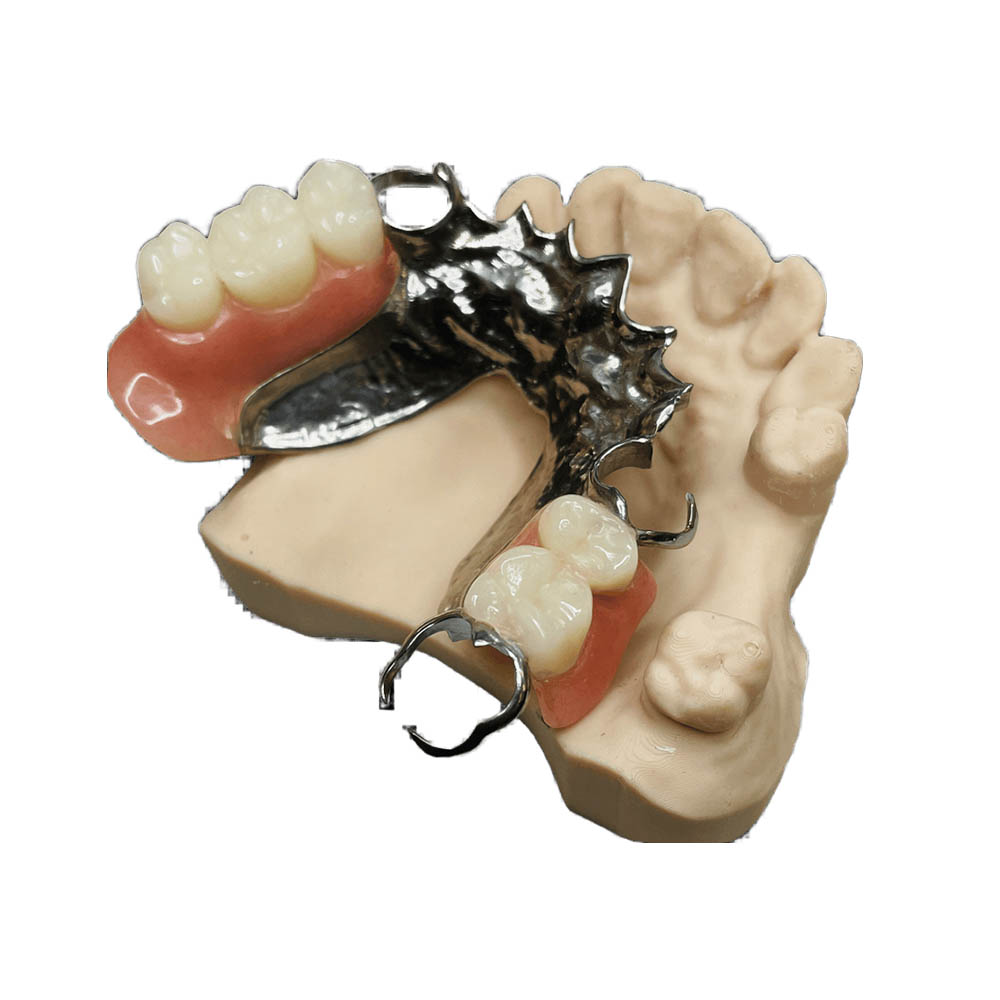
Cast Partial Denture | Classic cast metal framework with acrylic saddles and teeth | Cobalt-chrome, Vitallium 2000, titanium |
Milled Metal Partial Denture | CAD-designed, CAM-milled frame from a solid puck | Cobalt-chrome, titanium |
Laser-Printed Metal Framework | Selective laser-melted frame, stress-relieved and hand-finished | Cobalt-chrome |
Combo Cases | Metal framework paired with attachments, precision rests, or milled crown-under-partial | All of the above |
Repair, Reline, Add-a-Tooth | Break, warped clasp, extra pontic, tissue reline on an existing frame | Solder, laser weld, wrought-wire, cold-cure or heat-cure rebase |
Metal Occlusal / Metal Lingual on PFM | Under-partial support so your metal partial denture seats predictably | Non-precious, semi-precious, high-noble |
2. Why Send Your Metal Denture Cases to ASD
Five things that decide whether a metal partial denture case is worth sending overseas, and how we handle each.
2.1 A real factory, not a middleman
ASD has been running as a direct manufacturing facility since 2012, with plants in Shenzhen and Huizhou. About 460 people on the floor, including a dedicated 55-person removable department and a 70-person ceramic-and-metal team. Cases don’t get forwarded to a partner shop — the framework you order gets designed, cast or milled, finished and packed under one roof.
2.2 Cast, milled or laser-printed — you pick
Most of the industry gives you one framework path. We keep three live:
- Cast for classic RPD design, wrought-wire tweaks, and cases where you want a technician’s eye on the wax pattern.
- CAM-milled when you want tight, repeatable tolerances from a scan file.
- Laser-printed (SLM) when the design has thin rests, complex mesh, or a curved lingual bar that mills poorly.
All three cross the same inspection bench — thickness gauge, magnifier for margin and rest-seat fit, radiographic or dye-penetrant check for porosity on cast frames.
2.3 Alloys we can actually document
- Cobalt-chrome — the daily driver for cast partial denture work.
- Vitallium 2000 — for the cases where you want a named premium alloy on the prescription.
- Commercially pure titanium — nickel-free, lower-density option for allergy cases.
- PEEK — polymer framework option when you want a metal-free look with rigid load transfer.
Batch and composition documents are available on request for any framework we ship (Q&A file, P138). Base resins run the range too: Lucitone 199 (imported, high-end), our house heat-cure PMMA, and unbreakable resin for saddles that need extra impact tolerance.
2.4 Digital or analog — the workflow bends around you
Send an intra-oral scan (STL) or a PVS impression with a stone pour. Both work. Digital cases usually finish 1–2 days sooner because we skip the pour-and-repair step and the scan file survives forever, so remakes and add-teeth years later don’t need a new impression appointment.
2.5 Design approval before we cut metal
Every framework case goes through a survey / design review before casting or milling. You get a digital design showing clasp type (I-bar, C-clasp, RPI, embrasure), rest-seat locations, major connector geometry, and mesh coverage. Approve, comment, or ask for a redesign. Once you sign off, we cut metal.
3. How We Actually Build a Cast Partial Denture
Nothing here is boilerplate. This is the workflow that runs on our floor.
Cast partial denture, standard case:
- Rx and file review. Case coordinator opens the ticket, checks Rx completeness, and flags anything missing (Kennedy classification, tissue relief, major connector, clasp preferences).
- Scan or pour. Digital cases go straight to CAD. PVS cases get poured to a stone model in-house.
- CAD survey and design. Survey line, undercut depth on abutments, major connector position and clasp map — laid out digitally, saved with a version number.
- Design approval. Digital design goes back to you before we cut metal. Common turnaround: same day or next day.
- Framework production. Cast (lost-wax investment), milled from a puck, or laser-printed and stress-relieved. Cast frames cool in the investment, get devested and sandblasted with alumina.
- Fit and finish. Framework is seated on the working model. Rests, guide planes, clasps, and major connectors get hand-adjusted. Any warp shows up here.
- Denture teeth setup. Wax rims, tooth setup, occlusal alignment. Wax try-in or digital try-in is offered on request (Q&A, G265 / G266).
- Processing. Heat-cure, injection or milled acrylic. Injection gives the tightest fit; heat-cure is the classic route.
- Occlusion, articulator recheck, polish. Anatomical polish on cameo surfaces only; tissue surfaces stay untouched to preserve the seal.
- Multi-stage QC. Model check, wax check, setup check, and final. Any bubble, porosity, poor seating or bite mismatch triggers a rework, not a shipment.
- Pack and ship. Framework and finished metal partial denture go out with the prescription file, alloy note and a case-tracking QR.
Standard framework-only cases take 2–3 working days in production once the case data is confirmed. Full metal dentures with setup, processing and delivery pack usually land in the same window when the digital design is approved on the first pass.
Repair, add-a-tooth, reline
This is the part where a cast partial denture earns its keep — you can keep it in service for years.
- Laser weld or solder for broken clasps and fractured connectors.
- Wrought-wire clasp addition when a new tooth needs a retainer arm.
- Add-a-tooth by mechanical retention over the existing framework mesh.
- Rebase / reline with the same resin family as the original base to preserve bond.
- Flexible frame repair — for cases where the original was a nylon or thermoplastic framework, we handle addition and repair too. There are limits: Valplast-style frames aren’t a fit for heavy occlusal load, wide base coverage, or deeply undercut abutments (Q&A, G270).
4. Cooperation Workflow — What to Send, What You Get Back, When
The single most useful thing we can do for your chair time is remove ambiguity from case submission. Here’s exactly what a metal denture case needs on our end.
4.1 What to send
Data | Digital case | Analog case |
Impression | STL of both arches + opposing | Alginate or PVS + stone pour, or ship the impression to us |
Bite | Digital bite scan or wax bite | Wax bite, silicone registration, or old denture as reference |
Prescription | Rx form (upload or paper) — must include Kennedy classification, framework material, clasp preferences (I-bar / C / RPI), major connector, tooth shade | Same |
Photos | Smile line, midline, opposing dentition | Same |
Old denture | Optional but useful for shade, tooth position, VDO | Optional but useful |
If any of the above is missing we call before we cut — not after. Multi-doctor accounts (DSOs) can save per-clinician preferences in our system so we don’t need to re-ask every case (Q&A, G197).
4.2 Turnaround
Case type | In-lab days |
Cast, milled or printed framework (framework only) | 2–3 working days |
Full metal partial denture (framework + setup + processing) | 4–6 working days depending on try-in |
Full-arch removable | 5–7 working days |
Full-mouth / complex implant case | 7–10 working days |
Repair, reline, add-a-tooth | 1–3 working days |
Digital design review before casting | Same day / next day |
Shipping is on top and depends on your address. We do not roll shipping days into the in-lab days — you get honest numbers on both.
4.3 What you get back
- The finished metal denture or framework, seated on the working model
- Alloy note with batch identifier
- Rx acknowledgment with the Kennedy class, major connector and clasp map as-built
- Design snapshot (digital cases): the exact CAD file we cut, saved and retrievable for future add-teeth or remakes
- Any concerns we flagged on QC, in plain English
4.4 Factory audit / visit
Any lab, clinic or DSO partner can arrange a factory visit in Shenzhen or Huizhou, a video walk-through of the removable department, or a live production tour (Q&A, G005). We don’t ask for a minimum order to open the doors.
5. Materials, Alloys and Base Resins — What Actually Ships
For teams that need to write this into their own paperwork, or hand it to a compliance colleague.
- Cobalt-chrome (Co-Cr) framework — mainstream cast partial denture alloy. High modulus, holds rest-seat geometry under load, laser-weldable for repair. Batch and composition certificate on request.
- Vitallium 2000 — a named Co-Cr-Mo alloy option when your Rx specifies it.
- Titanium (CP-Ti) — for nickel-sensitive cases. Lighter, biocompatible, needs a slightly different clasp thickness at the same undercut.
- PEEK — polymer alternative when the goal is a metal-free frame with rigid seating.
- Base resins — Lucitone 199 (imported), our heat-cure PMMA (in-house), and impact-resistant unbreakable resin. Injection processing available.
- Bond strategy — the framework-to-resin bond is mechanical first: retention mesh, beads or slots, sandblasted and cleaned. Chemical primers are used as backup, not as the load-bearing bond (Q&A, P206).
Common Questions About Metal Dentures
Different production paths for the same design. Cast frames come out of a lost-wax investment; milled frames are cut from a solid Co-Cr or Ti puck; printed frames are laser-melted layer by layer. All three arrive at the same fit specs — the choice is about design complexity and your file format.
Yes, for most Kennedy classes. Distal extension cases sometimes benefit from a PVS wash for the tissue-borne zones, and we’ll flag it before we cut.
Yes. Titanium and PEEK options are on the shelf; the alloy note travels with the prosthesis.
Framework repair (laser weld, solder, clasp addition) is typically 1–3 working days plus shipping.
Both. Adding a try-in step extends the case by 1–2 days depending on shipping.
Standard. Every framework case gets a digital design review; you approve, comment, or ask for revisions. Approving after review is what starts the cut.
No. Every step listed in the workflow above happens in our Shenzhen or Huizhou plant, with named departments and named technicians.
Yes. Book through your case coordinator or sales contact.
Experience faster turnaround times with our cutting-edge technology
< class="ct-module-title">
Trending Now