Custom Night Guard — Lab-Direct Manufacturing by ASD Dental Lab
Looking for a lab that handles custom night guard cases end-to-end — with no outsourcing and no chair-side guesswork? You are in the right place. ASD Dental Lab is a full-service dental laboratory operating in Shenzhen and Huizhou, China, since 2012. We manufacture custom night guards, custom bite guards, and custom bruxism mouth guards for dental practices and lab partners across the United States and Europe. Every case is fabricated by our own licensed technicians inside our facilities — nothing goes to a third-party lab.


What a Custom Night Guard Actually Is
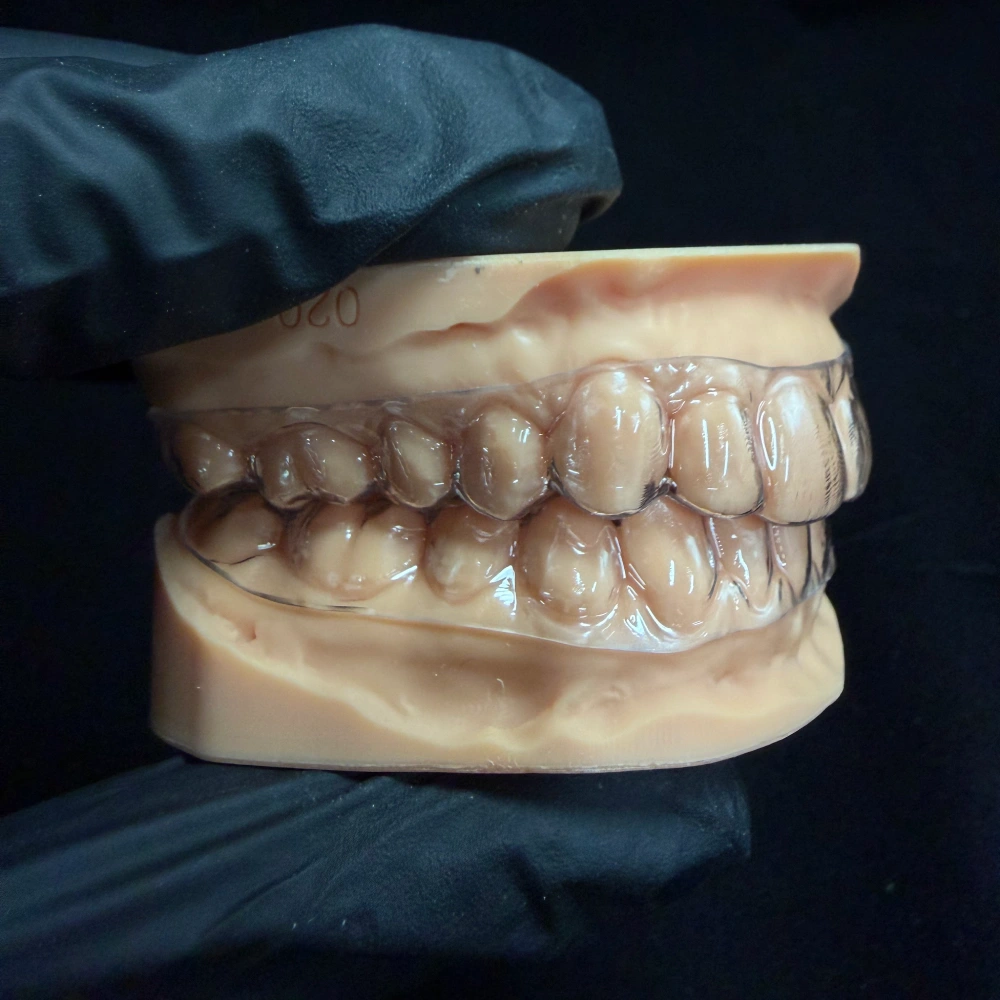
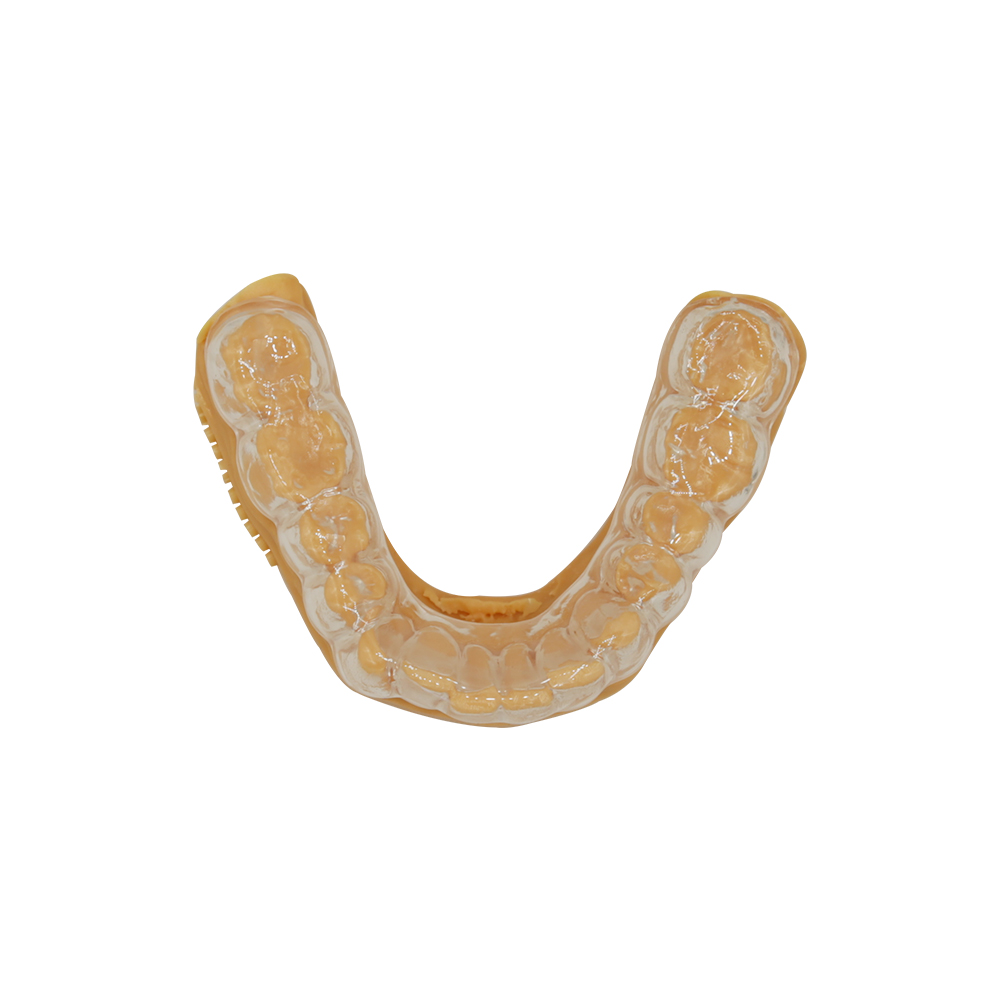
A custom night guard is a removable oral appliance made from a patient’s own impression or intraoral scan. It fits over the upper or lower arch and helps distribute occlusal forces during grinding or clenching (bruxism), reducing wear on natural teeth, restorations, and implant components. In clinical documentation it also shows up as an occlusal guard, bite splint, or occlusal splint. The term you use with your patient does not change what the lab fabricates — the design record, the arch, and the material class do.
A custom night guard is not a boil-and-bite. It is not a stock tray. And its purpose is confined to mechanical protection and load distribution — any decision about jaw position, occlusion adjustment, or long-term management stays with the clinician.
Evidence base for occlusal splints in sleep bruxism is well documented in the peer-reviewed literature. See the Cochrane review on occlusal splints for sleep bruxism and this PubMed systematic review on splint efficacy in bruxism.
Product Collection — Night Guard, Bite Guard, and Bruxism Mouth Guard Options
ASD produces the full range of occlusal appliances a general or restorative practice sends out. Everything below is available as upper arch or lower arch, full or partial — per your prescription.
1. Hard Occlusal Splint (Custom Night Guard, Hard)
Rigid acrylic-class appliance, thermoformed and finished by hand. Best for severe grinders, heavy clenchers, and patients where the goal is to protect crowns, veneers, or implant-supported restorations from occlusal load. Typical thickness range 1.5–3.0 mm, adjustable to your prescription.
2. Soft Night Guard (Custom Night Guard, Soft)
Softer thermoplastic base. Used for mild-to-moderate grinding, muscle-fatigue cases, and patients who cannot tolerate a hard splint on the first appliance. Not our recommendation for heavy bruxism — but the call is yours.
3. Dual-Laminate Hybrid (Custom Night Guard, Hard + Soft)
Soft inner surface for retention and comfort, hard outer shell for wear resistance. This is the most commonly requested custom bite guard configuration for patients who describe both jaw fatigue and heavy wear on posterior contacts.
4. Custom Bruxism Mouth Guard for Heavy Grinders
For patients with visible attrition, fractured cusps, or repeated restoration failures. Built to a higher-thickness spec, reinforced posterior coverage, adjustable anterior guidance. This is the workhorse custom bruxism mouth guard for restorative and prosthodontic cases.
5. Bite Splint (Stabilization / Michigan-Style Design)
Full-coverage stabilization splint, flat plane or ramped anterior guidance, fabricated to your bite record and articulator mounting. Suitable when the case documentation calls for a stabilization design rather than a simple night guard.
6. Periodontal Splint
For splinting mobile teeth. Case-by-case design; discuss requirements with our case coordinator.
7. Retainers (Companion Products)
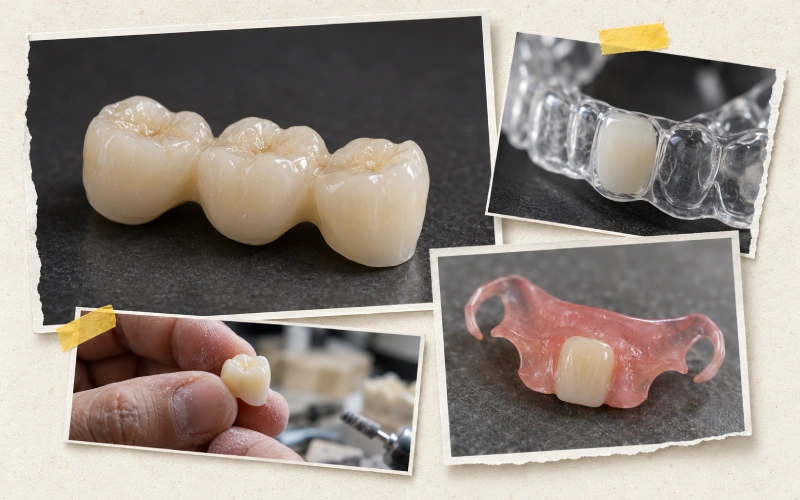
We also produce Hawley retainers, Essix / vacuum-formed retainers, and bonded lingual retainers. Useful when a night guard case comes bundled with post-ortho maintenance.
Why Send Your Custom Night Guard Cases to ASD
Short answer: we control every step. Long answer:
- Full-service, single-lab manufacturing. No case is farmed out. Case data intake, CAD design, model production, thermoforming, trimming, polishing, and QC all happen inside our facilities in Shenzhen and Huizhou.
- 460+ trained staff on-site. Roughly 100 in CAD, 70 in milling, 55 in removable, 25 in dedicated QC, plus around 50 trained backup technicians for peak-season coverage. When your case volume spikes, our turnaround does not.
- Digital and analog workflows both accepted. Send us a physical impression, or upload an intraoral scan file (STL, PLY, or your scanner’s native format). We will confirm on receipt.
- Documentation on request. Materials batch, arch coverage, thickness measurement, and case-level QC records are archived per case and available for your chart or audit.
- Direct communication with technicians. Case coordinators route your case notes to the technician who will actually finish the appliance — not a call center.
We serve dental laboratories, clinics, and independent dentists in the United States, Netherlands, Germany, France, Belgium, Austria, the UK, Luxembourg, Switzerland, and other European markets. Over 400 dentists and 100+ clinics have sent us cases since 2012.
Materials, Thicknesses, and Arch Options
The material and thickness are your call — we fabricate to your prescription. What we bring is process control, not a materials opinion. That said, here is what we most often see on incoming prescriptions:
Configuration | Typical use | Thickness range (post-processing) |
Hard, full-arch | Heavy bruxism, restorations to protect | 1.5–3.0 mm |
Soft, full-arch | Muscle fatigue, first-time wearers | 2.0–3.0 mm |
Dual-laminate hybrid | Combined comfort + wear resistance | 1.5–3.0 mm |
Partial-arch anterior | Specific limited-contact designs | Per Rx |
Arch choice — upper vs lower — is a clinical decision that stays with you. We follow the arch specified on your Rx. If your prescription leaves it open, our coordinator will ask before proceeding.
For material behavior under long-term use, the peer-reviewed literature has quantified aging effects on common occlusal splint materials. See this study on mechanical properties of occlusal splint materials after accelerated aging for the underlying data.
How We Make Your Custom Night Guard — Thermoforming, Step by Step
Our primary process for custom night guards, custom bite guards, and custom bruxism mouth guards is precision thermoforming. Here is the workflow inside our lab:
- Case intake and record verification. We open your file, log the case, and match the impression or scan file against your prescription. If anything is missing or unclear, our coordinator emails you the same day.
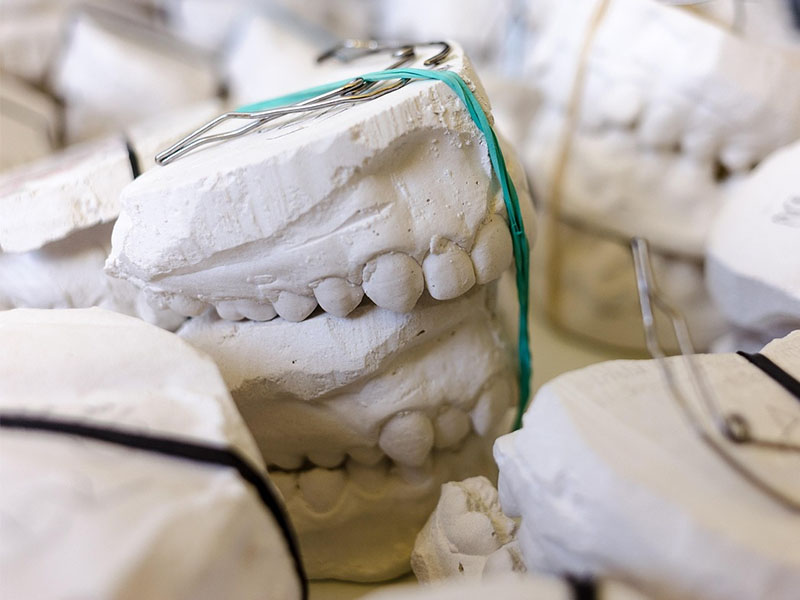
- Model production. For digital cases, we print a working model on a dental-grade 3D printer. For analog cases, we pour a stone model to standard.
- Articulator mounting and bite verification. We mount the models and re-check the bite record on the articulator. This double-verification catches occlusion mismatches before any material is loaded.
- Thermoforming. The material sheet is heated evenly, pressed onto the model under stable pressure, and cooled at a controlled rate to full hardening before demolding. Even heating, even pressure, and controlled cooling are the three parameters we lock down every cycle — that is where fit accuracy lives.
- Trimming and polishing. Border extension is trimmed to the design spec. Only minimal internal adjustment is made — over-adjustment kills seating accuracy.
- QC checkpoints (see next section).
High-pressure cleaning, patient-labeled sealed packaging, and shipment.
For the digital-workflow side, if you are curious about how printed and thermoformed splints compare in the current literature, this comprehensive review of 3D-printed splints in dentistry and Decisions in Dentistry’s overview of the digital occlusal-guard workflow are both useful reads.
Quality Control — What Actually Gets Checked
QC on a night guard case at ASD means five things, on every case:
- Thickness verification. Digital caliper, multiple points across the occlusal surface, cross-checked against the prescription.
- Border integrity. Edge smoothness, extension range, and model adaptation. No burrs. No warped margins.
- Retention seat test. The finished appliance is seated on and removed from the stone model to verify snap-fit and hold.
- Surface integrity. No cracks, no bubbles, no voids.
- Prescription match. Final acceptance is against your original prescription and design record — not against a generic template.
Each case is signed off by the QC technician before it leaves our facility.
Case Submission and Turnaround — What We Need From You
Give us a clean case file, and we give you a fast case back. Here is the minimum record we ask for:
- Impression (alginate or PVS in a stable tray) or intraoral scan file (STL / PLY / native scanner export).
- Bite record — wax bite is our default; wax bite plus articulator-friendly reference marks is even better.
- Arch specification — upper, lower, or both, per the Rx.
- Material and thickness — hard, soft, dual-laminate, and target thickness range.
- Design intent — flat plane, ramped anterior, limited-contact, or reference to a specific splint design if you have one in mind.
- Patient identifier — non-PHI case ID is fine.
- Delivery address and any expedite requirements.
Missing details are the number-one reason cases stall. If your record is incomplete, our coordinator will reach out within one business day — never assume we will fill in the blanks silently.
Turnaround: standard lead time for a straightforward custom night guard is typically several business days plus international transit. Rush lanes are available; ask the coordinator when you submit.
For the documentation practices behind lab-side occlusal guard records, the ADA documenting-occlusal-guards guidance PDF is the practical reference.
Coding and Documentation Support (CDT)
We fabricate to the code you bill. The relevant CDT categories for occlusal appliances include D9944 (hard, full arch), D9945 (soft, full arch), D9946 (hard, partial arch), and — where documentation calls for it — D7880 for occlusal orthotic devices. We do not bill on your behalf, and we do not make the coding decision for your case; that stays inside your practice. What we do is keep our lab-side records aligned with your code so your chart is defensible.
The American Dental Association’s oral-health topic page on sleep apnea and related appliances also lays out the scope difference between a night guard and an oral appliance for OSA — useful when the same patient shows both bruxism and sleep-disordered breathing.
Real Case Snapshots
Case 1 — Heavy bruxer with existing zirconia crowns (US practice). Rx called for hard, full-arch, upper, 2.5 mm target thickness, flat plane. We received a digital scan, mounted the case, thermoformed the appliance, and shipped in the standard lane. Follow-up from the practice confirmed seating on first try; no chair-side grinding required.
Case 2 — Dual-laminate for TMJ-linked clenching (EU clinic). Patient with muscle fatigue and morning jaw soreness. Practice specified dual-laminate, upper arch. We built it soft-inside, hard-outside, and it passed the retention seat test on the first QC pass.
Case 3 — Custom bruxism mouth guard, restorative case (US lab partner). Case bundled with three anterior veneers scheduled for delivery. Split lab work: veneers on the fixed-line, custom bruxism mouth guard on the splint line. Both shipped in the same package.
Case documentation, materials batch, thickness verification, and QC sign-off are archived and available on request.
FAQ — What Practices Actually Ask Us
Yes. STL and PLY are standard. Native scanner exports from major systems are accepted; if in doubt, upload the file and our coordinator will confirm.
Yes, if the model is stable, undamaged, and captures full arch coverage plus the opposing arch reference. Damaged models are the top cause of remake.
That is a clinical call. Our coordinator can share what the case notes typically look like for each configuration, but the decision is yours.
Yes. Please specify the coverage span on the Rx.
Yes, on request, at the case level.
Yes. In-person visits to our Shenzhen or Huizhou facility can be scheduled with your account coordinator. Live video audits are also available if travel is not practical.
No. From case intake to packaging, every step happens inside ASD. That is the single reason we can promise stable turnaround.
Send it back with your notes on where it is off. We remake against the same case record, no argument.
Ready to Submit a Case?
Send your case file to your account coordinator, or request a quote through the form on this page. Turnaround estimate and material options are confirmed within one business day.