Composite Inlay & Onlay — Product Page by a Manufacturing Dental Lab
Product Features
Material-level selection logic
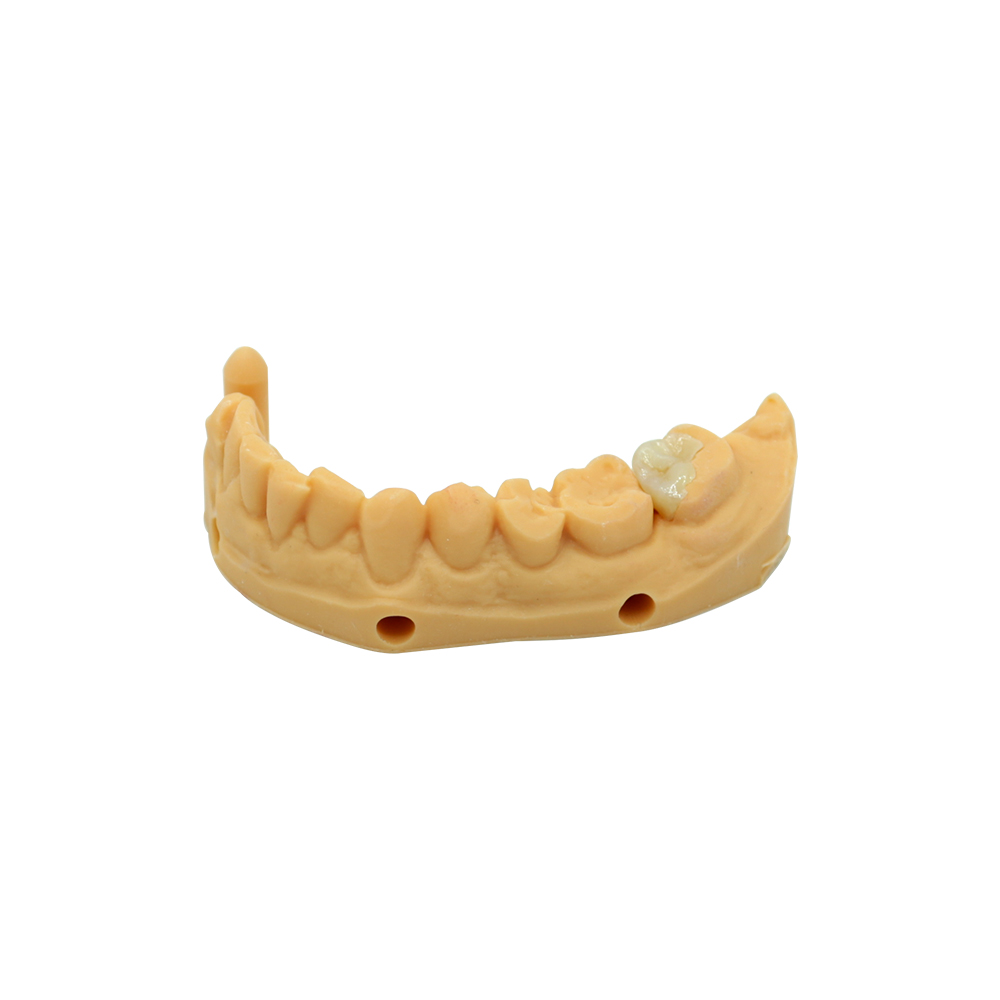
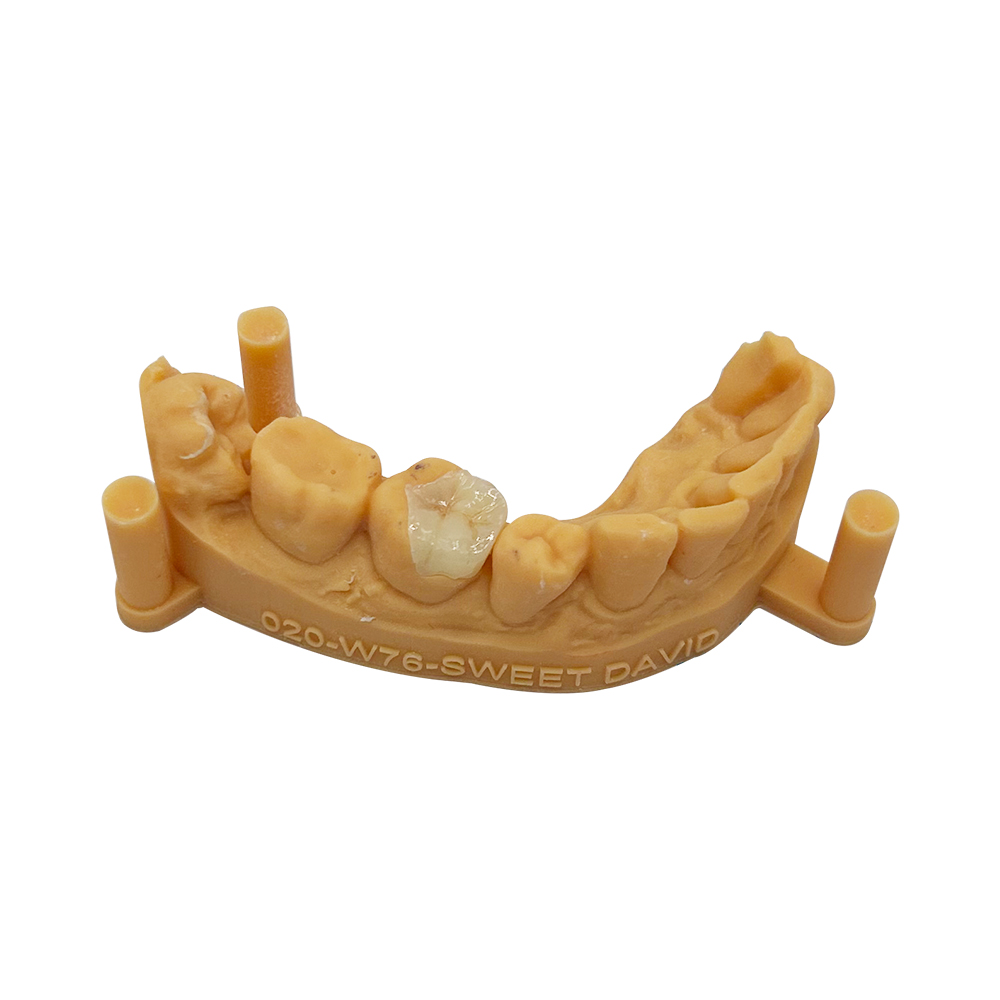
When the industry talks about composite inlay onlay, it is most often the same chemical family as direct-fill composite resin — the difference is the fabrication route. Direct filling is built up in layers chairside and light-cured by the clinician. An indirect composite inlay / onlay is shaped by the dental lab outside the mouth, either via CAD/CAM or pressed workflow, and then bonded back by the clinician. This shift from chairside to extra-oral is not a marketing slogan of “better” — it produces several measurable physical differences:
- Polymerization shrinkage is more controllable in direction and magnitude — extra-oral curing means the bonded interface only fires during the final luting step, so volumetric shrinkage no longer stacks onto cavity-wall stress
- Cure depth is more complete — extra-oral processes can run a secondary cure or a high-temperature post-cure, so the conversion rate typically exceeds that of a single chairside light cure
- Proximal and occlusal morphology is controlled by extra-oral scanning + CAD design, which is more stable than hand-built layering
| Path | When it applies | Decided by the technician |
| Lab’s house-brand nano / micro-hybrid composite resin | Routine inlay / onlay, shade-priority aesthetic zones | Default when the client has not specified a brand |
| Client-specified brand (including imported batches) | Clinic has a written requirement on material origin | Brand / batch must be noted on the prescription form |
The two form-level boundaries
Inlay and onlay are not distinguished by being “a bit bigger or smaller” — they are distinguished by whether one or more cusps are covered:
- Inlay: the cavity sits entirely within the cusps and does not cover any cusp
- Onlay: covers at least one cusp (typically a functional cusp)
- Overlay: covers all cusps across the full occlusal surface — a branch extending outward on the inlay/onlay decision tree, usually discussed together at the pre-op design stage
On the lab side, we take all three forms — inlay / onlay / overlay — and apply the following rules before a case enters production:
- The cusp-coverage range is written on the prescription form
- The working model or intraoral scan data clearly shows the margin line
- The proximal contact area can be morphologically controlled inside CAD
Shade and aesthetics
The anterior zone is where this section gets asked about the most. The lab workflow is:
- Layered shade-matching plus individualized characterization — not a single shade tab
- The cervical, body, and incisal thirds are each recorded for stump shade and target shade
- Shade is taken under natural light, with the tooth surface clean and moist
- Adjacent tooth morphology is referenced through the digital model’s mirror / copy function
For the layering logic of single anterior shade-matching, see the overview at Wikipedia: Dental restoration on shade matching and characterization.
Comparison with ceramic / metal restorations (a frequently asked question)
| Dimension | composite inlay / onlay | All-ceramic inlay / onlay | Metal inlay / onlay |
| Aesthetics | High; shadeable and characterizable | High; translucency closer to enamel | Low; metallic appearance |
| Occlusal wear (on antagonist) | Moderate; relatively friendly to natural tooth | Glass-ceramic higher, zirconia lower | Gold alloy low |
| Bonding requirement | Bondable (bonds well to enamel) | Glass-ceramic bondable, zirconia needs special handling | Usually conventional cementation |
| Per-unit re-shade / remake flexibility | Higher; can be relined and surface-adjusted | Lower; full remake required | Lower |
| Per-unit cost (industry range, directional reference only) | Medium | Medium to high | Low to medium |
This table is a directional comparison, not a price list. In clinical decision-making, inlay/onlay is usually weighed against a crown on the same decision tree; the actual boundary call depends on remaining tooth structure, occlusal space, and cusp-coverage range.
For a systematic-review-level long-term clinical comparison, see ResearchGate: Long-term Clinical Performance of Composite Resin or Ceramic Inlays, Onlays, and Overlays.
Why choose our composite inlay
This section is not about “how good we are.” It is about several operating premises that hold here and may not hold elsewhere — and those premises are themselves the answer to “why us.”
Production path is closed-loop inside the lab
We are a dental lab with in-house production. Once an order enters the lab, the workflow — case-data verification, scan intake, CAD design, CAM milling, sintering / polymerization, ceramic layering and staining, polishing, multi-stage QC, final release, packing and shipping — runs end-to-end on our own production lines, with no outsourcing.
For the division of workflow in a dental lab, see ScienceDirect Topics: Inlays and Onlays – an overview.
Why emphasize this? Because the yield rate of composite inlay restorations is sensitive to process continuity — when a case is repeatedly handed off between different teams, the most common failure modes are lost shade instructions, drifted proximal contacts, and interrupted polymerization sequences. On an in-house line, the information between these steps stays continuous.
Three-stage QC, with final release independent of production
Every restoration passes at least three inspection stages before shipping:
- Intake / pre-check: does the prescription match the scan or model; are working arch, opposing arch, and bite records present
- Inter-stage spot checks: one at the end of milling, one after polymerization, one after finishing
- Final release: performed by a dedicated QC technician who did not work on that specific restoration, who signs off against the confirmed prescription and the established acceptance criteria
The final-release checklist covers margin fit, intaglio surface (no burrs, no residue, no porosity), proximal contact tightness, and centric / protrusive / lateral occlusion.
Complex aesthetic cases and implant / full-mouth cases receive an additional targeted review on top of this (passive fit, cross-arch accuracy, screw-channel clearance, etc.) at no extra charge.
Design approval: one main design plus two free revisions
We accept editable design files from 3Shape Communicate, Medit Link, and exocad, as well as generic mesh formats such as STL / PLY / OBJ / DCM. Digital cases are uploaded as files; physical impressions are shipped by mail.
After a case enters CAD, design previews, STL screenshots, and PDFs can be sent to a work group chat or by email for the clinician to confirm. At the design stage we provide:
- 1 main design
- 2 free revisions
Beyond that, additional revisions are billed by labor time. Whenever the prescription and the scan data conflict, the case is automatically paused rather than forced forward — this is to prevent a small upstream issue from being amplified downstream.
Standard turnaround: 2–3 working days
Standard crown / bridge / inlay / onlay restorations ship 2–3 working days from the moment complete data is received. Complex implant / full-mouth cases run 5–7 working days.
| Start point | Working-day definition |
| Digital case | The day complete STL / scan files plus the prescription are received |
| Physical impression | The day the complete impression plus the prescription are received |
| Rush | Rush Case can be requested on any case |
Cross-border logistics: default carriers are DHL / FedEx / UPS; for Europe we additionally use SPIDER (France). The lab shipping account can be used, with the lab’s bulk-rate discount applied; outbound freight is borne by the clinic / clinician, and return freight is allocated by declared package value. Import duties, tariffs, customs broker fees, and remote-area surcharges are borne by the clinic / clinician and are not included in the lab-side quote.
Factory visits and video audits are available
We operate factories in both Shenzhen and Huizhou. On-site visits, video audits, and manufacturing-capability discussions can be scheduled. We have served approximately 50 dental labs, around 100 dental clinics, and roughly 400 individual dentists in total; the primary markets cover the United States and several European countries.
Our fabrication workflow
This section walks through the nodes that a single composite inlay / onlay passes through inside the lab, in chronological order. Each node maps to a specific role on the lab side, with no “virtual team” or “process black box.”
Case intake and pre-check (P0)
- Digital cases: routed directly to the CAD design department
- Physical-impression cases: routed to the plaster room for pouring, then to CAD design
- Intake check: confirm the working model is usable and the scan files are complete with no missing data
- Prescription check: clinic / clinician / patient information, product information, requested delivery time
- Unique work order: every case generates a unique barcode
If missing data or a prescription–scan conflict is detected at intake, the case is paused, the clinician is contacted for backfill, and production only restarts once the gap is closed.
Data scanning and CAD design
- Industrial-grade dental model scanners capture the working arch / opposing arch / bite record
- Dental-specific CAD software completes the morphological design
- Coverage scope: the opposing scan must cover the full occlusal dentition (distally to the last molar, mesially into the anterior zone), the prepared tooth’s 2–3 adjacent teeth, and the corresponding gingival soft tissue
- Long-span bridge / full-mouth cases: continuous unidirectional scanning, ≥30% overlap region, and stable anatomical landmarks such as cusps used as stitching references
- Design preview: can be sent to a work group chat or by email for clinician confirmation
CAM machining and polymerization / sintering
- Digital cases are routed via CAM milling (block-form composite resin blanks) or 3D printing depending on the workflow
- Milling burs are managed by usage count / machining time, with mandatory replacement once limits are reached
- Sintering furnace temperature curves are locked, verified by periodic temperature-test pieces, and logged for every cycle
- Shrinkage compensation is set in software against the material-maker’s parameters, and verified per batch with a standard test block
Hand finishing, staining / characterization, polishing
This is where composite inlay looks least like an all-ceramic inlay on the workflow chart — composite restorations typically do not receive stacked porcelain layering (unlike PFM or zirconia veneering). Aesthetics are delivered primarily through layered shade-matching + individualized staining + surface texture + an incisal translucent layer:
- Cervical zone biased deeper / more saturated
- Body zone gradient transition
- Incisal zone with translucent and opalescent effects
- Adjacent tooth morphology referenced through the digital model’s mirror / copy function
Multi-stage QC and final release
| Inspection stage | Content |
| Inter-stage check #1 | After milling / printing |
| Inter-stage check #2 | After polymerization / sintering |
| Inter-stage check #3 | After finishing / polishing |
| Final release | Margin, intaglio, proximal contact, occlusion (centric / protrusive / lateral) |
Packing and shipping verification
- Outbound verification: dual-person check, label marked with case number
- Small parts (implant screws, etc.) packed in separate small bags, dual-person check
- Tracking number provided on the shipping day, with a dedicated person monitoring the logistics status until the parcel is received
Cooperation workflow (from inquiry to delivery)
The following walks through the process from the clinician’s side, clarifying at each node what the clinician needs to do and what the lab will do.
Inquiry / evaluation
- Clinicians initiate inquiries through a work group chat, email, or the inquiry form on the official website
- We confirm whether the case is accepted (material / form / turnaround)
- Both sides align on whether it is Rush and on the rush level
Case submission
Two submission methods are supported:
| Method | What to submit |
| Digital case | STL / PLY / OBJ / DCM / native CAD design files + prescription form |
| Physical impression | Physical impression + bite wax + prescription form, shipped to the Shenzhen warehouse |
The prescription form must include: clinic, clinician, patient information; product information (form, material preference, brand specification); desired case-receipt time. Optional: photos, sketches, old prosthesis photos, diagnostic wax-ups, provisional restorations — all accepted as reference.
Design approval
- Once the lab finishes the CAD design, previews (screenshots / STL / PDF) are sent to a work group chat or by email
- The clinician confirms within 1 main design + 2 free revisions
- Beyond that, additional revisions are billed by labor time
Production and QC (see §4)
Clinicians do not need to be involved; the lab performs internal checks at the inter-stage and final-release phases.
Logistics and delivery
- A tracking number is provided on the shipping day
- Default carriers: DHL / FedEx / UPS; for Europe, SPIDER (France) is additionally available
- The lab shipping account can be used to enjoy bulk-rate discounts
- Multiple cases can be combined into one shipment to reduce cost
- Import-side taxes, tariffs, customs fees, and remote-area surcharges are borne by the clinic
Remake / adjustment / after-sales
- Report case issues within 24 hours (case number + patient name + complaint reason + complaint photos)
- Issues caused by the lab side — open margin, open proximal contact, high occlusion, non-seating crown, inaccurate shade, poor morphology — are reworked free of charge
- New impression / new scan / new design / material change are treated as new cases, not rework
- Rework shipping fees and implant-component costs are not included in the free rework scope
- A root-cause analysis is performed and confirmed with the clinician before rework
Case scenarios
The following groups of questions are typical ones clinicians are asked by patients and then turn around and ask the lab. This section is written for clinicians — next time you are asked, you can map directly onto our process or policy.
“What is the actual difference between an inlay and a regular filling?”
Answer (usable by clinicians as reply material): a direct filling is built up chairside in one visit, while an inlay is shaped outside the mouth and then bonded back. The difference is concentrated in three dimensions — polymerization shrinkage, cure depth, and the morphology precision of proximal and occlusal surfaces. The former is a single chairside light cure, the latter can run a secondary cure or high-temperature post-cure on the lab side.
“For a defect this large, can I get one?”
Answer: when a large defect involves at least one cusp, the form has already moved from inlay to onlay; if all cusps are involved, the form is closer to the boundary of an overlay / crown restoration. The decision rests with the clinician, but the lab will provide design input at the CAD stage based on remaining tooth structure, occlusal space, and cusp-coverage range.
“I’ve read online that composite inlays don’t last long — aren’t they worse than ceramic?”
Answer: systematic reviews of long-term clinical performance exist for both restoration families, but published figures vary widely across follow-up periods and evaluation criteria, so this page does not give specific numbers. The simple direction: ceramics get closer to enamel in translucency; composites offer more bonding flexibility and easier shade adjustment. The choice should follow the indication and the occlusal condition, not a blanket “which lasts longer.”
“After an inlay, will I end up needing a crown a few years down the line anyway?”
Answer: whether an upgrade to a crown is needed depends on remaining tooth structure, occlusal conditions, and the marginal stability of the inlay/onlay itself — all of which can be anticipated at the pre-op design stage. The lab can provide preparation-clearance input at the CAD stage for the transition to a crown.
“If it fails later, can it be repaired, or does the whole thing have to be remade?”
Answer: composite inlay / onlay offers repairability through its material behavior (can be added to, ground back, surface-reshaped), but the specific boundary between “repair” and “remake” depends on remaining tooth structure, the location of the failure, and the findings at that visit. When the lab receives a rework case, a root-cause analysis is performed first before the path is decided.
“What if occlusal space is insufficient?”
Answer: when occlusal space is insufficient, the material side tilts toward high strength at low thickness; the design side tilts toward space-saving structural adjustments. The specific plan is delivered at the CAD stage. If occlusal space is so limited that no inlay/onlay can be made to work, the lab will proactively propose whether to switch the design to a crown or a veneer.
Practical notes on “restoring a restoration”
Clinicians are often asked a specific question: “If a composite inlay fails, can it be repaired, or does it have to be remade?” This section lays out what the lab can actually do:
- Relining / surface adjustment: allowed by the material behavior; the lab can fabricate a new restoration against an updated prescription
- Full remake: when remaining tooth structure, occlusal relationship, and the findings of that visit make local repair unviable, a full remake is initiated
- Reusable design files: the original CAD design can be reused for the new case after clinician confirmation, shortening the design cycle
- New impression / new scan / new design / material change is a new case: the lab bills it as a new order, not as rework
CTA: start an inquiry
If your clinic / lab is evaluating the composite inlay / onlay product line, you are welcome to send an inquiry. Inquiry entry points support any of the following:
- Work group chat (WhatsApp / WeChat)
- Inquiry form on the official website
- Direct contact with sales
Please tell us at inquiry:
- Your role (clinic / lab / individual clinician / other)
- The main case types you plan to send (inlay / onlay / overlay / mixed)
- Whether you have a material-brand specification
- Whether Rush Case is needed
- Primary market (US / Europe / other)
We will reply within 24 hours, confirming whether we can accept the case, and giving a directional turnaround and price range.
References
- UHC Provider: Single Tooth Indirect Restorations – Dental Clinical Policy
- DentalReach: Inlay and Onlay Impressions: Step-by-Step Clinical Guide
- Springer Trials: Efficacy of composite versus ceramic inlays and onlays
- PMC: Clinical performance of direct versus indirect composite restorations
- ResearchGate: Long-term Clinical Performance of Composite Resin or Ceramic Inlays, Onlays, and Overlays
- ADA: Materials for Direct Restorations
- Wikipedia: Inlays and onlays
- Wikipedia: Dental restoration
- ScienceDirect Topics: Inlays and Onlays – an overview
- Greater DC Specialists: Dental Inlays and Onlays
SEO Title & Meta Description
- SEO Title : Composite Inlay Onlay | Custom Dental Lab Restorations
- Meta Description : Custom composite inlay onlay from a full-service dental lab. Precise fit, natural shade, fast turnaround for clinics. Request a case quote or free sample today.
Experience faster turnaround times with our cutting-edge technology
< class="ct-module-title">
Trending Now