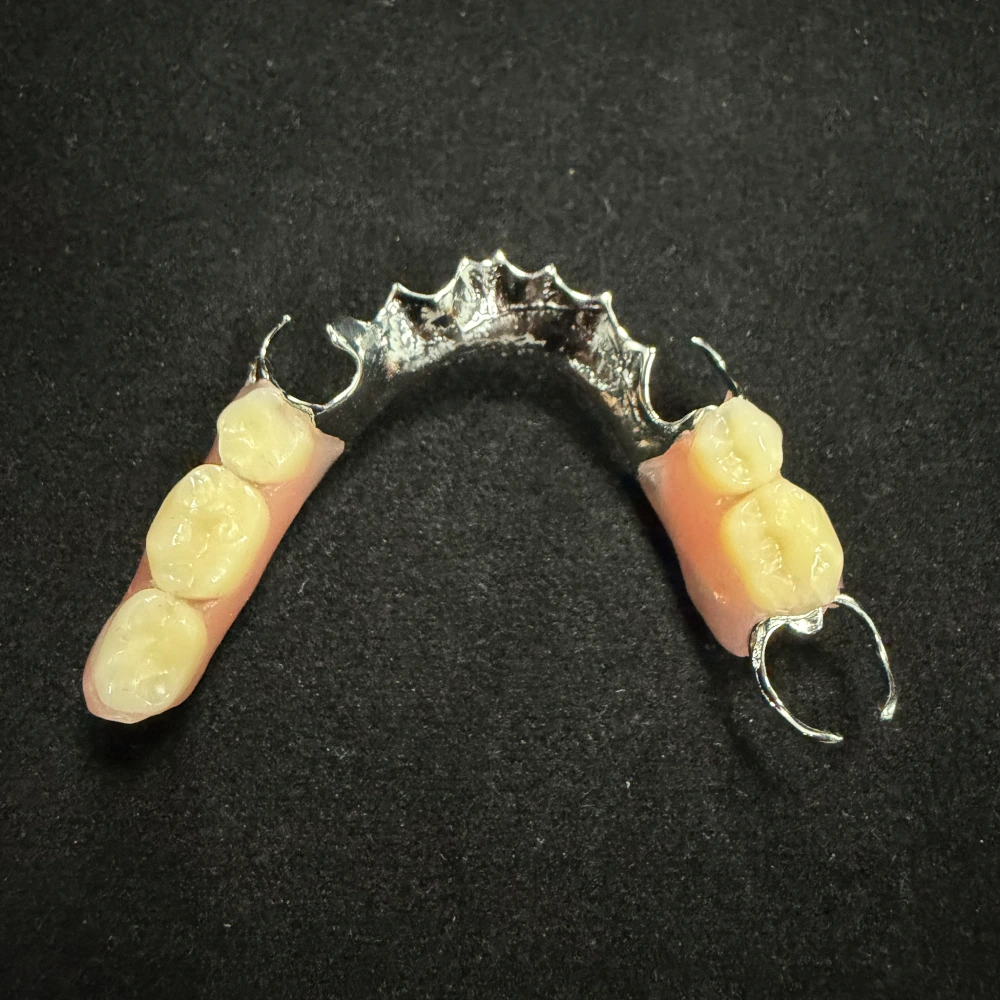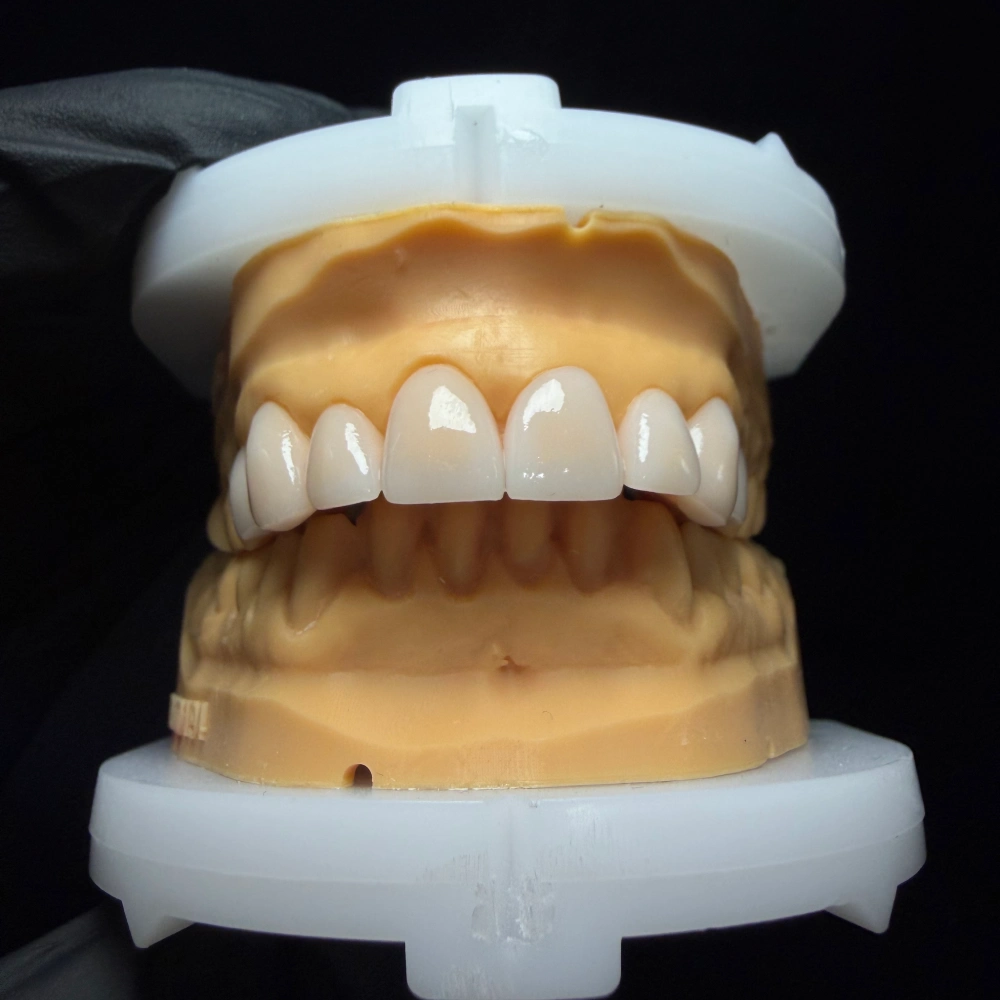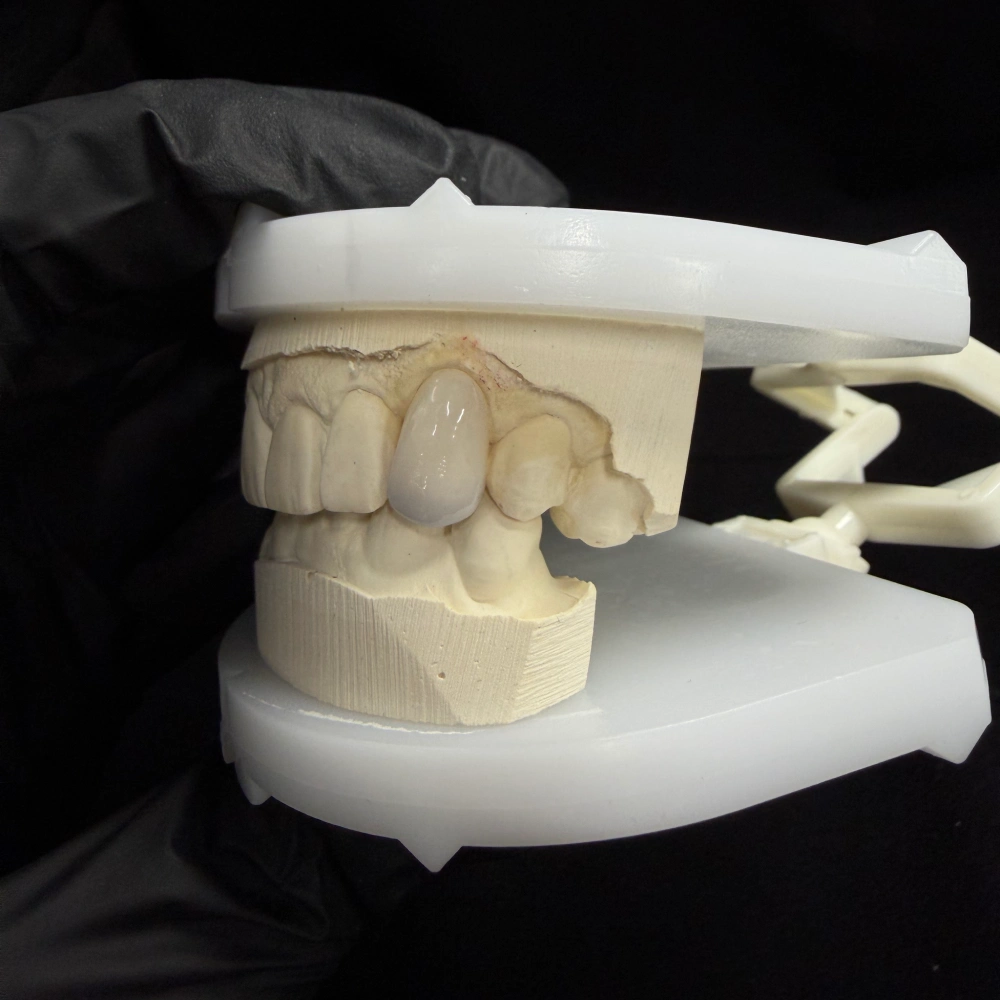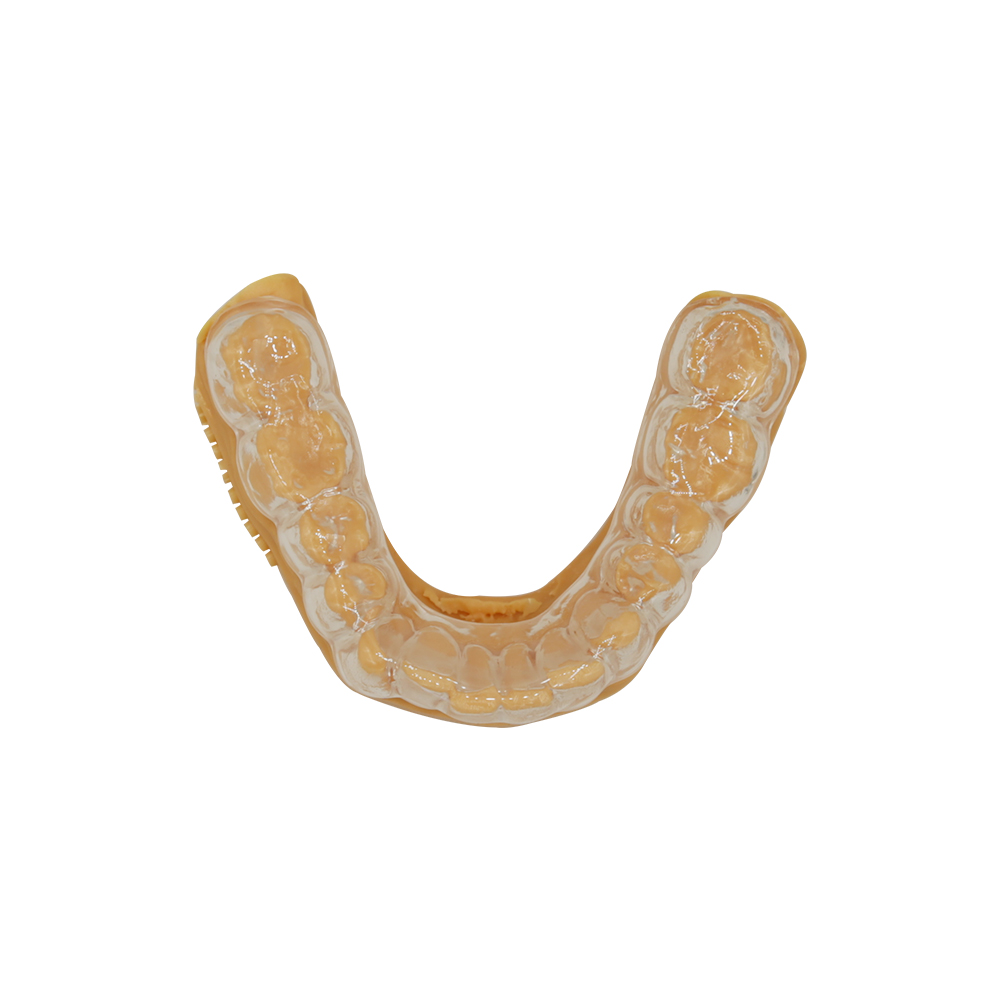
Implant Supported Dentures
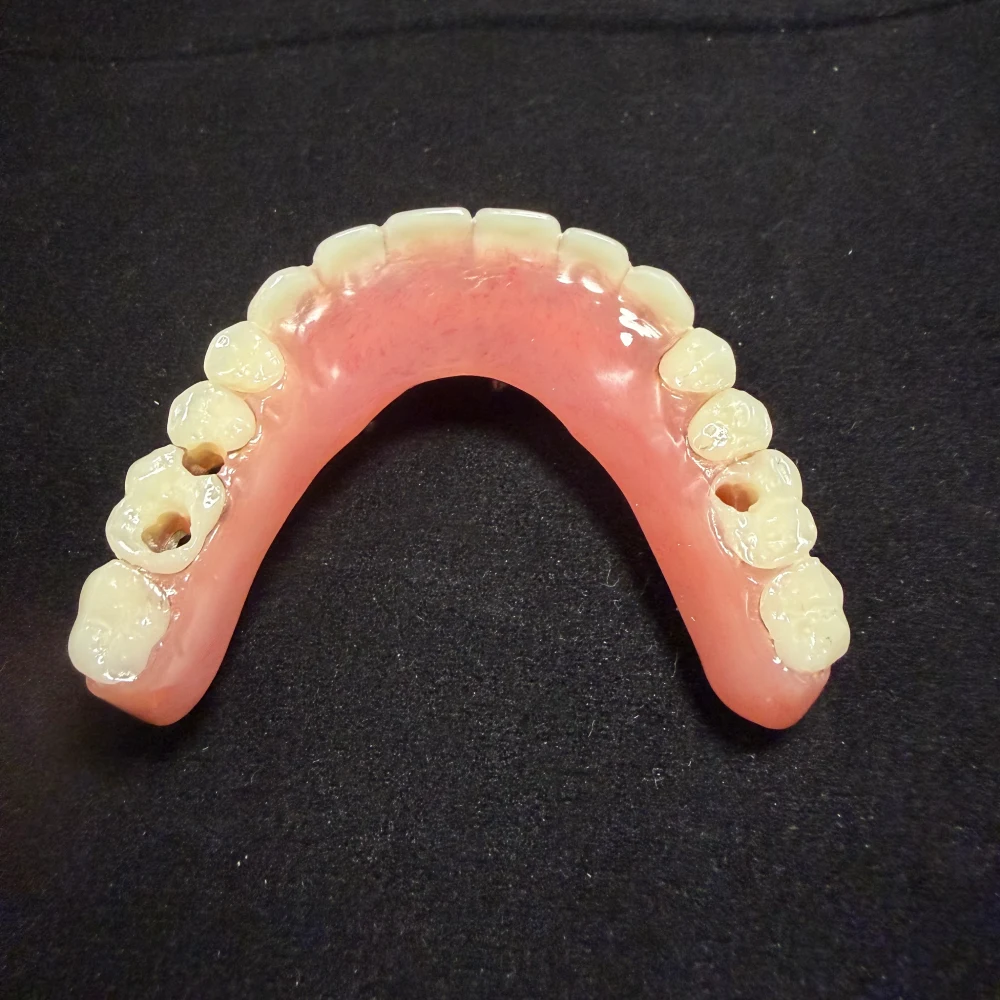
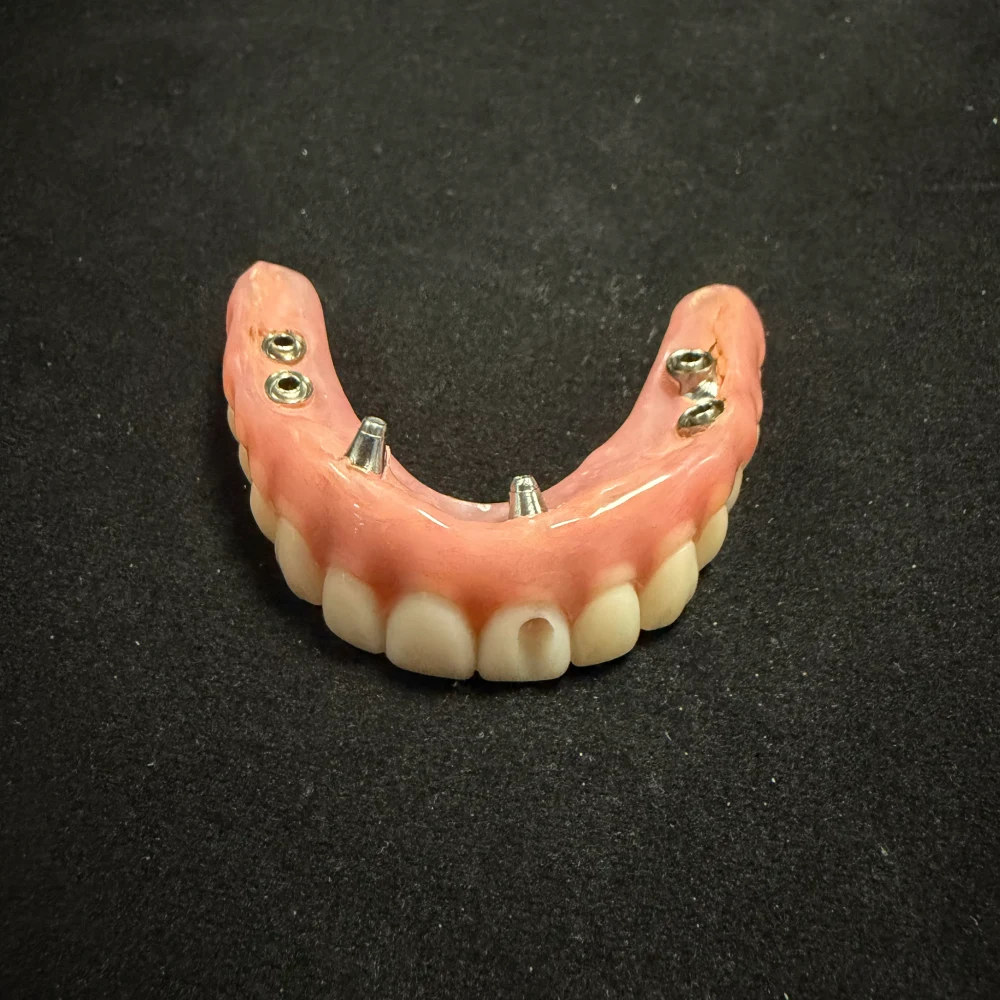
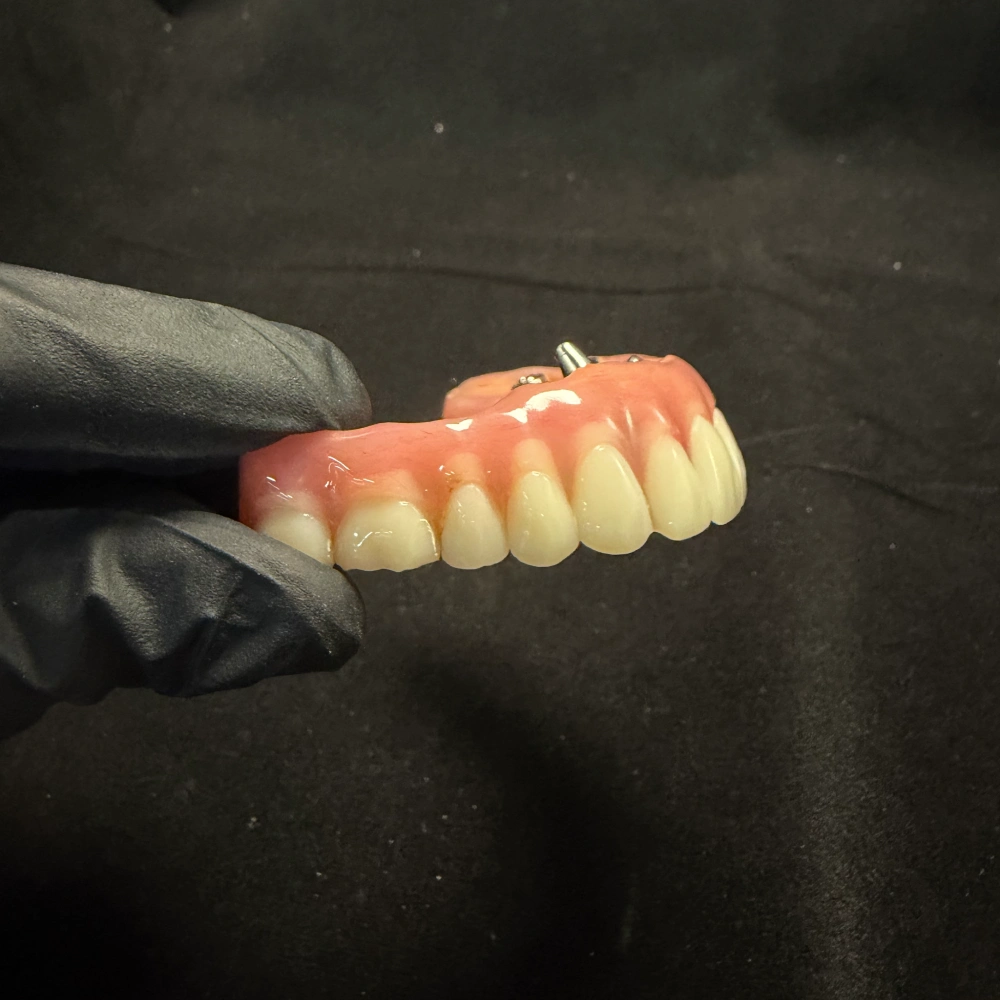
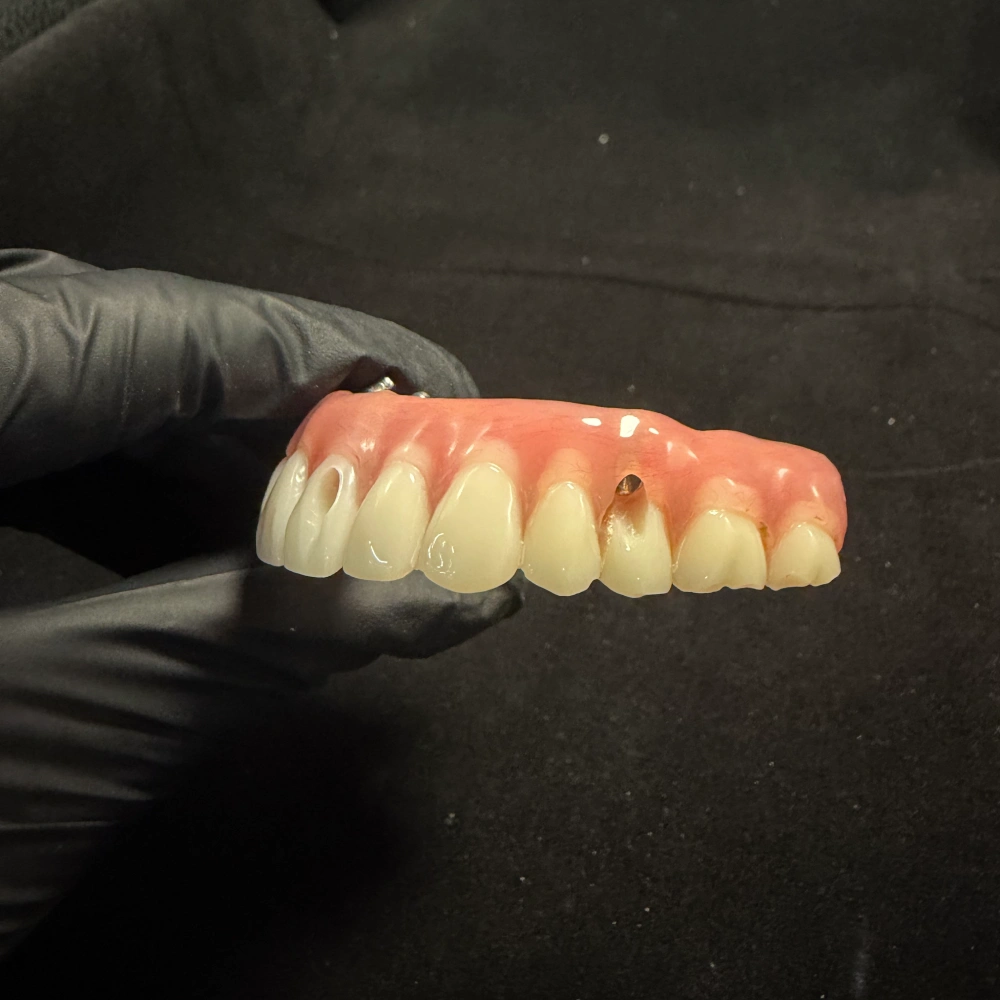
Lab product page for implant supported dentures / implant retained dentures / implant overdenture work submitted to an in-house dental lab in Shenzhen and Huizhou, China. Each submission is reviewed by your sales contact; a written quote is returned against your lab slip.
Request a quote
Send the implant brand, platform, scan body library, and case file (Trios, iTero, Medit, Primescan, DS Core, or wetransfer). Your sales contact returns a written quote within one business day with the design proposal, attachment system options, and the input checklist for your specific case.
→ Open a case · Order a sample pack · Schedule a factory video audit
Implant Supported Denture Features
The features below are what you can confirm on every quote, lab slip, and shipment.
| Feature | What you actually get |
| Material — frameworks | Commercially pure titanium per ASTM F67; Ti-6Al-4V per ASTM F136 |
| Material — superstructures | Acrylic-on-titanium hybrid, PMMA provisional, cast metal-framework with resin teeth |
| Attachment systems stocked | Locator, ball / O-ring, milled bar + clip, magnet, telescopic / conical |
| Implant system compatibility | All major U.S. and EU implant systems; multi-unit and angulated screw-channel abutments supported |
| CAD libraries | Libraries kept current to the scan-body catalogs of the supported systems; mismatched libraries are caught at the receipt stage |
| File transfer channels | Trios 3Shape, iTero, Medit Link, Shining 3D, Dexis, Ori, Primescan, DS Core, Panda, wetransfer |
| QC stages | Pre-design record check → senior CAD review → pre-sinter framework check → final restoration QC → pack-out audit |
| Case traceability | Every case carries an internal case number, photo log, and CAD file; the CAD file and QC log are kept on file for rework and warranty |
| Rework window | Free rework for any lab-side defect; shipping, OEM / 3rd-party components, and post-approval design changes quoted separately |
Why Choose Our Implant Dentures?
Choosing a lab for implant supported dentures work comes down to four things on the lab slip: terminology, materials, passive fit, and after-delivery support. The points below state where ASD stands today.
- Terminology is precise on the lab slip. implant supported dentures, implant retained dentures, and implant overdenture all resolve to a restoration we manufacture, but they are not synonyms on the lab slip. We follow the ACP framework on definitions of implant dental prostheses; the search-side label only routes you to this page, the order code on the lab slip is what we mill.
- Frameworks and superstructures are traceable to spec. Titanium frameworks are manufactured to ASTM F67 unalloyed titanium spec and ASTM F136 Ti-6Al-4V spec; superstructure material and shade are written on the lab slip with brand, batch, and origin on request. We do not make medical claims; the references cited here are material and process standards.
- Passive-fit verification is built into the QC flow. On full-arch and multi-implant cases, the framework seats on a verification jig or model without forced pressure before final milling. The criteria follow the FOR overdenture clinical protocol.
- Replacement parts and small components are stocked. Locator inserts, ball-attachment O-rings, bar clips, and abutment screws are kept on our shelves; recall visits do not stall waiting for a part. See FOR’s overdenture maintenance protocol for the cadence.
- You can audit the production line. Factory visits, production-line tours, video factory inspections, and manufacturing-capability discussions are available by appointment through your sales contact.
- You work with a direct factory, not a middleman. ASD is the manufacturer on the invoice; we do not broker cases out to a third party for any step. Customer service and case coordination are handled in-house in the same facility as production.
Implant Denture Manufacturing Process
The process below is the actual workflow on the production floor. Each step is staffed and scheduled as a station; cases move from one station to the next on the production calendar.
- Case data receiving and evaluation. Your case file lands with the customer-service team, the implant brand / platform / scan-body library is matched to the prescription, and any missing record is flagged back to the clinic before CAD time is spent.
- CAD digital design. Senior CAD specialists build the digital restoration; design review covers margin, emergence profile, connector dimensions, and screw-channel access.
- 3D model printing. Resin models, prototypes, and try-in pieces are printed in-house to match the CAD file.
- CAM milling. Frameworks (titanium bar, cast metal substructure) are milled on multi-axis CAM stations.
- Acrylic processing and finishing. Wax-up, flasking, packing, and curing for acrylic-on-titanium hybrid and PMMA provisional; tooth set-up, contour, and polish.
- Quality inspection. QC runs the standard five-stage check: pre-design record check → senior CAD review → pre-sinter framework check → final restoration QC → pack-out audit. Any non-conformance opens a rework ticket; the case is not shipped until it clears.
- Packaging and shipment. The case is packed with screws, small components, and a labeled pouch cross-referenced to the case number; shipping is quoted against destination and carrier.
A case that needs a try-in (PMMA provisional, diagnostic wax-up, or verification jig) loops through steps 2–3 twice, once for the try-in stage and once for the final. The lab-clock time per stage is given in the Turnaround section below.
Cooperation process
Every quote and every shipment runs through the same six-step flow. The steps below are how a first case and an ongoing volume case both proceed; the only thing that changes between them is the SLA windows, which tighten once a cadence is established.
- Submit the case. Send the prescription, intraoral or model scan, bite registration, scan-body library reference, and any photos. Standard file transfer channels are Trios, iTero, Medit Link, Shining 3D, Dexis, Ori, Primescan, DS Core, Panda, and wetransfer; an alternative channel can be set up for recurring volume.
- Quote and input checklist returned within one business day. Your sales contact replies with a written quote, the order-code recommendation (see below), the material options, and a list of any records still missing from the submission.
- Design review call. Once the input is complete, the CAD team returns the design package: occlusal / buccal / lingual views, connector cross-sections, screw-channel position, and occlusal contact maps. Approval is logged against the case number.
- Production. The case moves through the seven-station workflow above on the production calendar. Multi-stage cases (wax-up, PMMA try-in, custom abutment, final restoration) are tracked per stage and the lab-clock windows are written on the work order.
- QC and shipment. Final QC is logged against the case number; the package is packed with screws and small components and shipped against the carrier and destination on the order.
- After-delivery support. Replacement inserts, clips, O-rings, and screws are ordered by the case number; reline and remake are quoted on request; warranty rework follows the Rework policy in this page.
For ongoing volume, the cooperation process is the same with the SLA windows tightened on quotes, design review, and replacement-parts supply; the cadence is agreed in writing with your sales contact.
Implant Overdenture and Full-Arch Options
To make the lab slip unambiguous, use the order codes below when requesting a quote.
OD — Implant overdenture (patient-removable)
| Code | Attachment | Implant count (typical) | Use case |
| OD-LOC | Locator | Mandible 2 / Maxilla ≥4 | Routine edentulous mandible; maxilla when bone allows |
| OD-BAL | Ball / O-ring | Mandible 2 | Lower-cost alternative to Locator; long-term clinical record |
| OD-BAR | Milled bar + clip | Mandible 4 / Maxilla 4–6 | Divergent implants; non-ideal spacing; rigid splinting preferred |
| OD-MAG | Magnet | Mandible 2 | Limited manual dexterity (elderly, post-stroke, Parkinson’s) |
| OD-TEL | Telescopic / conical | Case-by-case | Retrievability + passivity both required |
FA — Fixed full-arch implant prosthesis (screw- or cement-retained)
| Code | Framework | Superstructure | Loading |
| FA-TIZ-PMMA | Milled titanium | PMMA provisional | Immediate load temporary |
| FA-TIZ-COMP | Milled titanium | Composite / acrylic-occlusion hybrid | Immediate load final |
| FA-TIZ-ACR | Milled titanium | Acrylic-on-titanium hybrid | Final; retrievable |
| FA-PFM | Cast metal-framework | Porcelain-fused-to-metal | Selected clinical indications |
AB — Abutment options (sold standalone or with restoration)
| Code | Type | Indication |
| AB-STK | Stock abutment | Implant position favorable; function-driven cases |
| AB-CUS | Custom abutment (Ti or zirconia) | Aesthetic zone; complex implant position; emergence profile critical |
| AB-MUA | Multi-unit abutment | Full-arch correction of divergent implant angles |
| AB-ASC | Angulated screw-channel abutment | Screw access exits in aesthetic-sensitive position |
Send the order code on the lab slip; the rest of the spec is resolved on the design review call.
Terminology — pick the right words on the lab slip
The three search-side labels — implant supported dentures, implant retained dentures, and implant overdenture — all resolve to a restoration we manufacture. They are not synonyms on the lab slip. The ACP framework is what we follow; the Glossary of Prosthodontic Terms is the reference. See ACP’s white paper on definitions of implant dental prostheses and FOR’s prosthodontic options overview for the underlying definitions.
| Term | Fabrication spec it points at | Patient-removable? | Support pattern |
| Implant-supported | Predominantly implant-borne functional load; little soft-tissue displacement | Fixed or patient-removable, depending on design | Mostly implants |
| Implant-retained | Implant resists dislodgment; doesn’t by itself fix the support pattern | Ambiguous unless specified | Implant- or tissue-supported |
| Implant-assisted | Implants assist a conventional denture; mucosa still participates functionally | Yes | Shared implant + tissue |
| Implant overdenture | Removable prosthesis covering and resting on implants | Yes, by definition | Implant-supported, implant-assisted, or mixed |
The order code on the lab slip is what we actually fabricate. The search label only routes the page you are reading; it does not change the workflow.
What we need from your side to start the case
A complete submission removes the back-and-forth, prevents fabricated parts arriving where they won’t seat, and shortens the lead time. Send the items below on every case; missing any one of them puts the case on hold at the receipt stage.
Standard implant case (single or partial)
- Implant brand, platform, diameter, and connection — taken from the original packaging label or the OEM scan body / analog. Reference the package label for the platform / diameter notation (NP / SP / WP or specific mm).
- Scan body brand, model, and matching CAD library name — without the library match, the scan data cannot be imported into the design software
- Intraoral scan or model scan with the scan body in place
- Opposing arch scan / model
- Bite registration (in the format your scanner captures it)
- Frontal smile photo, intraoral bite photo, shade photo (aesthetic zone)
- Shade and material selection
- Emergence profile reference (healing abutment / temp crown scan or gingival cuff data)
Full-arch / All-on-X case (in addition to the above)
- Verification jig / model for any multi-implant or long-span case, so cross-arch accuracy can be checked against a physical reference before milling the final framework
- Facebow transfer or equivalent aesthetic reference
- CBCT and implant system labels
- Existing denture or wax rim for VDO, midline, lip support, tooth-position reference
- Frontal smile, intraoral bite, shade, and (for try-in approval) the prototype in the mouth
Reference the FOR full-arch guideline and our implant brand identification workflow for the exact records expected on a full-arch submission.
Turnaround and capacity
Turnaround is lab-clock days; shipping is quoted separately based on destination.
| Case type | Working days (lab only) |
| OD-LOC / OD-BAL single arch, no try-in change | 3–5 |
| OD-BAR single arch | 5–7 |
| FA-* full-arch framework + provisional | 5–7 |
| FA-TIZ-ACR final full-arch bridge | 5–7 |
| Complex full-arch with multiple try-ins | Quoted case-by-case |
For multi-stage cases, the per-stage breakdown is:
- Diagnostic wax-up / guide: 2–3 working days
- PMMA try-in: 2–4 working days (plus clinic try-in and feedback before next stage)
- Custom abutment: 3–4 working days
- Final restoration: 3–5 working days
- Full-arch / All-on-X complex case: 5–7 working days
Plan your seating appointment with at least 10 working days of lab-clock buffer before the patient visit.
Design review and approval
Every implant case goes through three checkpoints before the final restoration is milled. Each checkpoint is logged against the case number and is available on request.
- Pre-design record check. Case file is matched against the prescription: implant brand, platform, scan body library, arch, attachment, material. A mismatch is flagged back to the clinic before any CAD time is spent.
- CAD design review. Senior design specialist reviews margin, emergence profile, connector dimensions, and screw channel access. The design package you receive for sign-off includes occlusal, buccal, and lingual views; connector cross-sections; screw channel position; and occlusal contact maps.
- Final restoration QC. Shade match against the photo, occlusion, contour, polish. For full-arch and multi-implant cases, passive fit verification: framework seats on the verification jig or model without forced pressure; no rock; no lift on any single implant. The criteria follow the FOR overdenture seating protocol.
Design changes after approval (different abutment, different shade, different material) restart the case at the CAD stage and re-quote the timeline.
Compatibility and component sourcing
We work with all major implant systems on the U.S. and EU markets. If your system is not on the supported list, ask — most are.
- OEM components. Sourced at OEM price plus a handling fee. Pass-through pricing on the invoice.
- Third-party compatible components. Available for many systems and quoted separately. We default to OEM for the critical interfaces (abutment-implant, scan body-implant) and offer compatible options for non-critical components when the case warrants it.
Screw-retained or cement-retained — what we need from you
The default on the lab slip is screw-retained unless you flag otherwise. The reason is retrievability: a screw-retained restoration can be removed for hygiene, maintenance, and component replacement without destroying the prosthesis.
If the screw channel exits in an aesthetic-sensitive position, we default to the following solutions in this order:
- Angulated screw channel (ASC) with a custom angulated abutment
- Multi-unit abutment (MUA) to relocate the screw access lingually
- Redesign of the restoration contour to move the screw hole to a non-aesthetic zone
- Cement-retained as a last resort, when the above is not feasible
The clinician picks the option on the lab slip; we do not override the choice.
Risk-factor flag-back
We fabricate on the prescription you send. The list below is the patient-side risk factors that change the design or the material choice on our side. Flag any of these on the lab slip; we adjust the design and the QC cadence accordingly.
| Risk factor | Lab-side adjustment |
| Heavy smoker | Material selection may shift to Ti-bar + composite where retrievability matters more than ceramic aesthetics |
| Uncontrolled diabetes | No design change; case flagged for tighter QC |
| Bisphosphonate or antiresorptive medication | No design change; case flagged for tighter QC, case file documented |
| Bruxism / heavy occlusion | Material upgrade path; connector dimensions opened; occlusal scheme adjusted |
| Limited manual dexterity (elderly, post-stroke, Parkinson’s) | Attachment selection shifts to bar-clip or magnet; Locator insert replacement is harder for the patient |
| Previous implant failure at the same site | Case flagged for additional verification jig and framework seating check |
The clinical literature on these risk factors is summarized in the medical-compromise implant placement review and the smoking / radiotherapy / diabetes / osteoporosis risk review.
Maintenance parts and post-delivery support
A restoration that seats well on day one is the start of the lifecycle, not the end. The replacement parts and consumables are stocked at our end so the recall visits run smoothly.
- Replacement inserts and clips. We stock Locator inserts, ball-attachment O-rings, and bar clips for the systems we routinely deliver. Order by the case number from the original packaging; we cross-reference the attachment we shipped.
- Screws and small components. Shipped in a labeled pouch inside the original case package, with the case number on the label. If a screw is missing from the package, tell us and we replace it.
- Reline and remake. Reline as the ridge remodels (typically every 2–4 years), full prosthesis remake when the denture teeth or framework is at the end of its service life. The cadence is documented in the ADA denture care guidance and the FOR overdenture maintenance protocol.
Maintenance parts can be ordered separately from new restorative work; quote and lead time on request.
Rework policy
- Free rework for any lab-side defect: framework fit, margin, shade mismatch against the photo reference, connector dimension, attachment seating, screw channel access.
- Free rework does not include shipping, implant components (Locator inserts, abutments, screws), or third-party components the clinic chose to source independently.
- Rework opens a fresh case ticket so the rework timeline does not affect your other open cases.
- Design changes after approval (different abutment, different shade, different material) are not rework and are quoted as a new case.
- Failed clinical seating from non-passive implant placement, soft-tissue rebound, or implant failure is clinical, not lab rework. We can help diagnose; the case is clinical.
If a framework does not seat passively, the diagnostic sequence follows FOR’s passive-fit protocol: scan data → model / verification jig → framework fabrication.
About the ASD Dental Lab
ASD Dental Lab is a direct manufacturer, founded in 2012, with full-service production in Shenzhen and Huizhou, China. Customer service, CAD, milling, QC, packaging, and shipment are handled in-house at the same facility; no step is outsourced to a third party.
- 50+ dental labs, 100+ clinics, and 400+ dentists served worldwide; main markets include the U.S. and EU
- Factory visits, production-line tours, video factory inspections, and manufacturing-capability discussions available by appointment through your sales contact
What we will not do on this page
- We do not give clinical advice to the patient. Treatment planning is between the clinician and the patient. We quote and fabricate on the prescription.
- We do not publish list pricing. Pricing is case-specific (implant count, attachment system, material, design complexity) and is quoted on the lab slip. The structural reason is documented in the ADA introduction to dental benefits.
- We do not handle patient billing, insurance pre-authorization, or Medicaid / Medicare claims. Insurance varies by state and by plan; the clinic’s insurance coordinator handles pre-authorization. The ADA dental plan benefits overview and the ADA annual maximums guidance describe why the annual maximum cap exists.
References
- ACP — Definitions of Implant Dental Prostheses
- ACP — New White Paper announcement
- Feine et al. — The two-implant mandibular overdenture (McGill consensus)
- Systematic review — conventional complete dentures compared with implant overdentures
- ADA — Denture Care and Maintenance
- FOR — Implant overdenture maintenance protocol
- Patient satisfaction and survival of maxillary overdentures (PMC)
- Maxillary overdentures on 4 vs 6 implants (PMC)
- Number of implants for mandibular overdentures — systematic review (PMC)
- Performance of two-implant overdentures in the atrophic maxilla (PMC)
- FOR — Prosthodontic Options overview
- FOR — Implant overdentures introduction
- FOR — Overdenture Clinical Protocol
- Comparative evaluation of implant overdenture attachment systems (PMC)
- 10-year marginal bone loss — mandibular overdentures with ball attachments (PMC)
- Attachment systems systematic review 2022 (ScienceDirect)
- Dental implant placement in medically compromised patients (PMC)
- Smoking / radiotherapy / diabetes / osteoporosis risk factors (PLOS ONE)
- ADA — Dental Benefits: An Introduction
- ADA — Typical Dental Plan Benefits and Limitations
- ADA News — Dear ADA: Annual maximums
- ASTM F136 — Wrought Titanium-6Aluminum-4Vanadium alloy for surgical implants
- ASTM F67 — Unalloyed Titanium for surgical implants
Experience faster turnaround times with our cutting-edge technology
Recommended