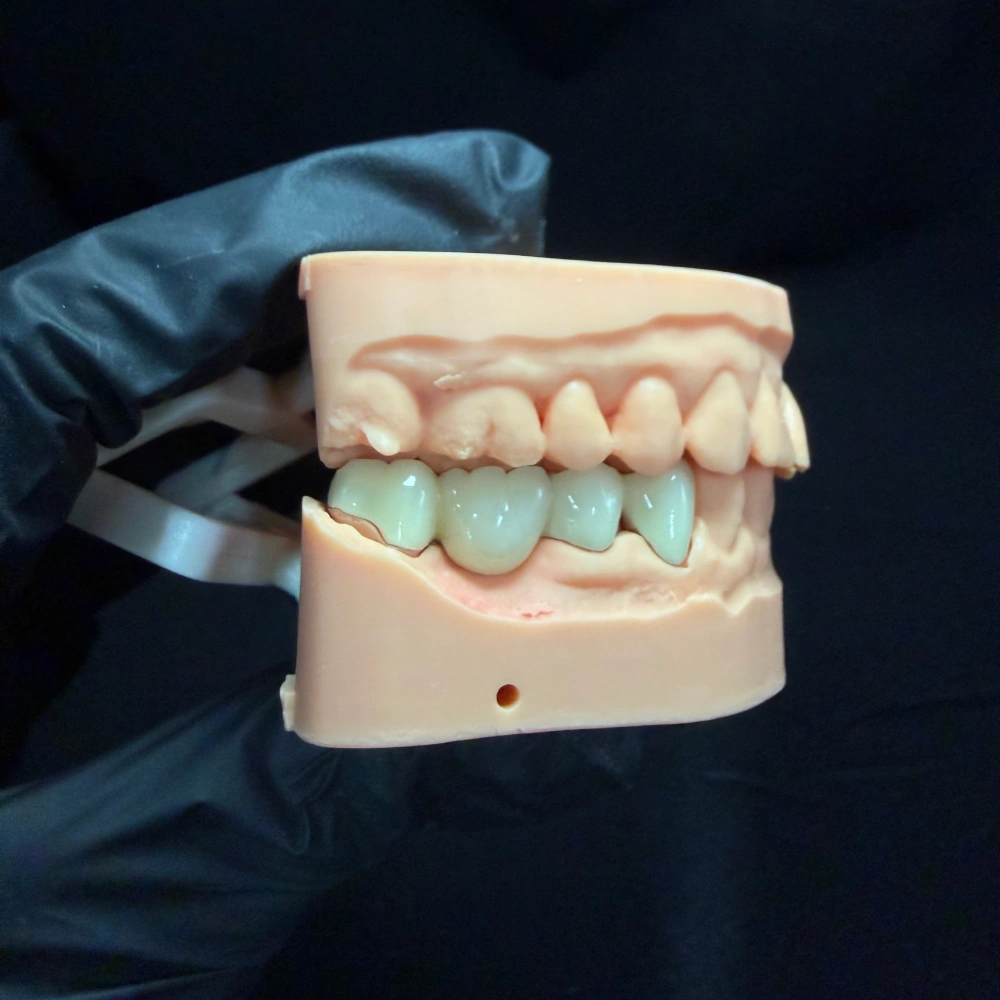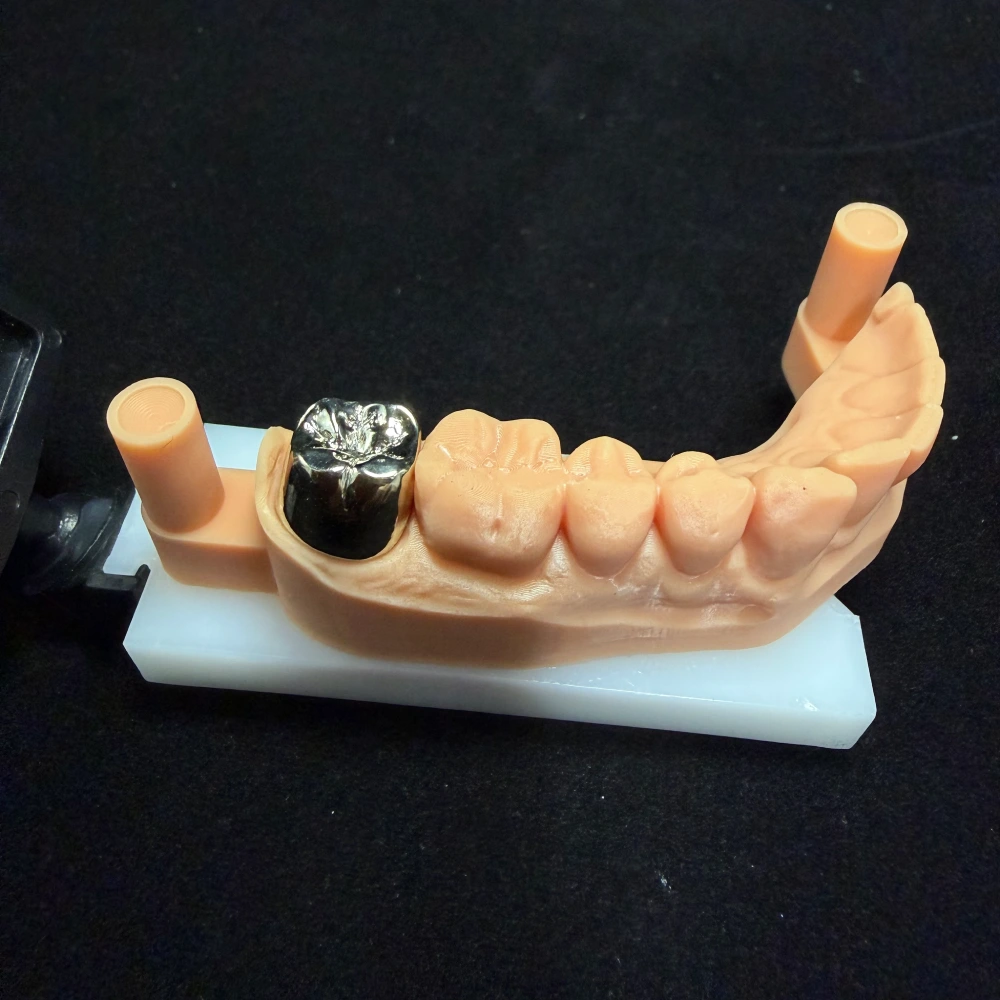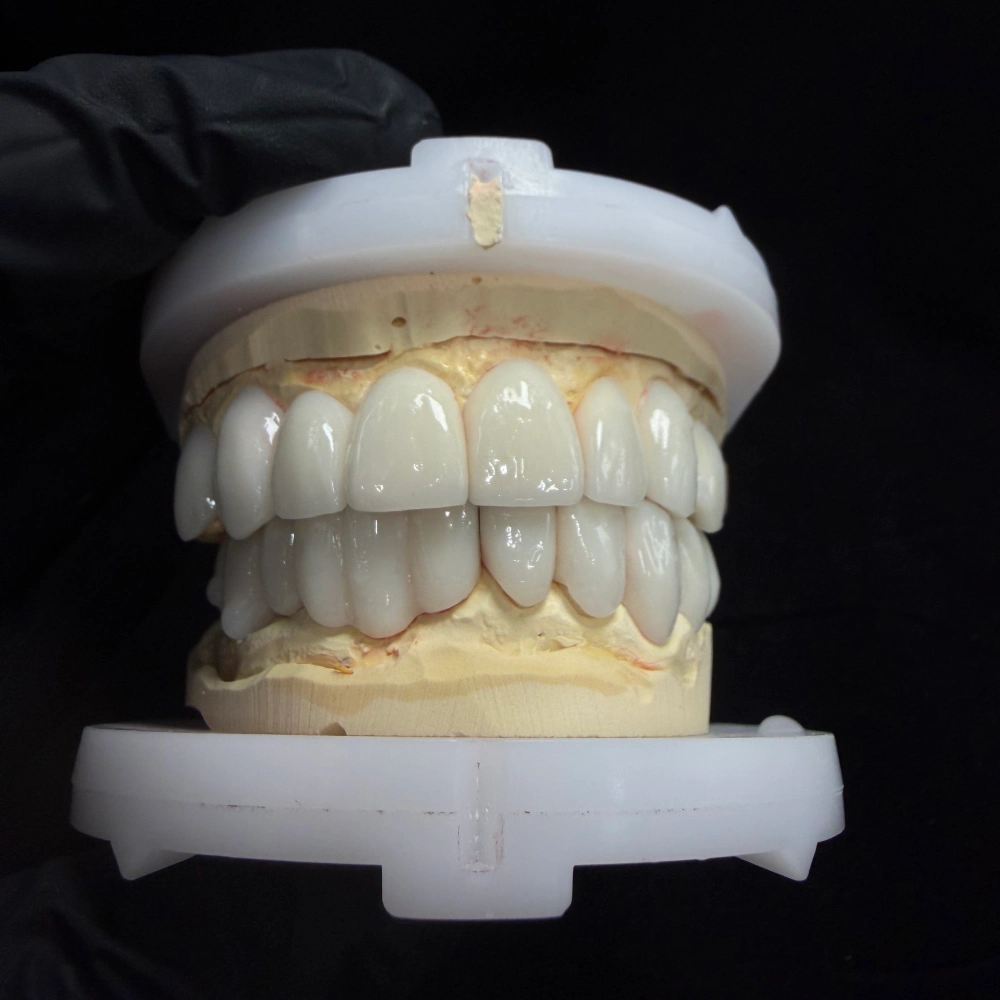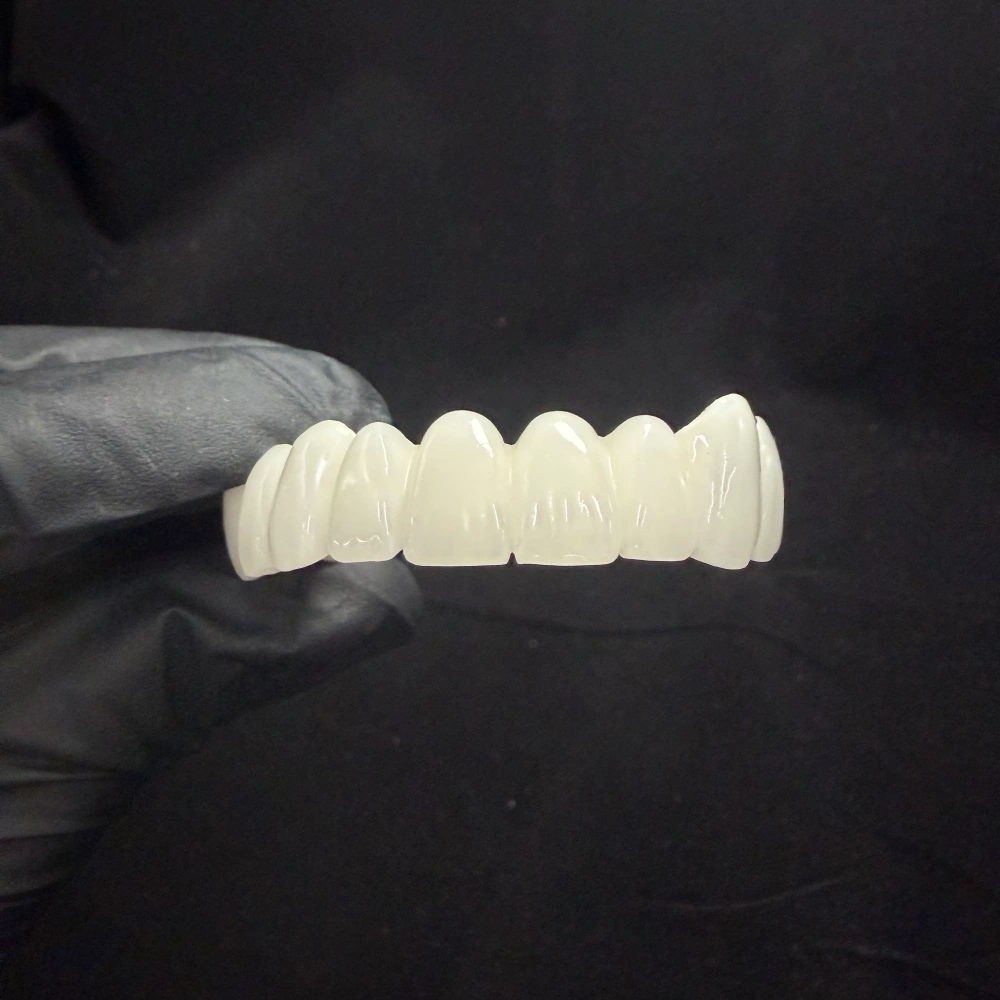
Composite Veneers – Lab-Fabricated Indirect Restorations
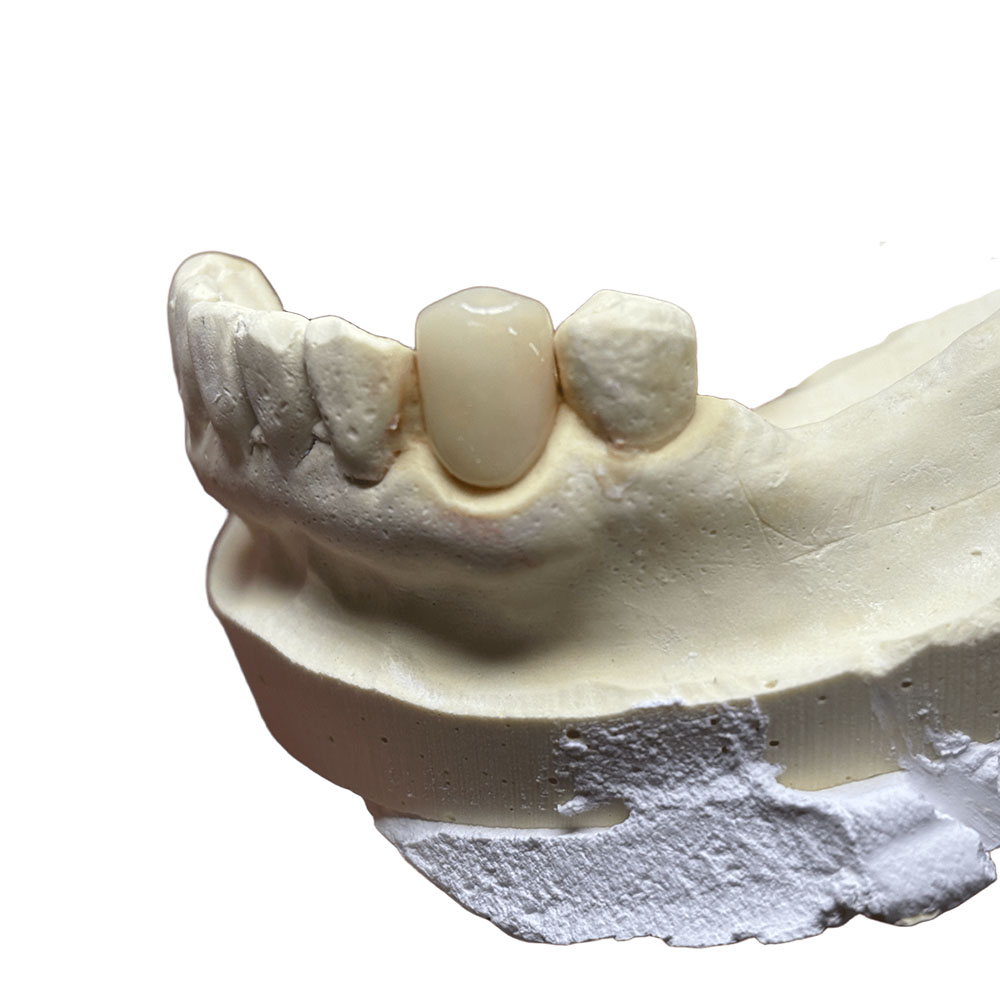


Lab-fabricated indirect composite veneers. Direct factory, in-house production, full service dental laboratory. Trusted by 400+ dentists, 100+ clinics, and 50+ dental laboratories.
At a Glance
| Product | Indirect composite veneers (composite resin veneers, lab-fabricated) |
| Product category | Lab-fabricated anterior restoration |
| Manufacturing model | Direct factory, full service dental lab, in-house production, no third-party outsourcing |
| Resin system | Nanohybrid / microhybrid / nanofilled composite; CAD/CAM resin block option |
| Layering | Hand-layered polychromatic (dentin / body / enamel / incisal effect shades) |
| Extraoral curing | Light + heat + pressure / vacuum cycles |
| Files accepted | STL (3Shape, iTero, Medit, CEREC) or physical impression |
| Packaging | Individual case packaging; white-label available for outsourcing dental labs |
| Documentation per case | Material batch, case ID, technician record, certificate of conformity |
| Service regions | United States and Europe |
| Lead time | Standard or urgent — confirmed at case intake |
Composite Resin Veneer Features
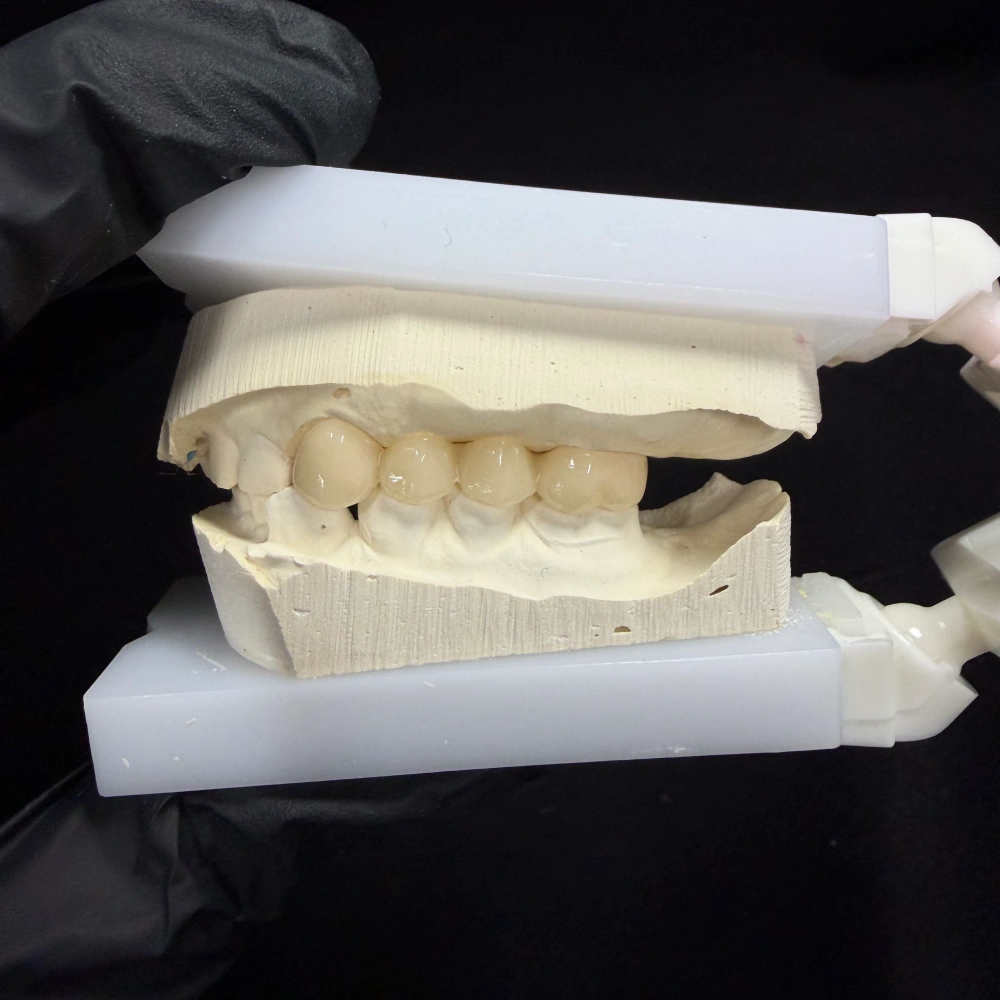
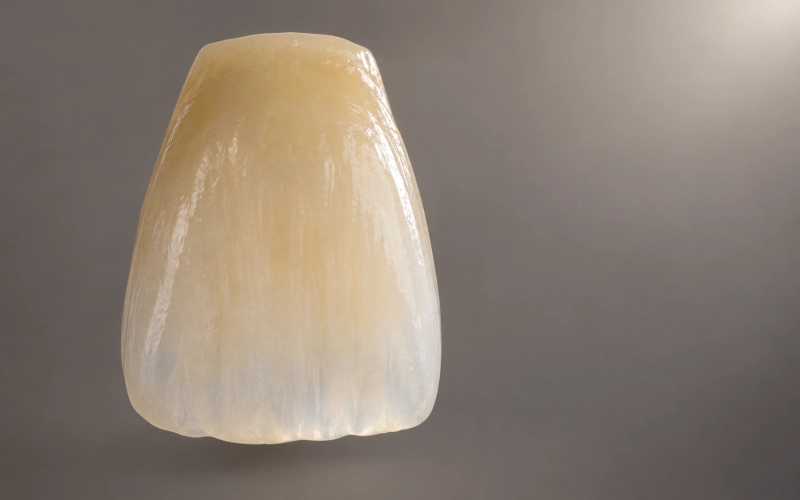
Composite veneers are thin shells of resin composite, bonded to the front surface of anterior teeth to change shade, shape, or contour. Indirect composite veneers are fabricated on a model in a dental laboratory, then returned to the clinician for bonding at a second visit.
The composite resin veneers that ASD produces combine a methacrylate-based resin matrix (Bis-GMA / UDMA / TEGDMA) with silica, glass, or zirconia fillers, plus a silane coupling agent at the filler–matrix interface. Nanohybrid, microhybrid, and nanofilled formulations are all available; the specific material is confirmed per case based on shade target, prep design, and handling preference.
| Feature | What it means for the case |
| Layered, not monolithic | Dentin, body, enamel, and incisal-effect shades are built up separately — not a single block shade. Shade match is closer to natural tooth optical depth. |
| Extraoral post-cure | Light, heat, and pressure cycles outside the mouth raise the degree of polymer conversion before the veneer is bonded. Shrinkage at placement is associated primarily with the resin cement, not the veneer itself. |
| Nanohybrid / microhybrid / nanofilled options | Material is matched to the case. Material substitutions require written approval. |
| CAD/CAM resin block option | For practices that scan and prefer milled indirect composite veneers over hand-layered. |
| No-prep and minimal-prep accepted | Where tooth volume and emergence profile allow, no-prep indirect composite laminate veneer protocols are workable. |
| White-label packaging | Outsourcing dental laboratories can keep their own brand on the box. ASD’s name does not appear on delivery materials. |
| Material documentation per case | Material batch, batch numbers, and certificate of conformity provided per case. |
Why Choose This Product
Composite resin veneers sit between chairside direct composite and porcelain. The choice comes down to what each restoration does well, and where each one runs out of room.
Reversibility and additive approach
Composite veneers are additive, not subtractive. The clinician can place a thin shell without removing significant enamel. If the patient later wants a different design, the restoration can be removed and replaced. For young patients and for transitional cases — where the design is being tested before any irreversible prep — composite resin veneers are a low-commitment first step. The Materials for Indirect Restorations page from the ADA outlines resin composite as a documented category of indirect restorative material.
Repairable in the mouth
If a composite veneer chips or fractures intraorally, the standard repair protocol is to add fresh composite to the affected area and repolish — the original restoration does not always need to be remade. Contemporary composite resins are documented as reparable intraorally in the dental literature. The same is not usually true for porcelain, which often requires full replacement.
Shade match and optical integration
A hand-layered polychromatic indirect composite veneer allows the technician to place different opacities at different layers — dentin shade at the body, translucent enamel shade at the incisal third, effect shades for characterization. The result is a restoration that picks up and reflects light in a way closer to natural enamel than a monolithic restoration.
Cost-to-commitment ratio
Porcelain requires more chair time, more lab time, and more irreversible prep. For patients who are cost-sensitive or not yet ready for full ceramic work, composite resin veneers give an aesthetic step up from direct chairside bonding without the lab and prep cost of porcelain.
Longevity with selection
When case selection is right, clinical data for indirect composite veneers is solid. A 7-year prospective case series of no-prep indirect composite laminate veneers reported 88.9% survival at 7 years. A systematic review of resin composite laminate veneers found 88% pooled survival over 2–8 years. A 10-year randomized trial comparing indirect composite to ceramic veneers found approximately 75% cumulative survival for composite versus 100% for ceramic — failures were debondings and fractures, and the gap was most pronounced in patients with parafunctional loading.
Indirect Composite Veneers Manufacturing Process
Every indirect composite veneer ASD ships goes through the same in-house workflow. Nothing is outsourced to a third-party lab.
Step 1 — Case intake and review
Digital intake (STL files from 3Shape, iTero, Medit, CEREC, or any standard intraoral scanner) or physical intake (impressions with tracking number). Minimum required: prep design, shade prescription, photos, patient notes.
The technician team reviews the case before production starts. Cases with parafunction, severe discoloration, or unfavorable prep design are flagged, and a porcelain recommendation can be made before any material is committed.
Step 2 — Model and die preparation
For digital cases, the STL is printed to produce a physical working model. For physical impression cases, the model is poured and sectioned in the conventional way. Dyes and markings are applied to capture margin position.
Step 3 — Hand-layered polychromatic buildup
The technician layers the composite incrementally, with separate shades for the dentin body, the enamel layer, and any incisal effect or characterization. Nanohybrid or nanofilled composite is selected based on the shade target and handling preference. CAD/CAM resin block (milled) is offered as an alternative for practices that prefer it.
Step 4 — Extraoral post-cure
The layered veneer goes through extraoral light + heat + pressure / vacuum cycles. This raises the degree of polymer conversion of the composite resin before placement, reducing the residual shrinkage that has to happen in the mouth at bonding. Indirect resin composites processed with extraoral curing cycles show higher conversion rates than the same material cured intraorally — a documented advantage of the indirect workflow.
Step 5 — Marginal fit check and finishing
Margins are checked on the die under magnification. The intaglio surface is prepared for bonding: silane application (after optional hydrofluoric-acid or air-particle treatment, depending on the resin system) to promote chemical bond to the resin cement at placement. The external surface is shaped and pre-polished.
Step 6 — Quality inspection and documentation
Per-case inspection log: case ID, technician record, material batch and batch numbers, certificate of conformity. The case is packaged with the documentation. White-label packaging (your dental laboratory’s brand) is available.
What “indirect composite veneers” actually means
| Aspect | How the product is fabricated |
| Where the veneer is made | On a model in the dental laboratory, not in the patient’s mouth |
| Curing method | Extraoral: light + heat + pressure / vacuum cycles |
| Polymer conversion | Higher than chairside direct composite, because the lab cycle is more aggressive than intraoral light |
| Layering | Separate dentin / body / enamel / incisal-effect shades built per case |
| Marginal fit | Fabricated from impression or scan, checked on a die |
| Visits required | Two: impression or scan → bonding |
| Repairability | Repairable intraorally with fresh composite, as documented for the resin category |
Indications
Indirect composite veneers are well suited for:
- Cosmetic veneer cases where the patient wants a less irreversible path than porcelain
- Young patients — additive, preserves enamel, leaves room for future changes
- Single-tooth or small-case corrections where the cost of full ceramic is not justified
- Transitional or staging restorations — test-driving a smile design before committing to permanent reduction
- Cost-conscious patients who still want a layered, aesthetic result
- Quadrant or full-arch aesthetic rehabilitation when paired with appropriate occlusal review
- Cases where shade, shape, or contour correction is the primary goal and the underlying tooth structure is otherwise sound
[Request a Quote for This Case Mix]
When Composite Veneers Are Not Indicated
The clinical literature is consistent on a few boundaries. These are case-selection facts, not marketing claims.
- Parafunctional patients (bruxism, clenching) — Thin anterior composite restorations show elevated marginal complication rates in patients with heavy excursive loads. A published case report describes the use of semidirect resin composite veneers in a patient with bruxism and notes the higher maintenance burden. The standard recommendation is to resolve occlusal issues before any thin anterior restoration, composite or ceramic.
- Severe discoloration — When the underlying tooth shade is too dark for composite opacity to hit the target shade, composite is not the right material. Porcelain is the better choice for these cases.
- Inadequate enamel for bonding — Bond durability to enamel is well documented; bond to large areas of dentin is less predictable. Cases with little remaining enamel may not be good candidates.
Clinical Performance — What the Literature Reports
| Study | Follow-up | Finding |
| 7-year prospective no-prep indirect composite laminate veneers case series | 7 years | 88.9% survival rate with careful case selection. (BMC Oral Health) |
| 10-year randomized trial — indirect composite vs ceramic veneers | 10 years | Approximately 75% composite cumulative survival vs 100% ceramic — failures were debondings and fractures, not uniformly distributed. (ScienceDirect) |
| Systematic review of resin composite laminate veneers | 2–8 years pooled | 88% pooled survival across the studies reviewed. (PubMed) |
| Reparability of contemporary composite resins | n/a | Composite resins are documented as reparable intraorally; chipped restorations are often repaired rather than remade. (PMC) |
| Composite veneers: the direct-indirect technique revisited | n/a | A clinical overview of the direct-indirect and indirect composite veneer workflows. (PubMed) |
| Long-term clinical performance of anterior composite restorations | ≥5 years | Systematic review documenting survival, complication types, and failure modes for anterior direct and indirect composite restorations. (PubMed) |
Failure predictors in the literature: bruxism, heavy excursive loads, irregular recall, and limited remaining enamel. Material category alone does not determine longevity — case selection does.
How to Work With Us
Step 1 — Case submission
Send STL files (3Shape, iTero, Medit, CEREC) or physical impressions with a tracking number. Include prep design, shade prescription, photos, and any patient-specific notes.
Step 2 — Case review and confirmation
Your case coordinator reviews the case with the technician team. Shade, prep design, and case complexity are confirmed before production starts. Any flags (parafunction, severe discoloration, prep concerns) are raised at this stage, not at delivery.
Step 3 — Fabrication
Production runs at ASD’s Shenzhen and Huizhou factories. Full traceability: case ID + technician record + material batch + QC inspection log + certificate of conformity.
Step 4 — Delivery and bonding
The case is delivered with full documentation. A bonding protocol sheet is included: silica treatment or air-particle abrasion of the intaglio surface, silane application, and resin cement selection guidance.
[Send a Test Case] · [Request a Quote]
Who We Serve
| Segment | Working arrangement |
| Individual dentists and private practices | Direct case submission. No minimum volume. New clients typically start with a test case. |
| Dental clinics and group practices | Multi-location accounts with per-location packaging available. |
| Hospital dental departments | Hospital procurement documentation available on request. |
| Other dental laboratories (outsourcing partners) | White-label packaging — ASD’s name does not appear on delivery materials. No direct contact with your doctors. |
| DSOs | Multi-provider workflow with a dedicated case coordinator per account. |
In-house scale: ASD Dental Lab has operated as a direct factory and full service dental laboratory since 2012. Approximately 460 professional employees across CAD design, milling, implant, ceramic and metal, removable denture, and quality control departments, plus a customer service and case coordination team. Manufacturing facilities in Shenzhen and Huizhou, China. The dental lab has served more than 50 dental labs, more than 100 dental clinics, and over 400 dentists, with main markets in the United States and Europe.
Composite Veneers FAQs
Q: What does “composite veneers” actually mean — and what’s the difference between direct and indirect?
Composite veneers are thin shells of resin composite bonded to the front surface of anterior teeth. Direct composite veneers are placed by the clinician in the chair, on the tooth, with intraoral light curing. Indirect composite veneers (composite resin veneers) are fabricated on a model in a dental laboratory, then returned to the clinician for bonding at a second visit. ASD fabricates the indirect composite veneers that you bond at the second appointment.
Q: What’s the difference between composite resin veneers and indirect composite veneers?
These terms refer to the same product category — resin composite veneers fabricated outside the mouth. “Composite resin veneers” emphasizes the resin material; “indirect composite veneers” emphasizes the lab-fabricated workflow. Both terms are used in the clinical literature and in practice.
Q: What composite materials do you use?
Nanohybrid, microhybrid, and nanofilled resin composites, with a CAD/CAM resin block option for milled workflows. The specific material is confirmed per case based on the shade target and prep design. Material substitutions require written approval. Material batch, batch numbers, and certificate of conformity are documented per case.
Q: How long do composite veneers last?
Clinical data shows 88% pooled survival over 2–8 years in a systematic review of resin composite laminate veneers, and 88.9% survival at 7 years in a prospective case series of no-prep indirect composite laminate veneers. A 10-year randomized trial found approximately 75% cumulative survival for indirect composite veneers versus 100% for ceramic veneers, with debonding and fracture as the main failure modes. Longevity depends primarily on case selection and patient factors (parafunction, recall, oral hygiene), not on the material category alone.
Q: Are composite resin veneers cheaper than porcelain?
Composite resin veneers generally require less chair time, less lab time, and less irreversible tooth preparation than porcelain, which makes them a lower-cost option. Specific pricing depends on case scope, material selection, and turnaround tier — contact the sales team for a quote.
Q: Can you match a specific shade or existing restoration?
Yes. Send shade tabs, photos, or an existing restoration sample. The layered protocol — dentin, body, enamel, and incisal-effect shades built separately — is designed to handle complex shade matching rather than relying on a monolithic block shade.
Q: Do you offer no-prep composite veneers?
Yes, where tooth volume and emergence profile support it. Cases where minimal prep would improve the result are flagged at the review stage.
Q: What file formats do you accept?
STL and standard intraoral scanner outputs (3Shape, iTero, Medit, CEREC). For proprietary formats, confirm with your case coordinator.
Q: Is ASD FDA-registered?
ASD Dental Laboratory holds FDA establishment registration. Registered device categories cover custom dental restorations including veneers. Documentation is available on request.
Q: Do you offer white-label packaging for outsourcing dental labs?
Yes. Packaging, prescription forms, and correspondence can all go out under your dental laboratory’s brand. ASD’s name does not appear on delivery materials, and we do not contact your doctors directly.
Pricing and Lead Time
Pricing and lead time vary by case scope, material selection, and turnaround tier. Common case scope and material factors include the number of units, the prep design (no-prep vs conventional), and whether hand-layered or CAD/CAM-milled fabrication is selected.
Clinical References
- Clinical survival of No-prep indirect composite laminate veneers: a 7-year prospective case series
- 10-year practice-based evaluation of ceramic and direct composite veneers
- Survival and complication rates of resin composite laminate veneers (systematic review)
- Composite veneers: the direct-indirect technique revisited
- Anterior composite restorations: a systematic review on long-term clinical performance
- Indirect resin composites — laboratory curing and polymerization review
- Reparability of contemporary composite resins
- Semidirect resin composite veneers in a patient with bruxism
- Clinical assessment of direct composite veneer and indirect veneers
- Materials for Indirect Restorations — American Dental Association
- Materials for Direct Restorations — American Dental Association
- Veneers — ADA MouthHealthy
- Bisphenol A — American Dental Association
- Dental Composite Resin Devices — Premarket Notification [510(k)] Submissions (FDA)
- Veneers — Cleveland Clinic
- An Economical Approach to Composite Veneers — AACD
ASD Dental Laboratory — Full-service dental laboratory, direct factory since 2012. In-house production. CAD/CAM digital workflow. Approximately 460 technicians. Shenzhen + Huizhou, China. Trusted by 50+ dental laboratories, 100+ clinics, and 400+ dentists in the US and Europe.
Experience faster turnaround times with our cutting-edge technology
Recommended