E.max Veneers, E.max Ceramic Veneers, and Porcelain E.max Veneers
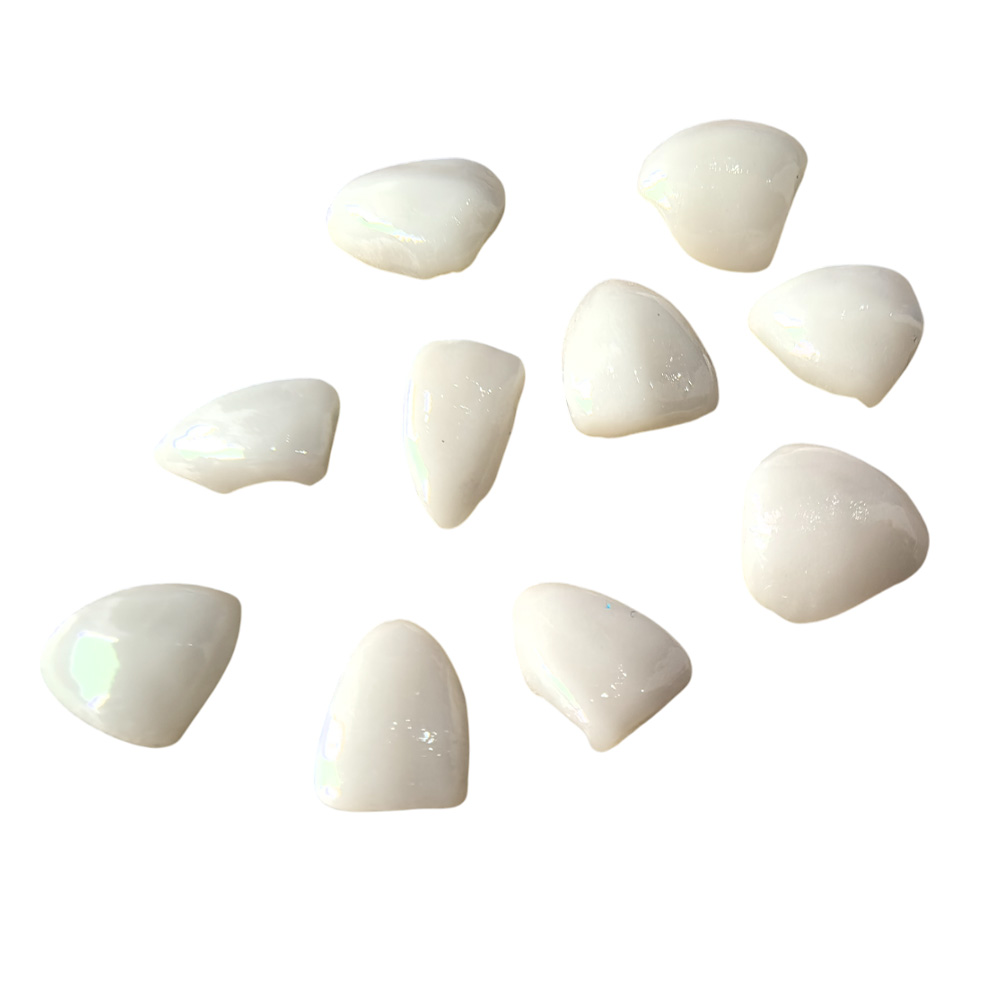


Lithium disilicate laminate veneers — pressed or milled to your prescription. Product specs, lab process, lead times, QC, and how to send a case, in one page.
E.max veneers — product specifications
We deliver e.max veneers in two production paths:
- IPS e.max Press — heat-pressed from an ingot in a lost-wax process
- IPS e.max CAD — milled from a pre-crystallized block in a digital workflow
Both paths are lithium disilicate. e.max Ceram is not in this list — it’s a layering ceramic that goes on top of a zirconia or metal substructure, not a standalone veneer material. When the prescription says “e.max veneers” or “porcelain e.max veneers,” it means Press or CAD. We confirm the path with you upfront because most remakes trace back to a path mismatch, not a material defect.
Material data: IPS e.max Press technical documentation · IPS e.max CAD product page
E.max veneers — clinical indications
We accept e.max ceramic veneers for the standard anterior esthetic indication set:
- Discolored teeth (fluorosis, tetracycline staining)
- Enamel hypoplasia
- Anterior diastemas under 3 mm
- Mild malalignment, microdontia
- Enamel defects on otherwise intact tooth structure
We flag the case back to you at prescription review if any of the following apply — these change the material call, not just the design:
- Heavy discoloration or a metal post underneath (e.max is translucent; we may need to step up thickness or recommend zirconia)
- Active bruxism without a night guard
- A prep that takes real occlusal load (a molar, a canine in group function)
E.max veneers — pressed or milled
When an e.max veneers case can go either way, here’s how we decide:
| Factor | Favors Press | Favors CAD |
| Shade target | Complex, multi-layered, internal characterization | Uniform shade, minimal translucency gradient |
| Thickness available | ≥0.5 mm | ≥0.3 mm (thinner prep tolerance) |
| Turnaround | Standard 7–10 days acceptable | Rush case, or part of a same-day digital chain |
| Margin design | Feather-edge, cervical butt | Chamfer, shoulder |
| Stated preference | Overrides all | Overrides all |
Every anterior e.max veneers case at this dental laboratory is assigned to a designated ceramist. You can request the same technician for repeat cases. The technician stays with your case through design, production, and finishing — not rotated between cases.
Porcelain e.max veneers — why choose this material
Lithium disilicate hits the strength-and-translucency window that other materials miss. Zirconia gives you strength but loses translucency; feldspathic gives you translucency but loses strength. E.max ceramic veneers sit in the middle, which is why they’re the default for anterior esthetics. Flexural strength lands in the 360–470 MPa range (Current status on lithium disilicate and zirconia, PMC).
Where e.max isn’t the call: heavy bruxism without a guard, posterior load on a patient who clenches, or a dark underlying shade with limited thickness. In those cases we recommend zirconia or layered zirconia — and we say so at prescription review, before any work starts.
Bonding protocol: hydrofluoric-acid etch + silane coupling + adhesive + resin cement (Variolink, RelyX Ultimate, or equivalent MDP-containing systems). Final etch and silanization happen chair-side just before seating. If you want the lab to pre-etch and silanize so the e.max veneers ship ready-to-seat, mark it on the prescription — we’ll do it and note it on the case card.
E.max veneers — longevity and failure handling
Systematic reviews put 10-year survival for e.max ceramic veneers at 96.8% (Survival and Complication Rates of Feldspathic, Leucite-Reinforced, Lithium Disilicate, and Zirconia Ceramic Veneers, 2024). That’s clinical survival — the restoration is still in place and functional. Individual studies report ranges from 10–20+ years depending on occlusal load, bonding protocol, and night-guard compliance.
Failure modes we see: chipping under heavy load, debonding if the prep was too short or cementation was off, fracture when there’s bruxism without a guard.
What happens if an e.max veneers case fails in your hands:
- Within 90 days, production defect — open margin, high occlusion, binding contact: we remake at no charge.
- Within 90 days, material failure (veneer fractured under normal use, no occlusal interference): we evaluate the failed unit, identify the cause, and decide next steps based on what we find.
- Outside 90 days or with clinical variables involved (prep design, cementation technique, patient load, opposing dentition): we still do the failure analysis and tell you what we see. We adjust our design or process if it’s something we should have caught.
If the same defect happens twice, we trace the root cause, update the process standard, and add a control point so it doesn’t repeat. Recurring issues are logged as corrective and preventive action (CAPA) entries — not one-off remakes.
E.max veneers — intake specifications
Digital case (preferred)
- File formats: STL, PLY, OBJ, DCM (3Shape native scan). PLY preferred for anterior esthetic e.max veneers cases, implant bars, or any case where you want us to see the soft-tissue and gingival color — it carries the color data. For simple posterior work, STL is enough.
- Platforms: 3Shape Communicate, Medit Link, plus most other case platforms. We also accept iTero, CEREC (Sirona), Shining3D Aoralscan, Planmeca — any scanner that exports open file formats.
- Design file handoff: If you’ve already designed the e.max veneers case in exocad or 3Shape, send the native project file. We can edit it, finalize it, and send back a revised STL for your approval before production.
Design confirmation = one design + two free revision rounds. If you need a third round, we still do it — we just flag it so we can review our intake checklist and figure out what we missed upfront.
Required for esthetic anterior cases:
- Photos: full-face smile at rest, repose, profile, retracted intraoral, shade-tab match shot
- Scans: prepared tooth, opposing arch, pre-prep or wax-up / mock-up (if you have one), adjacent teeth, soft tissue
- Bite: occlusal record, maximum intercuspation
- Esthetic parameters: shade, translucency target, incisal edge character, surface texture, tooth proportions, midline, smile line
- References: ideal smile photo, prior restoration photos, DSD design files
Physical case
- Impression material: VPS (addition silicone, our first choice), condensation silicone, or polyether
- Model types: stone models, segmented models with removable dies, implant models with analogs, 3D-printed resin models, pre-poured models
- Die shade: Note the stump shade on the prescription. If sending a physical die, mark the shade on the die itself or include a shade tab in the box.
Shipping (for physical cases): UPS Saver or DHL Express 12:00 international covers most of our client base. If you’d rather use our account, let us know when you submit the e.max veneers case.
For digital e.max veneers cases, upload to your case platform or email large files via WeTransfer / 3Shape Communicate to [email protected].
E.max veneers — manufacturing process
Every e.max veneers case at this dental laboratory follows a five-stage workflow:
- Receive — case files and prescription checked against the intake list. If anything’s missing, the case pauses and we ping you daily until it’s resolved.
- Design — digital preview sent for approval (for design cases). Custom acceptance criteria you submit in writing get locked into your account profile at this stage.
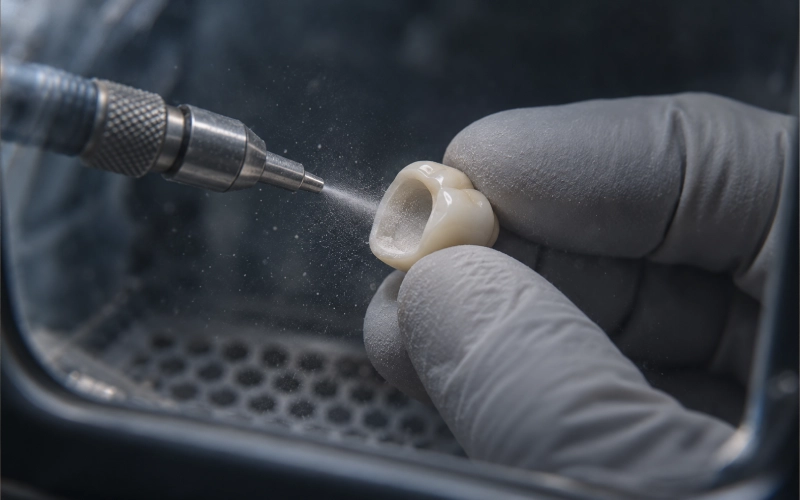
- Production — pressing or milling, then cut-back and ceramic layering where the case calls for it.
- Quality control — independent inspection before packing (see next section).
- Ship — packed and shipped. Tracking number sent as soon as the e.max veneers case leaves the bench.
Case traceability: every e.max veneers case is bound to a unique case ID that logs the technician, the equipment, the material batch, and the QC checkpoint results. Records are kept for at least three months by default — longer if you ask for it.
Production capacity: 8,000 zirconia single crowns in normal season, scaling to 15,000 in peak season. The e.max veneers line runs through the same five-stage workflow, with a 25-person QC department supporting every restoration category. Peak-season capacity is buffered by ~50 trained backup workers, so lead time on e.max veneers doesn’t slip when the queue gets long.
E.max veneers — quality control
Three checkpoints plus final sign-off by a technician who did not make the case.
Incoming check: Are the files clean? Is the impression acceptable? Do we have all the information?
In-process inspection: Wax-up or design review, post-press or post-mill dimensional check, pre-glaze surface review.
Final inspection: A QC technician who was not involved in production inspects four areas:
- Marginal adaptation — even, no lifting, no gaps
- Tissue surface — no burrs, residual nubs, or voids
- Proximal contacts — snug but not binding
- Occlusion — verified in centric, protrusive, and lateral; early contacts removed
We use microscopes, digital comparisons, and coordinate measurement when indicated. If you want QC photos before the e.max veneers ship, request them when you submit the case.
Fail criteria: If a case doesn’t pass final inspection, it returns to production. It doesn’t ship. If the same defect recurs, we perform root-cause analysis, update the process standard, and add a control point. Recurring issues are logged as corrective and preventive action (CAPA) — not treated as one-off remakes.
Custom acceptance criteria: You can define your own pass/fail standards in writing — occlusal clearance tolerance, contact tightness, esthetic priorities, margin finish — and we lock them into your account profile at the design stage. Verbal preferences don’t override written standards.
E.max veneers — lead time
Standard: 7–10 business days from the day a complete e.max veneers case file lands. Rush: 1–2 days if you mark the case URGENT (on the box, on the prescription, and in an email to [email protected] so we can slot it).
“Complete” means: prescription filled out, all required files or impressions received, no missing shade information, no contradictory instructions. Incomplete e.max veneers cases pause the clock until we hear back from you.
You’ll get an inquiry-form response within 30 minutes during business hours. Once the e.max veneers case is in production, you’ll get status updates at each stage gate.
E.max veneers — limitations and contraindications
E.max veneers are strong, but they’re not indestructible. Here’s what to flag to the patient:
- Grinding and clenching: Active bruxism can chip or fracture e.max veneers. A night guard is part of the treatment plan, not optional.
- Very dark underlying shades: Lithium disilicate has good masking, but it’s translucent. If the prep is discolored or you’re working over a metal post, the final shade may need extra thickness or a switch to zirconia.
- Heavy posterior load: E.max handles moderate occlusal forces. On a molar with heavy contact, full-contour zirconia is the safer pick.
- Irreversible prep: Even a minimal-prep e.max veneers removes enamel. Patients need to know this is permanent.
We don’t diagnose or treatment-plan. That’s your call. We list these so you have the talking points for the case-planning conversation.
E.max veneers — cooperation workflow
- Submit an inquiry: Use the form on our site or email [email protected]. You’ll hear back within 30 minutes during business hours.
- Send the case: Digital upload via your case platform, or physical impressions/models via UPS Saver / DHL Express 12:00.
- We confirm receipt and flag anything incomplete: Missing shade, unclear prescription, contradictory instructions — we’ll ask before we proceed.
- Design confirmation (if it’s a design case): We send a preview. You approve, or you request changes (up to two free revision rounds).
- Production: Press or mill, layer, finish, glaze.
- QC inspection: Independent sign-off by a technician who didn’t make it.
- Ship: Tracking number sent as soon as it’s packed.
You can request the same technician/designer for repeat e.max veneers cases. You can ask for QC photos before we ship. You can submit custom acceptance criteria in writing and we’ll lock them into your profile.
Confidentiality: We can sign an NDA on request. Inside the lab, every case is referred to by case ID only — patient names don’t circulate. We never contact the dentists on your client list directly. Your packaging, prescriptions, and case labels can ship without our brand name on them if you need white-label.
About this dental laboratory
We’ve been making e.max veneers since 2012 as a full-service dental laboratory. Two production facilities (Shenzhen and Huizhou). Around 460 technicians and specialists, including a 25-person QC department. We work with 50+ dental laboratories, 100+ clinics, and 400+ direct-referring dentists, mostly in the United States and eight European countries. Every step — design, milling, pressing, layering, QC, and shipping — runs in-house. We don’t outsource cases.
Regulatory standing: FDA Establishment Registration & Device Listing FY2026 (Registration No. 3039441248, Listed Device Numbers D571460–D571464). This is registration and listing; it does not represent FDA approval, clearance, or certification. EU MDR compliance under Regulation (EU) 2017/745, Article 52(8) and Annex XIII, Class IIa custom-made device notification.
Pricing: Fee-per-unit pricing is case-specific. The variables are material choice, design complexity, turnaround speed, and unit count. We don’t publish a rate card because every e.max veneers case is different. Request a quote when you submit the case details.
Questions about e.max veneers, e.max ceramic veneers, or porcelain e.max veneers? Email [email protected] or use the inquiry form. We respond within 30 minutes during business hours.
Experience faster turnaround times with our cutting-edge technology
Recommended