Cement Retained Implant Crown
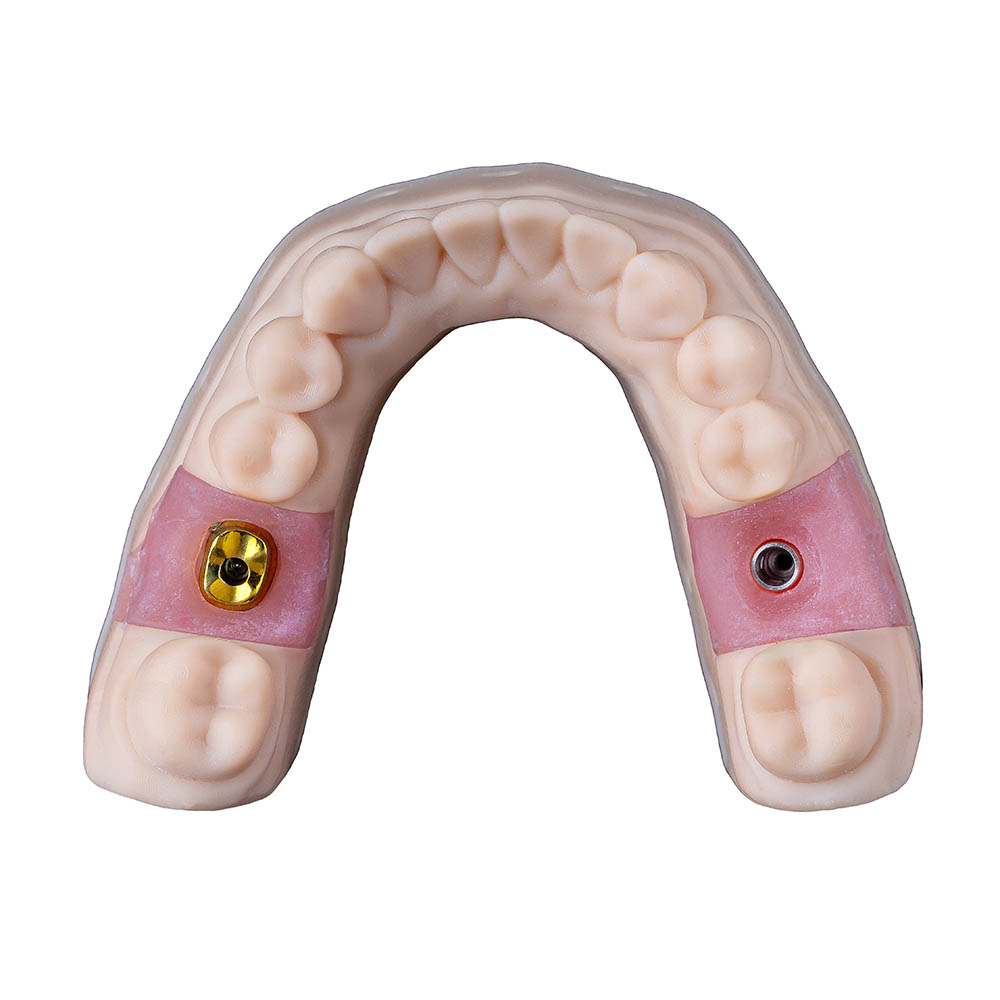
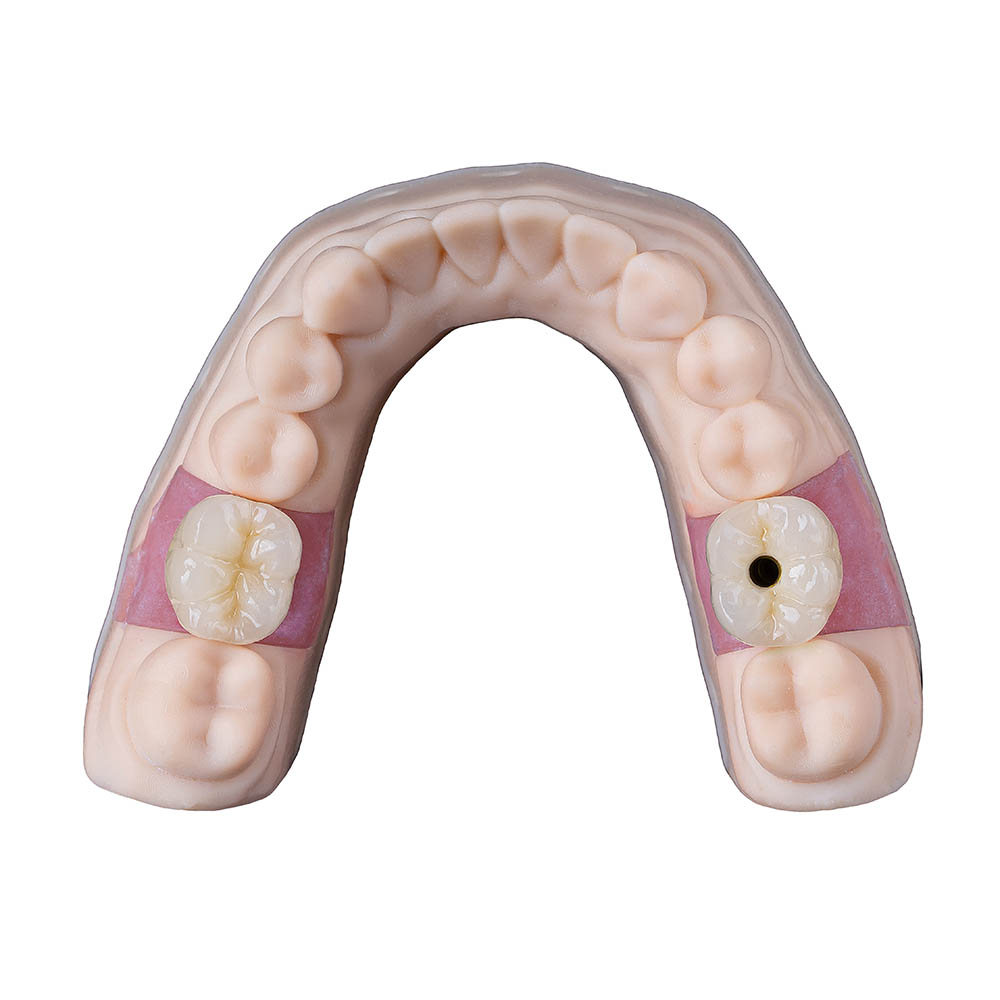
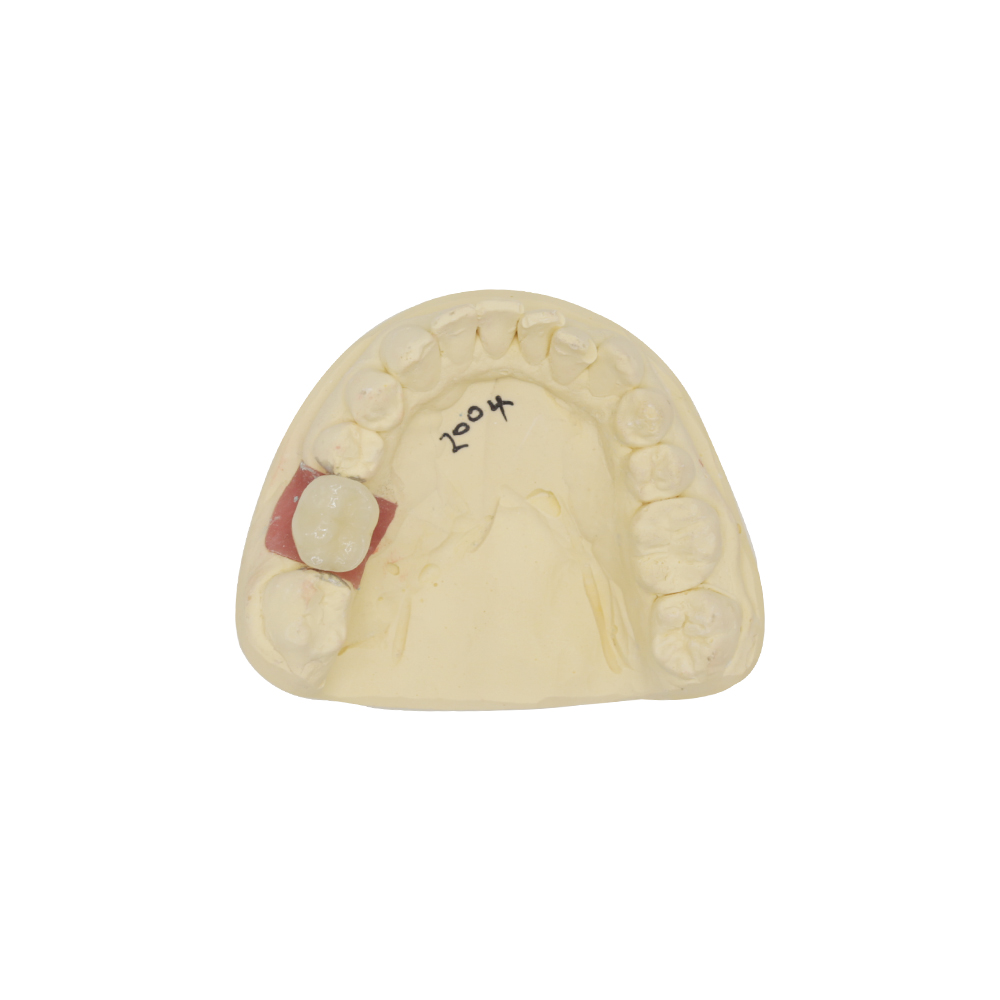
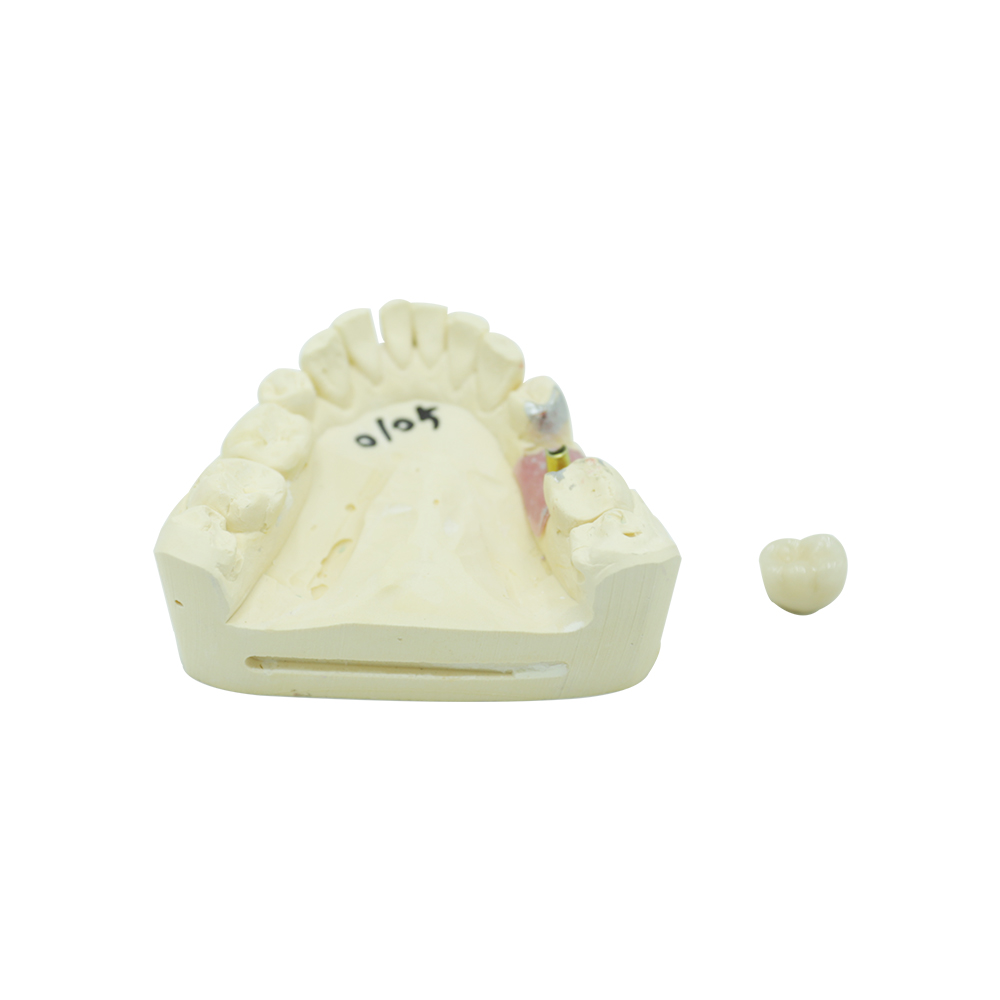
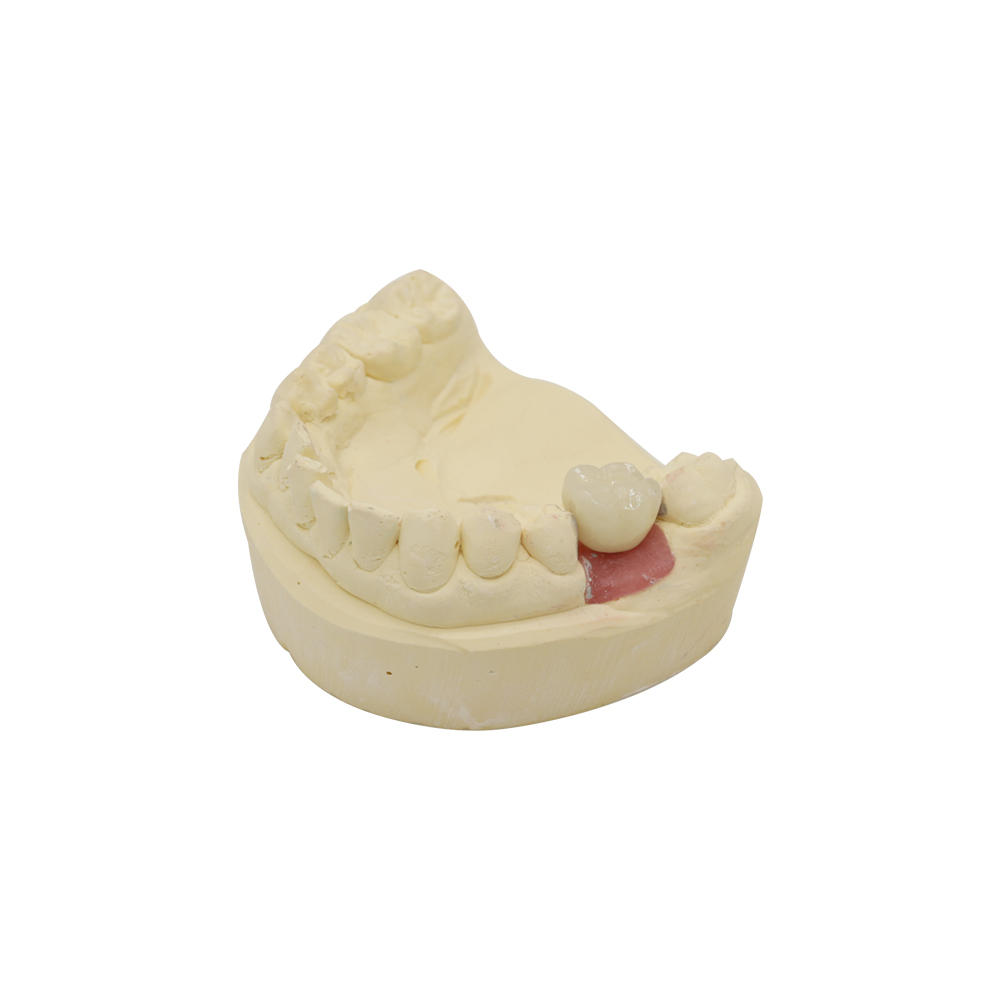
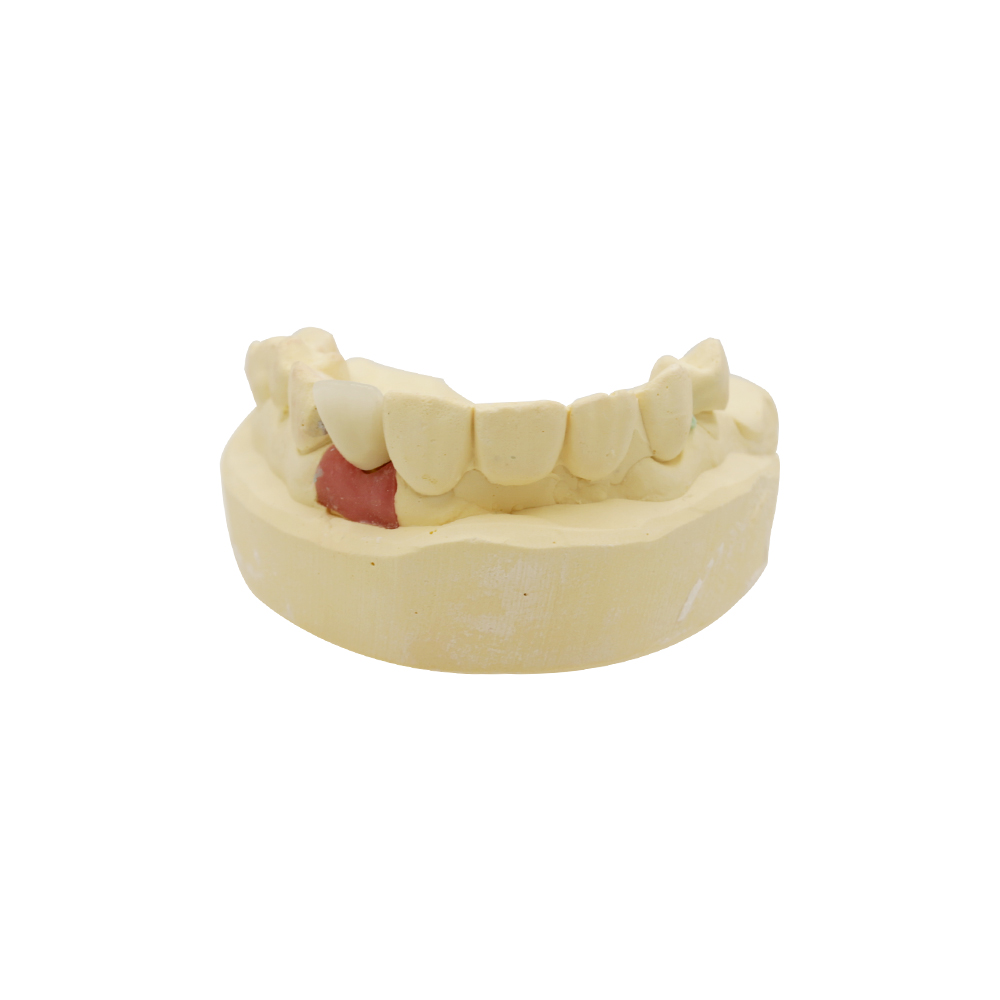
A cement retained implant crown is a single-tooth or short-span implant restoration in which the crown is luted onto a prepared abutment — stock, custom-milled, or Ti-base — using dental cement. There is no occlusal screw access channel; the crown looks and functions like a tooth, and the cement line sits at the margin the abutment geometry dictates. You will also see the same restoration referred to in literature as an implant cemented crown — same product, same build, two ways of naming the retention mode.
This page covers four things in order: what the product is and what it can do, when it is the right choice for the case in front of you, how we build one in our own facility, and how to send a case. Each section is written so you can scan to the part you need and stop reading. If you want to send a case first, jump to how to send a case or the contact block.
Cement Retained Implant Crown Features & Specifications
A cement retained implant crown has three load-bearing layers. Each can be specified independently, and each decision changes what the lab fabricates:
| Layer | What it is | What we offer |
| Implant fixture | The OEM titanium implant in bone | Not part of what we fabricate — you or the surgeon place it. We work to the platform and connection you tell us. |
| Abutment | Screws into the implant at the torque the OEM specifies; the crown lutes onto this | Stock titanium / titanium-alloy per OEM; custom-milled titanium; custom-milled zirconia; Ti-base + zirconia hybrid. Milled in-house from titanium, zirconia, or Ti-base blanks. |
| Crown | The visible restoration; luted to the abutment with the cement of your choice | Monolithic zirconia; layered zirconia (hand-built porcelain on zirconia coping); lithium disilicate; PFM (noble / base-metal alloy); cast noble metal on request. |
Two design features worth flagging up front because they shape everything below:
- Retrievability is a property you choose. A crown cemented with a definitive resin cement is at the top of the retention scale; a crown cemented with a provisional resin cement is deliberately weak and intended to come off. We build both — your prescription decides which.
- Residual luting agent is the single largest clinical risk. Residual cement below the gingiva is the failure mode specific to this retention mode. The lab’s job is to keep the volume low and put it where you can see it. The residual-cement control section covers how we do that.
Material and structural options at a glance
| Component | Standard options | Pick when |
| Abutment | Stock titanium / titanium-alloy (per OEM); custom-milled titanium; custom-milled zirconia; Ti-base + zirconia hybrid | Stock when OEM and platform allow; custom when emergence profile or margin depth is non-standard; Ti-base when you want a zirconia esthetic zone with a metal-to-implant interface |
| Crown material | Monolithic zirconia; layered zirconia; lithium disilicate; PFM; cast noble metal | Monolithic zirconia for posterior and most single units; layered zirconia or lithium disilicate for high-esthetic anterior; PFM when the prescription or material history calls for it |
| Luting agent | Resin cement (highest retention); RMGI (mid-range); zinc phosphate; temporary / provisional resin cement | Pick by retrievability plan and esthetic demand — see retention numbers |
| Connection | Internal hex / tri-channel / conical, per OEM platform | Always OEM or validated compatible; we do not fabricate onto an unknown platform |
Custom abutments, CAD/CAM, and Ti-base
A cement retained implant crown is only as good as the abutment under it. We mill custom abutments in our CAM room from titanium and zirconia blanks, and we mill Ti-base hybrids in the same room. Three things this lets us do that a stock abutment cannot:
- Margin position by surface. A custom abutment lets us put the facial margin at gingival level and the interproximal margins slightly subgingival, instead of forcing a single circular margin depth dictated by a stock collar.
- Emergence profile control. A custom abutment can carry a cleansable emergence profile from the implant platform out to the crown margin.
- Ti-base with a zirconia top. A Ti-base (titanium base that bonds to a zirconia crown) gives you a metal-to-implant interface plus a zirconia esthetic zone — useful in the anterior and useful when you want the marginal seal at the Ti-base level rather than at a deep cement line.
On Ti-base height: the in-vitro evidence is mixed — see PMID 37633730 and PMID 39093291. We will pick a Ti-base height that gives you a cleansable margin and adequate material thickness; we will not oversell the retention gain .
Design parameters we control
The numbers below are the ones we ask you to confirm or override. Each is sourced to a specific peer-reviewed study so you can see the test condition behind the default . Where the evidence is in-vitro or single-system, we say so.
| Parameter | What we default to | Where the default comes from | Override when |
| Abutment height | 5 mm minimum for definitive cement; 4 mm is a yellow flag (retention drops sharply below); <4 mm we push for screw retention or build-up | PMID 16164467, PMID 23057023, PMC3442431 | You have a clinical reason to accept less retention (planned retrieval, limited vertical space) |
| Abutment taper | 6° total convergence (within OEM tolerance) | PMID 12964683, PMC6202427 | You are building for planned retrievability (more taper helps) |
| Cement space | 40–60 µm on the axial walls, 25 µm at the margin (CAD software defaults) | PMID 27460314, PMID 30231093, PMID 25196982 | You specify a different space; we will print your value and run the mill accordingly |
| Vent hole | Optional, 0.75 mm diameter on the occlusal, only when you request it | PMID 19166549, PMID 29044723 | You are trying to control extrusion of luting agent and you accept the esthetic compromise |
| Margin position | Equigingival wherever possible; ≤1 mm subgingival on the facial only; never >3 mm circumferentially | PMID 31200680, PMID 21382089, PMC6567410 | The clinical situation requires otherwise |
| Torque at delivery | Per OEM IFU — typically 35 Ncm for the final abutment screw, 15 Ncm for a temporary titanium cap | Nobel Biocare Torque Guide, ITI consensus | The implant system calls for a different value; always follow the OEM IFU |
These are not universal truth. They are the values we use as defaults and that we adjust when you give us a reason to. No single number on this page should be treated as a universal constant for every implant system and every luting agent.
When to Choose a Cement Retained Implant Crown
A cement retained implant crown and a screw-retained implant crown are two ways to retain the same kind of restoration. The 2014 ITI systematic review found no significant difference in implant survival or crown loss across studies, and the 2018 meta-analysis on peri-implant disease incidence reported RR 1.36 (CI 0.42–4.38, P=.61) — also not significant . What differs is the failure mode, not the failure rate.
| Dimension | Cement retained implant crown (this product) | Screw-retained implant crown (the alternative) |
| Occlusal anatomy | Looks like a tooth; full occlusal control | Screw access channel sits in the occlusal surface; anatomy has to work around it |
| Retrievability | Retrievable with effort via a planned luting agent; cement line has to be accessible | Designed for retrieval; driver accesses the screw through the channel |
| Margin depth envelope | Works at or just below the gingiva; >3 mm subgingival becomes a cleanup risk | Can sit deeper because there is no cement line |
| Abutment height floor | 5 mm minimum for definitive cement; below 4 mm is a red flag — see PMID 16164467 and PMC3442431 | Less sensitive — screw mechanics dominate |
| Esthetic zone | Strong — no screw access to mask | Moderate — angulated screw channels help |
| Primary clinical risk | Residual cement subgingivally | Screw loosening |
| 5-year crown loss | ~4% in the ITI / EAO systematic review | Comparable |
| 5-year screw-loosening event rate | N/A (no occlusal screw) | ~8.8% in head-to-head series |
Indications — pick this product when:
- The implant platform and angulation let us set the margin at or just below the gingiva without going deep circumferentially.
- You want the occlusion to look like a tooth — no screw channel to mask.
- The abutment height is at least 5 mm for a definitive cement; 4–5 mm is workable with a more retentive cement; below 4 mm we steer you elsewhere.
- You are comfortable with a planned luting agent — either definitive resin / RMGI for highest retention, or provisional resin cement for planned retrieval years later.
- You can clean around the margin at try-in and at recall.
Contraindications — pick the screw-retained alternative when:
- The margin would have to sit deeper than 3 mm subgingivally for tissue contour or esthetics.
- The abutment is shorter than 4 mm and you cannot build it up.
- You need on-demand retrieval in year one for a high-risk patient profile.
- The implant angulation puts the cement line against bone without an accessible margin.
When any of the second list applies, we steer you to a screw-retained, angulated screw channel (ASC up to 25° per Nobel Biocare ), or conometric alternative and tell you why on the case card.
Controlling residual luting agent
Residual luting agent below the gingiva is the failure mode specific to a cement retained implant crown. We address it at the fabrication step. Three design features we can build in:
- Vent hole. A 0.75 mm channel through the occlusal surface of the crown, plugged after seating, that lets excess cement express coronally instead of apically. PMID 19166549 quantified it at 0.8 ± 0.3 µl residual with venting vs 4.2 ± 1.1 µl with a pre-cemented replica and the highest residual with conventional cementation . The trade-off is a small access channel on the occlusal — sometimes worth it on a posterior, usually not on an anterior.
- Pre-cementation on a replica abutment (extraoral cementation). We lute the crown onto a lab analog outside the mouth, seat the assembly on the implant, then retrieve the crown-clean abutment and torque the abutment into the implant. Excess cement stays on the analog, not on the tissue. See PMID 32631640 and PMID 26574860 .
- Half-fill / die spacer / retraction cord. We control the volume of cement we ship in the crown so there is not enough material to express far subgingivally. The literature behind die-spacer and half-fill is in PMID 25153002 and PMC8788496 .
What we do not promise. None of these features make residual cement impossible. The honest summary is in Glidewell’s clinical review: the cement itself is rarely the contributor — what matters is the excess that escapes cleanup . The features above reduce the excess; they do not eliminate the need for careful cleanup at the chair.
Retrievability — what “retrievable” actually means here
Retrievability is the question “can you get this crown off in year three without destroying the abutment.” It is not the same as retention. Retention is about how strongly the cement holds; retrievability is about whether the cement will let go on demand.
What we adjust at the build step when you tell us the crown is meant to be retrieved later:
- Luting agent. RMGI or provisional resin cement rather than a high-bond resin.
- Abutment taper. Slightly higher within the OEM window so the cement has somewhere to fail.
- Margin depth. Kept as shallow as the tissue allows so the cement line is accessible.
What we will not promise: that any of this lets you pull a crown off cleanly in five years with no risk to the abutment screw. The in-vitro data on retrievability after aging is in PMID 23057023 and PMID 26757337 . The honest answer is “retrievable with effort” — not “retrievable for free.”
Retention numbers (and the condition each one came from)
You will find retention numbers quoted everywhere online. Most are in-vitro single-system studies. The values below are what we use to pick a luting agent when you have not specified one, and each is labeled with the test condition so you can judge whether it matches your case.
| Luting agent | Retention (in-vitro) | Test condition | Source |
| RelyX U200 (resin cement) | 581.08 N | Single crown, titanium abutment, after thermocycling | PMC4866252 |
| PANAVIA F 2.0 (resin cement) | 674.07 N | Single crown, titanium abutment, after aging | FOR.org treatment guideline summary |
| Zinc phosphate | 529.48 N | Single crown, titanium abutment | PMC4866252 |
| RMGI (resin-modified glass ionomer) | 338.10 N | Single crown, titanium abutment | PMC4866252 |
| Non-eugenol provisional (acrylic resin base) | 249.05 N | Single crown, intended for retrieval | PMC4866252 |
| Temporary resin cement | 140.49 N | Single crown, planned retrieval | PMC4866252 |
All of these are in-vitro. None of them predict a five-year survival rate in your patient. We share them so you can see what the lab is thinking, not so you can pick a cement from a number.
Our Cement Retained Implant Crown Manufacturing Process
Every cement retained implant crown we ship follows the same internal flow, end to end, in one facility, with no step outsourced:
- Receiving. Files or impressions come in, prescription is parsed, the implant system, platform, and material choices are checked against the work order before anything is started.
- CAD. A technician designs the abutment (if custom) and the crown in CAD software. Margin depth, emergence profile, cement space, and occlusal anatomy are set in the model.
- Model printing. The design is printed for try-in and verification, on the same printer run as the final.
- CAM. Custom abutments are milled from titanium, zirconia, or Ti-base blanks; crowns are milled from the chosen material. A second technician reviews the milled output against the CAD.
- Zirconia pressing (where applicable). Layered zirconia work goes through pressing and sintering before porcelain layering.
- Porcelain layering and glazing. Hand-built porcelain where the prescription calls for it; stain and glaze on monolithic work.
- Finishing. Margin refinement, contact adjustment, occlusal check against the opposing model.
- QC. Fit check on the printed model, margin check under microscope, shade verification against the prescription, photography for the case card.
- Packing. Case card, materials traceability sheet on request, and the restoration are packed together and shipped.
What that means for the case in front of you:
- CAD/CAM, model printing, milling, and zirconia pressing all happen in the same building. The design you signed off in step 2 is the same crown you receive in step 9 — no third-party mill, no trading company in the middle.
- 460 staff across CAD, milling, the implant department, ceramic layering, removable, QC, and customer service. Roughly 100 in CAD, 70 in milling, 80 in the implant department, 70 in ceramic layering and casting, 55 in removable, 25 in QC, plus customer service and admin.
- Capacity you can plan around. In a typical month we ship about 8,000 zirconia single crowns, 2,000 zirconia bridges, 20 All-on-X arches, and 4,000 removable units; in peak months the single-crown line scales to 15,000 and the bridge line to 3,000. We will tell you when we are full before you submit.
- Service footprint. We currently work with 50+ dental laboratories, 100+ clinics, and 400+ dentists, primarily in the United States and Europe (Netherlands, Germany, France, Belgium, Austria, the UK, Luxembourg, Switzerland). We work in English; technical meetings can be scheduled in your time zone.
- Single-unit policy. We accept single-unit cement retained implant crown orders as try orders. We do not run long-term single-unit workflows because international shipping does not pencil out on one crown — we will tell you this on the first call and offer a small-bundle option instead.
- Factory audit. You can visit the facility. Send us a note through the contact block and we will arrange it.
Quality control and what we ship back with each case
Every case ships with:
- A printed case card. Implant system, platform, abutment type and lot, crown material and lot, luting agent recommended, torque value per OEM IFU, fabrication date, technician initials.
- A traceability sheet on request. Material batch, brand, country of manufacture, and conformity statement for the materials we used. Available per case, not just on request for regulated markets.
- A 3-month record retention. We retain the digital design files, mill logs, and QC photos for 3 months, extendable on request. The retention matters when a clinical question comes up months later and you need to know exactly what was in the case.
Compliance, registrations, and traceability
Registrations and quality-system coverage we hold for the restorations we ship:
- United States — FDA. Our facility is registered with the US FDA and the custom dental restorations we export to the United States — custom crowns, fixed bridges, inlays and onlays, veneers, custom implant abutments, implant superstructures, full and partial dentures, and provisional restorations — are listed under the relevant device categories. The listing does not extend to dental implant fixtures themselves.
- European Union — MDR. We follow the EU Medical Device Regulation custom-made device pathway under Annex XIII for Class IIa custom dental restorations (crowns, fixed bridges, inlays, veneers, removable partial and full dentures, custom implant superstructures). Each case carries a custom-made declaration; technical documentation is retained; our EU representative handles EUDAMED submissions. The MDR custom-made notification does not extend to mass-produced Class IIa accessories, Class III custom implantables, or implant fixtures.
- United Kingdom — MHRA. We hold an active MHRA registration for the custom dental restorations we place on the UK market.
- Quality system — ISO 13485. Our factory operates under an ISO 13485-aligned quality management system that covers design, production, and post-market traceability for the restorations listed above.
How that translates into a case you can audit later:
- Material traceability, per case. On request we provide the brand, country of origin, and lot number for every material used in your restoration, together with the relevant conformity / material certificate.
- Case-level traceability. Every case is bound to a unique identifier. The technician who designed it, the technician who milled or pressed it, the equipment used, the raw-material lot, and each QC checkpoint are recorded against that identifier. The chain stays searchable for as long as we hold the record.
- Record retention. Prescription, design approval, and production records are kept for three months by default. If you tell us in advance — for a study, a hospital tender, or a delayed clinical follow-up — we extend the retention window.
- Country-specific differences. We confirm the destination country before we accept an order and apply the destination’s material, labeling, and conformity requirements. If a destination’s rule conflicts with the prescription, we flag it before we start cutting.
We will not claim more than the registrations above cover. Anything not listed — implants, Class III custom implantables, mass-produced accessories, MDR general CE marking — is outside our scope, and we say so on the case card.
How to send a case
The full submission flow below is the way to make a cement retained implant crown case go through without silent prescription errors. Most errors only surface chairside, and most of those come from gaps on the lab slip.
For digital cases
- Scan or impression. STL / PLY from any open-format scanner is fine. Tell us the scan-body system and library you used.
- Implant system + platform. Manufacturer, product line, platform diameter, connection type. We will not fabricate onto an unknown platform — we will come back to you.
- Abutment choice. Stock (with OEM part number), or custom (we mill in titanium or zirconia), or Ti-base + zirconia hybrid. Tell us which.
- Margin plan. Supragingival, equigingival, ≤1 mm facial only, or — if you have to — specify the subgingival depth per surface.
- Crown material. Monolithic zirconia, layered zirconia, lithium disilicate, or PFM.
- Luting agent intent. Definitive (resin or RMGI), retrievable (provisional), or — rarely — zinc phosphate.
- Shade + stump shade. Vita Classical or 3D Master, plus photo if the case is anterior.
- Occlusal notes. Opposing dentition, bruxism history, any implant-implant occlusion to manage.
- Delivery expectations. Standard turnaround, or a date you need it by.
For physical cases
- Impression or model. Vinyl polysiloxane or polyether preferred; alginate is a last resort for implant cases.
- Lab slip. Same eight items as above, on the physical slip, in the language you ship with.
- Bite registration. Verified bite, not a stick-bite.
- Shade + stump shade as above.
Send digital files via the case-upload channel on the contact block, or email to the address we send on your first inquiry. Send physical cases using the prepaid shipping label we provide on first order. We cover return shipping.
Turnaround
Standard turnaround for a cement retained implant crown is 8–10 business days from receipt of a clean case. Rush (5 business days) is available on stocked materials with a surcharge. All-on-X and full-arch implant cases have a separate schedule — ask us before submitting.
Reply time and communication
We confirm receipt of a clean case inside one business hour during open hours, and we always reply within 12 hours even across time-zone gaps. Every client has a dedicated account manager and a customer service team behind them; technical meetings can be scheduled in your time zone in English.
Warranty, remakes, and what we cover
- Fit and margin. If the crown does not seat at try-in or the margin is open beyond the tolerance on the case card, we remake at our cost including shipping both ways.
- Material defect. If a material fails QC on arrival or in the first 30 days, we replace and document the failure mode on the case card.
- Design change after fabrication. If you change the abutment platform, margin depth, or material after we have started, we re-quote. We do not absorb the cost of a mid-build prescription change.
- What we do not cover. Failures from incorrect torque application, cement choice, occlusion adjustments made chairside, or trauma. The OEM IFU on torque and the luting-agent IFU on working time are part of the deal.
Cement Retained Implant Crown FAQs
These are the most common questions on cement retained implant crown cases, in the wording of real case threads.
“Does a cement retained implant crown come loose more often than a screw-retained one?”
No consistent difference across studies. The five-year literature puts cement-retained crown loss around 4% and screw-loosening events on screw-retained crowns around 8.8% in head-to-head series — different failure modes, not clearly higher failure rates either way. See the ITI / EAO systematic review and the 2018 meta-analysis . What matters more than retention mode is the fabrication control behind the crown you actually receive.
“My assistant keeps finding cement left behind. What does the lab do about that?”
Two of the design features in the control section — vent holes and extraoral cementation on a replica — exist for exactly this reason. They are not magic; they reduce the volume of cement that has to be cleaned and put most of it where you can see it. We build the features when you ask for them on the prescription.
“Can I get a custom abutment and a Ti-base on the same case?”
Yes. We mill the Ti-base in our CAM room and bond the zirconia top in our ceramic department; both go on the same case card. The Ti-base height, the zirconia thickness, and the cement interface all follow the OEM IFU for the Ti-base system you specify. Note that on Ti-base hybrid abutments we recommend following the manufacturer’s torque value rather than a generic number .
“What if I want to retrieve the crown in a few years?”
Tell us on the prescription and we adjust three things: luting agent (RMGI or provisional), abutment taper (slightly more), and margin depth (kept as shallow as the tissue allows). The build details are in the retrievability section.
“How fast can you turn a case around?”
8–10 business days standard on stocked materials, 5 business days rush. All-on-X and full-arch implant cases run on a different schedule — ask us before sending.
Send a case or a question
- Email for cases and quotes: the address we send when you reply to this page.
- WhatsApp / WeChat: available for the US and European time zones during open hours (we reply within 1 business hour, never longer than 12).
- Technical meeting: English, scheduled in your time zone. Ask for a 30-minute call with our implant department if you want to walk through a case before submitting.
- Factory visit: by appointment. We arrange the local logistics; you pick the date.
Tell us the implant system, the platform, and the question. We will take it from there.
Experience faster turnaround times with our cutting-edge technology
Recommended