Titanium Dentures
Titanium dentures, cast, milled or 3D-printed — designed, produced and inspected under one roof. Whether you prescribe them as titanium partial dentures for Kennedy I / II cases, or need a titanium denture plate as the major connector on a specific arch, the workflow is the same: one facility, named grades, batch-traceable. Built for labs, dentists and clinics that need a partner they can actually see, name and audit.
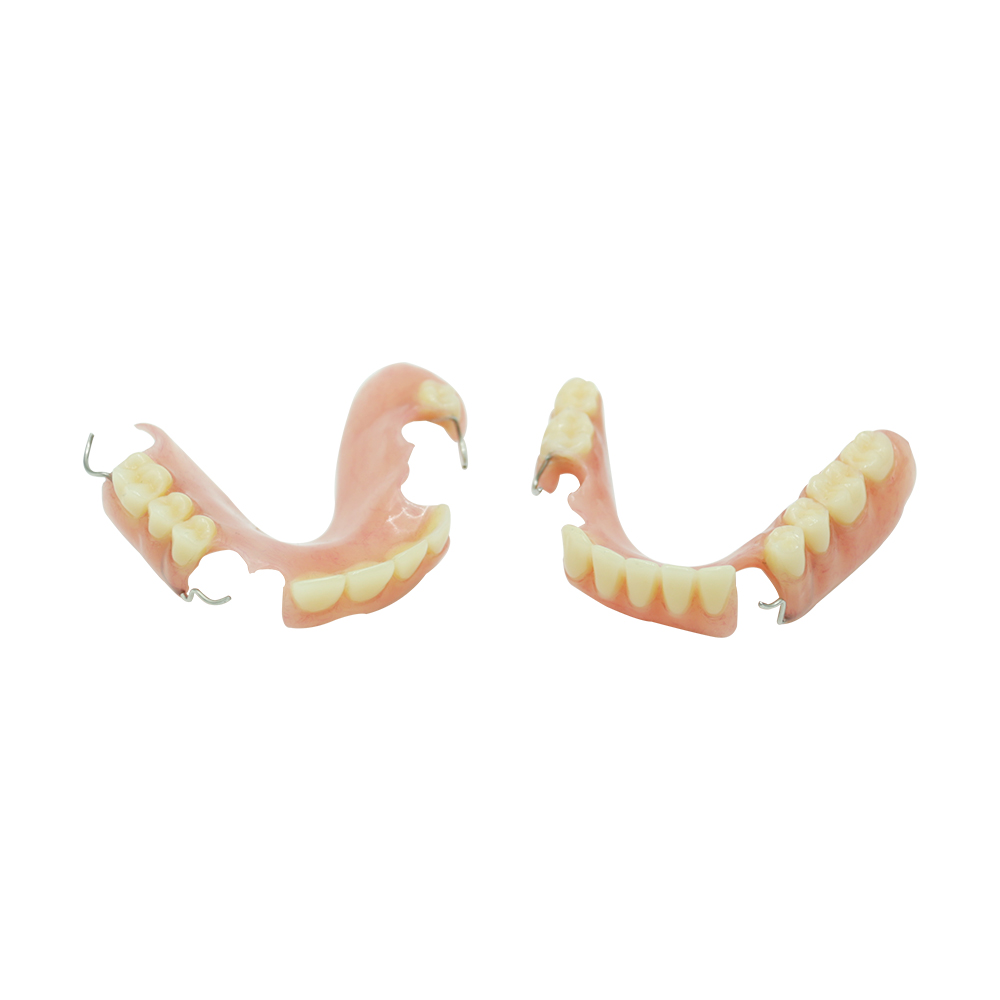
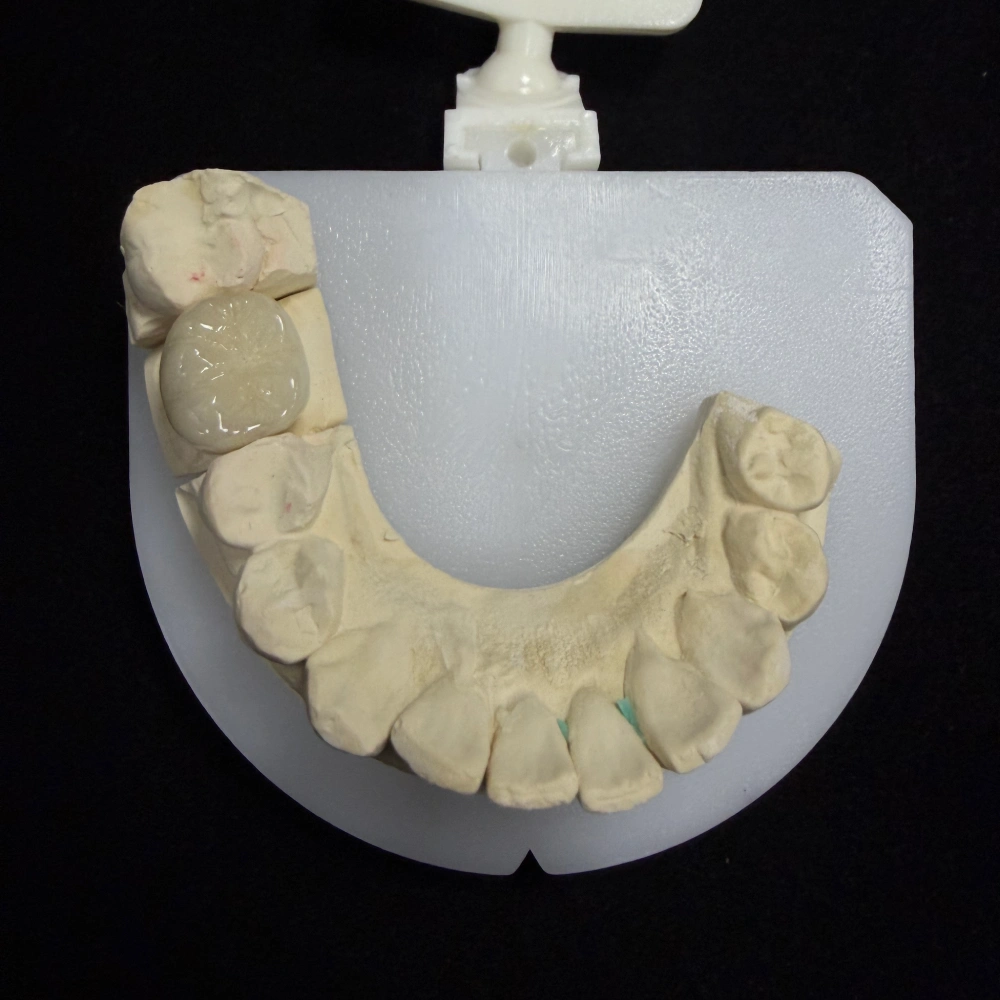
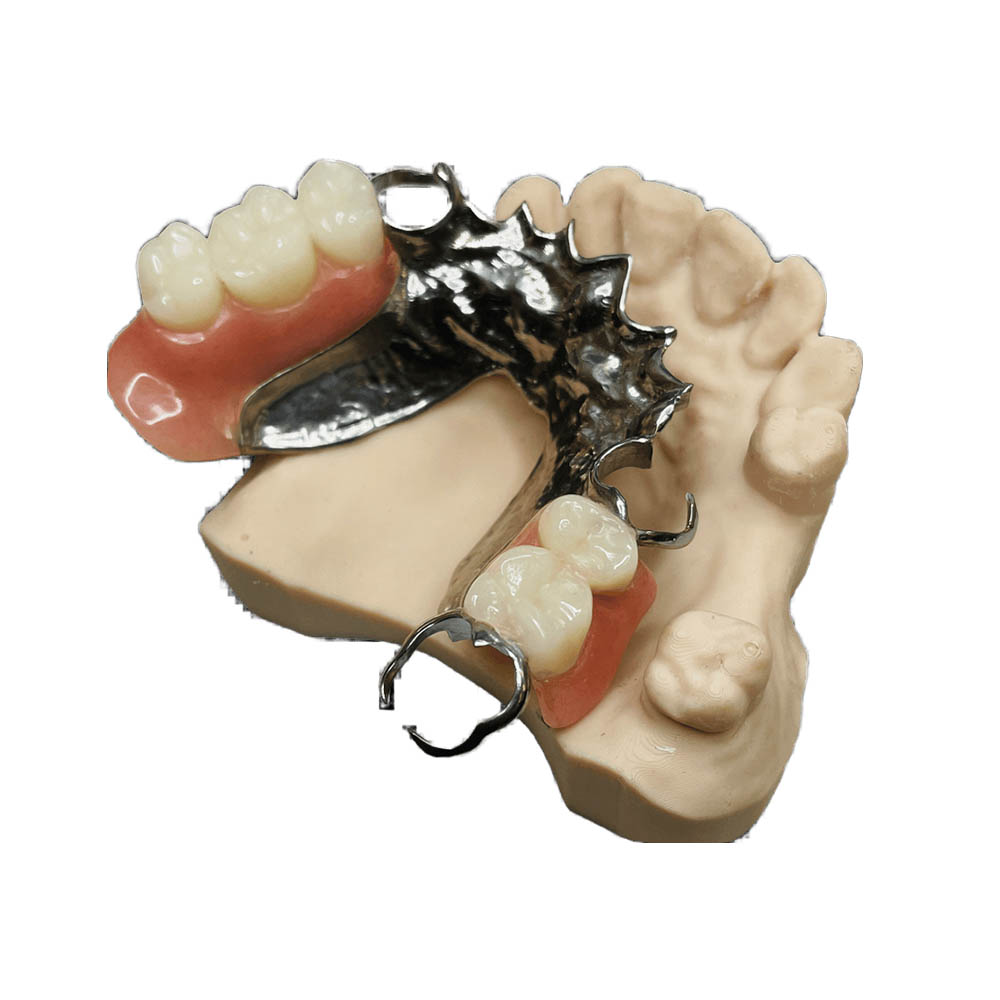
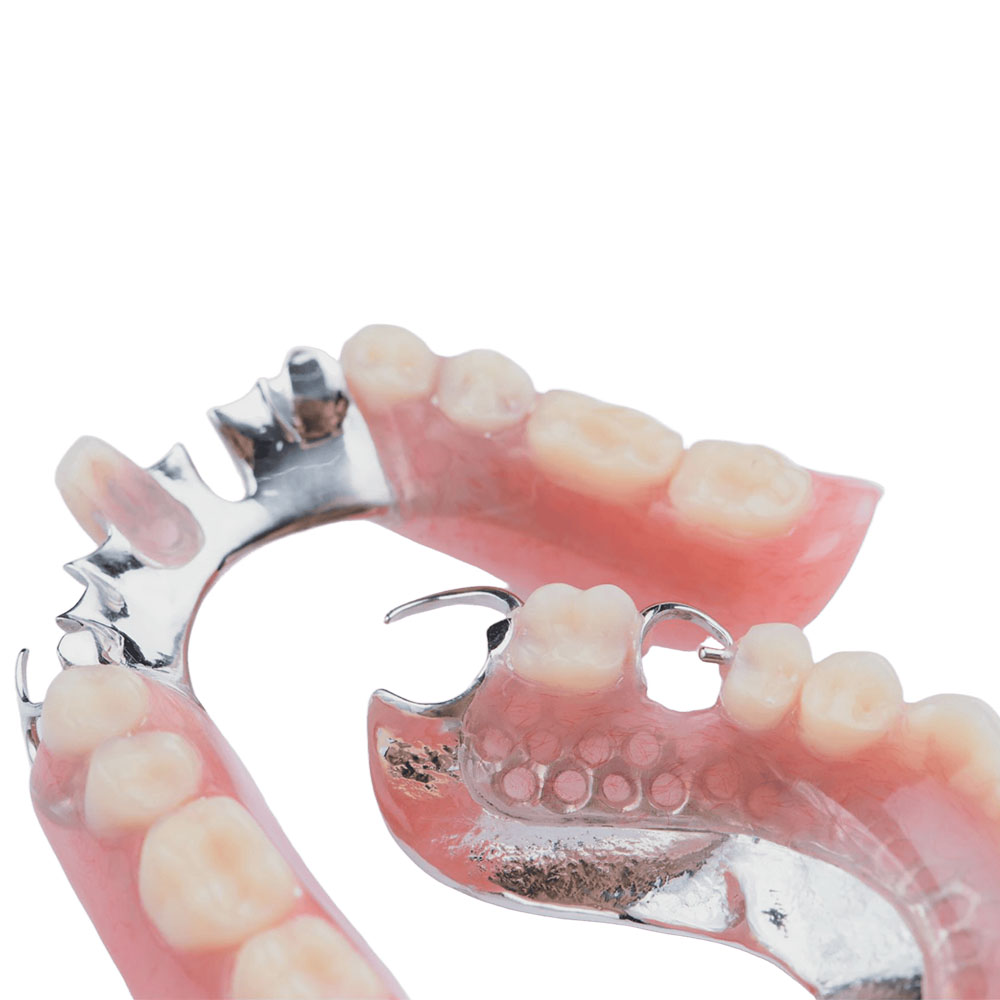
Titanium dentures in our workflow means a laboratory-manufactured removable partial denture (RPD) framework in commercially pure or Grade 5 titanium, finished with an acrylic base and denture teeth. The framework is the metal part that carries the rests, minor connectors and clasps; the arms of the RPD that engage the abutment teeth are clasp-retained, and the framework is tooth-supported through occlusal, cingulum or incisal rests seated on prepared rest seats.
We build these frameworks in three routes — lost-wax casting, CNC milling and laser powder bed fusion (SLM / DMLS) — and pick the route case by case. You send us the case data; we do the design, the metal work, the base, the tooth set-up and the QC, and ship the finished appliance from our facility in Shenzhen or Huizhou.
Titanium Denture Specifications
| Item | Detail |
| Product type | Titanium partial denture framework + acrylic base + denture teeth |
| Framework materials | CP titanium (Grade 2 / Grade 4, per ASTM F67) · Ti-6Al-4V (Grade 5, per ASTM F136) |
| Manufacturing routes | Lost-wax casting · 5-axis CNC milling · Laser powder bed fusion (SLM / DMLS) |
| Base materials | Lucitone 199 (heat-polymerised PMMA, imported) · standard heat-polymerised PMMA · injection-molded resin · 3D-printed base resin |
| Denture teeth | Composite resin teeth · acrylic resin teeth · porcelain teeth (VITA, Ivoclar, Shofu) |
| Attachments (optional) | Locator, ball, bar and other attachment systems on request (paid option) |
| Case inputs accepted | Digital scans (STL) · analogue impressions and models · dual workflow supported |
| Turnaround | Framework-only: typically 5–7 lab days · full RPD: typically 10–14 lab days (case-dependent) |
| Batch traceability | Material brand, batch number, country of origin and certificate of conformance available on request per case |
| Made in | Shenzhen · Huizhou, China (in-house, not outsourced) |
| Warranty | Rework at no charge for lab-side defects — see “How we handle rework” below |
Deliverable is a finished RPD. If you only need the framework, that is fine — we ship it separately for you to complete chairside or in your own lab.
Key Features of Titanium Dentures
Titanium grade, matched to the case — not one grade for everything
We work in three named grades and choose one per case, not by habit.
- CP Grade 2 (ASTM F67): the workhorse for cast and milled RPD major connectors — moderate strength, easy to finish and adjust, and the grade most of the cast CP-Ti RPD framework literature is written on.
- CP Grade 4 (ASTM F67): for higher-load posterior frameworks and larger arches where we want the extra strength but still want the chemistry of unalloyed titanium.
- Ti-6Al-4V, Grade 5 (ASTM F136): for SLM-printed frameworks and any case where the design calls for thinner sections without giving up rigidity. Higher yield and fatigue behaviour than CP grades, with an ELI variant when the case warrants it — see the MDPI overview of Ti alloys for additive dental manufacturing.
Every framework leaves the lab with the material name, ASTM standard, brand and batch number logged on the case sheet. You can request the certificate for any given case.
Lighter than cobalt-chrome — with the numbers, not just the word “lighter”
Titanium density is roughly 4.5 g/cm³ versus cobalt-chrome at roughly 8.3 g/cm³. For the same framework geometry, that is about 45% less mass — a difference confirmed in the comparative mechanical work on Ti vs Co-Cr RPD frameworks. The operator side is what actually cares about that number, because it changes how you seat and how the appliance behaves at rest.
Lower modulus (~110 GPa for Ti vs ~220 GPa for Co-Cr) also changes clasp behaviour and major-connector rigidity. We flag this at the design stage — the reciprocation, undercut and connector cross-section have to be drawn for titanium, not copy-pasted from a Co-Cr design.
Non-magnetic — dentist-relevant, not a marketing line
Titanium is non-ferromagnetic. That matters when a dentist is coordinating with a physician or radiologist on head-and-neck imaging: a titanium RPD is generally left in place for CBCT and produces smaller streak artefacts on CT than higher-Z metals; on MRI it does not migrate and produces limited local susceptibility artefact compared to cobalt-chrome. Behaviour still depends on the scanner and sequence — the review of metal artefact behaviour in dental imaging lays out the trade-offs — and the imaging team makes the final call.
Nickel-free by design
CP titanium and Ti-6Al-4V contain no nickel and no beryllium. For cases where the prescribing dentist has flagged a nickel-sensitive history, we default to CP Grade 4 — consistent with the published overview of titanium biocompatibility in dentistry — and avoid alloys of concern in solder joints and clasp adjustments.
Fit that is checked, not claimed
Every framework is fit-checked on the working cast against the digital design before it leaves QC. On the appliance we run:
- Occlusal check: centric, protrusive and lateral — early contacts eliminated.
- Base extension and tissue-side contact: within the outlined design, no rocking on the model.
- Clasp arms on the abutments: seating path free, engagement elastic, no interference with occlusion.
- Overall polish: no scratches, no burrs, no residual investment.
Titanium in the mouth is a passive material — the surface oxide and corrosion behaviour of dental titanium is what keeps it stable long-term. We do not compromise that surface with abrasive shortcut finishing.
Why Choose Our Lab for Titanium Denture Frameworks?
We are the manufacturer, not a middleman. ASD Dental Lab was founded in 2012 and runs a full production line in Shenzhen and Huizhou. Cases are not outsourced — CAD, CAM, casting, printing, base work, tooth set-up and QC all happen inside our facility.
A dedicated removable department of about 55 technicians. The removable line runs alongside CAD (~100), milling (~70), implant (~80), ceramic and metal (~70) and QC (~25). Roughly 50 trained backup technicians handle peak season without slipping delivery.
Real capacity numbers. In normal season we ship roughly 4,000 removable cases per month; in peak season roughly 6,500. If your practice or lab wants to move volume titanium framework work our way, we can absorb it without dropping timelines.
Track record with labs, clinics and dentists worldwide. We have shipped work to 50+ dental laboratories, 100+ dental clinics and 400+ individual dentists, mainly across the United States and Western Europe (Netherlands, Germany, France, Belgium, Austria, the UK, Luxembourg, Switzerland).
You can visit the factory. Shenzhen and Huizhou both host on-site tours; if the trip is not practical, we run video factory audits and walk you through the line live — production floor, QC bench, packing.
Batch and origin on file for every case. Framework metal brand, batch, origin and certificate of conformance are logged per case and available on request. That is the level dentists usually get quoted only for implant parts; we do it on the framework too.
When rework is on us, it is on us. For lab-side issues on a removable case — seating problems, warping, ill-fitting clasps, poor occlusion, unsatisfactory gum shade — we redo the work at our cost. The framework goes back on the model, gets diagnosed and either adjusted or remade.
Titanium Partial Dentures — Where They Fit
A titanium partial denture is the same physical product; the term is used by many prescribing offices to signal the RPD form. The clinical decision to prescribe rests with the dentist, and different case profiles fit different framework materials:
- Longer edentulous spans, distal-extension cases (Kennedy I / II): titanium’s lower modulus is worth planning for; connector cross-sections are drawn slightly wider than a comparable Co-Cr design.
- Interim / transitional RPDs: we typically recommend a printed or milled titanium framework when the plan is to convert to implants later and the practice wants a metal framework that plays well with imaging.
- Cases with a documented nickel-sensitivity history in the prescription: default to CP-Ti in the framework and in any solder joints.
- High occlusal load in the posterior: we may switch from CP Grade 2 to CP Grade 4 or to milled Ti-6Al-4V for stiffness — flagged in the design proof before we cut metal.
Every prescription is reviewed at design; if the material called out on the Rx is not a good fit for the case, we send back a design proof with a note rather than a silent substitution.
Titanium Denture Plate — A Note on the Terminology
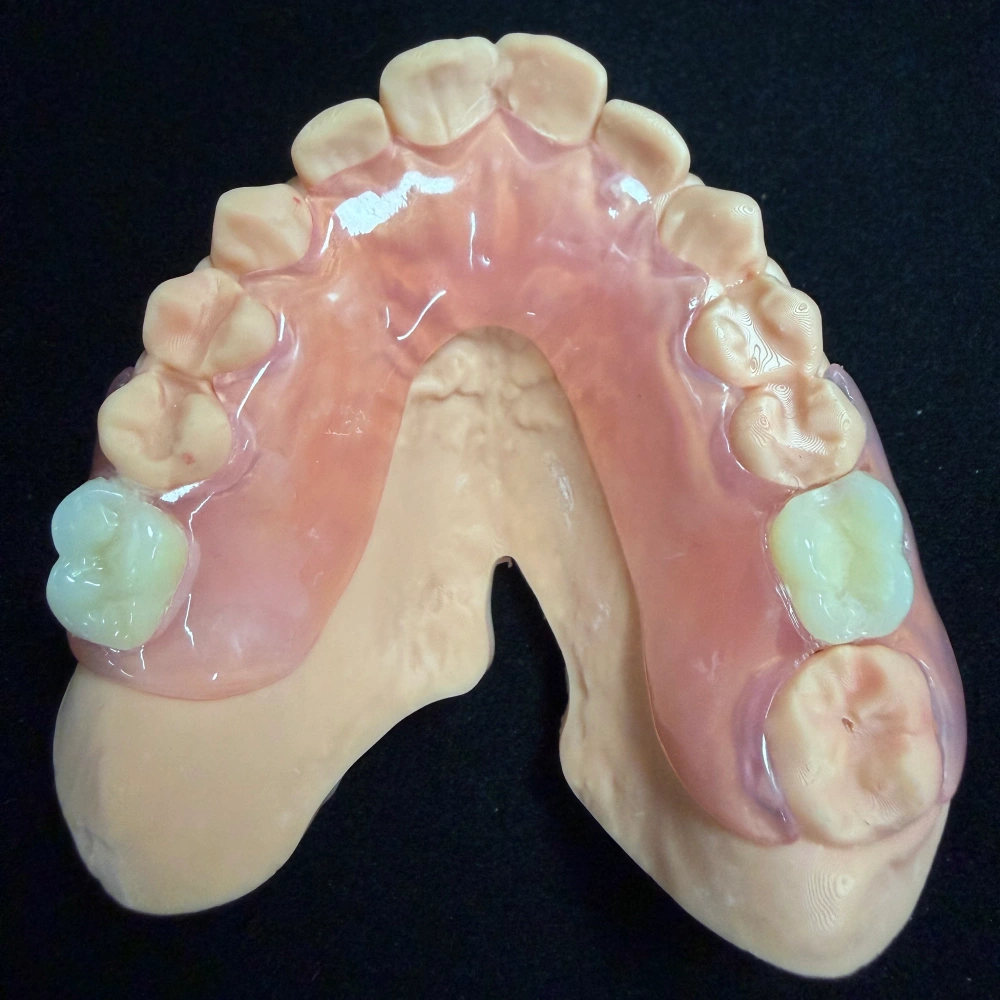
Prescriptions sometimes come in written as titanium denture plate. In the RPD context, “plate” refers to the major connector — the palatal plate on a maxillary case or the lingual plate / bar on a mandibular case. We build both:
- Maxillary: palatal strap, anterior-posterior palatal bar, complete palatal plate or U-shaped connector — chosen from the survey and design brief.
- Mandibular: lingual bar or lingual plate, sized from the floor-of-mouth measurement and the periodontal status of the anterior teeth.
Section thickness and cross-section are drawn for titanium’s modulus — as laid out in the design study on RPD major connectors — not copy-pasted from a Co-Cr template. The design is sent back to the prescribing dentist for approval before metal work starts.
If the prescription actually refers to something else — a reconstruction plate, an implant bar or a forensic marker — we flag that on receipt and route the case to the correct product line. We will not silently reinterpret an Rx.
Our manufacturing workflow
The removable line is the same nine-stage workflow we run for every case. What changes per case is the framework route (cast, milled or printed) and the base method (heat polymerisation, injection or printed).
1. Case intake and review
Digital scans (STL) or analogue models come in. Our case coordination team logs the Rx, checks that the design brief, bite records, shade information and any attachment requirements are complete, and assigns a case number that follows the job through every stage.
2. CAD design and survey
The framework is designed digitally. Rest seats, minor connectors, major connector cross-section, clasp type (I-bar, C-clasp, etc.), reciprocation, and network area for resin retention are laid out with the survey line and undercut analysis. A design proof (screenshots + brief note) goes back for dentist approval before any metal is committed — the practice aligns with the accuracy data reported in the CAD-CAM RPD design accuracy study.
3. Framework production — three routes
We pick the route from case geometry, span length, mechanical demand and the prescribing lab’s preference:
- Lost-wax casting (CP titanium): vacuum arc-melting into a phosphate-bonded investment, controlled cooling. The classical route with the deepest clinical track record — see the cast Ti RPD framework accuracy study for the reference numbers.
- 5-axis CNC milling (CP-Ti or Ti-6Al-4V): milled from a pre-sintered puck; clean surface finish and repeatable geometry when the digital design is dialled in.
- Laser powder bed fusion / SLM (Ti-6Al-4V or CP-Ti): built layer-wise from the STL, supports removed by wire cutting / machining, followed by de-stressing and ageing per material spec, then surface finishing — the process window matches the SLM titanium prosthesis performance review.
4. Framework post-processing
Support removal, stress-relief and ageing per the alloy’s material spec, sandblasting, ultrasonic cleaning, framework fit on the master cast. Framework thickness is checked with callipers at defined points; internal porosity and cracks are checked visually against a checklist and, where warranted, with radiographic inspection.
5. Wax-up, tooth set-up and try-in
Denture teeth are selected against the prescription — mould, shade, and where relevant the reference photo the dentist supplied. Wax try-in is available: we can ship the case at the try-in stage for a chairside verification of aesthetics, occlusion, VDO, phonetics and denture stability before we commit to the final acrylic.
6. Packing and processing (acrylic base)
Four base routes, chosen by case:
- Heat-polymerised PMMA: the classical route, stepped water-bath polymerisation, cooled slowly to reduce shrinkage and tooth movement.
- Injection-moulded (Lucitone 199 or standard heat-polymerised): tighter dimensional control on the base and better tissue-side fit — our default when fit is critical.
- Auto-polymerised PMMA: reserved for repairs, additions and relines.
- 3D-printed base resin: for digital workflows where the whole case is print-based.
7. Polish and finishing
Coarse to fine, then buff — with the tissue-side masked, edges preserved. Framework metal is polished separately to a mirror finish before combining with the base.
8. QC — 100% inspection
Every removable case is checked on:
- Fit and seating on the master cast (rocking, tilt, path).
- Occlusion — centric, protrusive, lateral.
- Framework margins, rest-seat seating, clasp elasticity.
- Base extension, tissue-side smoothness, no bubbles or voids.
- Aesthetics — tooth arrangement, shade, gum tinting where prescribed.
Rejected cases loop back to the responsible station, are re-checked, and only leave QC after the check-list is clean.
9. Packing, documentation and shipment
The case ships with the working cast (if returned by the prescribing office), the approved design proof and the material trace log if you requested it. Trackable international shipping from Shenzhen.
How we work with you — cooperation flow
We are set up for repeat prescribing, not one-off transactions.
- Send a test case. For new accounts we usually start with one or two cases so your team can see the framework, the fit and the finish before we talk about volume.
- Choose your channel. Digital scans are welcome; analogue impressions and models are equally welcome. Our case coordination team handles both formats on the same line.
- Approve the design proof. Every RPD design goes back to you before metal work starts. Turnaround on the proof is normally same-day or next-day depending on time zone.
- Framework or full RPD. You can order the finished RPD, or the framework only and finish the case in your own lab.
- Audit us any time. Visit the Shenzhen or Huizhou facility, or run a live video audit of the removable line and QC bench. We keep an audit slot open on request.
- Ask for the certificate. For any framework we can pull the material name, ASTM standard, brand, batch number, country of origin and certificate of conformance from the case file.
- Rework path is defined. If a lab-side defect turns up chairside, ship it back with a note. We diagnose, fix or remake at our cost. The categories are listed in our written policy: framework not seating, warping, ill-fitting clasps, uneven occlusion, unsatisfactory gum shade.
Regulatory and compliance context
We ship titanium framework work into markets — including the United States and Western Europe — that regulate custom dental appliances. The framework itself is not an implantable device; it is a case-specific external prosthesis fabricated to a licensed dentist’s prescription. In the United States, custom prosthetic dental appliances of this type fall under 21 CFR 872.3600 (partial denture) and the framework metal is a listed dental base metal under 21 CFR 872.3060. Custom devices produced to an individual dentist’s order are addressed under the custom-device provisions of the Federal Food, Drug and Cosmetic Act.
We do not make regulatory claims on the finished appliance itself — that responsibility sits with the prescribing dentist and, where applicable, with the distributor. What we do provide, per case:
- Material name and ASTM standard (F67 for CP-Ti; F136 for Ti-6Al-4V).
- Framework metal brand, batch number and country of origin.
- Certificate of conformance for the framework metal.
- Design records and QC records held on file for the case.
If your practice, DSO or distributing lab has a specific documentation checklist — FDA Establishment Registration status of the manufacturer, MDR technical documentation for EU-bound cases, custom-device notifications — send the checklist with the case brief; our compliance contact will respond in writing.
Titanium Dentures FAQs
Which titanium grade do you use for RPD frameworks?
Three, chosen per case: CP Grade 2 (ASTM F67) for standard cast and milled frameworks, CP Grade 4 (ASTM F67) for higher-load posterior work, and Ti-6Al-4V, Grade 5 (ASTM F136) for milled or SLM frameworks that need thinner sections without losing rigidity. The grade for your case is on the design proof before metal is committed.
Cast, milled or 3D-printed — how do you pick?
Case geometry decides. Long spans with heavy clasp reciprocation and cases where a classical CP-Ti chemistry is preferred go to casting. Cases with a clean STL and tight fit requirements go to 5-axis CNC milling. Cases with complex internal geometry or thin sections in Ti-6Al-4V go to laser powder bed fusion. We can also do a mixed route — printed framework, injection-moulded base — where it fits the case.
Can you send the material certificate for a specific case?
Yes. Framework metal name, brand, batch number, country of origin and certificate of conformance are logged per case and can be issued on request. Ask for it at the design-proof stage and it ships with the case; ask later and we pull it from the case file.
Turnaround for a full RPD?
5–7 lab days for a framework only, 10–14 lab days for a complete RPD from a clean case. Digital workflows shave 1–2 days off the analogue path because we do not have to pour a working model or mail back an intermediate cast. Peak-season slots are protected by our backup technician pool — we do not slip published timelines by more than 1–2 lab days.
Do you accept both digital and analogue impressions?
Both. Digital (STL from any major scanner) is our fastest path. Analogue impressions and models are handled on the same line — we pour, scan, and continue in the digital design flow. Mixed workflows work too: some offices scan the arch and mail a wax rim for the bite registration; that is fine.
Can you handle Locator, ball or bar attachments on a titanium framework?
Yes, we source the specified attachment system and integrate it into the framework design. Locator is a brand of attachment; specify the model and dimensions in the prescription and we order the matching part. Attachments are a paid line item.
Is titanium OK for imaging?
Titanium is non-ferromagnetic and produces smaller streak artefacts on CT than higher-Z metals; on MRI it does not migrate and shows limited local susceptibility artefact compared with cobalt-chrome. The imaging team still calls the shot per scanner and per sequence.
What if the case needs a rework?
Ship it back with a note. Our written lab-side defect list for removable work covers seating problems, warping, ill-fitting clasps, uneven occlusion and unsatisfactory gum shade — those are on us. We diagnose, adjust or remake, and log the outcome against the case number. Repairs, additions and reline on cases returning from the chair are also part of the removable line.
Request a quote
Tell us the case profile — arch, Kennedy classification, number of abutments, attachment plans, whether you want the framework only or the full RPD — and we come back with a quote, a suggested framework route and a lead-time slot.
- Send a case brief: Contact form
- Request a fee schedule: available to verified dental practices, labs and DSOs on inquiry.
- Book a factory tour or video audit: Shenzhen or Huizhou, weekdays.
Experience faster turnaround times with our cutting-edge technology
Recommended