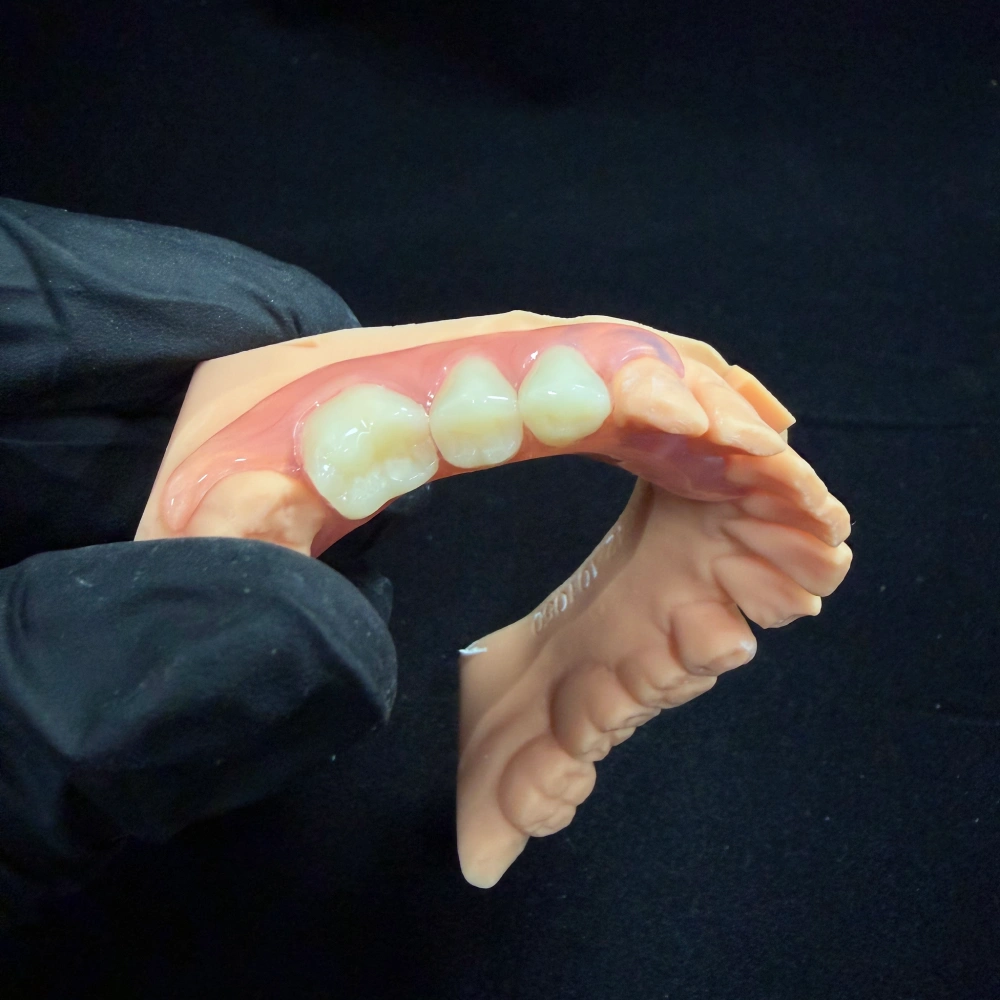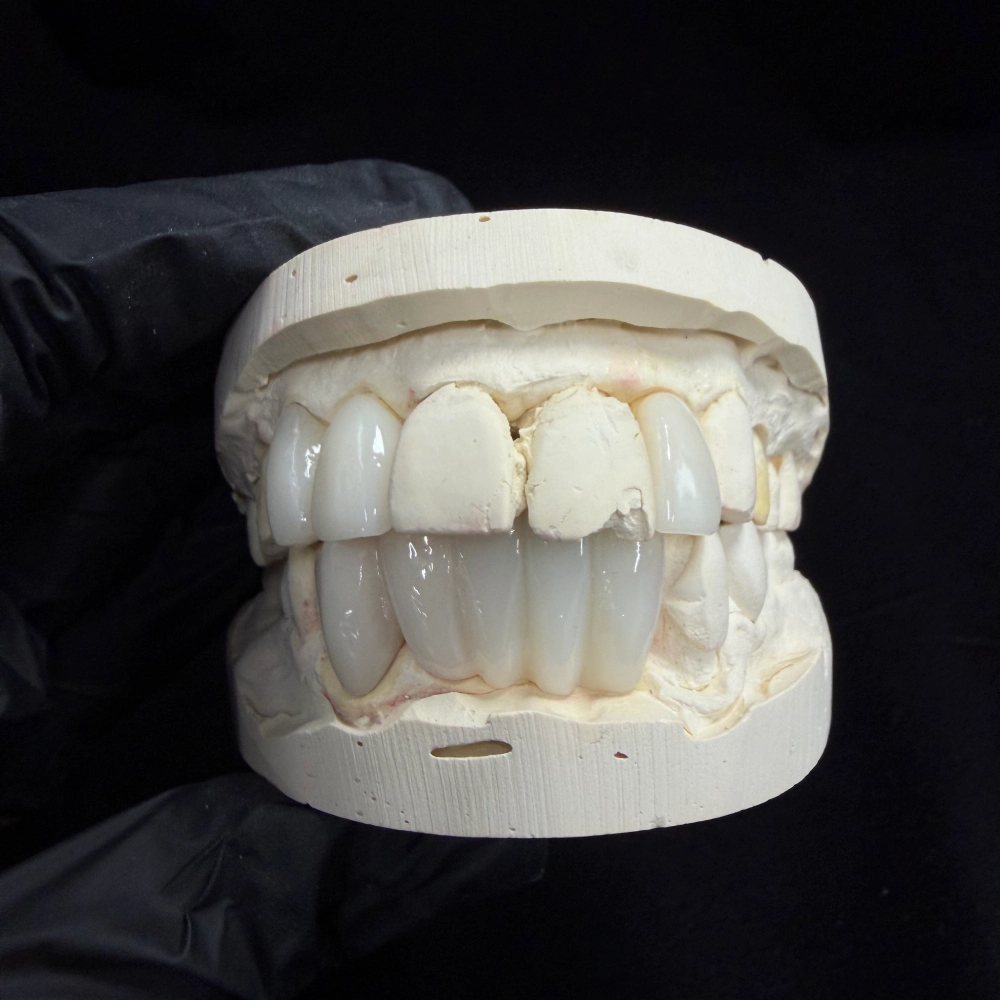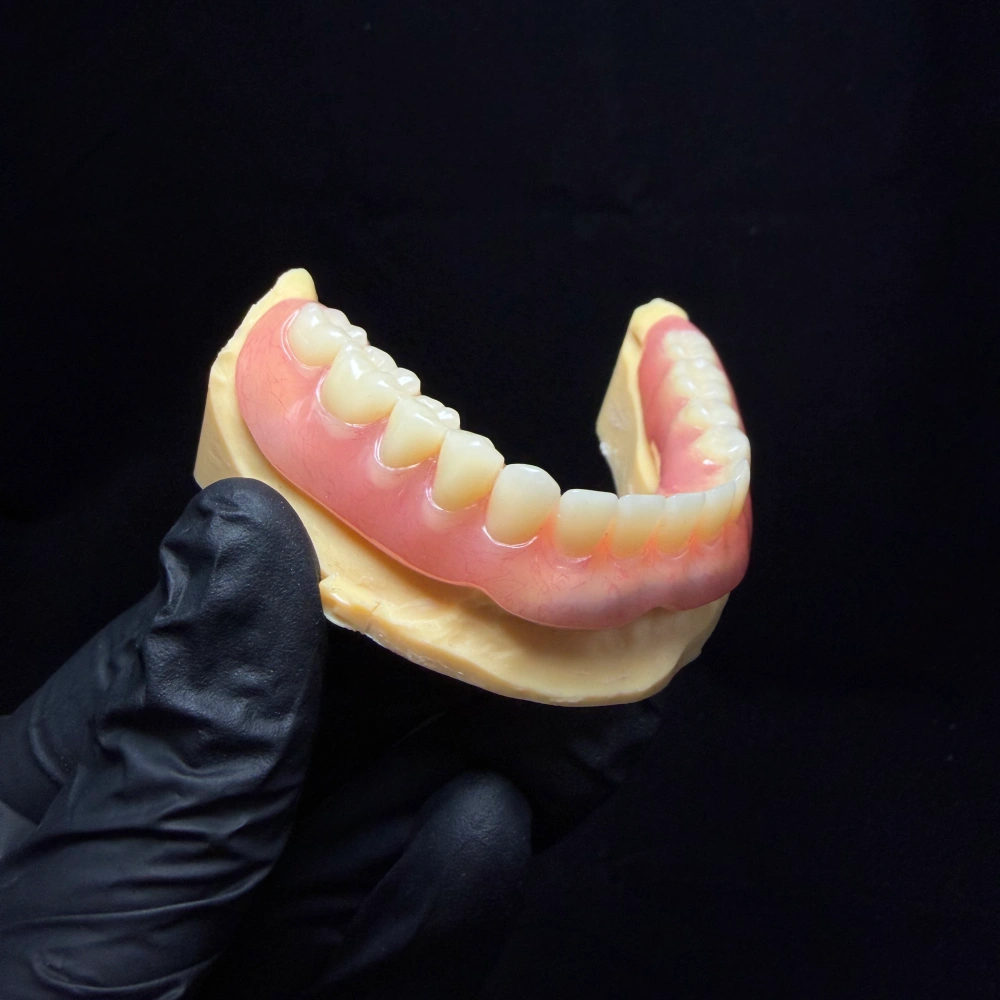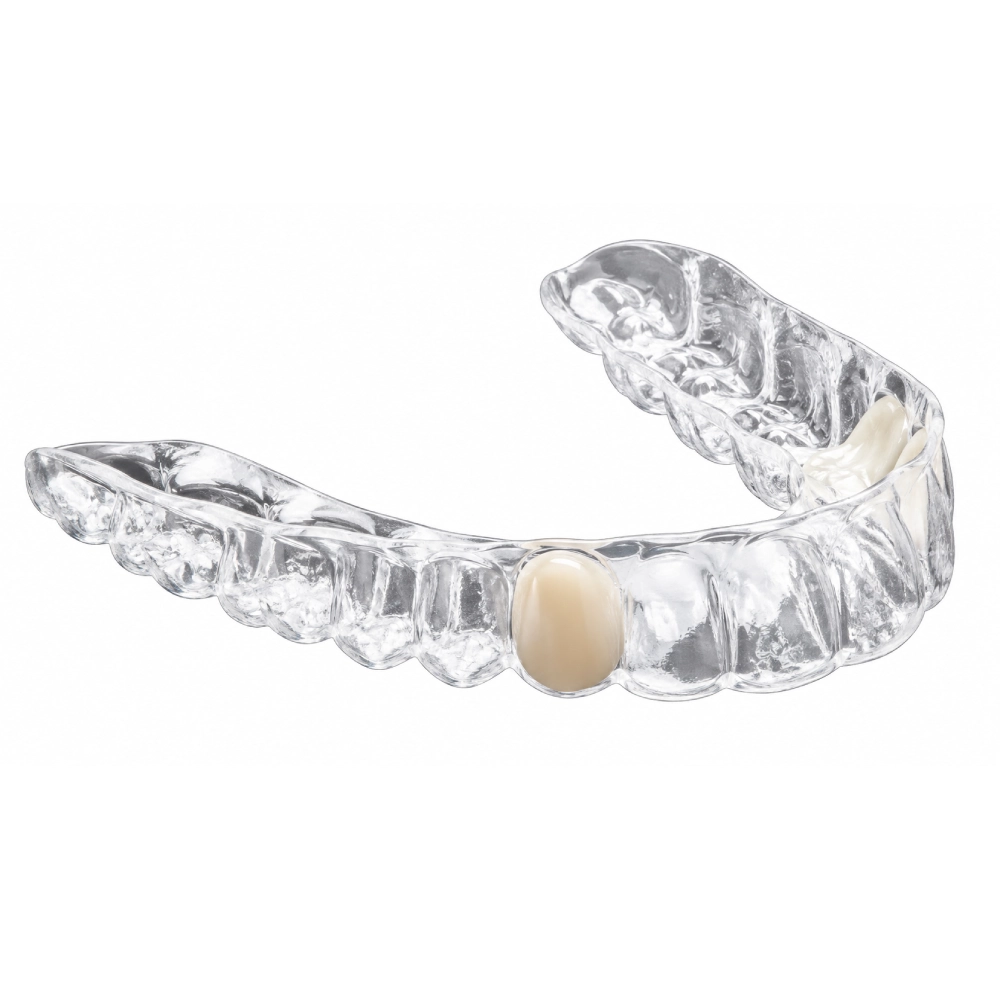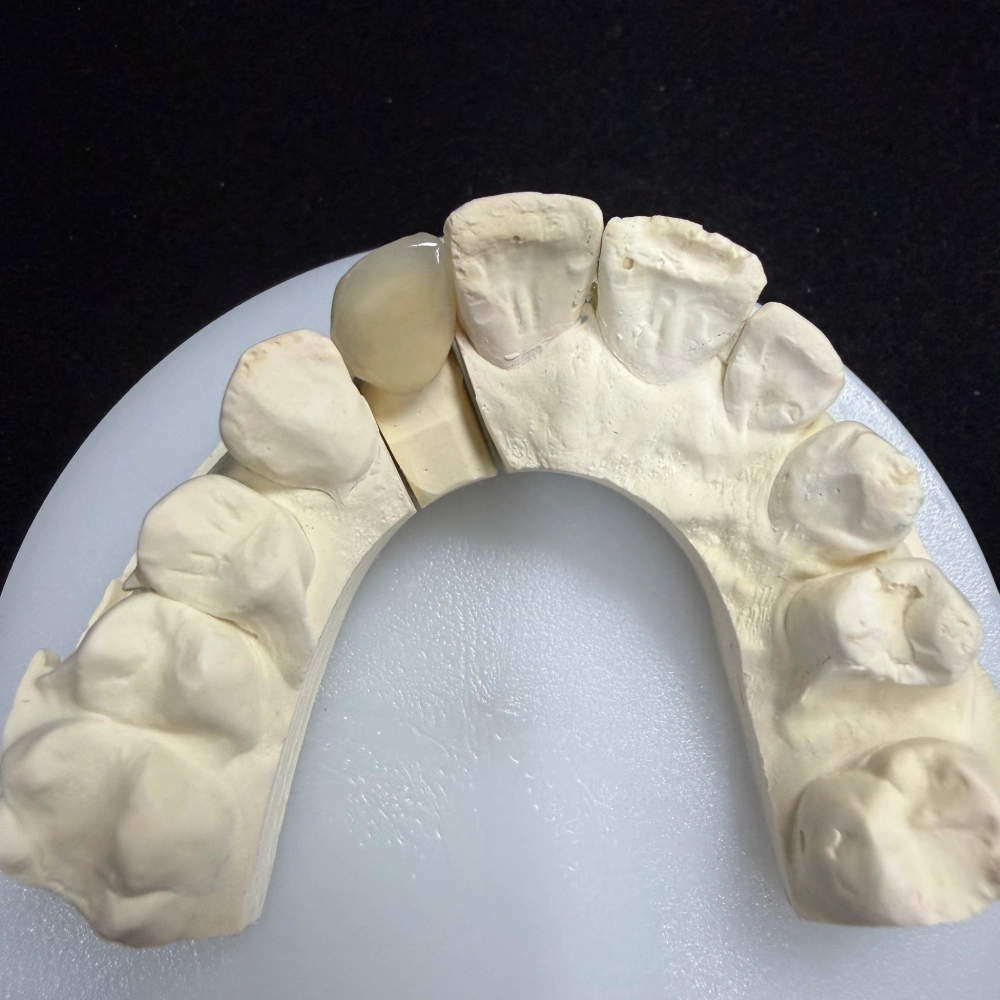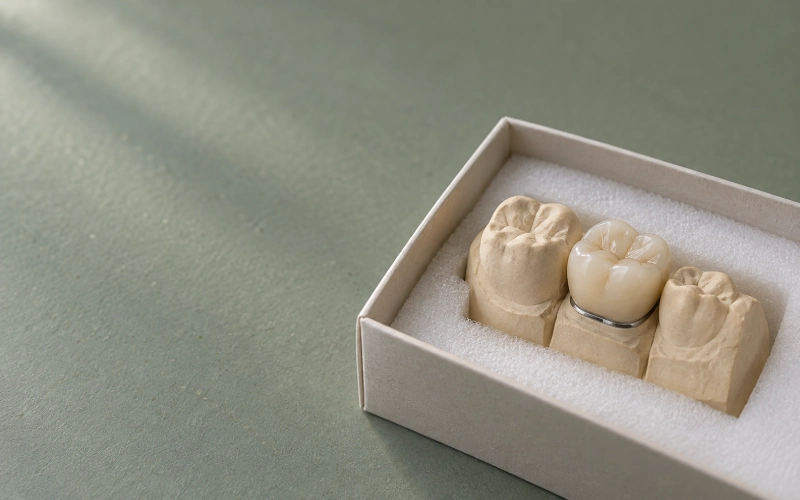
PFM CoCr Crown — Porcelain-Fused-to-Metal with Cobalt-Chromium Coping


Want a reliable PFM crown for back teeth, long-span bridges, or implant superstructures where strength and cost-effectiveness matter most? Our PFM CoCr Crown pairs a high-rigidity cobalt-chromium coping with a layered feldspathic porcelain veneer — built in our own Shenzhen/Huizhou factory since 2012, with full digital workflow and metal-try-in available.
Primary use cases: posterior single crowns and bridges, implant-supported crowns, long-span FDPs, bruxism and limited-clearance cases.
What Is a PFM CoCr Crown?
A PFM (Porcelain-Fused-to-Metal) crown is a two-layer dental restoration: a metal coping on the inside, porcelain layered and fired over it on the outside. CoCr (Cobalt-Chromium) is the alloy used for that inner coping in our PFM line.
Here’s what goes into CoCr, and why it matters:
- Composition. Cobalt is the principal element, with chromium around 25–30% providing oxidation and corrosion resistance, plus small additions of molybdenum, tungsten, silicon, manganese, carbon and sometimes nitrogen. As a base-metal dental alloy, CoCr typically contains at least 75% base-metal elements. Because every batch can vary, we work from the manufacturer’s certificate rather than generic numbers.
- Stiffness and hardness. CoCr is one of the hardest dental casting alloys, with a Young’s modulus substantially higher than precious alloys. That rigidity is exactly why the coping resists flexing under porcelain — and why the same hardness makes finishing and polishing more demanding than softer alloys.
- Melting range. Roughly 1,300–1,400 °C, requiring dedicated casting equipment and phosphate-bonded investment.
- Corrosion behaviour. Generally good corrosion resistance, provided the chromium-oxide layer forms properly and the surface is well polished. Ion release increases when the surface is rough, polishing is poor, pH is low, or galvanic couples with other metals are present.
- Metal-ceramic bonding. Depends on controlled oxidation, the oxide layer, and a coefficient-of-thermal-expansion (CTE) match with the chosen porcelain. Mismatched or excessive oxide causes debonding or porcelain discolouration.
In plain terms: a CoCr coping gives you high-load rigour stiffness, thin framework geometry, and a price point well below precious alloys — all backed by a long porcelain-metal clinical record.
Why Choose This Product
Most of the time, the lab you trust for one-off cases isn’t the lab you’d trust for a steady stream of PFM work. Here’s why clinics and partner labs stick with us:
- Factory-direct manufacturing, no middlemen. We are a direct dental laboratory and full-service dental lab — not a trading company or broker — founded in 2012. Every case stays in-house from data receipt to packaging.
- ~460-person in-house team. About 100 CAD designers, 70 milling operators, 80 implant specialists, 70 ceramic & metal technicians, 55 removable department staff, 25 dedicated QC, plus administration, sales, and a 40-person case-coordination team. Roughly 50 trained backup workers cover peak season. PFM and metal work is one of our core production streams, not a side line.
- Proven international track record. We’ve served more than 50 dental laboratories, more than 100 dental clinics, and over 400 dentists, with primary markets in the United States, Netherlands, Germany, France, Belgium, Austria, the United Kingdom, Luxembourg, Switzerland, and other European markets.
- Ni-free, Be-free CoCr as standard. Be (beryllium) raises occupational and biocompatibility concerns and is avoided in many markets. Our CoCr alloys are nickel-free and beryllium-free; composition certificate available on request (see Quality Control and Certifications).
- Metal try-in before final porcelain. When you want risk reduction on a tricky case, we can ship the metal coping first for you to verify fit, contacts, and margin before the porcelain layer is applied.
- English-language technical support. Every account gets a dedicated manager plus a case-coordination team; we run technical case meetings, compliance-document conversations and design reviews in English.
- Cumulative certifications to back it. We hold valid FDA registration, EU MDR custom-device notification, MHRA listing, and ISO 13485 quality-system certification. Material side carries CE and ISO 1993 documentation.
We’re a full-service dental lab — which means design, milling, porcelain layering, glazing, polishing, repair work and re-contouring all stay under one roof, with one QC chain.
Indications and Clinical Use
PFM CoCr is a deliberate choice, not a fallback. It shines in a specific set of cases:
- Posterior single crowns and bridges where occlusal load is high and aesthetic demand is moderate.
- Long-span fixed dental prostheses (FDPs) and large multi-unit frameworks, where CoCr’s stiffness is an advantage.
- Implant-supported crowns and frameworks, including screw-retained and cement-retained designs — including titanium custom abutment cases where the metal coping masks the abutment shade.
- Full-arch or segmented frameworks that act as the substructure for veneered prostheses.
- Documented nickel allergy patients, when a Ni-free and Be-free CoCr is used.
- Cost-conscious cases where a metal-ceramic restoration is clinically sufficient.
- Bruxers and limited-clearance cases where metal occlusal surfaces or thin copings matter.
How to Order and Start a Case
You can send us digital scans or physical impressions — we support both. For PFM CoCr cases, we just need:
- Prescription with: alloy (CoCr, Ni-free / Be-free), fabrication route (cast / milled / SLM), margin design (metal collar / porcelain butt / porcelain facial), occlusal surface (porcelain or metal), shade, and any implant-abutment specs.
- Working model or scan, opposing model or scan, bite registration.
- For implant cases: implant brand, platform, diameter, connection, scanbody info, and CAD library.
File formats we accept
STL, PLY (with colour), OBJ, DCM (3Shape native), and CAD-native design files. STL under 150 MB per arch, PLY under 300 MB. Use the same CaseID prefix across all files, no Chinese characters in filenames. We support TRIOS, Medit, iTero, CEREC (Sirona), Shining3D Aoralscan, Planmeca, and any scanner that exports open files.
Scan quality — what we check
We check edge clarity at the prep margin (no blur, no soft-tissue coverage), holes in the scan, stitching errors, and bite-registration accuracy. If we find issues, we notify you within one business day and let you know what to rescan. We routinely run digital measurement, microscope inspection, and scan-vs-design comparison.
What you’ll need to send for a PFM CoCr case
- Working impression or intra-oral scan of the prepared tooth and adjacent teeth.
- Opposing-arch model or scan.
- Bite registration — a single centric record for routine cases; extra bite records for long-span or implant cases.
- Shade information — shade tab, stump shade where relevant, photos if it’s a visible zone.
- Prescription — alloy (CoCr, Ni-free/Be-free), fabrication route, margin design, occlusal surface, shading, characterization, and notes on the opposing material, occlusion scheme, and any bruxism or night-guard info.
- For implant cases — implant brand, platform, diameter, connection type, scanbody brand and model, CAD library name.
Opening an account or running a test case
We accept single-case test orders and are happy to start with one. We don’t run long-term single-case accounts because international shipping on a single case loses money — we work with clients who can give us a steady flow. We do serve small clinics (a weekly bundle), group practices, DSOs, and partner labs. Talk to us about your volume before we open the account.
Production Workflow and Turnaround
Here’s the lifecycle of a typical PFM CoCr case at our facility:
1. Case receipt and data check
We confirm the file or physical impression on arrival, run a completeness check, and notify you if anything needs to be redone — standard turnaround is the same day-onward flow covered in What Happens Before Production. If something is missing, production is paused until you reply.
2. CAD design
A copedent CAD design module does the coping design, margin, cement space, connector design, and emergence profile. Designs are produced in-house using professional dental CAD software.
3. CAM milling or casting or 3D printing
We run a dedicated copedent milling line for digital PFM cases, casting for lost-wax, and an SLM/DMLS line for additively manufactured frameworks.
4. Sintering or casting
For zirconia-copied cases, we use a copedent zirconia sintering furnace. For PFM, we either cast the CoCr or run the milling route through finishing.
5. Hand finishing, porcelain layering, glazing
Technicians with ceramic & metal skills handle layering, dyeing, glazing, and hand-finishing. Stump shade, characterization, micro-texture, incisal translucency — all hand-done.
6. Multi-stage QC
Three QC gates: ①incoming material and prescription check, ②in-process spot checks, ③final release by an independent QC staffer. Complex implant, full-arch and aesthetic cases get an extra specialist review.
7. Packaging and shipment
Final restoration is cleaned and disinfected before packing. Each shipment includes the case-processing list (order number, case detail), the processing prescription, and a commercial invoice for customs.
Turnaround
- Rush case turnaround: 3–5 working days from receipt of an order to shipment, once production starts.
- Cases with approved design or full materials: turnaround starts when we have the complete data and you have approved the design — the clock doesn’t run through waiting-on-you time.
- Working days, not calendar days. Chinese statutory holidays and weekends are not scheduled production days.
- Rush cases under 10/month are free. No upcharge for low-volume rush work, regardless of material or case type.
Rush and exception handling
If a rush case can’t be done in the rush window, we treat it as an extra-rush case to keep delays small. When production issues, equipment failure, or material shortages occur, we proactively notify you with reason, estimated delay, and a workaround — we don’t wait until the original ship date to surface the problem.
Tracking and notifications
We send notifications at every key milestone — case receipt, design complete, production complete, shipment — with the courier tracking number attached.
Quality Control and Certifications
Here’s how we make sure the restoration that lands in your hands does what it should.
Three-stage QC
- Pre-production check. Material receipt, prescription completeness, scan integrity, file and format checks.
- In-process checks. Spot audits during milling, casting, sintering, and finishing.
- Final release. Independent QC staffer inspects: edge fit and uniformity, internal-surface quality (no burrs, no residual nodules, no porosity), contacts, occlusion (centric, protrusive, lateral), morphology, contour, aesthetics, polish, screw channels and implant interfaces, no cracks or chips. The final QC staffer is independent of the production technician.
Pre-delivery inspection, detailed
We verify edge gap uniformity, no lifted edges or gaps, internal surface free of burrs and porosity, contact tightness and seating verified, occlusion (centric, protrusive, lateral) cleared of premature contacts, morphology, contour, aesthetics, plus screw channels and implant connections. Everything is reconciled against the confirmed prescription and design.
Equipment and measurement
Microscopy, scan-over-scan comparison, and digital measurement are used to verify edge fit and dimensional accuracy, not just visual inspection. Every restoration is reconciled against the confirmed prescription.
Material traceability
We keep batch numbers, brand, country of origin, and compliance certificates for every material used, traceable to a specific case via the unique case ID. Material and biocompatibility documentation is available on request.
Certifications and regulatory coverage
- FDA registration (United States).
- EU MDR custom-device notification for Class IIa custom dental devices under MDR Annex XIII (covers crowns, fixed bridges, inlays, veneers, removable partial and complete dentures, custom implant superstructures).
- MHRA listing (United Kingdom).
- ISO 13485 quality-system certification (lab side).
- Material-side compliance: CE-marked materials, ISO 1993 documentation.
The factory also handles customs paperwork, custom declarations, and EUDAMED support for European shipments.
Audits and inspections
Independent third-party audits, factory visits, video factory audits, and production-line tours are available on request. We can sign NDAs, quality agreements, supplier agreements, data-processing agreements, and confidentiality agreements.
Rework policy
Most rework is free. Examples of rework we cover at no charge: edge gap, contact gap, high occlusion, crown not seating, colour inaccurate, visible aesthetic defects, poor form. Initial rough edges with unclear models after you have been informed in advance and you still ask us to push the case through, that rework is billable. We analyse the rework cause before redoing — we don’t blindly redo. Redo cases follow the same rush window outlined in Turnaround.
Confidentiality and data handling
Original patient case files, scans, and customer-provided materials belong to the clinic or customer — we only hold processing rights for the duration of the case. We can delete your case data on written request. Case data is uploaded and transmitted over encrypted channels and stored encrypted. All case coordination staff and access personnel are bound by confidentiality agreements.
Frequently Asked Questions
What alloy do you use for the PFM CoCr crown?
Ni-free and Be-free CoCr is our default. Full composition details and the alloy certificate process are in Why Choose This Product and Quality Control and Certifications.
How do you make sure the porcelain doesn’t chip off?
It comes down to a CTE-matched veneer, controlled oxidation firing, and a final QC that checks both edge fit and porcelain margin support. Detailed process steps live in How We Make It.
Can I order a single PFM CoCr crown to test?
Yes. We accept single-case test orders and most new clients start that way. Long-term accounts work better for us — international shipping on a single case loses money, so steady volume is what keeps our pricing straightforward.
Which fabrication route should I pick?
Pick the one that fits the case, not the other way around. Casting is the right call for routine single units and bridges where the classic hand-worked feel matters. CAD/CAM is right for long-span frameworks and implant superstructures that need reproducibility. SLM/DMLS is right for complex geometry and uniform microstructure. We recommend once we see the case, or you can specify on the prescription.
What margin designs do you offer?
Conventional metal collar, porcelain butt margin, and porcelain facial margin. The choice depends on aesthetic demand, gingival biotype, and where the margin sits. We’ll suggest an option once we see the case, or you can specify on the prescription.
Do you accept standard digital impression systems?
Yes — full list of supported scanners and accepted file formats lives in How to Order and Start a Case above.
What are the indications for PFM CoCr vs zirconia?
Full comparison sits in CoCr Compared to Other Materials above. Short version: CoCr PFM is the deliberate choice for posterior load, bruxism, limited clearance, metal-occlusal cases, long-span frameworks, and implant superstructures where a metal coping is useful for shade masking. Zirconia is the usual pick for high-aesthetic anterior work and many everyday posterior units. Both earn their place — the case decides.
How do I send a PFM case?
Digital case: upload the scan files via our encrypted channel. Physical impression: ship to our address and send us the tracking number. Submission checklist, supported formats and confirmation cadence sit in How to Order and Start a Case above.
What is the rush-case turnaround?
Full turnaround policy, including the free-rush threshold, sits in Production Workflow and Turnaround above.
Are there complications I should know about?
The full list sits in Three Things to Watch in Service above. The headline items: metal margin at the gum line if gingiva recedes (mitigated by porcelain butt or porcelain facial margin), wear on opposing teeth from a rough porcelain surface (mitigated by careful polishing), and porcelain chipping on occlusal contacts and unsupported porcelain at the margin (mitigated by uniform porcelain thickness and proper coping support).
How do I get a quote?
Send us your case details (or scan files) and we’ll come back with a quote. First-time clients get per-case quotes; longer-term clients move to per-batch or monthly invoicing. We can stamp clinic case numbers, patient IDs and purchase-order numbers on the invoice. Payment: bank transfer or PayPal. No minimum order fee or monthly account fee.
Can I sign a quality or confidentiality agreement before we start?
Yes. We’re happy to sign NDAs, quality agreements, supplier agreements, data-processing agreements and confidentiality agreements.
Can I visit the factory or do a video audit?
Yes. Factory visits and video audits are available on request — book through the sales team.
Get in Touch
Send us a quick brief about your case, volume, and target indication — we’ll send you a quote and a sample PFM CoCr Crown to evaluate.
- Account & quote: reach out via the contact form on this site or email our sales team.
- Technical questions: your dedicated case manager handles technical case meetings, design reviews, and compliance-document conversations in English.
- Sample request: we accept single-case test orders so you can evaluate fit, finish, and communication before scaling up.
We respond to technical questions fast and keep design, production, QC, and shipment under one roof — one QC chain, one accountability, one English-speaking point of contact from start to finish.
Experience faster turnaround times with our cutting-edge technology
Recommended