Dental Retainer Manufacturing for Dental Practices and Labs
We are a full-service dental laboratory. We build every dental retainer in our own facilities in Shenzhen and Huizhou — Hawley, clear thermoformed, and bonded lingual. No middleman, no third-party subcontracting. If you need an orthodontic retainer or a removable orthodontic retainer built to your prescription, this page tells you what we make, how we make it, and how to send us the first case.

Retainers hold tooth position after active orthodontic work is finished. The device itself is well understood — see the American Association of Orthodontists overview of orthodontic retainers and the Cochrane review of retention procedures for stabilising tooth position. What differs case to case is who builds it, from what material, on what turnaround, with what documentation. That is our part of the workflow.
Quick facts. Founded 2012 · in-house team ~460 people · two production sites in China · full-service, not a trading house · main markets: United States, Netherlands, Germany, France, Belgium, Austria, United Kingdom, Luxembourg, Switzerland.
Types of Dental Retainers We Manufacture
We build three families of retainer. If your prescription names something else, ask us — most bespoke variants map onto one of these three routes.
1. Hawley dental retainer (removable, acrylic base with a labial wire)
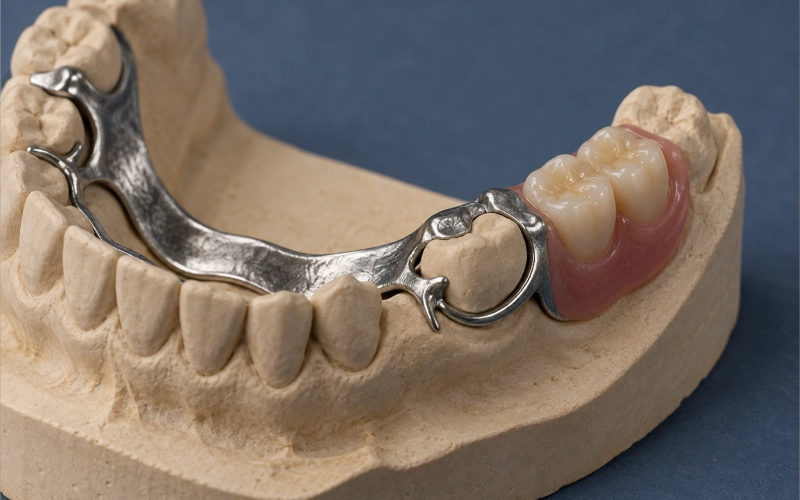
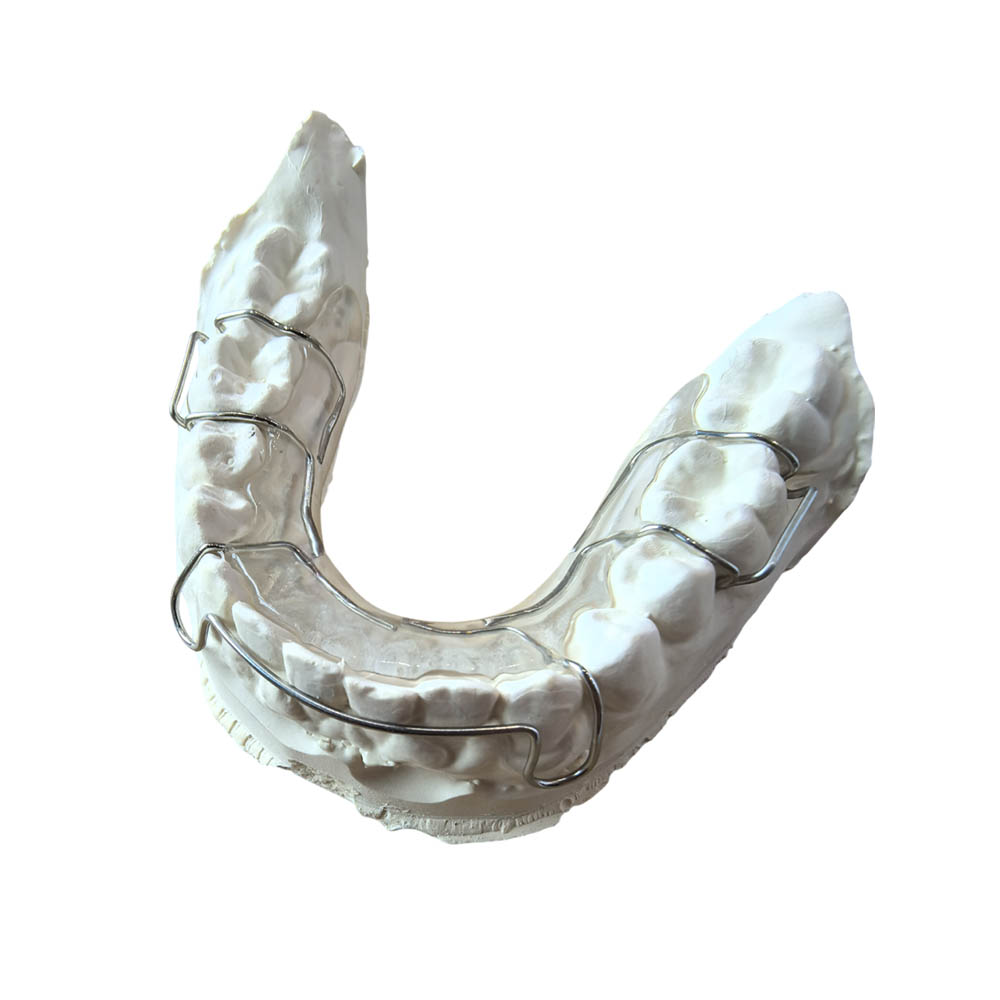
The classic Hawley design — a heat-polymerised acrylic base with a stainless-steel labial bow and Adams clasps. We shape the wire to your prescription (loop position, incisal coverage, occlusal clearance), polymerise the base, trim and polish. Good for cases that need small post-finish adjustments and long service life.
2. Clear thermoformed dental retainer (removable, transparent shell)
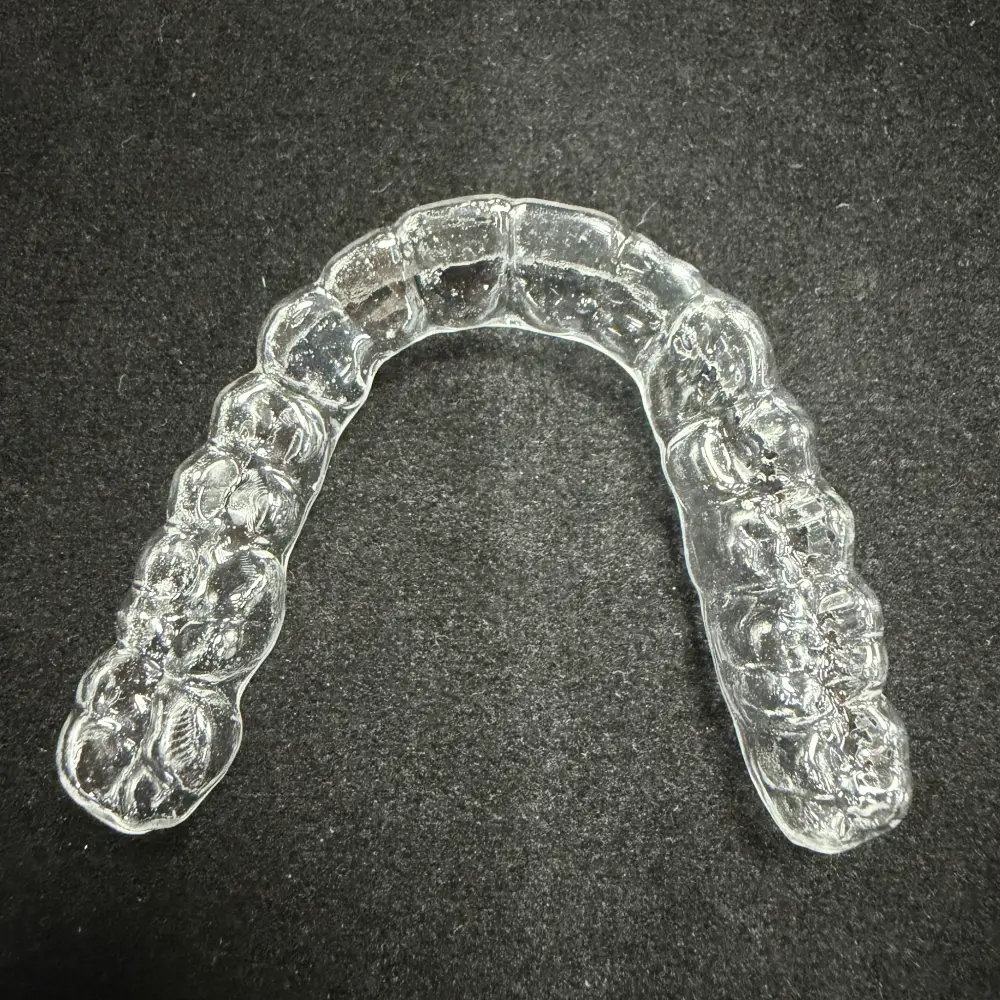
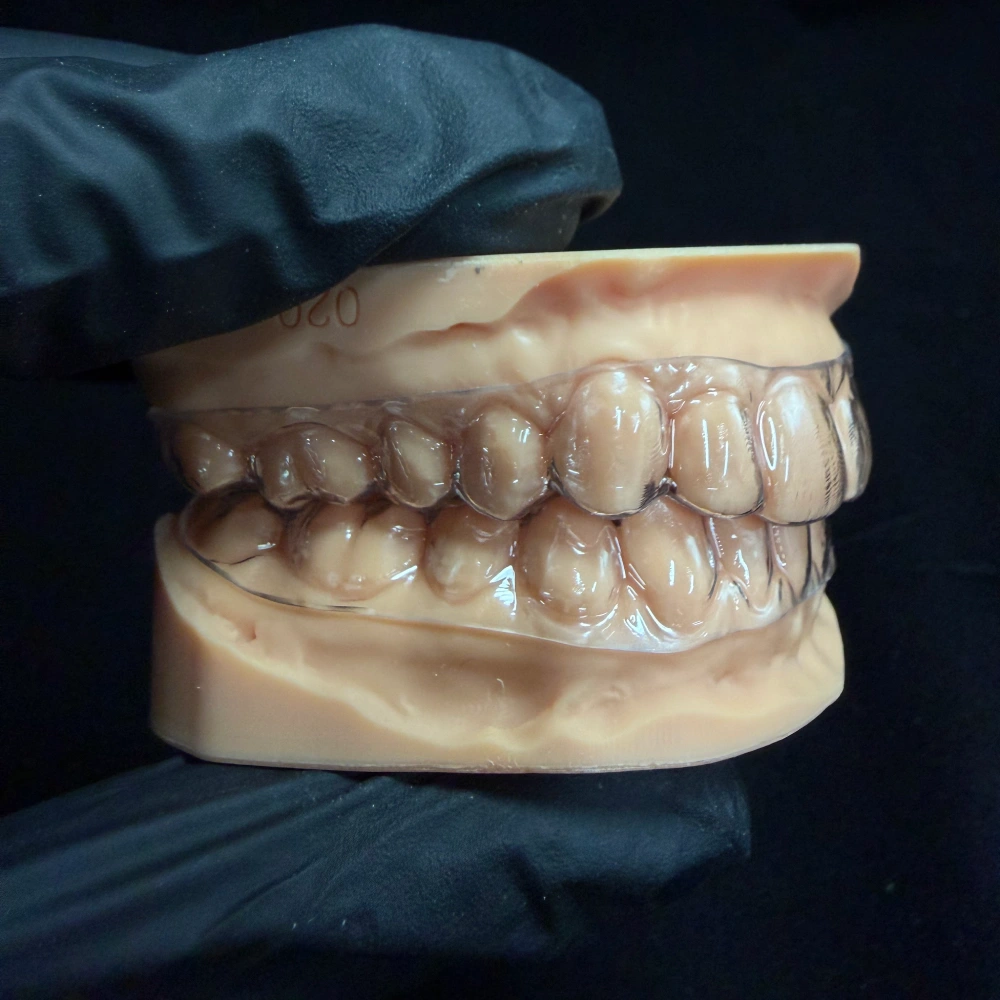
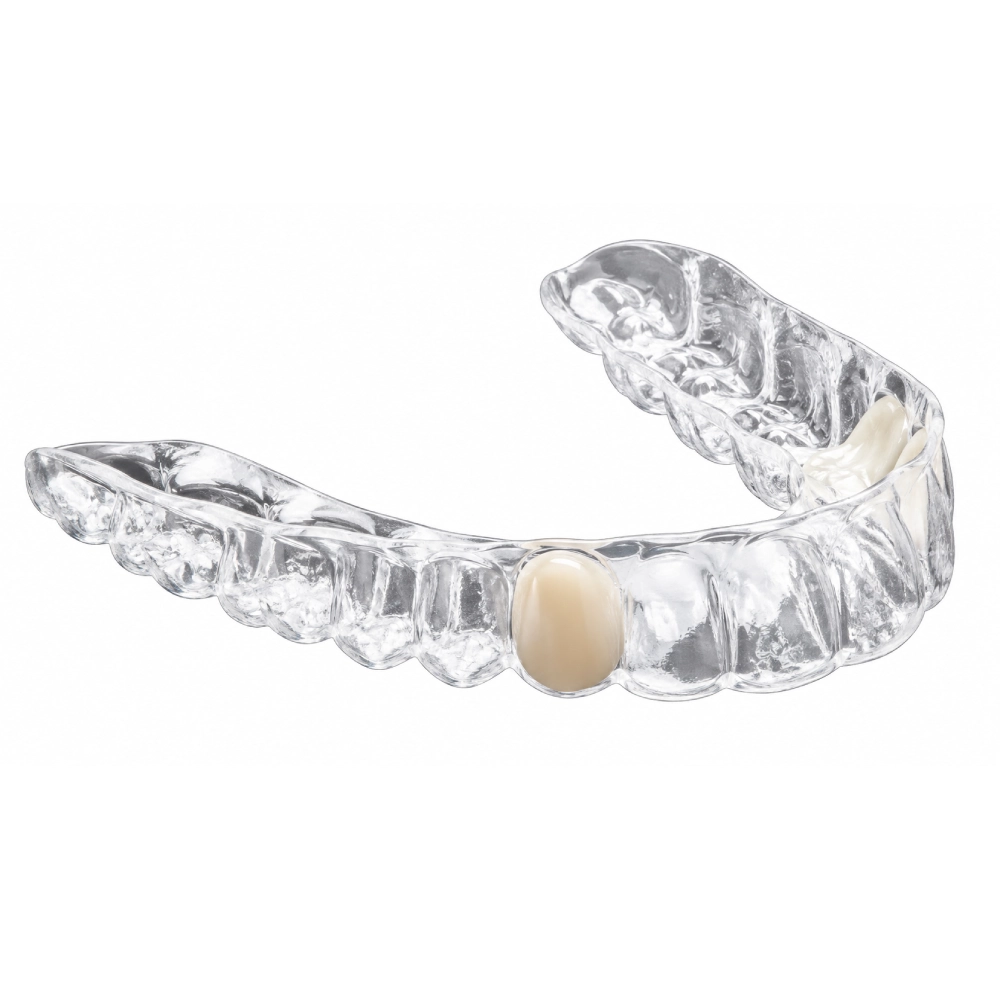
A vacuum-formed or pressure-formed clear shell over the working cast. In our workflow this is our main removable orthodontic retainer route, and it is the one most practices order alongside aligner finishing. Sheet gauge, coverage line and any localised relief follow your Rx.
3. Bonded lingual dental retainer (fixed wire, chairside-bonded)
Custom-bent multi-strand wire delivered on a positioning jig. Bonding is done chairside by the dentist; we only ship the wire and jig. Multistranded designs of this class are documented in the peer-reviewed literature — for example the review “Multistranded wire bonded retainers: from start to success” — and in the critical review published on orthodontic retainers.
Route | Type of retainer | Typical workflow input | Retention pattern |
Hawley | Removable, acrylic + wire | Digital scan or physical impression | Long-term, adjustable |
Clear thermoformed | Removable, transparent shell | Digital scan preferred; impression accepted | Long-term, full coverage |
Bonded lingual | Fixed wire, chairside-bonded | Digital scan preferred | Long-term, no patient compliance required |
If your case combines a fixed lower with a clear upper, we ship them together as one case.
Why practices and labs work with us
We are not the only place a dentist can order a retainer from. What we hear back — and what we build the operation around — is these five things.
- The lab that answers the phone is the lab that made your case. Sales manager, coordinator and technician are all under one roof. There is no re-sold work behind the scenes. See the internal Digital Workflow and Quality pages.
- Peak season does not blow up your turnaround. Removable-department capacity runs at roughly 4,000 cases per month off-season and about 6,500 at peak, with ~50 trained backup workers on standby. That headroom is why an August case ships on the same schedule as a March case.
- We handle the paperwork side of international laboratory supply. We hold registrations that cover United States and European Union shipments — details in the “Compliance and documentation” section below.
- You get one point of contact. Every account gets a dedicated sales manager and case coordinator. In business hours we reply within about an hour; outside them the time-zone offset applies, but the reply is back within twelve hours.
- English case discussions are part of the service. Written English, English video review meetings, and English versions of custom-device statements, material certificates and product labels are all standard.
How we make a dental retainer — the workflow
Two roads lead into our lab: a digital scan file, or a physical impression. Both end up in the same production line, and the acceptance checks at the end are the same. The difference is a few days of shipping.
1. Case receiving and Rx check
Digital case: send the scan file to your account email or transfer platform. Physical impression: ship to Shenzhen with the tracking number sent ahead. Either way, we log receipt on the day it arrives, confirm the count against your Rx, and open the case in our internal system with a unique case number.
If the file or impression is incomplete, or the Rx conflicts with what we see in the model, the case is paused and your coordinator asks the question in your working group before we cut a single sheet.
2. Model or digital design
Physical impressions are poured into a stone model, which is then scanned or used directly for thermoforming. Digital cases are prepared for either milled or printed models depending on the retainer type. Retainer thermoforming works better on printed models because print accuracy on the scan side is higher; that is the internal default unless the case calls for something different.
3. Fabrication
Hawley dental retainers go through a controlled polymerisation cycle after the wire is bent and the base is packed. Clear retainers are thermoformed — we heat the sheet evenly, apply pressure, and hold pressure through cooling until the shell has fully set. Trim lines follow the Rx; only micro-polishing is done on the intaglio surface to protect fit.
Bonded wires are pre-formed on the model, tacked to a transfer jig, and shipped ready for chairside bonding. General fabrication and insertion principles for this appliance family are covered in the Fabrication and Insertion of Removable Appliances teaching resource, and the digital side is summarised in the review Orthodontic digital workflow: devices and clinical applications.
4. Three-stage quality check
Quality control runs at three points, not one:
- Incoming check — data or impression completeness, Rx conflicts, missing parts.
1) In-process check — the technician at each station confirms the case is good before it moves to the next station.
- Final release — a dedicated QC technician, separate from the production technician, checks the finished retainer against the working document and only then releases it for packing.
For retainers specifically, thickness is measured with a caliper at several points against the Rx, borders are inspected for smoothness and extension, and retention is trial-fitted on the model to confirm clasp grip and seating. Cases that do not pass are automatically remade — we do not ship a borderline case and let the practice sort it out.
5. Independent packaging and traceability
Every finished case is high-pressure cleaned, sealed into a case-specific bag with the patient identifier on the label, and packed into a rigid outer box with cushioning between cases. Screws and small parts, when a case has them, are bagged and label-verified by two people before packing.
Each case is bound to a unique case number that ties the technicians, equipment, material lot and QC results back to the original Rx. Material brand, country of origin, batch number and material certificate can be attached to a case on request — the traceability discipline is aligned with the direction of UDI basics from the FDA.
Materials and material discipline
We use materials with documented specifications from named suppliers. If a case names a specific brand you already validate, we source it when it is available in China; if we need to substitute, the change is proposed to you in writing and only goes ahead once you approve. Cases with a client-locked material book keep their locked list — we do not swap silently.
- Hawley base — heat-polymerised PMMA. Polymerisation cycle and post-polymerisation control are recorded per case.
- Clear shell — thermoplastic sheet in the gauge your Rx specifies. Sheet properties and thermoforming behaviour are documented in the peer-reviewed comparison of orthodontic thermoformed retainers.
- Bonded wire — multi-strand stainless steel per your prescription; bond-up handled chairside.
- Documentation on request — brand, country of origin, lot number and material certificate can travel with the case.
Our material claims stay auditable. Instead of loose category labels, we describe materials by what they actually are — manufacturer, standard, batch number — and hand the classification work to your compliance team. For biocompatibility framing, the FDA’s Use of International Standard ISO 10993-1 guidance is the reference we work from.
Compliance and documentation
Ordering a dental retainer across borders means the paperwork has to be right. Our lab side and the US and EU pathways all sit on the following:
- ISO 13485 quality management system on the laboratory side.
- FDA facility registration and product listing. ASD is registered as a facility with the U.S. Food and Drug Administration; our custom restorations are listed under the applicable product codes. The regulatory basis for orthodontic devices sits under 21 CFR 872.5410 — Orthodontic appliance and accessories. Both can be verified in the FDA’s public establishment database; we can point you to the entry on request. This is not the same as “FDA approval” and we do not use that phrase.
- EU MDR — Annex XIII custom-device route. Class IIa dental custom appliances follow the custom-device flow in the MDR; we prepare the manufacturer statement of the custom device and keep the technical file on our side. See the Custom Device Exemption guidance for a comparable framing on the U.S. side.
- MHRA registration for UK-market cases.
- Traceability records. Every case is bound to technician, equipment, material lot and QC records. Retention periods vary by market; we align to the country of delivery.
- Direct-to-consumer boundary. We build for licensed dental professionals only. The scope aligns with the American Dental Association policy on Direct to Consumer Dental Services.
When your customer or regulator asks for a document — a material certificate, a batch record, a custom-device statement, an English label — we can send it in the format they expect.
Turnaround — the five things worth being precise about
“Turnaround” is one of those words that sounds simple until the case is late. We define it five ways so nothing hides in the numbers:
- Start point. The clock starts on the day we receive the case, not the day it was posted.
1) Working days, not calendar days. Weekends and Chinese public holidays are outside the promised turnaround.
- Design approval and information waiting time are not counted. If we are waiting on your reply to a design question, the case is paused and the clock is paused with it.
1) Shipping and customs are separate. International transit and customs clearance are quoted separately and do not sit inside the lab time.
- Digital cases finish sooner overall. Lab time is the same; you save the days that would be spent posting the impression to us.
Multi-stage cases have their own step times — we quote each stage when we scope the case. For rush requests, most cases fit inside our free-rush policy up to a monthly threshold; ask your account manager when you send the case, or on submission.
How to start working with us — the case flow
The first case is the one that tells you whether it is worth building a relationship. We keep the first-time flow deliberately short.
- Open the account. For laboratory-to-laboratory work in the U.S. market, this includes registering on the FDA OAA portal (DRLM module), appointing a U.S. agent (required for facilities outside the U.S.), paying to obtain the FEI facility number, and doing the product listing. We walk you through the four steps; your side keeps the login.
1) Send the pilot case. A digital scan file to your dedicated email, or a physical impression to the Shenzhen address using our shipping account or your own. Confirmation of receipt comes back the same day.
- Rx and design confirmation. Anything unclear on the Rx is asked in your working group. For anterior aesthetic or complex occlusion cases we ask for photographs and, when relevant, a face-bow or semi-adjustable articulator record.
1) Design approval. For cases that need a design step, we send you the file for sign-off. The clock pauses while we wait.
- Production. Fabrication and three-stage QC as described above.
1) Ship. DHL, FedEx, UPS or SPIDER (for France). Tracking number the day it leaves the facility.
- After delivery. If anything is off, tell us within 24 hours with case number, patient name, product, reason and photos. We take it from there.
Quotations are prepared per case. The price is driven by unit count as the base, material as the base price, and any extra parts or design complexity as add-ons. Design, model, standard packaging and outbound shipping are included in the quote unless you specifically ask us to break them out. Ask your sales manager for the current price list — contact page.
Remake and warranty — where the line is
Retainers, like anything worn intraorally, sometimes need to be remade. We are direct about which side that lands on.
We remake free of charge when the cause is on our side. For retainers this covers: does not seat on the working model, warped margins, missing or misplaced clasp geometry against the Rx, wire dimensions that do not match the prescription, or a shell that cracks during acceptance testing.
We charge for a rebuild when the cause is not on our side. Common examples: the practice changes the target material or design after fabrication, the impression was flagged as unclear on receipt and the practice asked us to try anyway, a fresh impression or new scan arrives after fabrication has started, or the case is a “new case” under a new Rx.
How to raise a concern. Report within 24 hours of receipt. Include the case number, patient name, the product built, the reason, and photographs. For a physical retainer where the problem is not apparent from photos alone, we ask for the piece to be returned; for a digital-only case we may not need it back. Cause analysis happens before we cut a second one — a case with an unclear reason gets discussed with you first, not remade blindly.
When remake happens, it moves to the front of the queue. A remake usually sits at 3 to 5 working days rather than the standard lead time. Free remake covers the fabrication; it does not include return shipping or any third-party implant components, which are billed separately.
If the second attempt still is not right. Your case goes up to the technical director and production manager. If we cannot get to a build you accept, we refund. This does not need to be negotiated case by case — it is how the policy is written.
Shipping and packaging
- Carriers we run: DHL, FedEx, UPS, and SPIDER for France.
- Cases are packed one-per-sealed-bag with the case label, cushioned in the outer box, and can be grouped by practice location when the client asks.
- Outbound shipping is included in the quote by default; return shipping and any third-party components sit outside free-remake cover.
- Import duties, customs brokerage and remote-area surcharges are the buyer’s responsibility.
- If a shipment arrives damaged, send an unboxing video with the courier label visible, plus photos of the damage and the original packaging, inside 24 hours. With that evidence and the shipment insurance where applicable, damaged cases are rebuilt at no cost.
Outsourcing Services for Dental Laboratories
We do a real share of our work for other dental laboratories. If that is you, three things you probably want to hear on the record.
- We do not go around you. We do not contact the terminal dentist or clinic your lab serves. That is a written commitment. NDAs and supplier agreements are welcome.
- We ship under your brand. Case labels, box labels, packing slips and the paperwork format follow your standard — send us the artwork and the template and we set it up per account.
- Your preferences are held per account. Each terminal-doctor preference (design margin, occlusal contact style, aesthetic notes) is kept under the terminal-doctor identifier — a case coming back six months later is built to the same rules.
CAD-only, CAM-only and finishing-only outsourcing are all available. Send us the design file, we mill and finish. Send us the model file, we design and build. It is your choice which parts to keep in-house.
Case snapshot — the shape of a typical retainer order
A composite drawn from our own case files rather than a single named case. Numbers are internal ranges; actual timing and content depend on the Rx.
- Origin. A U.S. orthodontic practice sending 30–60 retainer cases per month, mixed clear thermoformed uppers and Hawley lowers, all digital scans.
- First case. Sent Monday morning U.S. time via cloud transfer. Receipt confirmation from us the same day. Rx clarification on one anterior clasp position resolved within four hours.
- Fabrication. Printed models the same day. Clear shells thermoformed the following morning; Hawley bases polymerised through the second afternoon; QC release end of the third working day.
- Shipping. Overnight courier out of Shenzhen. Tracking number in the practice’s inbox the same day.
- Follow-up. Two months in, the client added bonded lingual wires to the same account. Six months in, they moved the impression-based cases to full digital scans.
We prefer this composite to a named case study. When you need reference clients, we can arrange a video factory tour and, in some situations, a direct introduction — walk-ins to the Shenzhen and Huizhou sites are also welcome.
FAQ — the questions that come up most in the first month
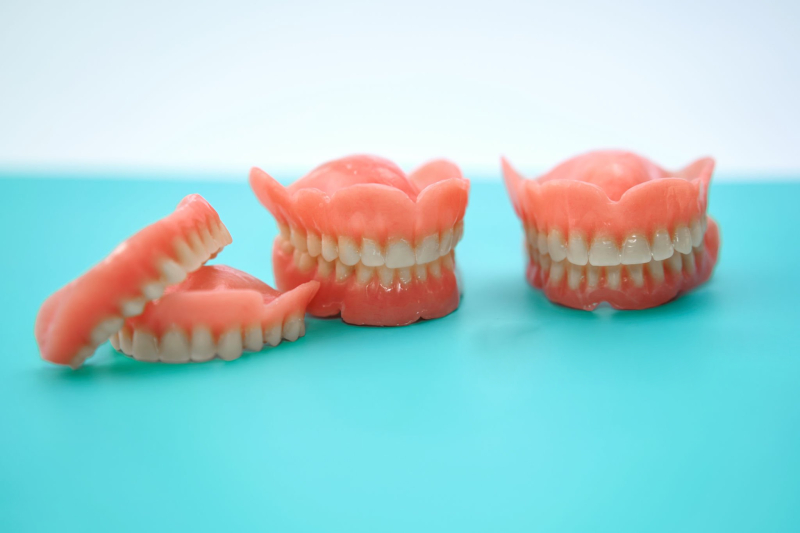
A removable orthodontic retainer — Hawley or clear thermoformed — is worn by the patient and removed for eating and cleaning. A bonded lingual retainer is a fixed wire we build on a jig; the dentist bonds it chairside. Both are custom-made per case.
Yes. Send it to Shenzhen with a tracking number sent ahead. Digital scans are faster overall — the lab time is the same, but you save the postal transit days.
Fabrication faults are remade free and jump to the front of the production queue. Cases that changed on the practice side after fabrication started, or that were built off an impression flagged as unclear at receipt, are billed as a new case. Return shipping is not included.
Case data is transferred through your account channel, held on our internal case system, and only used for the case. Design files stay in the account. NDAs are available on request.