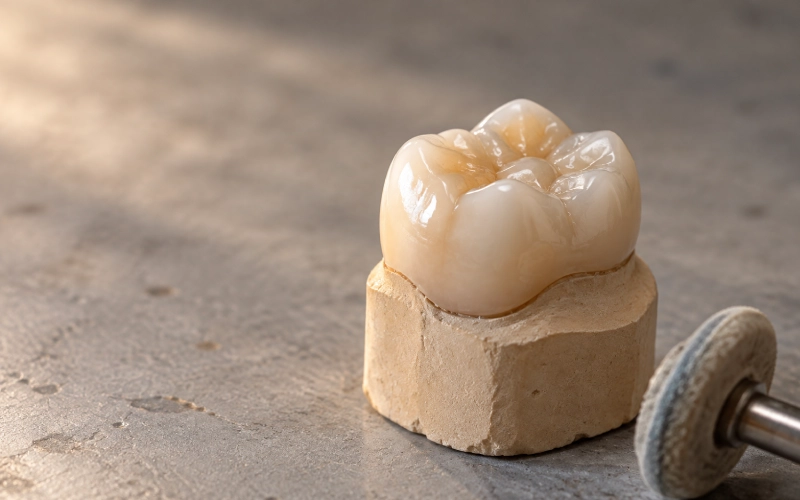
Dental Flipper Case Study: How Our Lab Built a Single-Tooth IRPD in 3 Working Days

This is a documented dental flipper case from our removable department.
One-line summary. A general dentist sent us a single missing upper right central incisor (tooth #8, FDI 11), extraction 4 days earlier, patient waiting on an implant plan. We fabricated a heat-cured PMMA dental flipper — professionally an interim removable partial denture — with a light wrought-wire clasp, delivered to the practice in 3 working days, and the case has been in service for 6 months with one scheduled reline.
Why we’re publishing this case
A dental flipper is one of the most commonly requested short-term prostheses we make, and yet very few pages describe it the way a dentist actually needs to read it — as a documented workflow, with what came in, what we did, and what came out. That gap is the reason for this page.
This is a professionally styled case record. Field structure follows the CARE case-report convention (patient info → clinical findings → timeline → intervention → follow-up → limitations) as described in the BMC Oral Health case report submission guidance. Naming and coding follow the CDT descriptors for interim partial dentures.
We keep that scope note near the top of every flipper case page. It is also the language we use when talking to a dentist who is prescribing one for the first time.
Patient presentation
Chief complaint. “I lost my front tooth 4 days ago and I have a wedding in 3 weeks. I need something in there now.”
Demographic and history
- Adult, mid-30s, non-smoker, ASA I.
- Extraction of #8 (FDI 11) 4 days prior to prescription, following coronal fracture that could not be restoratively saved.
- No history of bruxism reported by the dentist. Occlusion Class I. Overbite and overjet within normal range.
- No known allergies to acrylic or nickel. No allergy to any denture cleanser previously used.
- Oral hygiene good; no active caries at adjacent teeth #7 (FDI 21) or #9 (FDI 12) at the time of impression.
Diagnosis on the Rx. Single anterior edentulous space, #8, post-extraction, ridge remodeling in progress, awaiting implant consultation.
Reason for tooth loss. Traumatic coronal fracture with an unrestorable remaining root. Cause is documented because it drives the choice of appliance: a dental flipper is a reasonable transitional option after this kind of single-tooth loss when the site is still remodeling and the definitive plan is not yet fixed.
What the dentist asked for
Field-by-field, straight from the prescription (Rx):
| Field | Value |
| Product | Interim removable partial denture (flipper), maxillary |
| Tooth to replace | #8 (FDI 11) |
| Arch design | Palatal acrylic base, minimum coverage for a single anterior |
| Retention | One 0.9 mm wrought-wire clasp on #9 (FDI 12), no clasp on #7 (aesthetics) |
| Base material | Heat-cured PMMA, pink shade to match tissue |
| Denture tooth | Acrylic pontic, VITA A2, mold selected from photograph of #9 |
| Occlusion | Non-occluding at #8 pontic (light incisal contact only) |
| Interim period | Approximately 4–6 months, until implant abutment placement |
| Delivery date | 3 working days from receipt of complete records |
| CDT for the practice bill | D5820 (maxillary interim partial denture) |
Records that arrived with the Rx
- Intraoral scan (STL) of the maxillary arch, opposing arch, and a bite registration.
- Two photographs of #9 with a shade tab under neutral lighting, and one retracted anterior smile photograph.
- Written photo consent covering all identifiable images.
- No preoperative photograph of #8 (the tooth was extracted before the flipper was planned) — noted on the Rx so we would not chase it.
What was missing on arrival. No mold guide was specified, so we asked for one photograph of the contralateral #9 with the incisal edge visible against the lip line. The dentist sent it the same afternoon. The clock on the 3 working day turnaround starts from the moment records are complete, so this was a same-day resolution — no delay to the promised delivery.
Why a flipper here, and not something else
Every case page should say this out loud. For this patient the short list came down to:
- Dental flipper (IRPD). Fast, low cost, easy to modify as the ridge remodels, and removable — suitable while the implant plan is being finalized.
- Essix retainer with a pontic. Considered, and rejected in Rx notes because the dentist wanted a design that could tolerate limited light incisal contact and hold shade over ~5 months.
- Fixed interim bridge. Would require preparation of #7 and #9. The patient did not want either tooth touched.
- Implant provisional. Not available yet; the implant plan was still under discussion.
- No replacement. Ruled out on aesthetics and speech grounds — this was a maxillary central incisor.
That is the same decision tree described in general prosthodontics briefings for interim removable partial dentures. We add the reasoning to every case so anyone reading later can tell why the flipper won the shortlist, not just that it did.
How we made it — the lab-side workflow
Ten steps from records to shipping. This is the actual sequence we followed on this case, not a generic textbook flow.
- Records intake and validation. Scans opened and checked for arch completeness, opposing coverage, and bite registration integrity. Photographs indexed against the Rx. Every case that enters our floor gets a unique barcode and is tracked from step 1 through packing.
- Digital model print. STL exported to the print queue. Master and opposing models printed and post-cured overnight.
- Space and undercut survey. Edentulous space measured; adjacent axial contours reviewed for the clasp path on #9 and to confirm no unwanted undercut engagement on #7.
- Tooth selection. VITA A2 acrylic pontic selected from the mold set that visually matched the contralateral #9 photograph. Mold, size, and shade cross-checked with a second technician before wax-up.
- Wax-up. Pontic positioned against the incisal display and midline reference from the smile photograph. Palatal extension trimmed to the minimum viable coverage for retention while keeping speech impact low. Clasp path drawn.
- Wrought-wire clasp forming. 0.9 mm stainless steel wire, adapted by hand to the buccal survey line of #9, extended into the acrylic body for mechanical retention. No clasp on #7 as prescribed.
- Heat-cure processing. Waxed flipper invested, flasked, boiled out, packed with heat-cured PMMA denture base resin, and polymerized under the manufacturer’s validated cycle. This is one of the categories of resin covered by FDA’s Class II Special Controls Guidance for Denture Base Resins, and the material we used carries a matching product code EBI classification (see Materials and standards).
- Finish and polish. Flash trimmed, tooth-to-base junction checked under magnification, borders smoothed, external surfaces polished with pumice and polishing compound. Occlusal contact at #8 pontic verified light on the articulator.
- QC. Every case is inspected before it leaves the floor. On this one we checked: seating on the model, clasp adaptation, tissue-side smoothness, absence of internal voids under strong transmitted light, and pontic shade match against the reference photograph. Nothing ships from us without a QC pass.
- Packaging. Flipper packed in a labeled case box with the barcode, patient identifier, dentist name, and a wear-and-care card matching the dentist’s post-op instructions. Shipped with tracking; the practice was notified with the tracking number the same day.
Turnaround on this case. 3 working days from complete records to shipment. That figure is the internal lab time in our facility. It excludes international courier transit time, chair time at the practice, and any adjustment after seating. We report the number that way because “lab turnaround” and “chair delivery date” are two different clocks, and we do not want anyone comparing us to a same-day chairside promise that measures a third clock.
Materials and standards
- Base. Heat-cured PMMA denture base resin. Denture base resins are FDA Class II devices, product code EBI, regulated under 21 CFR § 872.3760. The official title of the regulation is Denture relining, repairing, or rebasing resin, and FDA confirms this coverage explicitly in its guidance for denture base resins. See the FDA product classification page for EBI and the Denture Base Resins guidance PDF.
- Applicable material standards for denture base polymers include ISO 20795-1:2013 Dentistry — Base polymers — Part 1: Denture base polymers and the current ADA specification ANSI/ADA Standard No. 139-2020 (R2025) Dental Base Polymers. These are the material specifications that apply to the base of a dental flipper; the appliance itself is not “ADA approved” as a device — that language would be incorrect.
- Tooth-to-base bond strength is the failure mode we see most often in service, and it is testable under ISO/TS 19736:2017 Dentistry — Bonding test between polymer teeth and denture base materials. We select acrylic pontics and processing conditions with this failure mode in mind.
- Regulatory identity of our lab. We manufacture a dentist-prescribed custom appliance from the dentist’s Rx and records. The FDA registration and listing framework recognizes this activity: 21 CFR § 807.65(i) lists dental laboratory personnel in the exemption for entities whose primary responsibility is to dispense or provide a service through the use of a previously manufactured device. See the current text of the exemption on eCFR § 807.65. The exemption has conditions and is not a blanket “labs never register.”
Delivery, seating, and follow-up
The dentist scheduled a 30-minute seating appointment on the day the box arrived.
Insertion. Flipper seated without adjustment on first try. Occlusion checked in centric and light protrusive; no interference at #8 pontic as prescribed. Clasp on #9 engaged the survey line without blanching.
Chair-side adjustments. One pressure spot on the palatal border, relieved with an acrylic bur. Total chair-side time under 10 minutes.
Patient instructions given by the dentist.
- Daytime wear; remove at night, unless the dentist gave a specific short-term immediate-postoperative instruction.
- Do not bite hard, sticky, or fibrous foods with it. Restrict eating to soft foods, and remove it for meals unless the dentist has confirmed the design and healing status allow limited eating.
- Rinse after meals when possible. Brush the appliance at least daily with a soft brush and non-abrasive denture cleanser. Clean the natural teeth, gums, tongue, and palate separately.
- Store overnight in clean water or a compatible denture-soaking solution. Avoid hot or boiling water, abrasive toothpaste, and any unapproved bleach. Denture cleansers must not be used inside the mouth.
Follow-up outcomes (dentist-reported, patient’s own words in quotes where marked):
| Timepoint | Finding |
| Day 1 | Seating clean, one relief spot, patient comfort described as “I forget it’s there when I’m not eating.” |
| Week 2 | Speech intelligible on read-aloud check. No looseness. No mucosal irritation at the ridge. |
| Month 2 | Ridge remodeling visible; slight looseness at rest. Scheduled soft reline planned. |
| Month 3 | Soft reline performed at the practice. No changes on our side. |
| Month 6 | Flipper still in service. Implant abutment appointment now scheduled. Pontic shade unchanged under neutral light; no chipping, no clasp fatigue, no debonding of the pontic. |
Nothing was hidden here. A reline at month 3 is not a failure; it is a normal event on a healing ridge, and we plan for it. If a case comes back with a fractured base, a debonded pontic, a broken clasp, or a poor fit that a reline cannot correct, we run a returned-case analysis and either repair, reline, or remake to written policy. Our overall remake rate across the removable book, all causes combined, has been tracking at 2–3% — the same figure our lab manager reports internally each month.
Start a similar case
If you have a single anterior loss or a short interim before an implant plan closes, and you want a dental flipper built to the workflow you just read:
- Download the Rx sheet and the case checklist from your account portal, or ask your sales contact for the current PDF.
- Send the intraoral scan (or the impressions with tracking) plus opposing arch, bite registration, one photograph of the contralateral tooth with a shade tab under neutral lighting, and any post-extraction healing instructions.
- Confirm the interim period and whether the case is a rush.
- Our case coordination team will confirm receipt, flag anything missing, and give you the delivery date the moment records are complete.
For a written quote on a similar single-tooth dental flipper, or to book a factory visit or a video audit, please contact your ASD sales representative directly. New customers are welcome to submit a single trial case before opening a regular account.
Experience faster turnaround times with our cutting-edge technology
Recommended