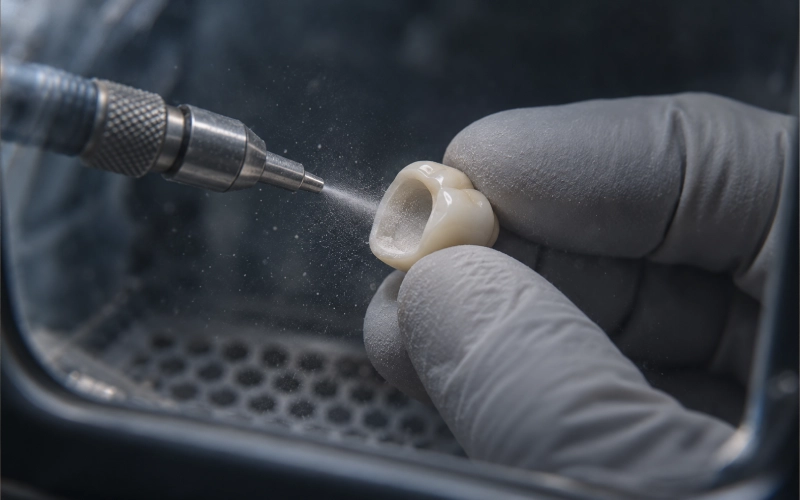
Custom Soft Night Guard — Made to Your Prescription


Send us the case, we build the soft night guard. Digital scan or physical impression, your thickness spec, your bite registration. Thermoformed in-house at our own facilities. Ready to seat when it lands on the operatory tray.
We take work from dentists, clinics, dental hospitals, and other labs looking for a manufacturing partner. If you need a soft night guard for teeth grinding cases that are light to moderate, or a soft occlusal guard that pairs a soft inner with a firmer outer shell, that’s exactly what we do — every unit built to your Rx.
What This Guard Is
A soft night guard is a removable oral appliance made from a resilient thermoplastic sheet — usually EVA or a similar copolymer — designed to sit over the occlusal surfaces of the upper or lower arch. It cushions contact during clenching and spreads bite load across a wider surface. It is described in the peer-reviewed literature as a resilient, custom-fitted appliance that is often the first option a clinician reaches for when a rigid device is not yet indicated or well-tolerated.
Point worth being straight about: an occlusal guard is not the same device as a TMD-indicated splint. The ADA’s own CDT documentation separates occlusal guards from TMD splints into distinct categories with different clinical intent. We build to the guard specification you send us. We don’t relabel one as the other.
Soft Night Guard Specifications
| Item | What You Can Specify |
| Guard type | Single-layer soft · Dual-laminate (soft inner + firmer outer) |
| Arch | Upper · Lower |
| Thickness | Common spec range 1.0 mm – 3.0 mm; other thicknesses on request |
| Coverage | Full-arch occlusal; margin extension per your Rx |
| Materials | EVA sheet · thermoformable copolymers · dual-laminate sheet stock |
| Case input | STL from intraoral scan · physical impression + bite registration |
| Turnaround | Quoted per case at intake, based on case type and volume |
| Packaging | Individually bagged, patient/case ID label per unit |
If the case needs a form we haven’t listed above, put it in the Rx notes and we’ll come back with a build option or flag anything that doesn’t fit.
Soft Night Guard Materials
We work with the material families that show up most in occlusal guard fabrication:
- EVA sheet — the workhorse for single-layer soft night guards. Flexible, well-tolerated overnight.
- Dual-laminate sheet stock — soft inner surface for seating comfort, firmer outer for wear resistance.
- Thermoformable copolymers — where the Rx calls for a specific handling profile.
Two things we do on materials that most order forms don’t ask about:
- Brand and lot are traceable. If your protocol requires a specific brand, we can source to spec where available and pass the batch information back with the case. If your quality file needs an origin declaration or a batch conformity note per unit, we can package that with the shipment. Just tell us what you need in the Rx.
- We document what the material is, not what it does. You’ll get the material composition and origin, not marketing language. Biocompatibility evaluation of dental polymers is governed by ISO 10993-1 — we can share the material’s biocompatibility documentation when your file requires it. What we don’t do is issue product-level regulatory statements. That is not our role as a manufacturing lab.
Why It Comes Down to the Case, Not the Material Alone
Here is what the evidence base actually says, so you can price a case with your eyes open:
- A 2024 systematic review comparing occlusal splint materials found no statistically significant overall difference in muscle activity or bite force between hard and soft designs.
- Cochrane’s review of the sleep bruxism evidence base reached a similar place — only a handful of trials met the bar for reliable comparison, and the pooled evidence was not strong enough to call one material category a clear winner.
- Earlier work reported cases where a soft appliance did not reduce nocturnal muscle activity the way a rigid one did, which is why case selection matters more than product marketing.
What that means for the person writing the Rx: the material alone doesn’t decide whether a guard works well. Thickness, coverage, fit accuracy, and how the design matches what the specific case needs — that’s what does the work.
So we don’t sell “soft” as a one-size answer. Send us:
- A soft night guard for teeth grinding case that’s light and won’t tolerate anything rigid — we thermoform it to your thickness spec.
- A heavier case that would chew through a single-layer in months — we build a dual-laminate soft occlusal guard with the firmer outer.
- Not sure which fits the case — write the symptoms in the Rx notes and we’ll flag anything that reads like it needs a second look before we start production.
Last point matters. If a case comes in with signs pointing beyond routine grinding — escalating joint pain, limited opening, or a bite relationship that reads off — we note it back to the ordering dentist rather than silently fabricating the wrong appliance. Case decisions stay with the prescribing clinician. Flagging what we see in the file before it becomes an expensive redo is our job.
How We Build It
We thermoform every soft night guard in-house. Not milled, not printed — thermoformed. Here’s the process end to end.
1. Case intake and review. Digital scan (STL) or physical impression comes in with your bite registration and Rx notes (guard type, arch, thickness, any specific design instructions). If anything reads unclear, we come back with questions before we open the case, not after.
2. Model preparation and articulator check. The model is mounted and cross-verified against the bite registration on an articulator before anything touches the thermoforming unit. Occlusal contacts are confirmed before the guard is shaped, not after it comes off the mold.
3. Thermoforming. The sheet material is heated evenly. Pressure is applied steadily. Then — and this step is where a lot of soft guards go wrong on rushed lines — the guard cools under sustained pressure until fully hardened before demolding. Skipping the controlled cool-down is the single most common way a soft guard ends up loose, distorted, or with a compromised fit.
4. Trim and finish. Margins are trimmed and lightly polished by hand. Internal surface is left largely untouched — over-adjusting the inside of a soft guard is an easy way to lose seating, so we remove only what’s needed to eliminate rough edges.
5. QC inspection. Thickness is verified at multiple occlusal points with calipers against your Rx. Margins checked for smoothness and correct extension. Fit and retention tested by seating and removing the guard on the model. Anything with a visible crack, void, or air bubble doesn’t ship.
6. Cleaning, packaging, traceability. Each unit is pressure-cleaned and sealed in an individually labeled bag with the patient/case ID. Nothing gets mixed up on a multi-case shipment, even in peak weeks.
Full process, one facility. We complete every stage inside our own manufacturing floors in Shenzhen and Huizhou — no routing your case through a third-party lab. If you want to verify what that actually looks like, we host factory walk-throughs, production line tours, and video audits on request.
Quality Control You Can Audit
Every case goes out with these checks logged:
| Check Point | What’s Verified |
| Occlusal thickness | Measured at multiple points with calipers, against Rx spec |
| Margin | Smoothness, extension range, no burrs or lifted edges |
| Internal fit | Seating and retention tested on the working model |
| Cosmetic | No visible cracks, voids, air bubbles |
| Identification | Patient/case ID on the individual bag, matched to the Rx |
| Batch documentation | Material batch info retained; conformity notes available on request |
Because every stage happens inside our own facilities, batch consistency, timeline tracking, and inter-department communication stay in one workflow. That’s the practical reason we don’t outsource — not because we can’t source subcontractors, but because outsourced steps break case traceability, and traceability is what B2B buyers actually need.
Working With Us — the Handoff
What we need from you:
- Digital intraoral scan (STL, PLY, or your usual export) or a physical impression
- Bite registration — wax bite or equivalent
- Rx: guard type (single-layer soft / dual-laminate), arch, thickness, and any design notes specific to the case
What we send back:
- A guard built to your spec, QC’d against the Rx before it ships
- Individually bagged and case-labeled for chairside identification on multi-case orders
- The material and batch information filed with the case, available on request
If something reads off in the file — occlusion that doesn’t register cleanly, or a case description that looks more like a TMD referral than a routine soft occlusal guard order — we flag it back before production. It’s a quality gate, not a delay.
Cooperation Options
We’re set up for three kinds of buyers:
- Dentists and private clinics — case-by-case ordering, standard Rx workflow.
- Dental hospitals and DSOs — batch orders, consistent SKU spec across sites, batch documentation on delivery.
- Dental labs looking for a manufacturing partner — overflow capacity, a second opinion on a tricky case, or a consistent thermoforming pipeline behind your own front-end. Talk to us about how the handoff would look — file format, case volume, turnaround expectations, packaging/labeling requirements.
Factory visits, production line tours, and video audits are open on request. Bring the questions your quality file actually needs answered.
Soft Occlusal Guard FAQs
Is a soft night guard the same as a bite splint?
No. An occlusal guard and a TMD-indicated splint are documented as separate categories in the ADA’s CDT reference material. We build to whichever specification is in your Rx.
Do you build for light bruxism, or heavier cases too?
Single-layer soft night guards fit light-to-moderate grinding patterns best. For heavier cases where wear-through is a concern, specify a dual-laminate on the Rx and we’ll build the soft-inner-plus-firmer-outer configuration.
Can you thermoform to a specific thickness?
Yes. Common spec range is 1.0 mm – 3.0 mm. Anything outside that, put it in the Rx notes.
Digital scan or physical impression — which do you prefer?
Either works. Send whichever your workflow already produces. STL from an intraoral scanner is the fastest through our intake.
Milled, printed, or thermoformed?
Thermoformed. Pressure-formed with a controlled cool-down under sustained pressure — the process that keeps the fit accurate on a soft sheet material.
Can you provide material documentation for our quality file?
Yes. Material composition, origin, batch information, and biocompatibility documentation per the material’s supplier — available on request with the case shipment.
Do you take lab-to-lab work?
Yes. Overflow, backup capacity, or a manufacturing partner behind your front-end. Send us what you need and we’ll quote it.
What’s your turnaround?
Quoted at intake per case. It depends on case volume, guard type, and whether the input is digital or physical. Tell us the deadline and we’ll say yes or no.
Send Us a Case
Scan or impression, bite registration, prescription notes — that’s all we need to quote turnaround and start production. Dentists, clinics, dental hospitals, and labs are all welcome to reach out directly.
[Request a Quote →] · [Book a Factory Visit or Video Audit →]
This page describes fabrication services provided by a dental laboratory. Guard type, indication, and case management remain the responsibility of the prescribing dentist. Peer-reviewed and standards citations above are provided for reference and do not constitute clinical or product-level advice.