Hard Night Guard


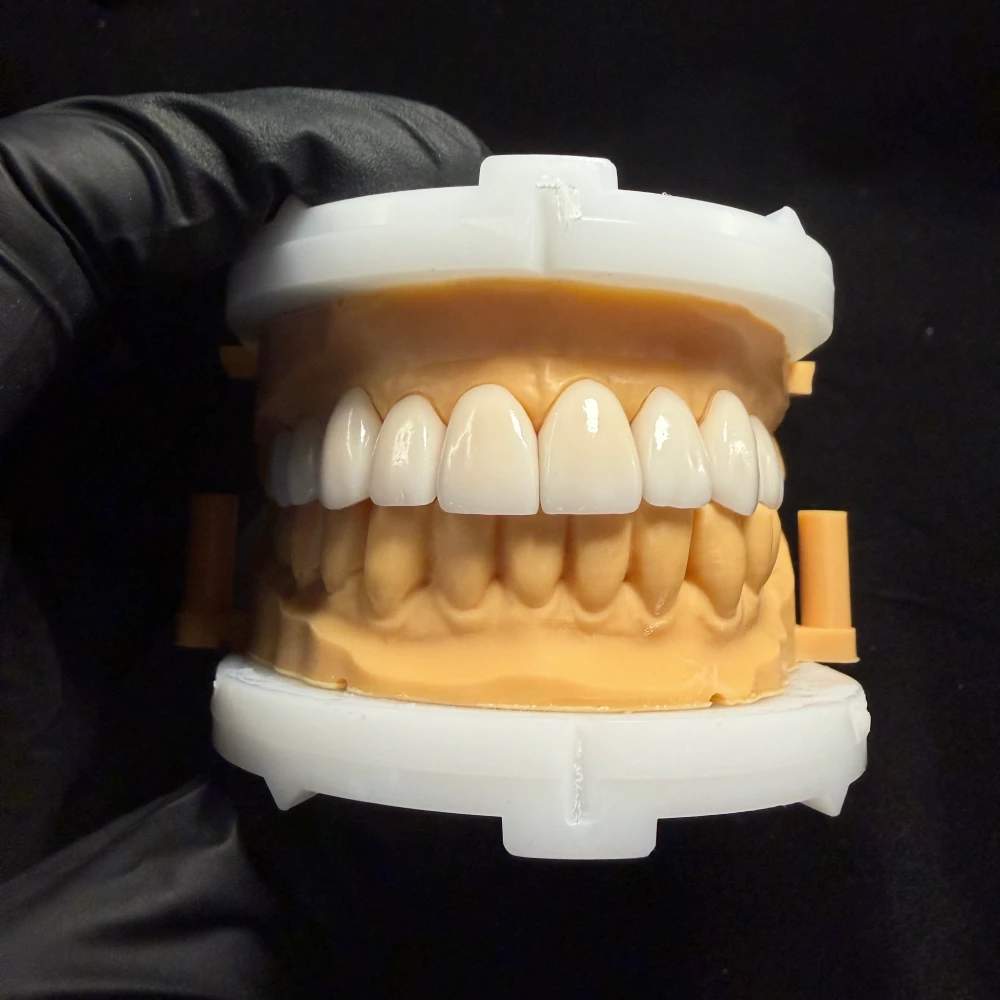
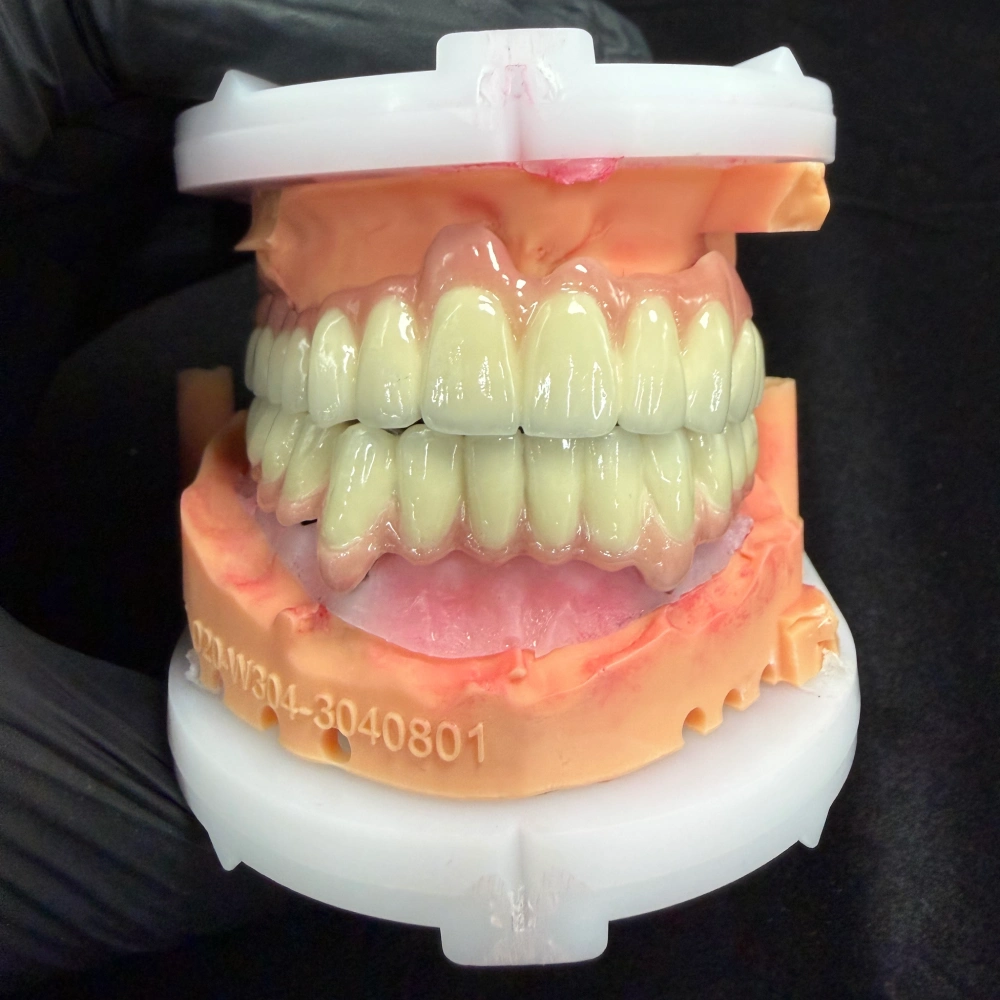
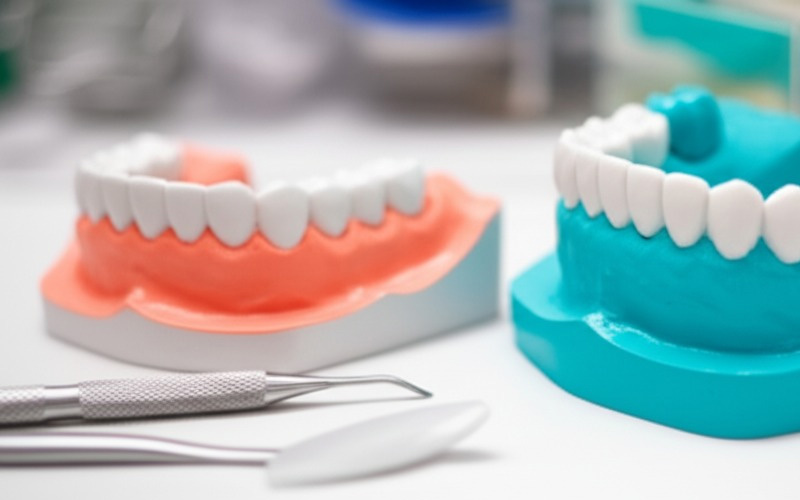
A hard night guard is a full-coverage occlusal appliance built to sit over one arch and take the load when a patient clenches or grinds. It’s the design most dentists reach for once wear, cracked cusps, or recurring restoration damage show up in the chart — and it’s the design we build every week for clinics, dental groups, and other labs that need it done right the first time.
We’re a full-service dental lab, not a broker. Every hard night guard that leaves our facility was designed, formed, and inspected under one roof — no case gets handed off to a third party partway through.
What “Hard” Actually Means Here
Terminology in this category gets used loosely, so it’s worth being precise.
A hard night guard has a rigid occlusal surface — the layer that actually contacts the opposing teeth is stiff, not flexible. That’s different from a soft guard (flexible material throughout) and different again from a dual-laminate guard, which pairs a soft inner layer with a hard occlusal layer. Under ADA guidance on documenting occlusal guards, even a dual-laminate appliance is coded as a hard appliance once its occlusal surface is hard — the soft layer underneath doesn’t change the classification.
You’ll also see this appliance called a hard occlusal guard, an occlusal splint, an orthotic device, or a bite guard. The American College of Prosthodontists describes an occlusal splint as a specially designed mouthguard for people who grind their teeth or have a history of jaw-joint discomfort tied to their bite — the more clinical cousin of what patients usually just call a night guard. We use these terms interchangeably here because that’s how a prescribing dentist and a lab actually talk to each other; what matters for fabrication is the design your prescription specifies, not which label gets used on the Rx.
A related but distinct request is a hard acrylic night guard — a hard guard where the rigid layer is a dense, heat-processed material rather than a thermoformed sheet. If your case calls for that specific route, flag it on the Rx; we’ll confirm the material path with you before production starts rather than assume.
Why Dentists and Labs Send Us Their Hard Night Guard Cases
We build to your Rx — we don’t guess at the design. Hardness, thickness, arch selection, and coverage are clinical calls that belong to the prescribing dentist. Our job is to execute that prescription accurately. If a detail is missing from the paperwork, we contact you before we start rather than fill the gap ourselves.
Full in-house production, no outsourcing. ASD Dental Lab has run every stage of production internally since 2012 — case intake, model work, fabrication, quality control, and packaging all happen at our own facilities in Shenzhen and Huizhou. Nothing gets routed to a subcontractor partway through a case.
A production team sized for volume without cutting corners. Around 460 staff work across our facilities, including dedicated CAD design, milling, and quality-control departments. That scale keeps turnaround steady during busier periods instead of pulling technicians off other case types to cover a backlog.
Three-stage quality control on every case. Every hard night guard passes through an intake check, a mid-process inspection, and an independent final review before it ships — the technician who built the appliance doesn’t sign off on it. If a case doesn’t clear final inspection, it’s corrected and re-run automatically, before it ever reaches you.
We work with the records you already take. A wax bite registration, a digital bite scan with mounted-cast verification, upper or lower arch per your preference — intake fits standard clinical workflow rather than asking you to change how you take records.
International experience without losing the specifics. We’ve produced restorations and appliances for more than 50 dental laboratories, 100+ clinics, and 400+ dentists, mainly across the United States and Europe — Netherlands, Germany, France, Belgium, Austria, UK, Luxembourg, Switzerland. Cross-border shipping and documentation are routine for us, not a special case.
What a Hard Night Guard Is Actually For
A hard night guard’s job is straightforward: put a durable barrier between the arches so clenching and grinding forces land on the appliance instead of on enamel, restorations, and the joint. The American College of Prosthodontists and a review indexed on PubMed Central both frame occlusal splints this way — as a protective, load-distributing device, not a fix for the underlying habit.
That distinction shapes how we’d describe the typical indications:
- Tooth wear, cracked cusps, or repeated restoration fractures tied to clenching or grinding are the clearest case for a full-coverage hard design.
- Protecting existing restorative work — crowns, veneers, bridges, implants — is a common reason a dentist specifies a hard guard rather than a soft one; a rigid occlusal surface holds up better under sustained contact than a flexible one does.
- TMD-related muscle or joint symptoms are a separate conversation. A hard occlusal guard can be one conservative, reversible option a dentist considers, but the National Institute of Dental and Craniofacial Research notes that evidence on which appliance designs help TMD symptoms most is still limited — which is exactly why appliance choice for TMD-related cases should follow the treating dentist’s clinical judgment rather than a lab default.
A systematic review on occlusal splints for sleep bruxism reaches a similarly measured conclusion: evidence that splints reliably stop nighttime grinding is limited, even though appliances remain a standard way to reduce the physical toll grinding takes on teeth. We think that’s the honest framing to build from — a hard night guard protects the dentition; it doesn’t promise to change a habit, and we won’t describe it as if it does.
How We Build a Hard Night Guard
We currently produce occlusal guards — hard, soft, and dual-laminate designs alike — through a thermoforming process: a rigid sheet material is heated, seated over the working cast under controlled pressure, and cooled through to a stable, hardened state before trimming. It suits consistent wall thickness and a clean fit against the cast, and it’s the route we run for the majority of hard night guard and hard occlusal guard cases today.
Design specifics — hardness, thickness, and whether the case calls for a hard, soft, or dual-laminate build — follow your prescription. We don’t default to one thickness across every case; that decision sits with the prescribing dentist based on the patient’s bite and wear pattern. If your Rx doesn’t specify a value, we’ll reach out and confirm before we form the appliance rather than guess.
Our production sequence for a hard night guard case:
- Case intake and review — impressions, digital scans, or bite registrations (typically a wax bite record) come in and get checked against the Rx before anything is mounted.
- Model work and mounting — working and opposing casts are poured, or the digital scan is aligned, then mounted using your bite registration. Where a specific mandibular position is prescribed, we verify the mounting against that record before moving forward.
- Design confirmation — arch selection, coverage, and occlusal scheme are checked against the prescription. If anything is ambiguous, we contact you rather than assume.
- Fabrication — the appliance is thermoformed to the specified hardness and design, then trimmed to the prescribed borders.
- Finishing — borders are smoothed, undercuts relieved, and the occlusal surface adjusted to the mounted bite before polishing.
- Quality control — three checkpoints: an intake check, a mid-process inspection, and an independent final review by staff who did not fabricate the appliance. Fit, border smoothness, and occlusal contact are verified against your Rx before anything ships. A case that doesn’t clear final inspection is corrected and re-run automatically — it doesn’t reach you first.
- Packaging and shipment — each case is cleaned, individually packaged with patient identification, and shipped with case-matched documentation.
If you’d like to see this in person, our facilities in Shenzhen and Huizhou are open for factory visits, production line tours, and video inspections — arrange one through our sales team whenever a full audit makes more sense than a description on a page.
What We Need From You to Start a Case
A hard night guard case moves fastest when the paperwork matches what production actually needs:
- Impressions or digital scans of the arch receiving the guard, plus an opposing-arch record.
- A bite registration — a wax bite record is standard; if the design requires a specific mandibular position (centric relation, for example), note the method used to capture it.
- Arch selection (upper or lower) and the appliance type: hard, soft, or dual-laminate.
- Design instructions — coverage (full arch is standard for a stabilization design), occlusal scheme, hardness, and any thickness or border preferences.
- Anything case-specific — existing restorations, implants, orthodontic appliances, or areas requiring relief.
If a required detail is missing, we’ll follow up before starting rather than fabricate on an assumption. You’re also welcome to set your own acceptance criteria — bite, esthetic, or design preferences — in writing at the design-approval stage, and we’ll hold the case to that standard at final inspection.
Quality and Turnaround You Can Verify
We don’t ask you to take fit and finish on faith. On request, we can provide quality-control photos before a case ships, so you can confirm border extension, occlusal contact, and finish before it’s in the mail. Every appliance that doesn’t pass independent final inspection is corrected and re-run at no additional step on your end — that’s a standing part of our QC process, not an exception we make when something goes wrong.
We hold roughly 460 staff across CAD design, production, and quality control, which keeps turnaround steady through busier periods rather than sliding when volume increases. If you’re evaluating us for an ongoing case flow rather than a single case, our team is available to walk through capacity and typical scheduling for your volume.
Frequently Asked Questions
Is a hard night guard the same as a hard occlusal guard?
Yes, in practical terms. “Night guard” is the term used most often in casual and even clinical conversation; “occlusal guard” and “occlusal splint” are the more formal terms for the same category of appliance. What determines fabrication isn’t which name is used — it’s the prescription: hard versus soft versus dual-laminate, arch, coverage, and occlusal design.
What material do you use for a hard acrylic night guard?
We currently produce hard, soft, and dual-laminate guards through a thermoforming process using rigid sheet material for the hard component. If your case specifically calls for a different material path, note it on the Rx and we’ll confirm feasibility with you before starting production — we don’t substitute materials without checking first.
Can you match a specific thickness or hardness?
Thickness and hardness are prescription-driven rather than fixed by us. Specify the values you want on the Rx; if a value isn’t specified, we’ll contact you to confirm before fabrication rather than default to a standard we choose ourselves.
What if the guard doesn’t fit correctly when it arrives?
Cases that don’t clear our independent final inspection are corrected and re-run before they ship — that’s standard, not an exception. If a fit issue turns up after delivery, our standard rework policy covers correction; ask our sales team for the specifics that apply to your account.
Do you accept digital scans, or do you need physical impressions?
Both. We work with digital intraoral scans and traditional impressions, along with wax or digital bite registrations. Let us know which format you’re sending so intake routes the case correctly.
Can we visit the facility or see the production line before committing to a volume order?
Yes. Factory visits, production line tours, and video factory inspections can all be arranged through our sales team — useful if you’re vetting us for an ongoing case flow rather than a one-off case.
Send Us Your Next Hard Night Guard Case
If you’re ready to send a case — or just want to confirm turnaround, capacity, or a specific design question before you do — reach out to our team with your case details. We’ll walk through what we need and get your first case moving.
References above are provided for context on terminology, coding, and general clinical framing; they describe standards and research on occlusal splints as a category, not claims about any specific product. Links are marked nofollow and point to the original publishing organizations, not to any commercial storefront.
- American Dental Association — Documenting Occlusal Guards with Hard and Soft Components
- American College of Prosthodontists — Occlusal Splints
- PubMed Central — Occlusal splints: types and effectiveness in temporomandibular disorders
- National Institute of Dental and Craniofacial Research — TMD (Temporomandibular Disorders)
- PubMed Central — Occlusal splints for treating sleep bruxism (systematic review)