Full Mouth Dental Implants for Seniors: A Screw-Retained Maxillary Full-Arch Case
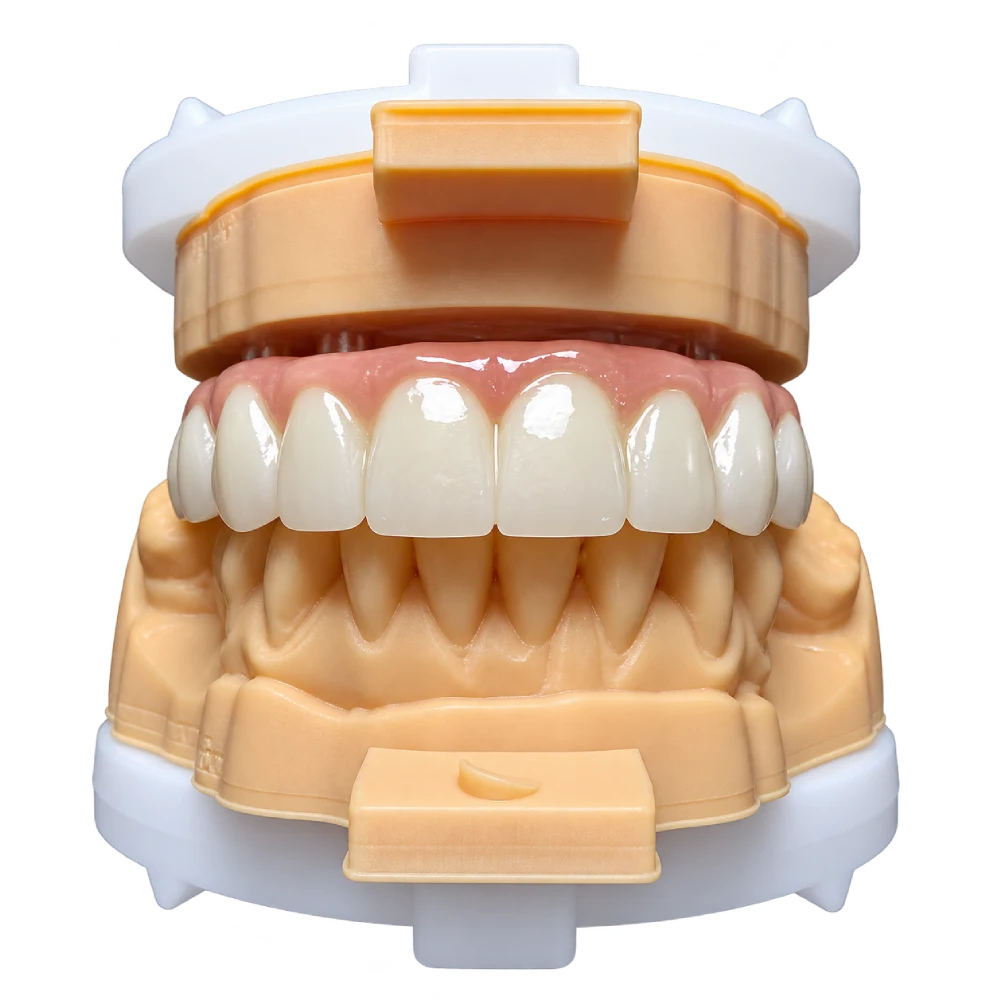
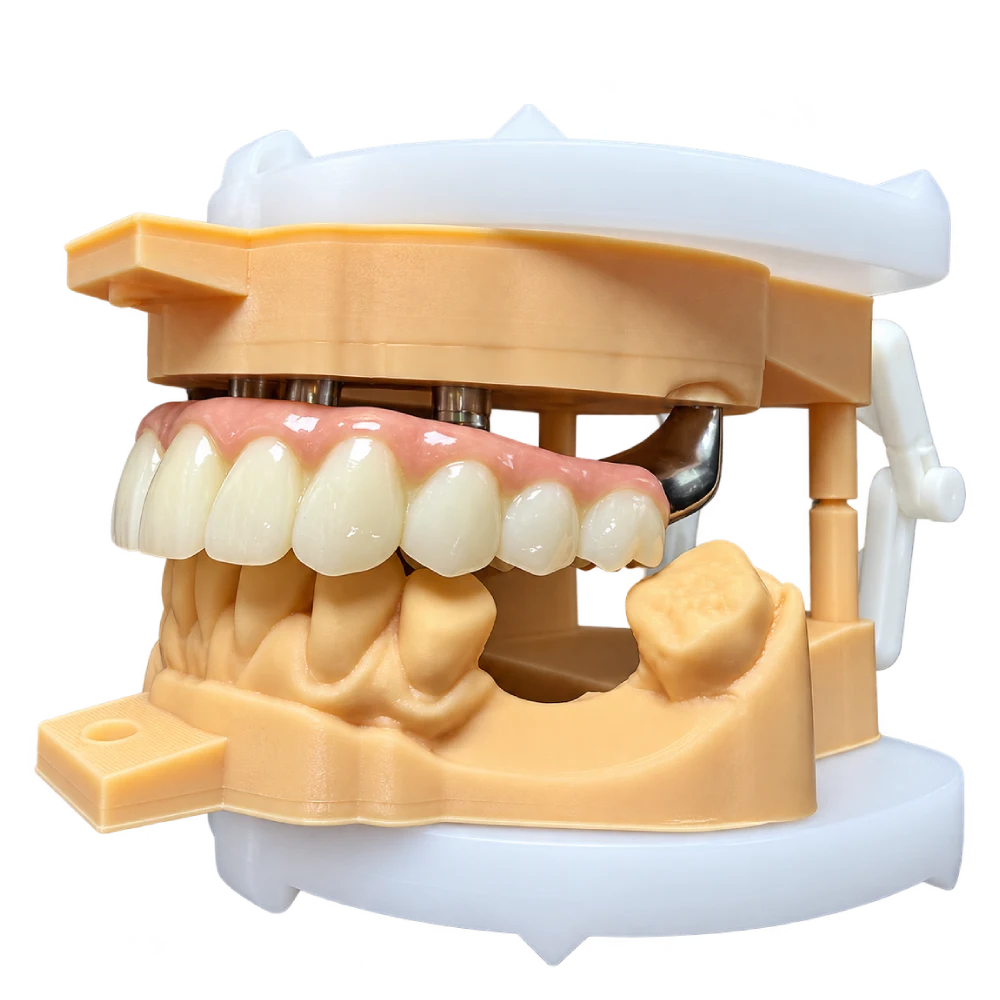
This is a de-identified case record from a laboratory that processes full-arch implant prostheses for clinicians who treat edentulous patients. The patient in this case had worn a removable complete prosthesis for an extended period, with advanced ridge resorption and declining function—a clinical presentation common among seniors seeking full mouth dental implants. The surgeon elected an implant-supported full-arch prosthesis so that support is transferred from the mucosa to the implants, removing the case’s dependence on the residual ridge. What follows is the fabrication record, written to show the constraints, the design decisions, and the feedback that followed delivery.
The Patient Behind These Full Mouth Dental Implants for Seniors
An edentulous adult maxillary case, opposing a partially restored natural dentition. The patient had worn a removable complete prosthesis for an extended period, and the residual ridge showed advanced resorption with limited mucosal support. The medical history recorded a managed metabolic condition and a history of long-term tobacco use, since discontinued under the surgeon’s protocol, both noted as post-operative modifiers.
The functional problem was not that the prosthesis did not fit but that the foundation for the prosthesis no longer existed. Retention of the removable prosthesis had declined to the point that function and dietary range were affected. The limiting factor was the absence of support, not the design of the prosthesis.
The surgeon’s clinical question was: Can we restore function without relying on what is no longer there?
The answer was a transition to implant support. The surgeon elected an implant-supported full-arch prosthesis so that the load is carried by the implants rather than the mucosa, and the case is no longer dependent on the residual ridge height.
Prior Dental History
- Long-term removable complete prosthesis wearer (maxilla)
- Progressive decline in retention and functional capacity
- Managed systemic metabolic condition
- Former tobacco user (discontinued under pre-operative protocol)
Full-Arch Implant Restoration: Design Challenges
Two factors shaped the fabrication path:
- Prosthetic space: Vertical dimension between the implant platform and the opposing occlusal plane was measured at approximately 12–13 mm in critical zones. Monolithic zirconia requires minimum 14–15 mm for adequate thickness and emergence profile. Where space is insufficient, the material option shifts to acrylic-hybrid.
- Implant divergence: The implant axes were not parallel. Screw-access channels must align with the screw axis while maintaining structural integrity of the prosthesis. In divergent cases, channel angulation is confirmed during verification, and final characterization is held until try-in validates the occlusal scheme.
The Surgeon’s Fabrication Brief
The surgeon’s instructions governed the fabrication sequence and material selection. Below is what the clinician asked the laboratory to produce:
Interim Phase
- Screw-retained reinforced interim prosthesis: PMMA-type base on a cast framework
- Tissue surface relief: Designed to avoid pressure on healing mucosa
- Chairside adjustment capability: Structure allows occlusal modification during the osseointegration phase
Definitive Phase
- Screw-retained, retrievable full-arch prosthesis
- Primary material: Monolithic zirconia suprastructure on milled titanium substructure (where prosthetic space permits)
- Fallback option: Acrylic-hybrid suprastructure (where prosthetic space cannot meet zirconia thickness requirements)
Framework Construction
- Milled from a single titanium blank—no soldered joints
- Ensures structural continuity and eliminates weak points at solder interfaces
Records and Verification Sequence
- Open-tray verification jig: Captures implant positions before definitive fabrication
- Verified interocclusal record: Establishes occlusal relationships for try-in appointment
- Try-in before final characterization: Occlusion validated in the mouth; final characterization deferred until try-in confirms fit
Abutments
- Custom abutments matched to specific implant platform and connection geometry
Occlusal Scheme
- Distal contacts reduced under lateral excursions: Minimizes lateral load on posterior implants
- Light, retrievable occlusal contacts: Designed for post-delivery adjustment without compromising prosthesis integrity
Documentation Requirements
- Material batch, brand, and country of origin recorded per case
- Certificates of conformity available for the clinician’s file upon request
How the Case Was Built
1. Data Capture
Open-tray impression copings transferred implant positions to the master model. The interocclusal record captured the vertical dimension and centric relation. Prosthetic space was measured between the implant platform and the opposing dentition to confirm material eligibility—the surgeon’s brief specified monolithic zirconia as primary option where space permits, with acrylic-hybrid as fallback. In this case, space in critical zones measured 12–13 mm, below the 14–15 mm threshold for zirconia; acrylic-hybrid was selected.
2. Design
The titanium substructure was designed with screw-access channels angled to align with the divergent implant axes, per the surgeon’s requirement for a screw-retained, retrievable prosthesis. Tissue-side relief was incorporated to eliminate mucosal loading. The occlusal scheme reduced distal contacts under lateral excursions as specified in the surgeon’s occlusal brief. The design file was approved before milling.
3. Substructure Milling
The titanium framework was milled from a single blank—meeting the surgeon’s directive for no soldered joints. Post-milling inspection confirmed dimensional accuracy and screw-channel patency.
4. Verification
A screw-retained verification jig was fabricated and sent to the surgeon for intraoral confirmation of fit. This step directly fulfilled the surgeon’s requirement for an open-tray verification jig and try-in before final characterization. The surgeon confirmed fit and returned the jig with occlusal adjustments marked. Final characterization proceeded only after try-in validated the occlusal scheme.
5. Delivery
The completed prosthesis was delivered with screw-access holes patent for chairside insertion. Documentation included material batch, brand, and country of origin per the surgeon’s specification, with certificates of conformity provided for the clinician’s file. Written maintenance instructions were embedded in the delivery package.
After Delivery: Patient and Surgeon Feedback
Patient Response at Try-In and Final Delivery
The patient reported improved stability and confidence during function at the try-in appointment. Retention concerns that had limited dietary choices with the removable prosthesis were no longer present. At final delivery, the patient noted ease of hygiene access compared to previous experience with a tissue-borne prosthesis.
Surgeon’s Post-Delivery Notes
The surgeon confirmed that the verification jig fit passively at try-in, validating the accuracy of the master model. The occlusal scheme required minor adjustment at delivery—distal contacts were further refined chairside to reduce lateral load. The screw-retained design allowed post-delivery modification without compromising the integrity of the prosthesis. The surgeon noted the acrylic-hybrid material selection as appropriate given the prosthetic space constraint, and the interim-to-definitive sequencing as effective in managing the patient’s healing timeline.
Why This Case Represents What We Do
ASD isn’t competing on “cheapest full-arch prosthesis” or “fastest two-day turnaround.”
We’re competing on “you sent us a complicated case, and we built exactly what you prescribed — first time, passive fit, no remakes.”
That requires:
- Full in-house workflow: CAD through final polish — no outsourcing steps to third-party mills or offshore partners.
- Experienced team: ~460 technicians across two facilities in Shenzhen and Huizhou.
- Digital planning capacity: ~100 CAD designers who handle non-parallel implant cases weekly.
- Traceability on demand: Batch certs, material origin docs, lot numbers — provided per case upon request.
We handle full mouth dental implants for seniors where the actual patient reality doesn’t match the textbook case:
- Limited bone
- Divergent implants
- Medical comorbidities
- Tight prosthetic space
- High maintenance requirements
The prescription governs the design. Not our inventory. Not our production defaults.
You tell us what the case needs. We build it. That’s the service model.
Full-Arch Implant Materials and Manufacturing Capabilities
Materials We Stock for Full-Arch Implant Cases:
- Monolithic zirconia: 3Y-TZP and 5Y-TZP, multiple translucency grades
- Milled titanium bar stock: Grade 5 Ti-6Al-4V, vendor-supplied lot documentation
- Heat-polymerized PMMA: Lucitone 199 and domestic high-impact resins
- Injection-molded thermoplastic denture base: When specified
- 3D-printed interim base resin: SLA and DLP
- Composite resin denture teeth: Multi-layer chromatic
- Acrylic resin denture teeth: Economy and premium lines
Fabrication Capacity
| Product / Category | Normal Season Capacity | Peak Season Capacity |
| All-on-X / Full-Arch Prostheses | ~20 arches / month | ~40 arches / month |
| Removable Dentures | ~4,000 cases / month | ~6,500 cases / month |
| Zirconia Single Crowns | ~8,000 units / month | — |
Quality Framework
- ISO 13485 Medical Device Quality System: Covers design controls, risk management, corrective/preventive action — the standard dental device manufacturers build their QMS around.
- CE Marking: EU MDR Annex XIII custom-made device notification (covers prostheses, not implant bodies).
- FDA Establishment Registration + Device Listing: Interim and definitive restorations listed (implant components not in scope).
Regulatory Note: Wording matters here: these are registrations and notifications, not clearance claims. The regulatory distinction is worth being precise about when a practice asks what paperwork we actually hold.
How to Start a Case Like This
If you’re planning a full-arch implant case for a senior patient with similar constraints (limited bone, non-parallel implants, high hygiene needs), here’s the cleanest workflow:
- Send the prescription early:
Don’t wait until surgery day. If there’s a prosthetic space concern or material question, we can flag it during planning. - Request digital planning preview:
We can send you the proposed substructure design and screw access paths before any milling. It is much easier to adjust at the CAD stage than after the bar is cut. - Specify material traceability needs upfront:
If your state board or patient requires batch documentation, tell us at case submission. We pull it per request (not auto-included on every case). - Use the two-phase protocol when primary stability is borderline:
Interim PMMA prosthesis during integration, definitive after confirmation. This reduces remake risk if an implant fails to integrate. - Plan for verification jigs and try-ins:
A passive fit check at the metal framework stage catches problems before final prosthesis fabrication. It costs an extra appointment but saves a full remake.