Zirconia Inlay from a Lab-Direct Manufacturer: Protocol, Materials & Turnaround


For dentists, dental clinics, dental hospitals, and dental laboratories evaluating a zirconia inlay workflow. This page walks through what we make, how we make it, what we ship, and what we cannot promise. Numbers that depend on a specific case come back as a conversation, not as a footnote.
What this page covers
If you already send zirconia restorations to a full-service dental lab and you’re comparing shops, the long version below covers everything our team treats as a routine handoff: materials, design rules, cementation protocol, turnaround, pricing logic, and what we do when a case needs a remake. If you’re a clinician or a dental laboratory that’s never ordered a zirconia inlay from an overseas lab before, start with the What a zirconia inlay is, in one paragraph section and follow the links.
We wrote this page for clinicians and lab-side decision makers, not for patients. Pricing here is the lab fee side of the equation — what a clinician pays ASD, not what a patient pays the practice.
What a zirconia inlay is, in one paragraph
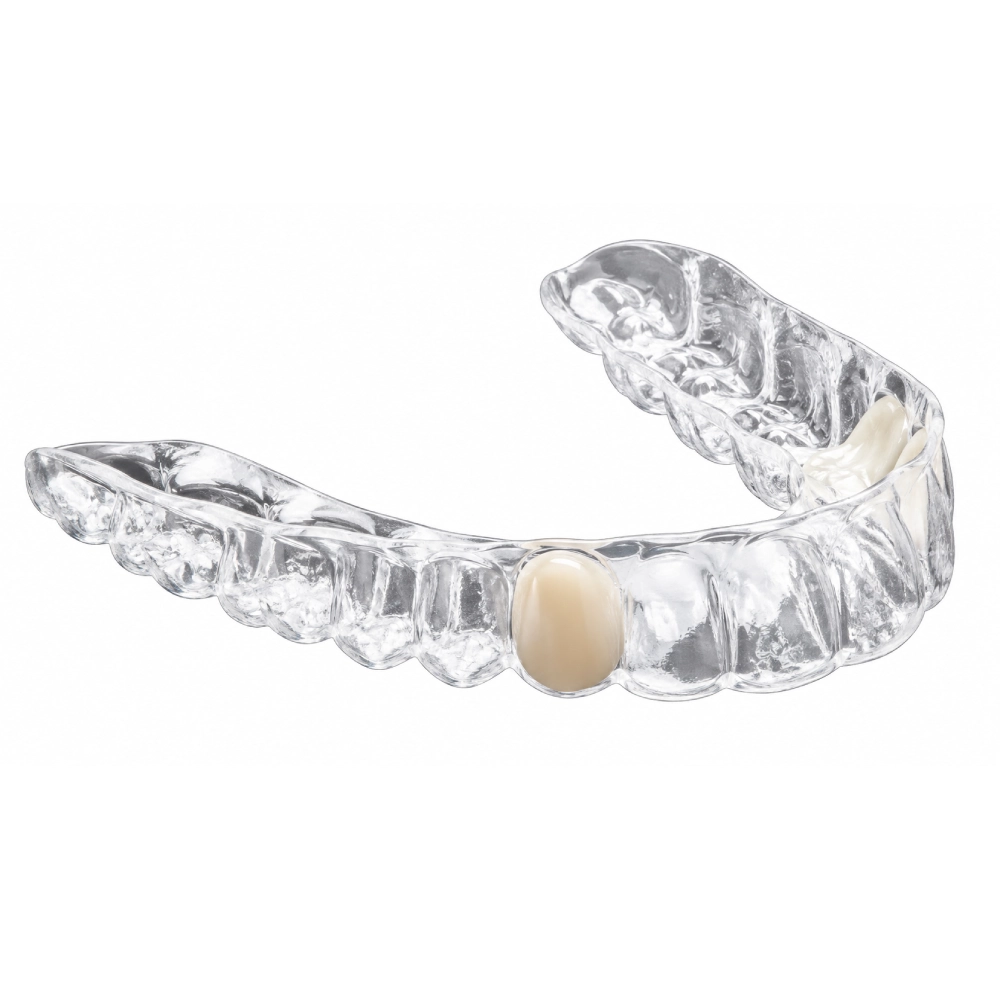
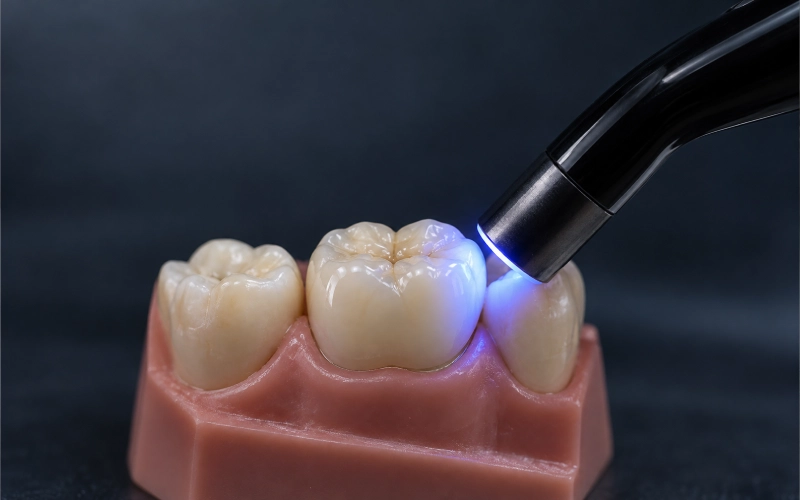
A zirconia inlay is an indirect, lab-fabricated restoration that fits inside the cusps of a posterior tooth (it does not cover cusps — once a cusp is covered you are talking about an onlay or overlay). It is milled from yttria-stabilized zirconia, sintered, and cemented with an adhesive resin protocol. The ADA classifies the underlying material under ADA oral-health topic: materials for indirect restorations, and the relevant material standard is ISO 6872:2015 (dental ceramics standard), which sets the flexural-strength and chemistry requirements for dental ceramics.
In the broader market, zirconia crowns are the dominant indirect restoration. Zirconia inlays specifically are a much smaller slice — long-term published data and clinical guidelines on inlays are also smaller than the data we have for crowns. We treat that asymmetry as a design constraint: every claim below is labeled either as a general industry claim (backed by the ADA, ISO, or peer-reviewed literature) or as an ASD Dental Lab internal practice (backed only by our own QA records).
For clinicians who already offer ceramic inlays and onlays and want to understand where a zirconia inlay specifically sits in the material choice, the rest of this page walks through what changes and what stays the same.
Who makes this for you — ASD Dental Lab
ASD is a full-service dental laboratory founded in 2012, with production facilities in Shenzhen and Huizhou, China. We are a direct manufacturer, not a trading company or middleman — every step from case intake to final inspection happens inside our facilities. About 460 technicians split across CAD design, milling, implant, ceramic & metal, removable denture, customer service, and QA, plus ~50 backup workers for peak-season capacity. In an average month we produce roughly 8,000 zirconia single crowns, 2,000 zirconia bridge cases, and 20 All-on-X arches; in peak season those numbers roughly double.
We routinely ship to dental laboratories, dental clinics, and individual dentists across the United States, the Netherlands, Germany, France, Belgium, Austria, the United Kingdom, Luxembourg, Switzerland, and other European markets. If you are evaluating a dental laboratory for zirconia inlay work, our position in plain terms: we treat zirconia inlays as a specialty line under the same in-house workflow that handles full-contour crowns and bridge cases, with the same technician pool, the same QC department, and the same case-coordination team. The difference is the design rules, the cementation protocol we recommend, and the post-delivery expectations.
If you are an outsourcing dental laboratory comparing ASD against a domestic dental lab, see our guide to outsourcing dental lab cases to China for the supplier-qualification workflow, and our post on bridging the gap between dentists and dental laboratories for the communication mechanics that make the relationship work.
Materials we mill zirconia inlays from
We mill zirconia inlays from yttria-stabilized zirconia (3Y-TZP, 4Y-PSZ, or 5Y-PSZ depending on the case brief) sourced from brands we have validated on our milling machines. Material batches are traceable per case, and on request we can ship the brand, country of origin, batch number, and conformity certificate alongside the case.
For the chemistry behind those materials — the difference between 3Y-TZP, 4Y-PSZ, and 5Y-PSZ, the flexural-strength trade-offs, and how translucency vs. strength tracks with yttria content — the PMC 11098698 review and the MDPI Materials (zirconia material properties) paper are the readable starting points.
Material choice — where zirconia inlay sits among the four common options
The four materials clinicians most often compare for an inlay:
- Zirconia (Y-TZP / PSZ): highest flexural strength, lowest translucency, adhesive bond requires 10-MDP primer after airborne-particle abrasion; the topic of this page
- Lithium disilicate (e.max): highest translucency, lower antagonist wear than zirconia, etchable with HF and bondable with silane; a separate product line we also mill
- Cast gold alloy: longest published track record; rarely chosen today for aesthetic zones but still used for high-load posterior cases; not a milled product in our workflow
- Indirect composite (laboratory-fabricated): lowest cost per unit, easier to adjust intraorally, lowest long-term wear resistance; we mill or press this as a separate product line
Tooth-specific preparation, cementation, and design
This is the part where the five commercial pages go quiet. It is also the part where we have the most to say, because it is where inlays actually succeed or fail.
Preparation geometry
For an inlay (cusps preserved), the working numbers our CAD team treats as the default envelope are:
- Occlusal isthmus width: roughly 1.5-2.0 mm in dentin, depending on the brand of zirconia disc
- Marginal chamfer / shoulder: 0.8-1.0 mm with rounded internal line angles
- Cusp capping: none for an inlay; partial for an onlay; full for an overlay
- Taper: 6-10 degrees total convergence
Indications and contraindications (when to send, when not to send)
A zirconia inlay is the right choice when the case brief checks all of the following:
- The tooth is a permanent posterior (premolar or molar) with adequate remaining enamel for adhesive bonding — typically 50% or more enamel at the cavosurface margins
- The cavity is an inlay-class preparation (cusps preserved); if a cusp is missing or thin, the case is an onlay or overlay, not an inlay
- The patient can isolate the field (rubber dam or equivalent) for cementation
- The occlusal scheme and remaining tooth structure will not generate uncontrolled flexure under load (very thin residual walls are a contraindication)
A zirconia inlay is the wrong choice (and we will tell you so on the Rx call) when:
- The patient has parafunctional heavy load and the cavity extends below the CEJ
- The remaining enamel at the margin is too thin for an MDP-based bond to hold long-term
- The opposing dentition has a heavy restorative or implant situation where antagonistic wear is a known concern — in those cases, the PMC antagonist-wear study and the JIPS 2024 (antagonist enamel wear study) paper both walk through the wear-direction question
- The patient has a documented allergy or sensitivity to yttria-stabilized ceramics (rare but not zero)
Cementation protocol we recommend (and document per case)
The single most important number in our protocol is the bonding step. Zirconia is a glass-free ceramic; the resin bond to its surface depends on a phosphate-monomer primer (10-MDP) after airborne-particle abrasion and after phosphate contamination is removed. Without all three, the inlay debonds — the literature is consistent on this, and our internal QA records show the same.
The protocol we ship with every zirconia inlay:
- Try-in; verify fit, margins, contact, occlusion
- Clean the intaglio (alcohol wipe or ultrasonic; we do not use phosphoric acid on the intaglio — phosphoric acid does nothing useful on zirconia and creates phosphate contamination that destroys the MDP bond)
- Airborne-particle abrasion with 50 micron Al2O3 at roughly 2.5 bar, then ultrasonic clean
- Apply a 10-MDP–containing primer (we recommend any one of the major commercial brands; we do not require a specific brand as long as the active monomer is 10-MDP)
- Use a dual-cure or chemical-cure resin cement; we do not recommend light-cure-only cements for zirconia because the cement does not reach full conversion under a thick or opaque restoration
- Tack-cure, remove excess, then full cure (full polymerization)
For dental laboratories that already cement composite inlays and onlays on their bench and want a side-by-side comparison, the difference is exactly at steps 2 and 4: composite inlays tolerate a phosphoric-acid etch step that zirconia does not, and they do not need an MDP primer because the bond is to a silica-containing filler network rather than to a polycrystalline zirconia surface.
Post-delivery expectations (what to tell the patient)
The clinical literature is consistent on what a patient should expect after a zirconia inlay seating:
- Cold sensitivity in the first 2-4 weeks: common, related to the bonding step and the temporary cement clean-up; the PMC long-term study reports this pattern in the early post-op window. We expect this to resolve; if it persists past 6 weeks, the case needs a follow-up occlusal and margin check.
- Bite adjustment: typically needed once, at the seating visit, on at least one occlusal contact. Light-cure-only cements do not allow post-seating adjustment; the dual-cure or chemical-cure cements we recommend do.
- Marginal discoloration or chip: not a diagnostic at any time-point; the PMC paper on marginal integrity, the J Prosthet Dent clinical-outcomes paper, and the JADA ceramic restoration evidence review are the readable starting points for what marginal discoloration means and does not mean.
A patient should plan on a 6-month follow-up radiograph and then annual bitewing review; that cadence matches the ADA’s general recommendation for indirect restorations.
Regulatory status (FDA / ISO / CE / UKCA / MDR)
For the lab-side regulatory framing — what the various marks and notices mean and do not mean for a custom-fabricated zirconia inlay:
- FDA (US): no product code is keyed on the exact phrase “zirconia inlay.” Custom lab-fabricated inlays are reviewed under the general eCFR 21 CFR 872.3275 (crown and bridge resin) framework. The FDA dental device classification overview and the FDA 510(k) K181816 (dental CAD/CAM material) summary (an example CAD/CAM material clearance) are the readable entry points. Anyone claiming a specific FDA product code for “zirconia inlay” is reading the regulation wrong — there isn’t one.
- ISO 6872: the underlying material standard. The ISO 6872:2015 (dental ceramics standard) page is the canonical reference for flexural-strength and chemistry requirements for dental ceramics.
- CE / UKCA / EU MDR: the EU Medical Device Regulation framework applies to dental laboratories placing custom-made devices on the EU market. A custom-made zirconia inlay is regulated as a Class IIa custom-made device in the EU MDR framework (Annex VIII Rule 6); the manufacturer’s declaration per Article 16A is the relevant artifact, and the Blatz & Alvarez compendium on zirconia bonding (2016, hosted PDF) is a readable cross-reference on the bonding step.
This is the regulatory layer we are willing to publish; claims beyond it (a specific FDA approval number for the inlay, a specific CE certificate number, etc.) should come with documentation on request.
Turnaround, case logistics, and what to send us
This is the part that varies by clinic and by dental laboratory, so we treat it as a contract rather than a fact. The numbers below are the working cadence for a routine zirconia inlay; they reset to per-case discussion as soon as something is non-routine.
Standard turnaround: 2-3 lab days for a routine single-unit zirconia inlay from the moment we accept the case file, where “lab day” means a working day in our Shenzhen / Huizhou facility. The 2-3 day window covers digital design, CAM milling, sintering, hand-finishing, quality inspection, and packaging. We will not ship on a calendar day until the case passes internal QC.
Rush cases: Yes, we accept rush cases. The internal rule, to keep it concrete: 10 or fewer rush cases per month per account, no rush surcharge; above that, we re-quote. We do this because a rush case that preempts a scheduled case is a tradeoff, not a free option.
What to send us:
- Digital intraoral scans or lab scans in STL, PLY, OBJ, DCM, or 3Shape / exocad native design files. For aesthetic cases where shade / texture / glaze characterization matters, send the PLY with color rather than the STL — STL has no color information and we will need to call you to clarify shade.
- For physical impressions: standard PVS or alginate impressions in a rigid tray, with the opposing arch and a bite registration. We disinfect on receipt (we do not return impressions; we scan or pour and store the model per your instruction).
- A prescription (Rx) — we can ship a downloadable Rx and case checklist, and we accept photos, diagnostic wax-ups, or old prostheses as reference. If the prescription and the scan disagree, we pause and call you before milling.
What happens when a zirconia inlay case needs a remake
We call it the remake policy rather than a “warranty,” because “warranty” implies a promise that a zirconia inlay will not fail. We can’t make that promise — neither can any dental laboratory.
What we do promise:
- Manufacturing defects (milling porosity, sintering cracks, margin mismatch from our scan-to-design step, material defect verified by batch certificate) are remade at no charge.
- Fit failures that we determine, on inspection of the returned unit and the model, are lab-side are remade at no charge.
- Fit failures that we determine are clinic-side (insufficient reduction, undercut in the prep, distorted impression, prescription mismatch) are billed at the standard unit price for the remake.
- Cases over 5 years post-delivery are reviewed case-by-case; we don’t publish a hard cutoff, but a 6-year-old debond is rarely a lab defect.