Zirconia Crown for Posterior Teeth: Molar Case Study


This is one posterior case, written up from the side of it that a laboratory sees: a mandibular second molar, root canal treated and never crowned, sent to us for full coverage. What follows is the condition of the tooth, why a full-contour zirconia crown was specified for it, the obstacles the case raised, what the clinician required of us in each of those, what came back with the unit, and what the patient and the clinician told us at try-in.
The case: a mandibular second molar, root canal treated and never crowned
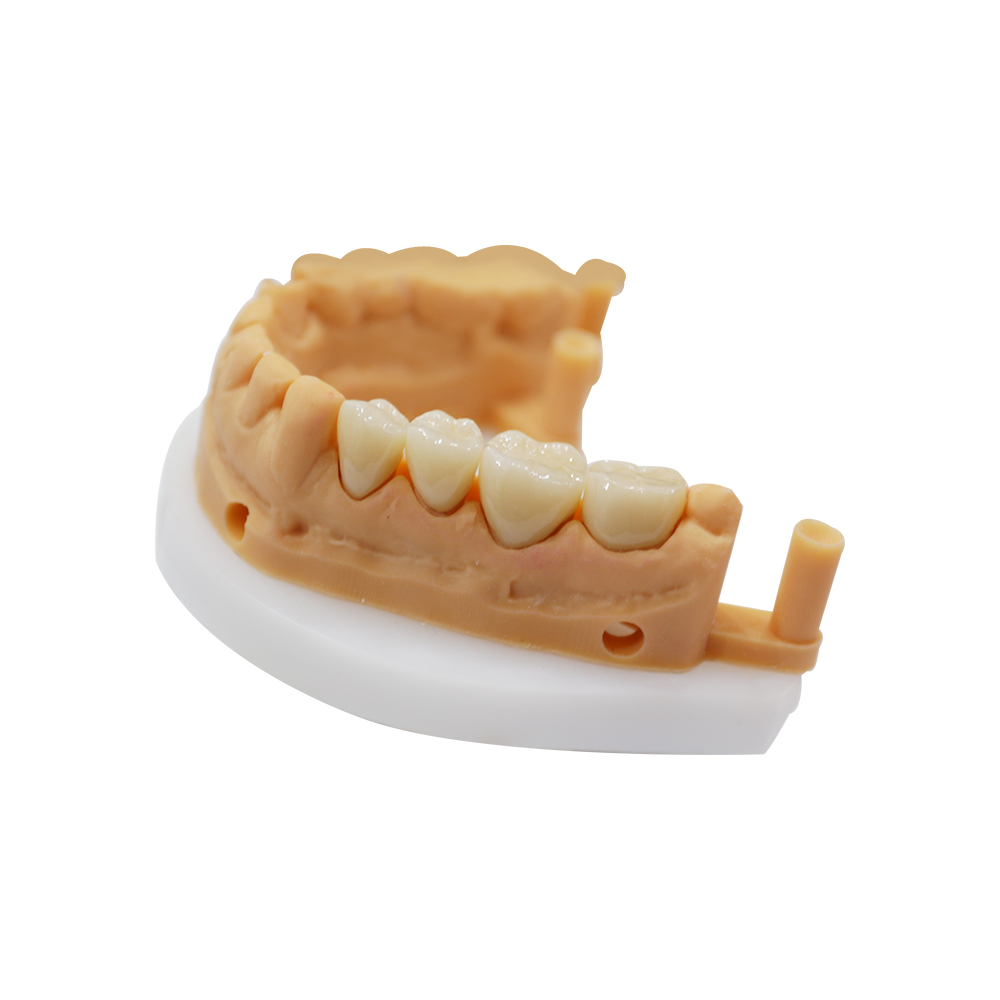
The tooth was the lower second molar on the patient’s right side. It had been endodontically treated and the root filling completed. It never received a crown, so between the end of that treatment and the day of the preparation the only material carrying the occlusal load was the composite core build-up placed over the access. That core had been chipping at the margins over time — first in small fragments, then in larger pieces — and the coronal tooth tissue left underneath was both reduced and compromised.
The case notes that came in with the impression showed a few specific things about the condition. The remaining tooth structure was sound but short, and once the failing core was removed the finish line sat just under the gingival margin in two places. The opposing upper molar on that side was intact and showed no wear facets, which meant the contact area on this unit was taking the full load it had always taken. The vertical clearance available at the central fossa, measured from the scan, was tight — in the region of 1.2 to 1.5 millimetres — and the clinical record described the occlusal load as heavy.
The clinician’s brief was equally so: do not reduce further than necessary, do not open the bite, and do not put porcelain over the zirconia. The patient had a porcelain-fused-to-metal crown on the adjacent molar on the lower left that had chipped once already, and neither side wanted to repeat it.
Posterior Zirconia Crown Design Requirements
Four things on this case could not be assumed away. For each, the clinician set out what was needed from the laboratory.
| Obstacle | What the clinician required | What we did |
| Retention. The coronal core had been chipping and the remaining preparation height was short for the material specified. | Replace the core with adequate resistance form, and state the taper and height the intended cementation route would need — before design. | Confirmed the figure before design. For conventional or self-adhesive cementation the preparation has to provide mechanical retention: a taper in the region of 4–8°, and at least about 4 mm of height. Where a preparation cannot reach that, adhesive resin cementation carries more of the load, so we designed and stated the case for the bonded protocol rather than assume the conventional one. |
| Load. A heavily restored posterior tooth under heavy occlusal load, with no room for a veneered layer. | Not the glass-ceramic — something that holds up here, and a design that does not depend on a porcelain veneer. | Specified a monolithic high-strength 3Y zirconia crown. Removing the porcelain-to-zirconia interface removes the part of a veneered restoration that chips most often. |
| Clearance. The occlusal table did not leave room for the thickness the material needs. | Design to the clearance that results from reducing the occlusal table, not to a generic thickness figure. | Designed to the tighter of the figure supplied and the material manufacturer’s minimum wall thickness for that system, not to a generic number. Where the two conflict, the manufacturer’s instruction applies, and we say so in writing before the case is booked. |
| Durability cannot be certified. No laboratory can promise a service life for a unit it does not follow up. | State what the design depends on, so that it is not compromised at seating. | Returned the unit with the functional surfaces polished, and stated in writing what has to be preserved chairside: the minimum thickness after any adjustment, and re-polishing of any area adjusted after try-in. Polished functional surfaces also wear the opposing natural tooth less than glazed ones. |
Nothing was changed on this case without the clinician’s written confirmation. Where the information submitted cannot be executed as prescribed, the case is stopped and the clinician is contacted; the unit does not proceed on a telephone call or on an assumption about what the answer will be.
Why Monolithic Zirconia Was Selected for This Molar
Three options were available for this unit: a glass-ceramic crown, a porcelain-veneered zirconia crown, or a monolithic (full-contour) zirconia crown. Two considerations decided it.
The load. A heavily restored posterior tooth that has already lost its root canal treatment is the situation monolithic zirconia is indicated for. Because a monolithic crown is zirconia throughout, it has no porcelain-to-zirconia interface — and that interface is where veneered zirconia restorations show the most chipping. In a systematic review of tooth-supported zirconia prostheses, both minor and major chipping were considerably more common in the veneered group, and the difference came from the veneered layer rather than the zirconia framework itself.
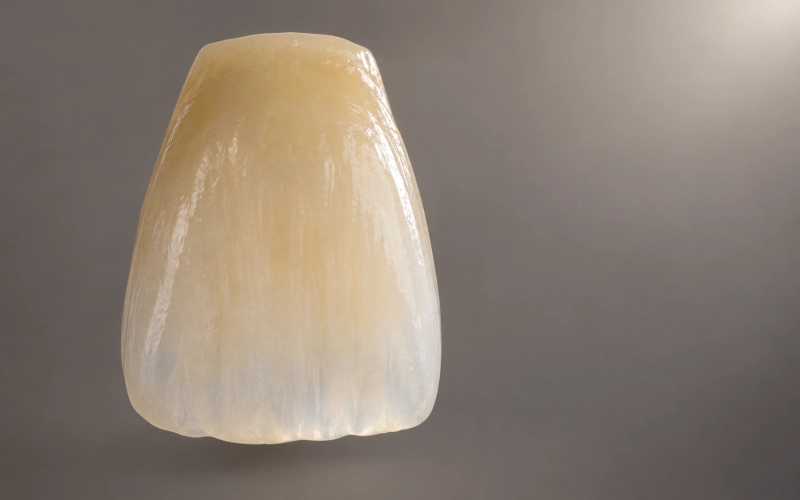
The thickness the space allows. Translucency and strength trade off against each other across the 3Y, 4Y and 5Y generations. At reduced thickness the more translucent materials do not do as well under fatigue testing. In that testing, 4Y and especially 5Y specimens performed substantially better at 1.2 mm than at 0.7 mm. Where the clearance is as tight as it was on this tooth, that pulls the choice toward the stronger end of the range.
Zirconia is not the right answer simply because it is strong. Insufficient thickness, sharp internal angles, poor occlusal design, excessive chairside adjustment and inadequate retention all decide whether the design holds up, and the material manufacturer’s instructions take priority over generic preparation numbers.
What was returned with this unit
| Item | Form |
| Material identification | The blank brand, its country of origin and the lot number, recorded against the case |
| Material certificate | The certificate issued for the material used |
| Design file | The digital design the unit was milled from |
| The working model | The articulated model, with any preparation or occlusal point we could not resolve within the prescription identified on it |
This documentation is part of every case, not something extra for this one. For how prescriptions, batch records and the risk carried in transit are handled across an offshore case, see dental lab outsourcing — the process page.
After the try-in: what the patient and the clinician told us
Two weeks after the unit was returned, the clinician seated it. The case notes from that visit describe the fit as accurate to the preparation. Occlusal contact required only a slight adjustment on the distobuccal cusp before seating, and after cleaning and bonding with the adhesive resin cementation protocol the crown sat at the finish line as the laboratory had set it. No sore teeth were reported by the patient at cementation or at the one-week follow-up, and the marginal integrity was described as good at both visits.
The clinician’s written feedback on this case, returned with the follow-up form, said that the contact was correct after the small adjustment, that no chairside re-polishing was needed beyond the standard rubber-wheel sequence, and that the patient described the crown as feeling solid on biting. At the one-week check, the patient reported no sensitivity to cold, no discomfort on chewing, and no sense of bulkiness that made her sit up and notice it.
At the three-month review, the crown was examined again. The notes describe no chipping of the zirconia, no marginal discolouration, and no visible wear on the occlusal surface of the opposing upper molar. The patient had no complaint at that visit. The clinician’s note at three months was that the unit was holding up as expected on the day of the review.
The patient is not named here. The clinician’s clinic is not named here. What is reported is what was written down on this case, in the records returned to us with the unit.
Zirconia Crowns for Posterior Teeth: FAQs
What do you need from me for a posterior zirconia crown?
A numbered prescription, the scan or model, a reproducible bite record and the shade reference. If the prescription names a ceramic system, we fabricate in that system or tell you we cannot; we do not supply an equivalent and describe it as the same thing.
What happens if my preparation cannot give the retention the material needs?
We tell you before design, with the figure, and set out what each alternative changes: a different cementation route, a core with more resistance form, or a revised preparation. We do not quietly design around it.
Will you alter my prescription?
No. If it cannot be executed as written, the case is stopped and you are contacted. Nothing is substituted, thinned or reshaped on our own initiative.
Why does the required thickness differ between zirconia systems?
Strength and translucency trade off against each other across the 3Y, 4Y and 5Y generations, and at reduced thickness the more translucent materials do not do as well under fatigue testing. We work to the tighter of your figure and the manufacturer’s minimum.
Do you return the working model?
When we have identified something on it — a preparation that cannot be finished to the prescribed margin, or an occlusal point we cannot resolve within the design — the articulated model comes back with the unit and the point is marked on it. The adjustment is then made knowingly rather than by trial.
Can material documentation come with the case?
Yes. The blank brand, country of origin and lot number are recorded against the case, and the certificate issued for that material is sent with the documentation.
Send a case
Send the prescription, the scan or model, the bite record and the shade reference. Before work starts we confirm in writing what will be fabricated, what is documented and returned with the case, and the date. This page does not publish prices.
If you are weighing a zirconia crown for posterior teeth against a glass-ceramic or a veneered design, this case shows the two questions that decide it: the occlusal load, and the thickness the space allows. For the controls that sit behind a case like this one — prescription handling, batch records, and who carries the risk in transit — see dental lab outsourcing.
Experience faster turnaround times with our cutting-edge technology
Recommended