Valplast Lower Partial Denture: Posterior Case Study
🕢 [ Remplissez le formulaire et nous vous répondrons dans les 30 minutes ! ]
1. Patient Situation
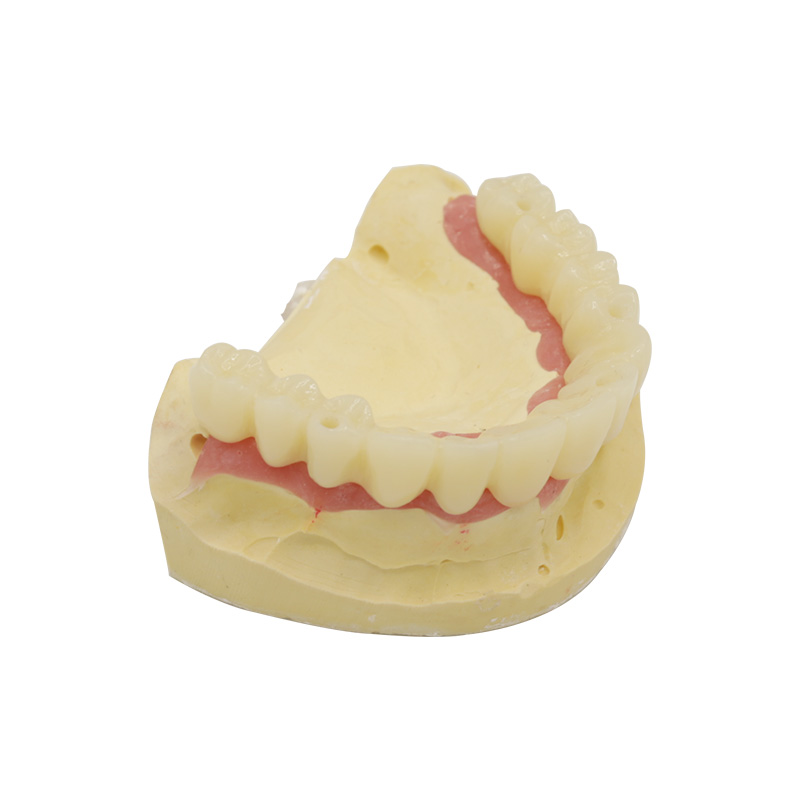
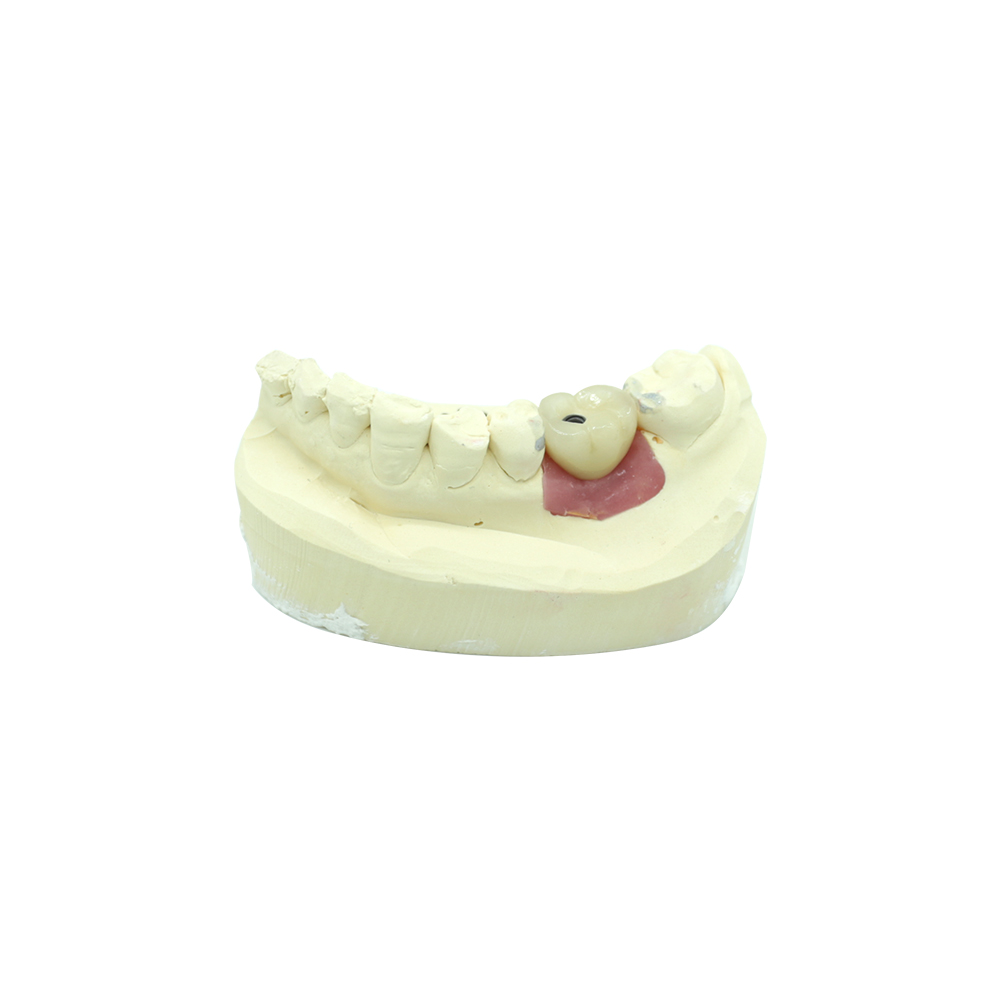
The patient presented with a bounded edentulous span in the lower right posterior region — missing three teeth from the first premolar to the second molar. The remaining dentition was intact anteriorly and on the left side, with the canine and second molar serving as potential abutments.
Tissue examination showed adequate ridge height but thin coverage over the edentulous area, with a shallow buccal undercut. The distal abutment had reduced periodontal attachment and slight mobility. Vertical dimension was stable, but interocclusal space measured close to the minimum threshold for an all-flexible design.
The patient had declined implant placement due to scheduling and cost, and explicitly refused any preparation of the abutment teeth. Visible metal was unacceptable. A fixed bridge was ruled out for the same reason — no tooth reduction permitted.
The first clinical appointment captured an intraoral scan only. No physical impression was taken at that stage, and no opposing cast or bite registration accompanied the digital file.
2. What the Prescribing Dentist Required
The prescription specified:
- Zero preparation. Retention from tooth and tissue undercuts only; no space could be created by cutting the abutments.
- Clasps must contact passively, with no torque from clasp thickness; the base must not be thickened to gain stability.
- Buccal block-out and relief on a duplicate cast; the flange ends at the functional area and must not be over-extended.
- All clasps in gingival shade; tooth shade and tissue shade selected separately and stated on the prescription.
- Supply a final physical impression plus an opposing cast and a bite registration; borders kept short rather than over-extended.
The dentist also noted that this base cannot be added to or relined at the chair — any change would be a return to the laboratory, and the remaining teeth were not stable enough to support repeated adjustments. The appliance had to be fully seatable at delivery.
3. Valplast Lower Partial Denture Design and Fabrication
3.1 Records and Case Planning
We requested — and received — a complete set of records before starting:
- A mucostatic alginate impression (not a functional impression under load)
- An opposing stone cast
- A wax bite registration in centric relation
- Digital photos showing tooth shade, tissue shade, and clasp placement
The case was evaluated against the Valplast case-selection criteria: bounded span, adequate undercuts, sufficient vertical space (measured at 4.5 mm), stable occlusion, and no heavy parafunction. It passed.
We confirmed with the dentist that the distal abutment’s mobility was monitored but not progressive, and that passive wrap-around clasps engaging both tooth and tissue undercuts would be appropriate.
3.2 Survey, Block-Out, and Duplicate Cast
The master cast was surveyed to identify:
- Usable buccal undercuts on both abutments
- A shallow lingual tori contour that required clearance
- Interproximal embrasure space for clasp termination
- Peripheral undercuts on the buccal flange that could lock the prosthesis during insertion
Block-out was applied to lingual tori, deep interproximal areas, and the mandibular buccal-flange junction. Relief of approximately 20 µm was placed at the clasp-to-flange junction to prevent binding.
The master cast was duplicated in high-quality stone. All subsequent wax-up and processing steps were performed on the duplicate to preserve the master for final verification.
3.3 Design: Tissue-Borne with Passive Clasps
The design followed tissue-borne principles:
- Broad, passive tissue contact across the edentulous ridge
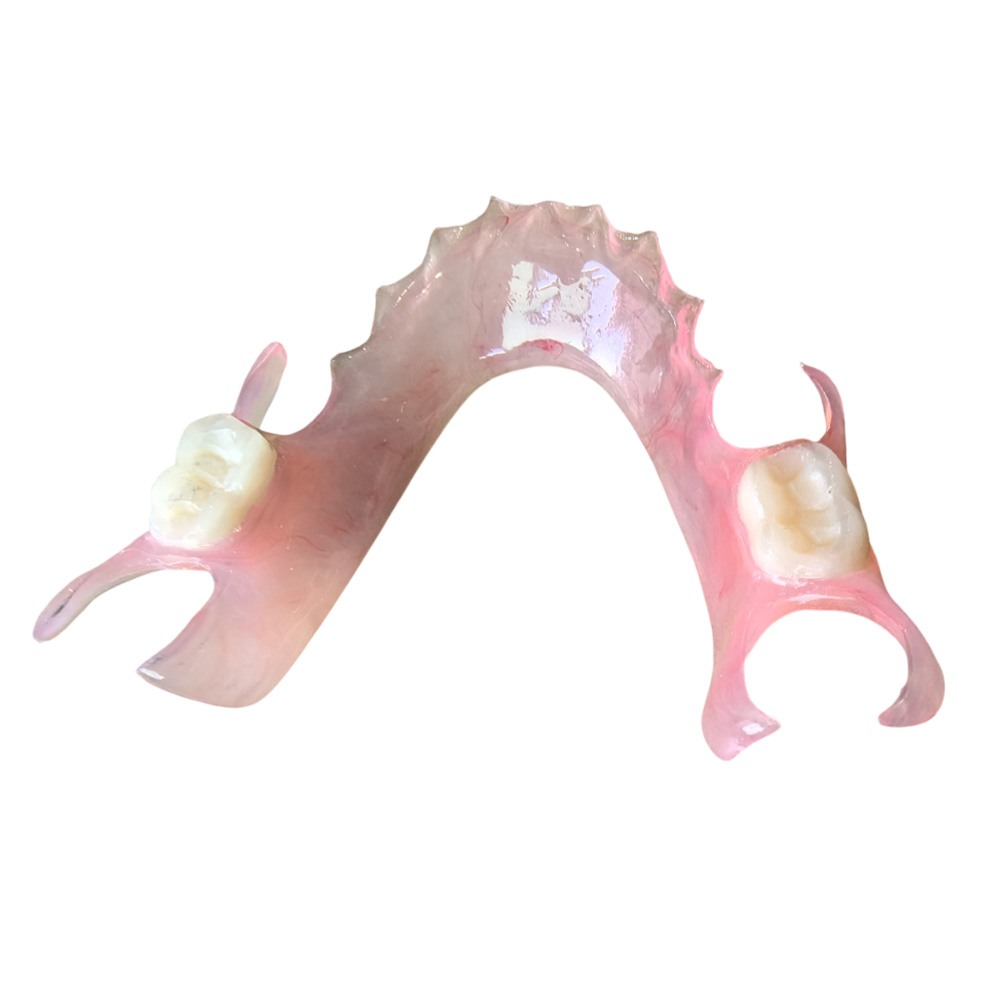
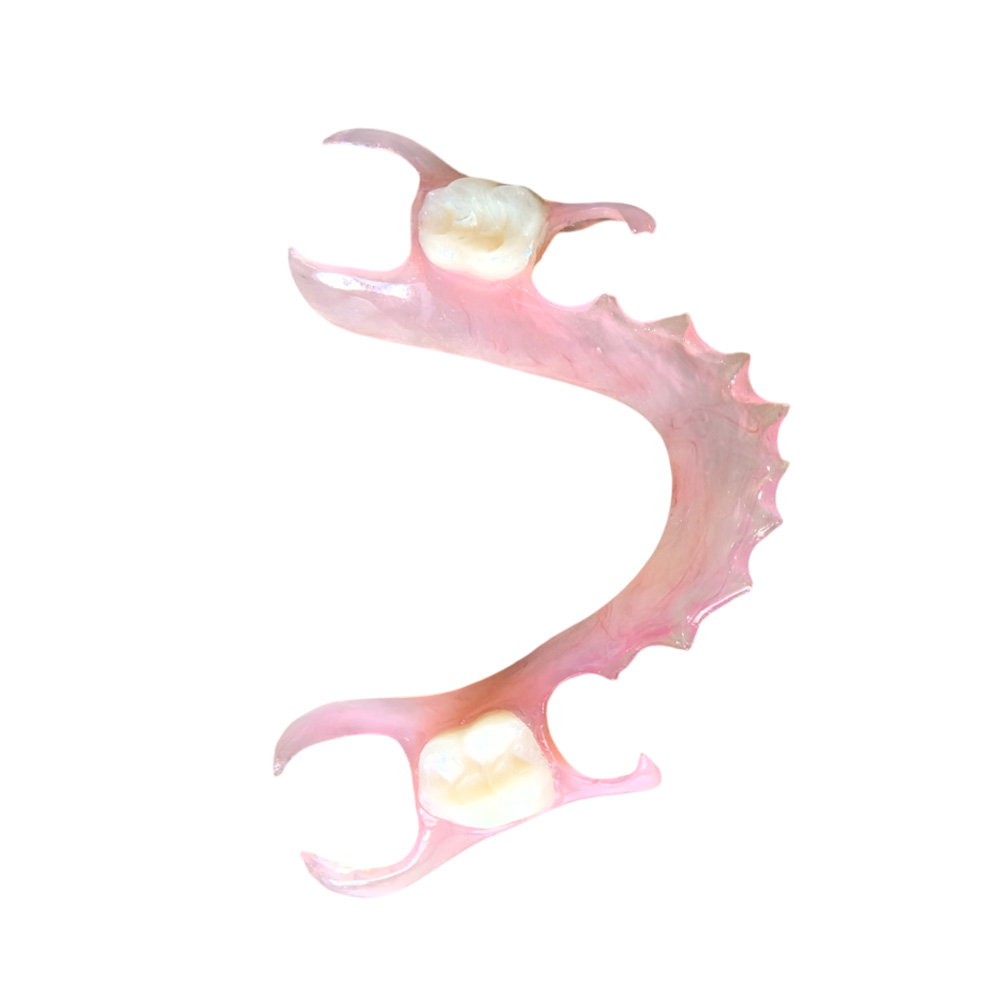
- Wrap-around clasps originating from the buccal flange, approaching the tooth from the gingival direction
- Clasp tips terminating approximately 1 mm onto the abutment tooth, ending in the embrasure
- No occlusal rests (not compatible with the zero-prep requirement)
- Adequate thickness at the clasp-to-saddle junction to prevent tearing during insertion
Clasp dimensions were set at approximately 1.2 mm thick and 5 mm wide, engaging approximately 0.6 mm of combined tooth and tissue undercut. These values were derived from published retention studies but adjusted for this specific case geometry.
The buccal flange was kept thin and streamlined, ending short of the functional depth to avoid displacement during swallowing or speech. The lingual extension cleared the tongue space and did not impinge on the tori.
3.4 Tooth Selection and Mechanical Retention
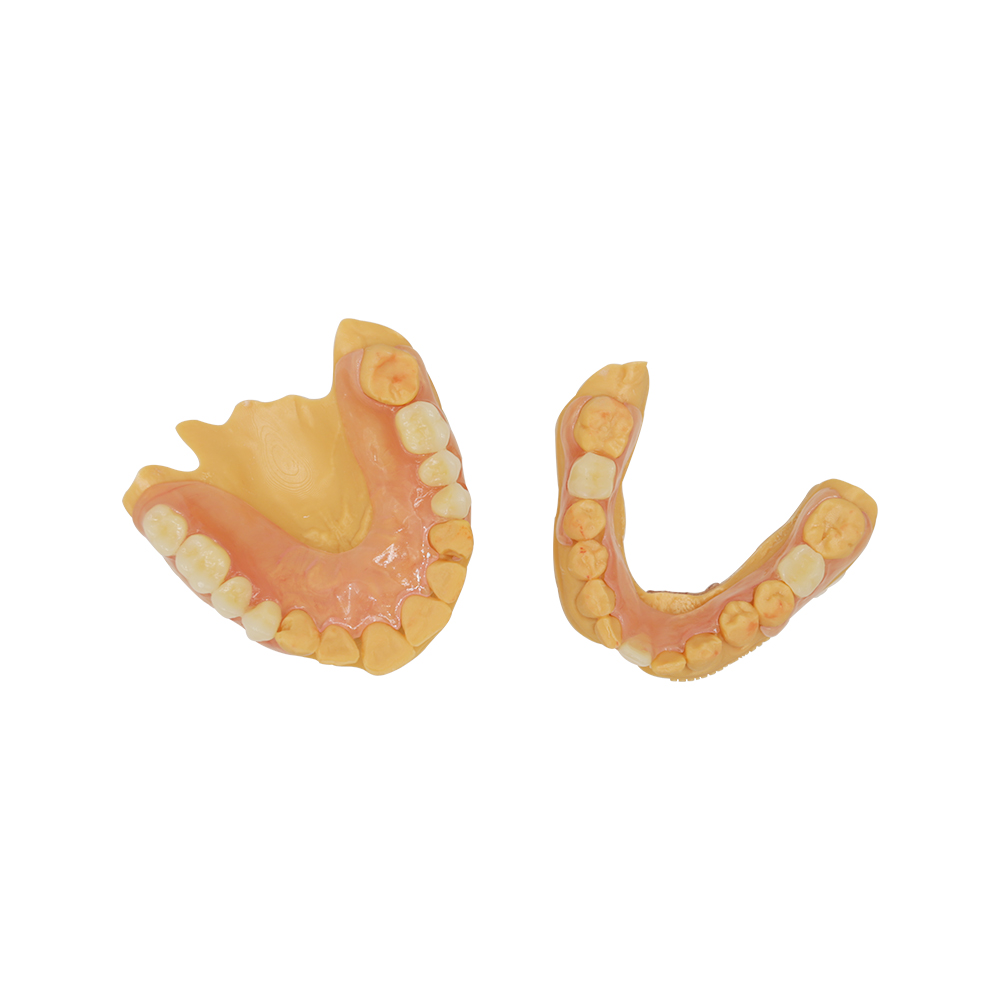
Three posterior acrylic teeth (premolar and two molars) were selected to match the prescription shade. Because Valplast does not chemically bond to conventional acrylic teeth, each tooth was prepared with T-shaped diatoric holes to allow the injected nylon to flow through and lock mechanically.
The teeth were arranged on the duplicate cast, verified against the opposing cast and bite registration, and embedded securely in the wax pattern.
3.5 Wax-Up, Investing, and Injection
The wax pattern was kept thinner and more controlled than a conventional acrylic partial. Bulky flanges were avoided.
The pattern was invested in a Valplast injection flask, sprued, and dewaxed. The Valplast nylon resin cartridge was plasticized in the dedicated furnace at approximately 288°C for the manufacturer’s specified melt cycle, then injected into the closed flask under controlled pressure.
After cooling, the flask was opened, and the prosthesis was retrieved. Sprues were trimmed.
3.6 Finishing and Polishing
Finishing was performed with Valplast-specific carbide burs under constant motion to prevent heat buildup. The bur was never held stationary; localized melting or distortion would compromise fit and retention.
Polishing followed a synthetic pumice → Tripoli → high-shine compound sequence. The entire finishing-to-polish cycle took approximately 6 minutes. The final surface was smooth, translucent, and free of visible tool marks.
3.7 Quality Check Against the Master Cast
The finished prosthesis was seated on the original master cast to verify:
- Full seating with no rocking or binding
- Passive clasp contact (no visible distortion of the clasp arms)
- Clearance at lingual tori and peripheral undercuts
- Proper tooth position and occlusion against the opposing cast
The case passed all checkpoints and was cleared for delivery.
4. Delivery and Seating
At the insertion appointment, the prosthesis was warmed in hot tap water for approximately 45 seconds to bring the nylon close to intraoral flexibility. This made initial seating easier and reduced the force required.
The dentist seated the appliance, verified that it was fully in place with no tissue blanching, and checked occlusion. The patient reported comfortable retention and no sharp areas.
Minor occlusal adjustment was performed chairside using a green mounted stone with light, moving contact. Conventional acrylic burs were avoided to prevent surface roughness.
The patient was instructed on insertion, removal, and daily cleaning. The dentist emphasized that this appliance cannot be relined at the chair; any significant tissue change or retention loss would require a laboratory rebase or a new prosthesis.
5. Case Outcome
The prosthesis has been in service for six months. The patient reports satisfactory function, esthetics, and comfort. No mucosal redness or soreness has been noted. Retention remains adequate, though the dentist has observed slight clasp relaxation — consistent with published reports of polyamide water absorption and clasp fatigue over time.
The distal abutment remains stable with no further mobility. The patient declined the initially proposed cast framework and is satisfied with the outcome.
6. Why This Case Worked
This case succeeded because it met the predictable indications for a mandibular Valplast partial:
- Short, bounded span — three teeth, not a bilateral distal extension
- Adequate tissue support — sufficient ridge height and stable tissue
- Usable undercuts — both tooth and tissue undercuts available for passive retention
- Sufficient vertical space — 4.5 mm, above the minimum threshold
- No heavy occlusion — stable bite, no parafunction
- Esthetic priority — patient refused visible metal
- Zero-prep requirement — no room for a conventional cast framework with surveyed rests
The patient also maintained excellent oral hygiene and followed the care instructions.
7. When a Flexible Design Is Not Appropriate
We would not have accepted this case as an all-flexible Valplast partial if:
- The span had been longer (e.g., Kennedy Class I or II bilateral distal extension)
- The ridge had been knife-edged or highly compressible
- Vertical dimension had been closed or interocclusal space insufficient
- The abutment had shown progressive mobility or poor periodontal prognosis
- Heavy occlusion, bruxism, or unstable occlusion had been present
- The patient had been unable to maintain hygiene
In those situations, we would have recommended a cast-metal or titanium substructure with Valplast esthetic clasps, or declined the case and referred the patient back for a different treatment plan.
8. Valplast Denture Manufacturing and Quality Control
ASD Dental Lab has been processing Valplast and other flexible partial dentures since 2012. Our removable denture department includes approximately 55 trained technicians dedicated to partial and full denture fabrication.
All major steps — from survey and block-out to injection, finishing, and quality inspection — are completed in-house at our Shenzhen and Huizhou facilities. We do not outsource flexible partial cases to third-party laboratories.
Our removable denture production capacity is:
- Normal season: approximately 4,000 cases per month
- Peak season: approximately 6,500 cases per month
We maintain a dedicated Valplast injection system, including the proprietary furnace, press, flasks, cartridges, and finishing tools. Technicians follow the manufacturer’s current processing protocols and attend periodic training updates.
Every flexible partial case undergoes a multi-point quality check before shipment:
- Fit verification on the master cast
- Clasp retention and passive contact
- Occlusion check against the opposing cast
- Surface finish and polish inspection
- Tooth retention and mechanical lock verification
Cases that do not pass any checkpoint are reworked or remade before delivery.
9. Valplast Lower Partial Denture Maintenance and Repairs
9.1 Adjustments
Minor clasp adjustments can be performed by warming the clasp in hot water for about 60 seconds and gently bending it inward (to increase retention) or outward (to reduce pressure). Indiscriminate grinding should be avoided because reducing clasp thickness changes its flexibility and retention.
Tissue relief is performed with Valplast-specific abrasives or a green mounted stone, using light, constantly moving contact. Conventional acrylic burs may produce a rough, melted, or distorted surface.
9.2 Repairs and Additions
Small repairs may be handled by a laboratory welding technique; larger additions generally require an injection technique. Adding a tooth to an existing Valplast base is possible but more involved than a conventional acrylic repair.
9.3 Reline and Rebase
A conventional chairside acrylic reline is not predictable because polyamide is chemically resistant and bonds poorly to self-cure acrylic. A Valplast rebase normally requires a laboratory pickup impression, a new base, and reinjection using the existing teeth.
A silicone soft liner may be used in selected situations, but it is not equivalent to a definitive rebase.
9.4 Retention Over Time
Published evidence indicates that polyamide clasp retention may deteriorate as the material absorbs water and the clasps fatigue. A recent systematic review found higher short-term satisfaction with flexible dentures but weak evidence that they perform similarly to conventional cast RPDs long term. Clasp-retention loss after 12 months was substantial in both distal-extension and bounded-saddle groups.
For this reason, we inform the prescribing dentist that flexible partials may require more frequent review and earlier replacement than a properly designed cast framework.
10. Valplast Lower Partial Denture FAQs
Q: Can I get a Valplast partial if I have a long bilateral distal extension?
Pour un Kennedy Class I or II case, an all-flexible design is usually not the most predictable option. We recommend a cast-metal or titanium substructure with Valplast esthetic clasps and saddles. This provides vertical support, cross-arch stability, and controlled retention while preserving esthetics.
Q: How do I clean a Valplast partial?
Clean daily with a soft brush and non-abrasive denture cleaner. Do not use boiling water, harsh chemicals, or ultrasonic cleaners unless specifically recommended by the manufacturer. Remove the prosthesis at night and store it in clean water.
Q: Can a Valplast partial be repaired if it breaks?
Small fractures may be repairable by laboratory welding or injection repair. Large fractures or base failures often require a remake. Repair predictability depends on the location and extent of the fracture.
Q: How long does a Valplast partial last?
Service life depends on case design, occlusion, patient hygiene, and maintenance. Published studies report clasp-retention loss and material degradation within 12–24 months in some cases. Regular review appointments are recommended.
Q: Can I add a tooth to my existing Valplast partial if I lose another tooth?
Tooth additions are possible but require laboratory processing. The existing prosthesis is used as a base, and the new tooth is embedded and bonded by injection. It is more involved than a conventional acrylic addition.
Q: Is Valplast safe for patients with acrylic allergies?
Valplast is monomer-free with respect to methyl methacrylate. However, a claimed acrylic allergy should be diagnosed clinically. Recent literature suggests that nylon partials are usually selected for comfort and esthetics — not because a confirmed acrylic allergy has been documented.
11. Summary
This case demonstrates how a Valplast lower partial denture can meet a specific clinical need: a bounded posterior span with zero tooth preparation, no visible metal, adequate undercuts, and sufficient vertical space.
The key to success was:
- Complete records before starting (impression, opposing cast, bite, photos)
- Careful survey, block-out, and relief on a duplicate cast
- Passive clasp design engaging both tooth and tissue undercuts
- Mechanical tooth retention using T-shaped diatorics
- Controlled injection processing and heat-free finishing
- Quality verification against the master cast before delivery
This design is not appropriate for all cases. For long spans, bilateral distal extensions, poor ridges, heavy occlusion, or a need for rigid support, a cast-metal framework with flexible esthetic components is more rational.
We provide flexible partial denture processing as part of our full-service removable prosthodontics capability. All fabrication steps are completed in-house at our Shenzhen and Huizhou facilities by experienced technicians using manufacturer-specified equipment and protocols.