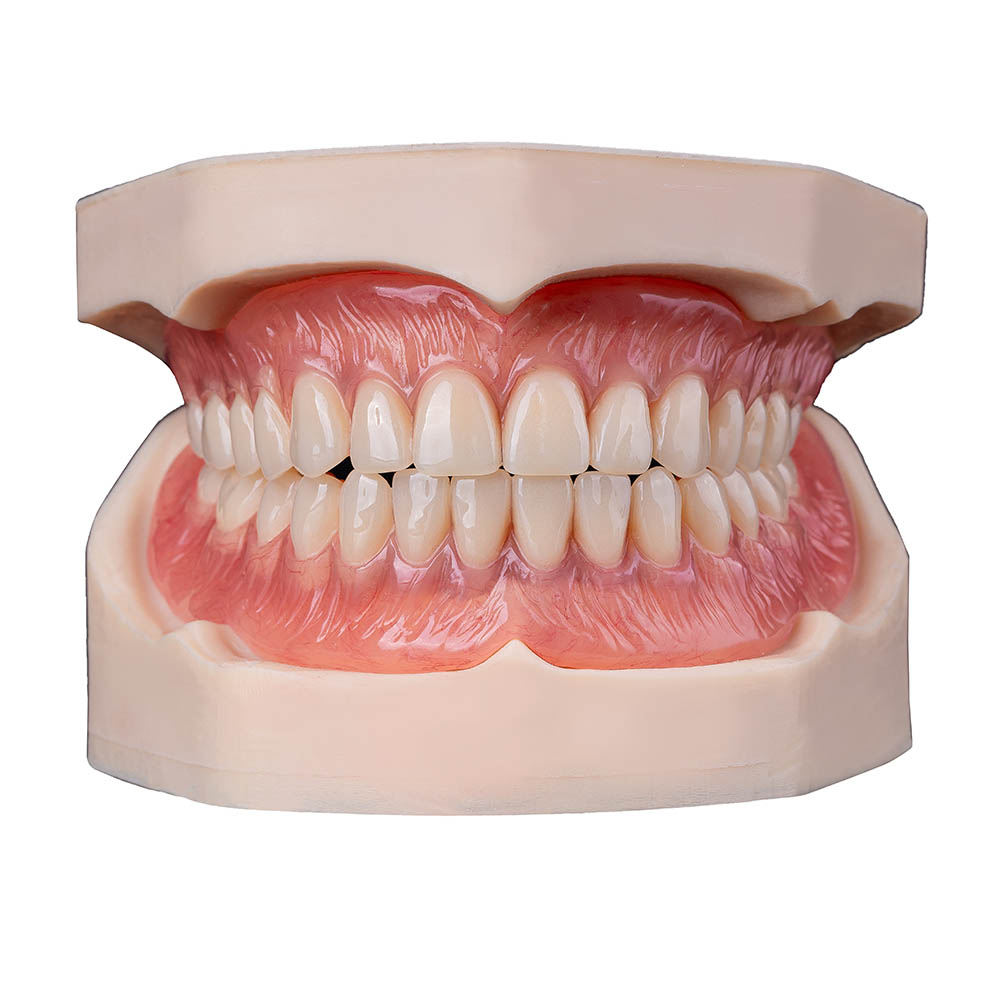
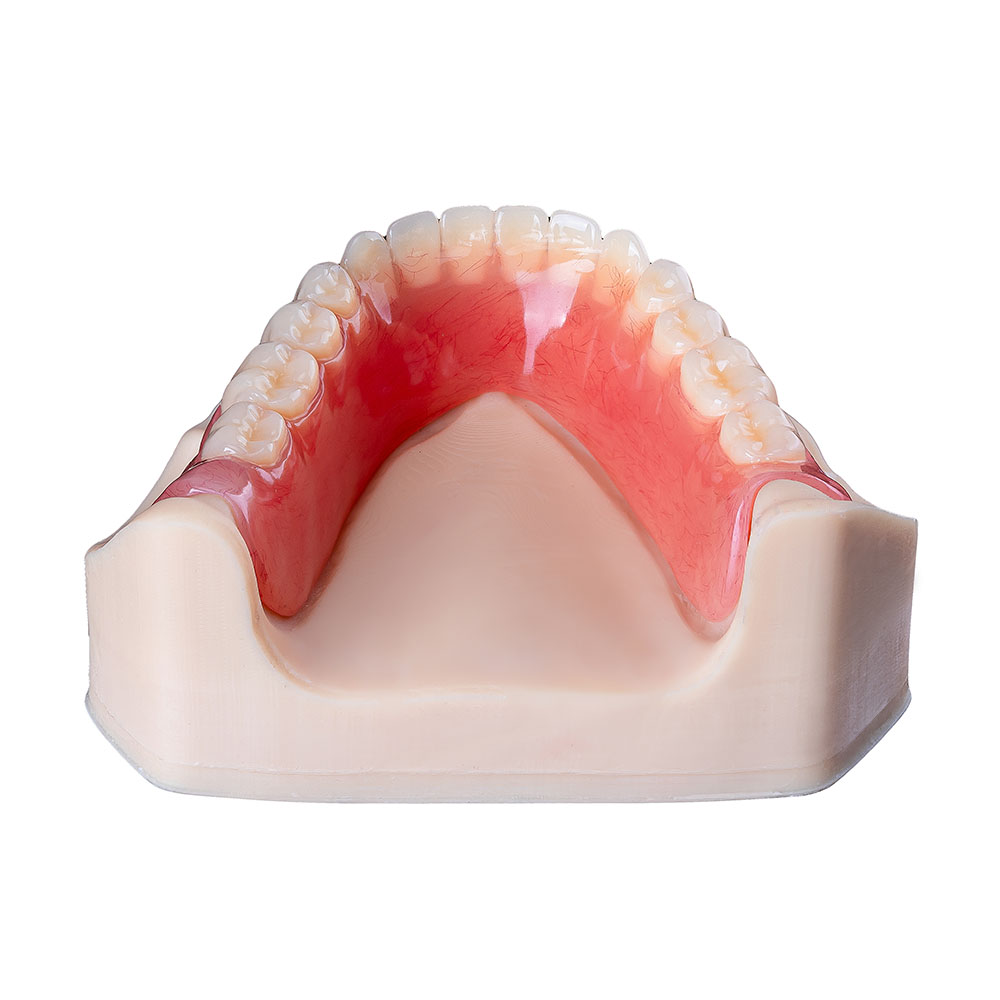
Full Upper and Lower Dentures on a Severely Resorbed Mandibular Ridge

🕢 [ Remplissez le formulaire et nous vous répondrons dans les 30 minutes ! ]
A referring clinic sent us a challenging case: complete upper and lower dentures for a severely resorbed mandibular ridge, with the patient declining implants. The order came with the situation documented, requirements in writing, and all necessary records attached.
The Case at a Glance
| Item | Detail |
| Arches | Complete upper and lower |
| Upper situation | Existing complete upper denture (~12 years old), worn and loose; patient wanted current appearance preserved |
| Lower situation | One infected premolar to extract; severely resorbed mandibular ridge with knife-edge anterior topography; maxillary arch had been edentulous for over a decade |
| Implant option | Patient declined; no attachment support available for the lower arch |
| Main challenge | Low retention potential, high adjustment demand, expectations anchored to old upper denture |
| Records received | Final impressions with border molding, VDO and centric relation records, existing upper denture for reference, facial and smile photographs |
| Delivered | Duplicated upper, new lower complete denture, wax try-in photo set with marked approvals, border extension map, adjustment guide, digital archive |
| Retournement | 14 working days after wax try-in approval |
Patient Situation
The patient is in his sixties. He’d been losing teeth gradually — first to decay, then periodontal disease. The upper arch had been edentulous for about twelve years, fitted with the same upper denture that entire time. That denture still fit well enough that he’d stopped thinking about it, and he was comfortable with how it looked.
The lower arch was down to one premolar. That tooth had become infected and couldn’t be saved. Once extracted, he’d be fully edentulous in both arches. The lower ridge underneath showed years of progressive bone resorption — very little tissue remained for a denture to rest on.
Two things shaped every decision. First, he’d watched a relative struggle with denture wear as a child and remembered it badly. He did not want to be seen without teeth at any point. Second, the upper denture he was wearing had become his reference for what a denture should feel and look like. That’s useful information in some ways and a trap in others.
Why Implants Were Not on the Table
The clinic raised a two-implant mandibular overdenture at the first consultation. That’s the design that solves most of the problems this ridge presents — clinical evidence supports two-implant retained overdentures as the minimum standard for edentulous mandibles when bone volume allows.
The patient declined. The reasons were cost, a medical history the clinic judged to be a poor surgical fit, and general reluctance to have surgery.
That decision removed the usual answer to a flat lower ridge. With no implants and no attachment support, retention has to come entirely from the peripheral seal, border extension that respects the functional sulcus, and capture of the retromolar pad. There’s no second mechanism.
Three other obstacles came with the case:
- Expectations anchored to the old upper. He wanted the new set to look like the one he had, including parts that were worn.
- Budget constraints. The clinic asked us not to quote premium material tiers.
- Travel distance. Post-delivery visits had to be kept minimal, pushing more work into the laboratory phase.
What the Clinic Asked Us to Build
These are the requirements as they arrived on the work authorization. Each one exists because of something in the patient’s condition or the obstacles that came with it.
- Use the existing upper as the template. Digitize it, archive the mould and shade, and reproduce the current appearance — including the patient’s own asymmetry. Do not “improve” the midline without asking.
- Match the old denture’s shade and tooth mould exactly, and keep that record on file so a future remake can match it as well. The patient’s reference is a physical object that will be compared side by side.
- Border mold with heavy body and take a light-body wash in occlusion. With no attachment support, this peripheral seal is the retention. Capture the retromolar pad in occlusion. Make this the critical step of the entire case.
- Hold the clinic’s recorded VDO exactly. Do not open the vertical dimension to compensate for lost ridge height. The clinic recorded it against rest position and swallow position, and it stands.
- Send a wax try-in with marked photographs before processing. The clinic will approve midline, smile line, incisal display, lip support, and shade in writing, with photos marked for any change. A note that says “looks fine” is not an approval.
- Leave the lower base overdenture-compatible. Shape it so two implants can be added later without remaking the denture. The patient may change his mind in five years, and the clinic doesn’t want to start over.
- Relieve and polish predicted pressure areas before shipping, and send a written sore-spot map. Every avoidable adjustment visit has to come off the schedule in advance.
- Expectation management is the clinic’s responsibility. The clinic documented the acceptance conversation in writing with the patient before delivery. The case will be judged against what was agreed in that conversation, not against an ideal that was never promised.
How We Built It
- Scanned the existing upper denture, archived its mould and shade on record, and prepared the duplication template.
- Poured the final impressions, blocked out undercuts, and fabricated stable record bases with wax rims for the clinic to adjust chairside.
- Mounted to the clinic’s VDO and centric relation records. Bite registration was taken on the rims, not on natural teeth.
- Arranged the teeth to the archived mould and shade, with anterior display matched to pre-existing smile photos rather than a standard template.
- Set the case up in wax, photographed it frontally, in profile, and smiling, and sent the photo set to the clinic for approval.
- Processed only after the clinic returned written approval with three marked changes: adjust upper central rotation 2°, reduce lower incisal display 0.5mm, confirm final shade under natural light. The setup was revised, re-photographed, and approved before final processing.
- Finished and polished with borders left full. Border thinning to make the denture feel lighter in the hand isn’t worth losing the seal.
- Shipped with the full delivery pack recorded on the order sheet.
Outcome
Honest framing first: with no implants and a flat ridge, the lower denture is tolerable, not effortless. The patient uses adhesive. He does not eat everything he used to eat. That outcome was described to him before delivery, which is why it did not become a dispute afterwards.
What the case did deliver: the upper looks like the upper he liked; the lower stays in place through a meal and through conversation; the case needed three adjustment visits in the first month, against five to seven the clinic typically sees on this ridge class.
At two-year follow-up, the patient is still wearing both arches. The lower has been relined once (at 14 months). He has not yet pursued implants but knows the lower base was designed to accept them. The upper remains stable with no intervention beyond routine cleaning.
Why this matters: Residual ridge resorption is progressive and irreversible. When patients stop wearing their lower dentures because they feel uncomfortable, the bone keeps resorbing without occlusal loading. Years later the ridge may be too flat to hold even a relined denture, and implant placement gets harder or stops being an option. Staying in the denture — even a compromised one — keeps the anatomy available for later.
Le American College of Prosthodontists takes the same position on the other end of the timeline: denture replacement is judged by fit, support, occlusion, hygiene, wear, fracture and function, and there is no single evidence-based replacement interval that fits every patient.
What This Case Shows
Retention with no implants is a records problem, not a material problem. The lab can only work with the border and the pad the clinic captured. A flat ridge plus a loose impression produces an unusable lower denture no matter what the base is made of.
An old denture is data, not a sample to imitate. Duplicating it gives the patient what he asked for. “Improving” it gives him something he didn’t ask for and will compare unfavourably to his memory.
The lab can remove visits from the schedule before shipping. Relieving predicted sore spots in advance and sending a written map moves work out of the clinic and off the patient’s calendar.
Wax try-in approval must be in writing with marked photos. A note that says “approved” without specifying what was approved creates disputes when the patient’s memory diverges from the lab’s interpretation. The clinic’s three marked changes on this case were small adjustments that would have become remakes if discovered after processing.
FAQ
Can you make a lower denture when there’s almost no ridge left?
Yes, but the performance ceiling is lower and the clinic has to say so before the case starts. With no implants, retention comes from peripheral seal and retromolar pad capture. That means border molding and the final impression carry the whole case. We’ll tell you if the impressions we receive don’t give us enough to work with, and we’ll ask for new ones rather than guess.
Why not just plan the two implants now?
That’s a clinical call, and it belongs to the clinic and the patient together — cost, surgical risk, bone volume and how much the patient wants to commit to one decision all feed into it. What we can control is not locking the door. A lower denture built today can be shaped so that, if the patient changes course, the case converts instead of starting over. The question worth asking up front is whether the clinic would rather pay for that flexibility now, or find out later.
The patient likes his old denture. Can you copy it?
Yes, and it’s often the right answer. We scan the existing denture, use it as the template for mould, shade, and occlusion, and archive the record. What we will not do is reproduce worn-out features — worn incisal edges, a collapsed vertical dimension — as if they were design choices. We preserve the functional relationships and esthetics the patient recognizes while correcting the degradation.
How many adjustments should the clinic expect?
Budget three to five visits across the first month for a ridge in this class, and plan the chair time around it rather than reacting to it. Clinics that plan the adjustment calendar in advance tend to hit the upper end of that range. Every resorbed-ridge lower leaves our bench with a marked pressure map attached — the first visit is then a confirmation pass, not a diagnostic hunt.
How long should a denture like this last?
There isn’t a fixed number, and anyone who quotes you one is guessing. What matters is whether the denture still fits, supports occlusion, and stays hygienic — not how many years have passed. The ADA’s denture care and maintenance guidance recommends a reline roughly every one to two years as the denture settles and the ridge changes underneath it. On a ridge like this one, the lower will need more frequent attention than the upper across its service life.
What happens if the patient stops wearing the lower denture?
The bone will continue to resorb without occlusal load. Research shows that residual ridge resorption in the mandible progresses faster than in the maxilla, and the process is not reversible. Patients who set aside uncomfortable lowers for years may find the ridge has resorbed to the point where no conventional denture — not even a relined one — will stay in place. At that stage, implant placement may require bone grafting or become unfeasible. Staying in the denture, even with adhesive, preserves the anatomy needed for future options.
What if the clinic didn’t document the acceptance conversation?
We still build the case to the records provided, but disputes are more likely. The most experienced clinics we work with use a short written form that lists what the patient was told about retention, adjustment visits, diet limitations, and adhesive use. The patient signs it before the wax try-in stage. That form doesn’t prevent dissatisfaction, but it converts “you never told me” into “we discussed this on [date] and you signed here.”
How to Submit a Similar Case
Cases like this one — full arch upper and lower dentures on a resorbed ridge with no implant support — require complete records before we can start.
Required for a full upper and lower denture case:
- Final impressions (or digital scans) for both arches, with adequate border extension
- Vertical dimension and centric relation records
- Shade selection and tooth mould preference
- Facial and smile photographs
- Written work authorization with special instructions
Records have to be complete before we can start. Missing any of these items will delay the case, or force us to fabricate record bases and send them back for bite registration.
Helpful but not required:
- Existing denture for duplication reference
- Marked photos showing midline and smile line preferences
- Patient’s diet or speech concerns
ASD Dental Lab provides case submission templates and digital workflow guides. If you’re planning a case with challenging anatomy — severe resorption, previous failed dentures, patient with high expectations — contact our case coordination team before taking final impressions. We can review preliminary records and suggest adjustments that improve the odds of a successful first delivery.
About ASD Dental Lab
ASD is a full-service dental laboratory and direct manufacturing facility founded in 2012, with production facilities in Shenzhen and Huizhou, China. We complete the entire removable denture workflow in-house — from digital design and wax setup through final processing, finishing, and quality inspection. Our Removable Denture Department includes approximately 55 technicians with experience in complete dentures, partial dentures, immediate dentures, and implant-retained overdentures.
We serve dental clinics, laboratories, and dentists in the United States, Netherlands, Germany, France, Belgium, Austria, United Kingdom, and other international markets. All cases are built to the records and requirements provided by the referring clinic, with full digital archiving for future remakes.
Des délais d'exécution plus courts grâce à notre technologie de pointe
Recommandé