Temporary Bridge Dental —— A Real Lab Case from ASD

🕢 [ Remplissez le formulaire et nous vous répondrons dans les 30 minutes ! ]
What this page is about: We’re ASD Dental Lab, a full-service manufacturing facility in China (founded 2012) with ~460 in-house technicians. This case showcase is for dentists, clinics, DSOs, and other dental labs looking for a lab partner. Not a patient guide.
The Patient Situation
A 52-year-old patient came in with a three-tooth span missing in the lower posterior region (#30–#29–#28, using ADA notation). The adjacent teeth #31 and #27 had been prepared as abutments several months prior, and the patient had been wearing a chairside temporary that was repeatedly debonding.
Clinical challenges:
- Moderate vertical occlusal force (patient reported grinding at night, though not diagnosed as full bruxism)
- Limited posterior contact due to opposing tooth supraeruption
- Six-week wait window before the final PFM bridge delivery
The Doctor’s Requirements
The dentist’s prescription wasn’t a generic “make me a temp” note. They came to us with a fairly specific request:
Functional requirements:
- Matériau: PMMA preferred for strength and marginal stability over chairside acrylic, especially given the span length and the patient’s grinding history. The dentist wanted something that wouldn’t flex under lateral forces.
- Span: 3-unit, two retainers + one pontic (#31 retainer, #30 pontic, #27 retainer). Connector cross-section needed to be adequate for the span — no thin connectors that’d snap mid-wear.
- Occlusal clearance: Match opposing dentition without opening vertical dimension. The opposing tooth had supraerupted slightly, so occlusal anatomy had to compensate.
- Color match: VITA shade A3, no special characterization needed (posterior, not visible in smile line).
Workflow requirements:
- Design approval before milling — they wanted to see the digital design on screen before we cut the puck. This adds 1–2 days but the dentist said it’s worth it for any case over 2 units.
- Send back the wax-up + stone replica, not just the final bridge — this is a workflow option we offer so the clinician can verify contour, occlusion, and emergence profile in the patient’s mouth avant committing to the milled version. It’s the kind of “try before you buy” approach that comes up in clinician-to-clinician conversations when discussing lab prescriptions.
- Box and case ID labeling — every package leaves our facility with a unique case ID and tooth-position labeling so nothing gets mixed up across shipments.
The dentist also asked a question that’s pretty common from first-time partners: what’s the turnaround, and from when does the clock start? We confirmed — production time is 2–3 days for conventional couronne et pont, and the clock starts when we approve the prescription (not when the scan uploads).
How We Delivered It
Here’s how the case moved through our shop. No marketing fluff, just the actual workflow:
Step 1: Data intake and case review
The dentist sent digital intraoral scans + a bite registration. Our case coordinator opened the case, verified margins on the prepared teeth, and flagged one thing back to the clinician: the #27 margin was unclear at the disto-lingual line angle. They re-scanned that area and we moved on.
Step 2: Digital design (CAD)
Our CAD designers (a team of ~100 in our design department) set up the case in CAD software with the prescribed parameters: 3-unit bridge, A3 shade, adequate connector dimensions, ridge-lap pontic designed for easy cleaning access rather than full saddle contact. We sent a screenshot of the design to the WhatsApp group for clinician approval — they signed off same day.
Step 3: CAM milling and finishing
PMMA puck (Ivoclar PMMA block, a brand we’ve worked with for years) milled on our 5-axis mill. Post-milling, the bridge was finished, polished, and characterized minimally — posterior case, no high-end layering needed.
Step 4: Quality check
This is where we get picky. Our QC team (25 people, dedicated) checks:
- Marginal fit on the printed model
- Proximal contacts (verified with floss and visual under standard inspection lighting)
- Occlusion against the opposing arch
- Internal fit (no grinding required inside the retainers)
- Polish and surface finish
Step 5: Packaging and shipment
The bridge went into a foam-padded case box with the case ID and tooth numbers clearly labeled on the outside. We ship internationally (US, EU) and every package gets tracked.
What It Looked Like
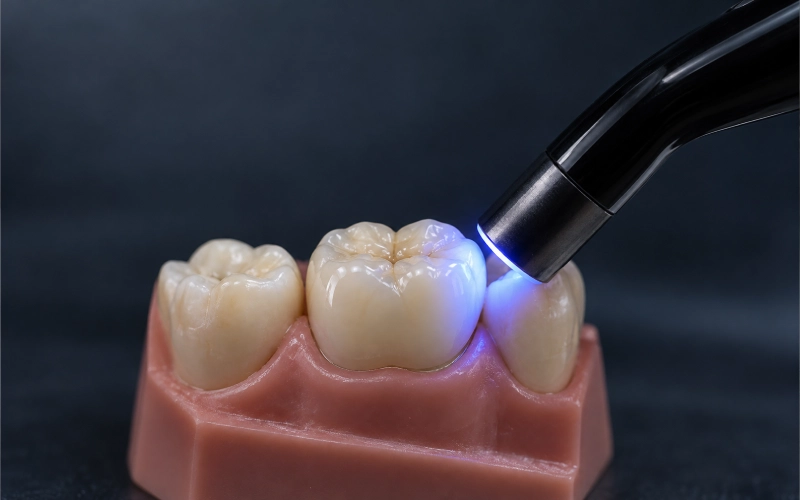
The final piece seated passively on both abutments on the first try. The dentist did light occlusal adjustment at chairside — that’s normal and expected for lab-fabricated provisionals, even well-made ones. Our protocol is to tell clinicians upfront: a lab-made bridge will almost always need some chairside refinement for margins, contacts, or occlusion. That’s part of the delivery, not a defect.
The patient wore it for seven weeks without debonding, including through a vacation that involved normal chewing. The dentist removed it when the final PFM bridge was ready and confirmed no gingival issues underneath.
A Few Things Worth Saying Out Loud
On FDA language
We’re careful here. The category this falls under is regulated as Class II under 21 CFR 872.3770 (Temporary Crown and Bridge Resin). “FDA-cleared” does not mean “FDA-approved for any span or duration you can think of” — clearance is indication-specific (research context, Massachusetts dental practice regulations). We follow the manufacturer’s labeled indications for the PMMA material we use.
On lifespan claims
You’ll see marketing that says “lasts 10 times longer than traditional temps” or “useable for months.” That’s vendor comparison language, not survival statistics (clinical overview reference). We don’t make that claim. What we can tell you: this specific case held for seven weeks in a grinding patient. Different cases hold for different times. How long a temporary bridge lasts depends on the patient, the span, the material, and the occlusion — not on the lab.
On lab fees
The cost structure for temporary bridges varies a lot depending on the region, plan, and case complexity. There isn’t a single authoritative national fee schedule for temporary bridges themselves (reference on the temporary prosthesis landscape). For lab-side fees, we work case-by-case and put the breakdown in writing — what we’re quoting includes the design, the milling, the QC, and the packaging. The chairside time and the cement are between the clinician and the patient. We don’t list prices on this page because every case is different; request a quote and we’ll give you one in writing.
On warranty and rework
Our rework policy is on every quote: if the issue traces back to our manufacturing (margins off, occlusion wrong, color mismatch from what was specified), we remake at no charge. If the clinician modifies the bridge chairside and that modification is what causes failure, that’s a different conversation. Patient-side fracture from trauma or grinding is covered under material warranty but not as a “remake.” Shipping damage gets a replacement. We say this out loud because the cases where labs and clinicians get sideways are almost always the cases where the rework rules weren’t on paper beforehand.
Let’s Talk About Your Case
If you’ve got a temporary bridge case coming up and you want to see how our workflow handles it, send us the scan or impression and a brief note about what you need. We’ll get back to you with a quote and a timeline within one business day.
We’re not the right fit for every clinic — and that’s fine. But if you want a lab that tells you what we did and what we didn’t, ships a properly labeled case, and stands behind the manufacturing side of the rework, we’re worth a conversation.
Sources & Further Reading
- Provisional Restorations, DentistryIQ — clinical overview of provisional crown and bridge workflow
- Temporization Methods, DDS Lab Blog — materials and indication-specific language for temporaries
- Temporary Dental Prostheses, Goodness Dental — overview of the temporary prosthesis category and lifecycle considerations
- 234 CMR 5.00 (Massachusetts Board of Registration in Dentistry) — example of state-level dental practice regulations clinicians should be aware of
- Temporary Crown (Wikipedia) — neutral encyclopedia overview, useful for cross-referencing terminology
Industry context references: Maryland Bridge clinical overview, Printed vs. Milled PMMA Provisionals, Implant Provisionals at Burbank Dental Lab
Des délais d'exécution plus courts grâce à notre technologie de pointe
Recommandé