Full Cast Metal Crowns: Direct From ASD Dental Lab
ASD Dental Lab manufactures precision full cast metal crowns in high-noble, noble, base-metal, and titanium alloys. Produced in our Shenzhen and Huizhou facilities, each crown is designed for accurate fit, reliable strength, and long-term durability. We offer factory-direct pricing, alloy certification, strict quality control, and a standard turnaround of 7–10 lab working days. Digital scans and conventional impressions are accepted, with flexible solutions for dental clinics, laboratories, and DSOs worldwide.
It seems we can't find what you're looking for.
Order Direct Cast Metal Crowns From The Lab That Makes Them
Cast in our own Shenzhen and Huizhou facility. Shipped with an IdentAlloy certificate. Quoted back in one business day.
Send your case — digital scan or conventional impression, prescription with alloy class — and we’ll confirm intake the same day. Standard turnaround is 7–10 lab days.
What you get | Détails |
Alloys | High noble (D2790), noble (D2792), base metal (D2791), titanium (D2794) |
Indications | Posterior molars, concealed premolars, bridge retainers, implant abutments |
Remake policy | Free remake if seating fails on a prep within our published parameters |
Qu'est-ce que c'est ?
A full cast metal crown is a single-piece alloy restoration that covers the entire clinical crown — every axial wall plus the occlusal surface. The “metal” can be a high-noble, noble, base-metal, or titanium alloy depending on the case. There is no porcelain veneer, which is why it does not chip the way Couronnes PFM can, and why it can function at thinner dimensions than most ceramics.
Alloy Options
Codes follow the ADA classification by weight percentage of noble metals (gold plus platinum group; silver does not count as noble). The alloy chemistry and clinical behavior are documented in peer-reviewed dental materials literature.
ADA class | Composition threshold | CDT code | Typical use |
High noble metal | ≥ 60% noble, ≥ 40% gold | D2790 | Posterior molar where biocompatibility and longevity are priorities |
Noble metal | ≥ 25% noble, below high-noble | D2792 | Posterior where budget matters, metal sensitivity is not a concern |
Predominantly base metal | < 25% noble | D2791 | Cost-driven cases; nickel-free alloy available on request |
Titanium / titanium alloy | Titanium-based | D2794 | Implant abutments, patients with documented multi-metal allergy |
The CDT code structure is set out in the ADA’s enhanced CDT code documentation.
When To Prescribe
Prescribe a full cast crown when | Avoid a full cast crown when |
Posterior molar with extensive damage — large MOD, endodontically treated, recurrent caries around an existing large restoration (PubMed 7008437 — clinical use of cast crowns for posterior teeth) | Anterior zone or visible premolar — metal will show |
Limited occlusal or axial clearance — metal tolerates thinner sections than most ceramics | A more conservative restoration (direct, inlay, onlay, ¾ crown) would adequately protect the tooth |
Heavy occlusal loading or parafunctional patient — bruxism, clenching, documented heavy bite | Patient objects to visible metal, full stop |
Retainer for a long-span fixed prosthesis | Documented allergy to nickel, cobalt, chromium, beryllium, or palladium without a confirmed safe alternative |
Concealed premolar where appearance is not a clinical priority | Tooth has an unfavorable periodontal, endodontic, or structural prognosis that can’t be predictably corrected (PMC3917630 — short clinical crowns treatment considerations) |
Patient accepts metallic appearance | Inadequate ferrule or axial height that cannot be built up — crown lengthening or orthodontic extrusion should come first |
- | Active caries, uncontrolled periodontal disease, or untreated occlusal disorder |
Prep Parameters
Send us a prep within these dimensions and seating goes smoothly. The numbers below follow the parameters documented in the standard prosthodontic teaching literature (Pocket Dentistry, Subharti Dental College teaching PDF).
Surface | Reduction |
Occlusal (functional cusps) | 1.0 – 1.5 mm (1.5 mm on heavy-load molars) |
Occlusal (non-functional cusps) | 1,0 - 1,5 mm |
Axial wall | 0.5 – 0.8 mm (0.8 mm on functional surfaces) |
Marginal finish line | 0.5 mm chamfer or heavy chamfer; no feather edges |
Total occlusal convergence | ~6° (range 6°–10°) |
Axial wall height | ≥ 3 – 4 mm; build up or crown-lengthen below this |
Functional cusp bevel | 1.0 mm wide × 0.5 mm deep |
Two practical tips from our QC team: round internal line angles (sharp angles concentrate stress in the wax pattern and the casting), and tell us the buildup material so we can adjust cementation guidance.
How We Make Them
Every case runs through one in-house workflow under one roof — no third-party outsourcing at any step.
- Case intake and evaluation — prescription and margin clarity checked; alloy class confirmed.
- CAD design — die digitally trimmed, margins marked, occlusal and axial reductions checked.
- Pattern production — wax or 3D-printed resin pattern, depending on alloy.
- Investing — pattern mounted, sprued, invested in phosphate-bonded refractory.
- Burnout and casting — pattern eliminated, alloy cast under vacuum or centrifugal force.
- Divesting and pickup — casting recovered; sprues cut.
- Finishing — internal fit verified, contacts and occlusion adjusted, surface polished to high gloss.
- Quality inspection — margins checked under microscope, contacts verified on solid model, alloy identity confirmed against mill certificate.
- Packaging and shipment — restoration sealed, tracking number issued.
Because every step happens in-house, the case stays inside our facility between departments. Our 70-person Ceramic & Metal department handles the workflow; a 25-person Quality Control team inspects every unit before it ships.
Cost And Quote
The price of a full cast metal crown has three components, and only two of them are stable.
Component | What drives it | Stabilité |
Laboratory fee | Crown type + alloy class + complexity | Fixed by our published schedule |
Alloy surcharge | Casting weight × current spot price of contained noble metals | Moves with the gold and palladium markets |
Clinical / practice fee | Prep, scan, provisional, cementation, follow-up | Set by the treating office |
The alloy surcharge is calculated as casting weight × London Fix spot price of the contained noble metals on the day the case is processed. If the spot price moves between impression and casting, the surcharge on the final invoice moves with it — that is the cost of the metal you asked us to put in the patient’s mouth.
We publish the alloy surcharge table weekly, lock the surcharge at intake when you confirm alloy choice in writing, and offer a base-metal option (D2791) for biocompatible cases where you want no surcharge exposure.
PFM And Zirconia, Side By Side
Patients often ask why not just do zirconia. Here’s the comparison we walk through with prescribing dentists.
Clinical factor | Full cast metal | PFM | Monolithic zirconia |
Fracture resistance | Excellent; no porcelain to chip | Strong metal sub; porcelain can chip | Excellent; high-strength posterior grades |
Tooth reduction | Usually the least of the three | Most — needs space for metal + porcelain | Moderate; depends on thickness |
Esthétique | Metallic; not for smile zone | Good; gray metal margin may show | Tooth-colored; translucency varies |
Wear on opposing teeth | Generally favorable when highly polished | Porcelain can be abrasive, especially if rough | Generally favorable; poorly adjusted zirconia can increase antagonist wear |
Biocompatibilité | High-noble alloys are corrosion-resistant | Depends on alloy (Ni can be problematic) | Metal-free; useful when sensitivity is a concern |
Main technical complication | Retention loss, caries, tooth fracture over long periods | Porcelain chipping, marginal discoloration | Fracture, loss of retention, adjustment-related surface damage |
Clinical evidence base | Very long — multiple 20+ year studies | Very long | Strong 5–10 year; longer-term evidence still accumulating |
A retrospective study of 2,340 high-gold restorations followed for up to 25 years reported strong long-term survival, with most failures attributed to tooth-related causes rather than material failure (PubMed 23476910, PubMed 35870735 — longevity of gold restorations in posterior teeth). A systematic review estimated 94.7% five-year survival for metal-ceramic single crowns, with earlier zirconia studies at about 92.1% five-year survival (PubMed 25842099 — all-ceramic vs metal-ceramic FDPs). Modern monolithic designs have narrowed that gap, though long-term data on newer zirconia formulations is still less mature than the multi-decade record on cast metal (JADA — zirconia restorations). For posterior single crowns in general, the largest retrospective cohorts show loss of retention and tooth-related problems are more common than framework fracture — bruxism increases this risk regardless of material (PMC9546353 — retrospective clinical study of single crowns).
Full cast metal is not obsolete. Monolithic zirconia is a strong modern alternative when the patient wants tooth-colored or metal-free. For a non-visible, heavily loaded posterior tooth where longevity and conservative prep matter most, full cast metal remains a well-evidenced choice with the longest published clinical record.
Cas d'implants
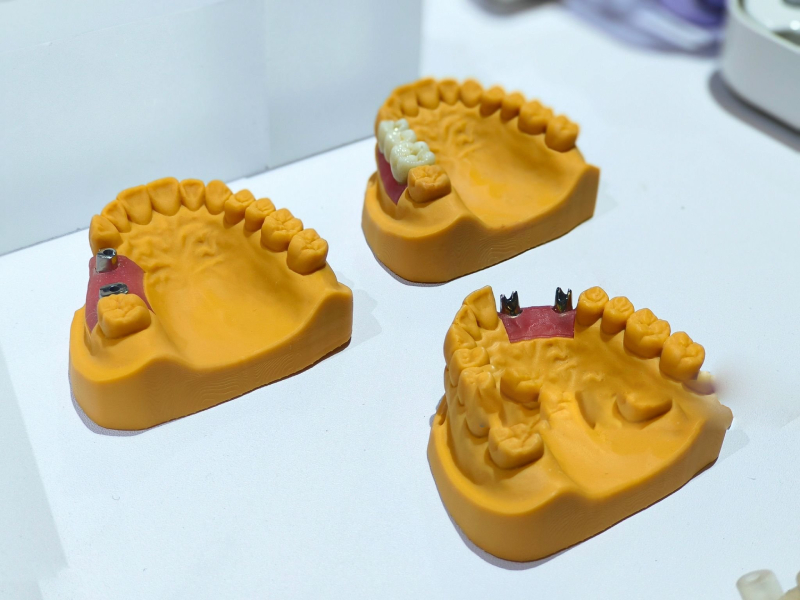
For implant cases, we can cast a UCLA-type custom abutment to a full metal crown as a single piece, eliminating the cement interface between abutment and crown — the most common technical complication in implant crown prosthetics. Send the implant system, platform, and abutment choice on the prescription; we work with all major systems (Straumann, Nobel, Astra, Zimmer, MIS, BioHorizons, and others).
Send A Case
Channel | What to send | What you get back |
Email — [email protected] | Digital scan (STL/PLY/OBJ) or conventional impression + prescription with alloy class | Same-day confirmation; full quote within 24 hours |
Secure upload portal | Idem | Same (link sent on first contact) |
Conventional models by courier | Ship to our intake address (provided on request) | Tracking and return label issued |
Remakes are free if seating fails on a prep that meets our prep parameters; we review every remake in QC to identify the root cause.
For high-volume partner labs and DSOs we set up dedicated case-coordinator contacts, weekly alloy surcharge updates, and locked-in pricing windows. Talk to us.
FAQ
How long does it take to get a full cast metal crown back?
Standard turnaround is 7–10 lab working days from confirmed intake. Rush service is available for an additional fee. Turnaround assumes margin clarity on the scan/impression and alloy class confirmed at intake; we flag any case that needs clarification before starting production.
Will the crown show a dark line at the gumline?
A high-noble alloy (D2790) does not. The dark line that appears on some patients comes from base-metal alloys showing through thin tissue or after gingival recession. If the patient is concerned about gingival esthetics, request a high-noble alloy and place the margin appropriately for the gingival biotype.
Is a full cast crown safe for patients with metal allergies?
For documented allergy to nickel, cobalt, chromium, beryllium, or palladium, request a high-noble alloy (D2790) and we ship the alloy certificate with the restoration. We do not use beryllium-containing alloys, and nickel-free base-metal alloys are available on request. About 10–20% of the population has nickel sensitivity per the ADA.
The CDT code and the certificate — how do they relate?
The CDT code on the claim tells the payer and your patient which alloy class the restoration is made from — D2790 high noble, D2792 noble, D2791 base, D2794 titanium. It describes the alloy class, not the color. Send the certificate with the restoration rather than relying on the patient remembering whether it looked “white” or “gold”.
Can a full cast crown go on a front tooth?
We don’t recommend it. Full cast metal cannot reproduce enamel translucency or tooth color and is intended for posterior and concealed premolar sites. For anterior cases, monolithic zirconia or layered PFM is the more appropriate choice — we make both.
What if the patient can't afford high noble?
Three options to walk through with the patient.
- (1) Step down alloy class — noble (D2792) or base-metal (D2791) costs less than high-noble, with trade-offs in corrosion behavior and gumline appearance.
- (2) Step up restoration type — monolithic zirconia is tooth-colored and priced between noble and high-noble in most U.S. markets.
- (3) Use the insurance alternate-benefit — many plans cover the lab fee for a base functional material even when a high-noble upgrade is prescribed, and the patient pays the difference. Send us the case details and we’ll quote all three.
Do you remake for free if the crown doesn't seat?
Yes. If our restoration does not seat on a prep that meets our prep parameters, we remake at no charge. Return the crown with the case notes and a brief description of the seating issue; our QC team reviews every remake to identify the root cause.
Will a high-noble crown cause a metallic taste?
A properly made high-noble crown does not normally cause a persistent metallic taste. When patients do report taste symptoms, the usual causes are galvanic interaction between dissimilar metals elsewhere in the mouth (IntechOpen — galvanic corrosion of dental alloys), corrosion or ion release from a base-metal alloy elsewhere in the mouth, plaque or food trapping around a margin, or a non-dental cause such as medication, reflux, or sinus infection (Ubie Health — metallic taste after a silver filling). Routine replacement without identifying the actual cause is usually not justified.
Do you offer custom abutments + full cast crowns as one piece?
Yes. For implant cases we can cast a UCLA-type custom abutment to a full metal crown as a single piece, eliminating the abutment–crown cement interface. Send the implant system, platform, and a scan or open-tray impression.
Why are some of your prep parameters slightly different from what I learned in dental school?
Our parameters follow the conventions documented in standard prosthodontic teaching literature. If your office or study club uses a specific parameter set, send it with the prescription and we’ll match it.