Glazing Zirconia Crowns: A Lab Guide for Dentists
When a zirconia crown case leaves the practice, one question keeps coming up: glaze it, polish it, or both? Here’s what glazing actually does, when it fits the case, and how a dental lab handles finishing from the prescription to final delivery.
Table des matières
What Glazing Is (and Isn’t)
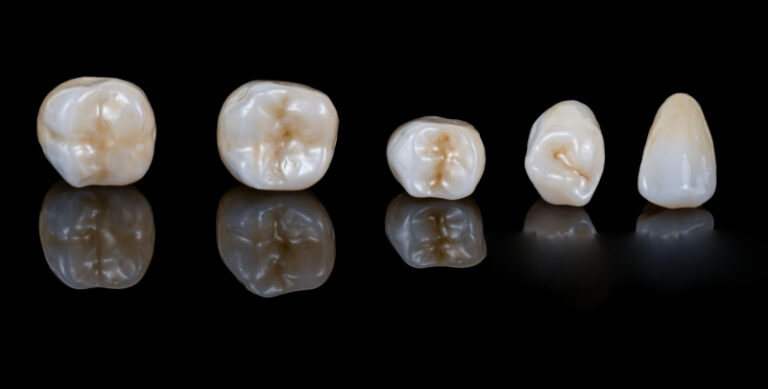
Glazing adds a thin glass-like coating to the zirconia surface. Think of it as a feldspathic layer—typically 15–40 micrometers thick—that gets fired onto the crown in a ceramic furnace.
Polishing works differently. It mechanically smooths the zirconia itself. No added layer—just the zirconia surface brought down to a smooth finish using diamond instruments and polishing pastes.
The key difference: polishing changes the zirconia; glazing covers it. Both can produce a smooth, functional surface, but they do it in different ways and carry different trade-offs.
Why Labs Use Glaze
Glaze does a few things well:
- Adds gloss and visual depth, so the crown looks more like natural enamel under light
- Carries stains and characterization—cervical shading, fissure lines, and translucent effects stick better to a glaze layer
- Smooths minor surface texture left after milling and sintering
- Protects external stain work, keeping hand-applied colors from wearing off quickly
That’s the cosmetic side. Functionally, glaze won’t strengthen zirconia, won’t produce a tighter margin, and won’t permanently shield opposing teeth from wear.
The Problem Dentists Keep Seeing: Glaze Wears Off
Glaze isn’t permanent. Functional contacts—where the crown meets opposing teeth during chewing—wear through the glaze layer over time. Once that happens, the unpolished zirconia underneath becomes exposed, and it can be rougher than the original glaze.
Research backs this up. A 12-month clinical study found glazed zirconia crowns caused more opposing enamel wear than polished crowns once the glaze layer degraded. The rough exposed surface becomes the problem, not the zirconia itself.
Un in-vitro study on polishing and glazing protocols found similar: stepwise polishing produced the lowest roughness values, while glazed specimens were rougher once the layer was disturbed.
This is why evidence-based protocols lean toward:
- Polish functional surfaces (occlusal contacts, cusp tips, anything touching opposing teeth)
- Glaze non-functional surfaces (facial, lingual walls, areas that don’t bear load)
Surface Roughness: The Number That Matters
Here’s a spec worth putting on your prescription: Ra ≤ 0.2 micrometers.
That’s the roughness threshold where plaque retention drops and the surface feels smooth to the tongue. Properly polished zirconia can hit roughness values around or below that level. Glaze, when intact, performs similarly. Once glaze chips or wears unevenly, roughness climbs.
If a crown gets adjusted after glazing and the ground area isn’t re-polished, the delivered surface will be rough at exactly the point of contact. That’s the gap worth closing on each case.
When to Specify Glaze, Polish, or Both
| Clinical Scenario | Recommended Finish |
| Posterior crown, natural enamel antagonist | Polish all functional contacts; optional glaze on facial/axial surfaces |
| Heavy bruxer or high occlusal load | Fully polish functional surfaces; skip thick glaze on occlusal |
| Crown adjusted chairside | Re-polish each adjusted surface before cementation |
| Anterior crown where esthetics dominate | Stain + glaze facial surface; polish lingual and incisal contacts |
| Pre-shaded multilayer zirconia | Polish-only or minimal characterization + facial glaze |
| Deep occlusal fissures | Fine-grit polishers under magnification; glaze won’t stay in tight grooves |
How a Lab Processes a Glaze Prescription
A typical zirconia crown with glazing moves through this workflow:
- Receive digital files or impression – scan, import, verify margin clarity
- CAD design – select zirconia type (3Y/4Y/5Y, pre-shaded or white), design crown anatomy and cement space
- Mill in green state – CNC mill the oversized pre-sintered blank
- Optional pre-sinter staining – apply coloring liquids if the prescription calls for internal shade modification
- Sinter – fire to final density (typically 1,450–1,530°C depending on the zirconia brand)
- Verify fit and adjust – check margins, contacts, occlusion on model or digitally
- Polish functional surfaces – diamond-grit sequence down to high-gloss paste on any area contacting opposing teeth
- Apply stain and glaze – brush or spray glaze onto facial/axial surfaces; external stains for characterization
- Fire glaze – second firing at lower temperature (typically 700–850°C)
- Final polish on adjusted areas – re-polish any surface ground after glaze firing
- Quality inspection – check under magnification for margin pooling, rough spots, color match
- Package and ship
Glaze Application Methods
Three main techniques are in common use:
- Brush-on paste – precise control, good for localized areas, easy to avoid margins
- Powder + liquid – traditional method, requires skilled hand, can pool if over-applied
- Spray glaze – fast, even coverage, works well for full facial surfaces, harder to isolate specific zones
Spray glaze suits high-volume standard cases. Brush-on gives more control for custom characterization or when glaze needs to stay away from margins and contacts.
What to Put on a Lab Prescription
Clear instructions reduce chairside adjustment and remakes. Here’s what to specify.
Matériau
- Monolithic or layered zirconia
- Strength/translucency level (3Y full-strength, 4Y balanced, 5Y high-translucency)
- Pre-shaded, multilayer, or white zirconia
- Indication: posterior, anterior, bruxism, implant
Ombre
- Vita shade tab or equivalent
- Cervical/body/incisal shade differences if needed
- Preparation shade (especially for translucent zirconia)
- Photos with shade tab in the same plane under natural light
- Note whether a natural match or a brighter cosmetic result is preferred
Shade should be evaluated value first, then hue and chroma, with surface texture and incisal translucency compared under the same lighting as the natural teeth.
Surface Finish (the critical one)
- Fully polished
- Stain and glaze
- Polish occlusal, glaze facial (common for posterior esthetics)
- High-gloss or satin finish
- Specific texture requests (e.g., match adjacent tooth texture)
- Whether the lab should re-polish functional contacts after glaze firing
Occlusion
- Opposing material: natural enamel, zirconia, porcelain, metal
- Bruxism or parafunction noted
- Desired occlusal scheme (mutually protected, group function)
- Whether the crown should be designed slightly out of heavy occlusion
Turnaround and Special Requests
- Standard timeline or rush
- Custom characterization notes
- Specific contact tightness preference
The field often missing from prescriptions: explicitly stating whether to re-polish after adjustment. If it isn’t specified, a lab may glaze everything and assume the dentist will polish chairside—or polish functional areas after glaze. Spell it out.
Does Glaze Wear Off? (The Question Patients Ask)
Yes. Glaze is a surface coating, not a permanent bond. On functional occlusal surfaces, glaze can wear through in months to a couple of years depending on:
- Occlusal load and bruxism
- Diet (acidic foods accelerate surface wear)
- Location (molar cusps wear faster than premolar facial surfaces)
- Glaze thickness and chemistry
- Whether the surface was adjusted after glazing
Once glaze wears through, the zirconia underneath needs to be smooth. That’s why polishing before glazing—or polishing functional areas and glazing only non-contact zones—is the safer protocol.
What this means for chairside work: when a glazed crown gets adjusted, re-polish each adjusted spot with zirconia-specific polishing instruments. Leaving a ground, unpolished surface is worse than skipping glaze from the start.
Glaze vs. Polish: What the Evidence Shows
Antagonist Wear
- Polished zirconia: low opposing enamel wear when the surface is smooth (Ra ≤ 0.2 µm)
- Intact glaze: similar or slightly higher wear than polished zirconia
- Worn-through glaze exposing rough zirconia: notably higher antagonist wear
A systematic review in PMC on natural teeth wear opposite ceramic crowns recommends polishing before any surface treatment, since staining or glaze that wears away can leave a rough surface in contact with enamel.
Takeaway: polished functional contacts are the safer bet. Glaze the parts that don’t touch.
Plaque and Biofilm
- Smooth surfaces (polished or well-applied glaze) both perform acceptably
- Rough surfaces retain more plaque regardless of finish method
- Un in-vitro study on polishing and glazing surface characteristics found glazed specimens were significantly rougher than polished, though colony counts for the tested microorganisms didn’t differ significantly
- Finish quality matters more than finish method
Fracture Strength
- Monolithic zirconia is strong because it’s one piece (no porcelain veneer to chip off)
- Heavy glaze application can introduce interface defects and reduce flexural strength
- Research on strength degradation mechanisms of dental zirconia due to glazing found glaze thickness matters—thicker glaze layers correlate with greater strength reduction
- Glaze doesn’t strengthen zirconia; the role is cosmetic and surface-functional
Marginal Fit
- Fit depends on prep quality, scan accuracy, CAD design, milling precision, and sintering shrinkage control
- Glaze can pool at margins if over-applied
- A systematic review on marginal fit of monolithic vs layered zirconia reported monolithic zirconia had better marginal adaptation than veneered zirconia overall
- Glazing doesn’t improve marginal fit—excess glaze at the margin can interfere with seating
Bond Strength
- External glaze on the visible surface doesn’t help cementation
- The intaglio surface should be treated per manufacturer protocol: airborne-particle abrasion + MDP primer
- Experimental work on internal glazing + HF etching exists, including a study using glaze as a bonding system for zirconia, but this isn’t standard practice
- Standard cementation protocols don’t change because the crown is externally glazed
Sintering and Its Effect on Shade
Zirconia is milled oversized from a partially sintered blank, then heated—commonly in the approximate 1,350–1,550°C range—to densify it and produce final dimensions and mechanical properties. Exact temperature and cycle are product-specific.
Speed sintering can cut production time, but the cycle has to be validated for the specific zirconia. Changes in heating rate, peak temperature, and hold time can affect grain size, translucency, chromaticity, strength, and marginal fit.
A systematic review on conventional, speed, and high-speed sintering of zirconia found current evidence is primarily in vitro, with sintering changes potentially affecting precision, mechanical properties, optical properties, and aging resistance. A separate study on speed sintering optical properties found speed sintering could decrease translucency and opalescence while increasing chromaticity in some multilayer zirconias, though color differences weren’t necessarily clinically perceptible.
Practical takeaway: use the block manufacturer’s validated cycle, don’t substitute a generic speed program, and keep the same cycle across shade tabs, remakes, and production cases.
Turnaround Expectations
A typical in-lab timeline for a zirconia crown with glazing:
- Standard crown (polished or standard glaze): around 5 working days
- Custom characterized crown (multiple stain layers, individualized glaze): 6–8 working days
- Rush cases: 3 working days, limited to simpler cases, often with a surcharge
Chairside milling + sintering can deliver a crown same-day when the practice has the equipment and validated protocols. Complex characterization, difficult occlusion, multi-unit bridges, and implant cases usually route to a full-service lab for predictable results.
Pricing: What Changes the Fee
Standard glaze is bundled into the base crown price at reputable labs. Custom characterization—hand-painted stains, multiple glaze firings, special texture work—adds to the fee.
Variables that drive the price:
- Zirconia formulation (3Y vs 4Y vs 5Y, pre-shaded vs multilayer)
- Characterization level (standard shade vs individualized stain work)
- Rush turnaround
- Multi-unit bridges or implant components
- Model handling (digital model-free vs physical model)
A lab price should be requested per case or per volume agreement, since fee schedules vary by material, finish complexity, and service level.
Common Questions About Glazing Zirconia Crowns
Should glaze be requested for each anterior crown?
Not automatically. A high-quality pre-shaded multilayer zirconia combined with good patient hygiene can produce an excellent fully polished crown that holds up longer. Glaze fits the case when the restoration needs:
1. Additional characterization (white spots, cervical shading, fissure lines)
2. High gloss hard to achieve by polishing alone
3. Fluorescent or opalescent effects carried in the glaze layer
For many anterior cases, a hybrid approach works: polish lingual and incisal functional surfaces, glaze the facial surface with custom staining.
Can a glazed crown be adjusted chairside without sending it back?
Yes—as long as each adjusted area gets re-polished with zirconia finishing burs and polishers. The sequence:
1. Adjust occlusion or contact with a fine diamond
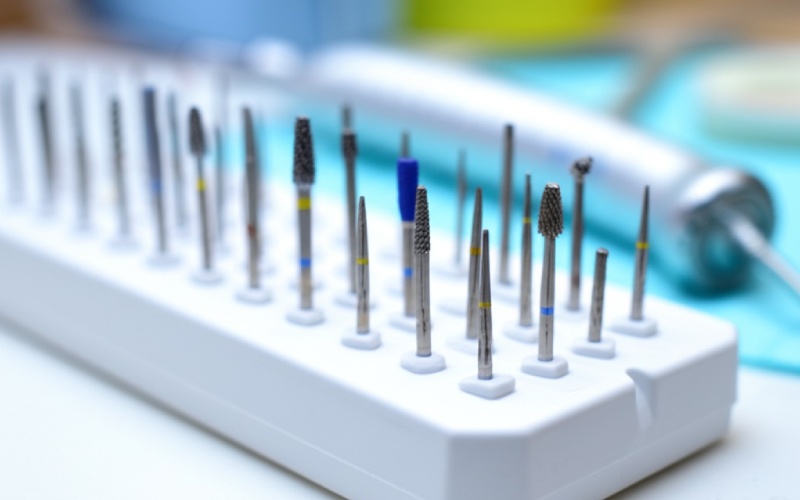
2. Smooth with a medium-grit zirconia finishing bur
3. Polish with rubber polishers (coarse → medium → fine → extra-fine)
4. Final polish with diamond paste
Skip the polishing steps and the result is a rough surface that wears opposing enamel faster than the original glaze. What gets reported as a “glazed zirconia failure” is often an adjusted-but-not-re-polished zirconia case.
Does glaze protect the crown from staining?
Glaze provides some stain resistance when intact, but it isn’t a permanent barrier. Coffee, tea, red wine, and smoking can discolor a glazed surface over time, especially if the glaze layer wears thin or develops micro-cracks.
Polished zirconia generally resists staining because there’s no porous coating to absorb pigments. Either way, patient hygiene and diet matter more than the finishing method.
What if the patient is a heavy bruxer?
For bruxers, prioritize durability over maximum esthetics:
1. Use full-strength 3Y zirconia (not ultra-translucent 5Y)
2. Fully polish all functional surfaces—don’t rely on glaze to handle occlusal forces
3. Optional glaze on non-contact facial surfaces only
4. Design the crown slightly out of heavy occlusion if possible
5. Recommend a night guard
Glaze wears off quickly under bruxing forces. Polished zirconia handles the load better.
Can a lab re-glaze a crown after it’s been in service?
Technically yes, though it’s rarely practical. The crown would need to be removed, cleaned, re-stained/re-glazed, fired, and re-cemented. By that point, making a new crown is usually more predictable.
If a patient notices the crown has lost its shine after a year or two, that’s often glaze wear. A dentist can re-polish chairside to restore smoothness, though the original gloss won’t fully return without re-firing.
What’s the difference between stain and glaze?
1. Stain adds color (pigments like iron oxide, chromium oxide). It can be applied before sintering (infiltrates the zirconia matrix) or after sintering (surface effect).
2. Glaze is a glass-forming material (feldspathic composition) that melts onto the surface during firing. It can carry stains or be applied clear.
A combined stain-and-glaze paste is common for efficiency: the stain provides color, the glaze provides gloss and seals the stain in place.
Does glazing meet FDA and ISO requirements?
Yes, when sourced and processed correctly. Dental glazes fall under FDA 21 CFR 872.6660 (porcelain powder for clinical use, Class II, product code EIH). FDA’s 2024 guidance on dental ceramics provides performance criteria based on ISO 6872 for dental ceramic materials.
What this means for a dentist:
1. A qualified lab uses glaze materials with documented regulatory status and biocompatibility
2. The lab should follow manufacturer firing protocols (temperature, hold time, cooling)
3. Material lot numbers and processing records should be traceable
4. If a patient has a known allergy or sensitivity, communicate it on the prescription
How to tell if the lab is glazing correctly?
Quality markers to check on delivery:
1. Clean margins – no glaze pooling or buildup at the margin line
2. Polished functional contacts – occlusal cusp tips and contact points feel smooth, not glassy
3. Even gloss – no patchy areas, drips, or matte spots where glaze didn’t flow
4. No craze lines – fine cracks in the glaze indicate thermal mismatch or over-firing
5. Color matches prescription – stain looks integrated, not painted-on
6. Crown seats fully on the die or model – excess glaze shouldn’t block seating
If margin pooling, rough functional surfaces, or uneven glaze coverage show up, send photos and request a remake.
When Glazing Doesn’t Make Sense
Some cases call for a fully polished finish instead of glaze:
- Heavy bruxers – glaze wears off fast; polished zirconia is more durable under load
- Patients with challenging oral hygiene – glaze can stain or wear unevenly; polished zirconia is easier to maintain
- Posterior crowns with minimal esthetic demand – polishing is faster, cheaper, and functionally comparable
- Tight occlusion or limited clearance – adding a glaze layer (even 20–30 µm) can make occlusion too heavy
- Crowns that will likely need chairside adjustment – glaze before adjustment is wasted; polish after adjustment instead
Final Recommendation: Polish First, Glaze Smart
The evidence-based approach for zirconia crowns:
- Polish all functional surfaces (occlusal contacts, cusp tips, incisal edges)
- Glaze non-functional surfaces (facial, lingual walls) when esthetics call for it
- Re-polish any surface adjusted after glaze firing
- Use pre-shaded or multilayer zirconia to reduce reliance on heavy external staining
- Specify finish preference clearly on each prescription
Glazing isn’t bad. It’s just not magic. Used correctly—on the right surfaces, with proper polishing where it matters—it’s a solid tool for delivering natural-looking, durable zirconia restorations.
About Istar Dental Lab
Istar is a direct manufacturing dental lab founded in 2012, with facilities in Shenzhen and Huizhou, China. CAD design, milling, sintering, staining, glazing, and polishing all happen in-house, with lot traceability and documented processing records retained for each case. The finishing team handles stain and glaze protocols for pre-shaded, multilayer, and white zirconia across 3Y, 4Y, and 5Y formulations. Services cover dental practices and laboratories across the United States and Europe.
For prescription forms, pricing, and technical questions on zirconia finishing, contact Istar directly.