Valplast Upper Partial Denture: Anterior Case Study
🕢 [ Remplissez le formulaire et nous vous répondrons dans les 30 minutes ! ]
Patient Situation
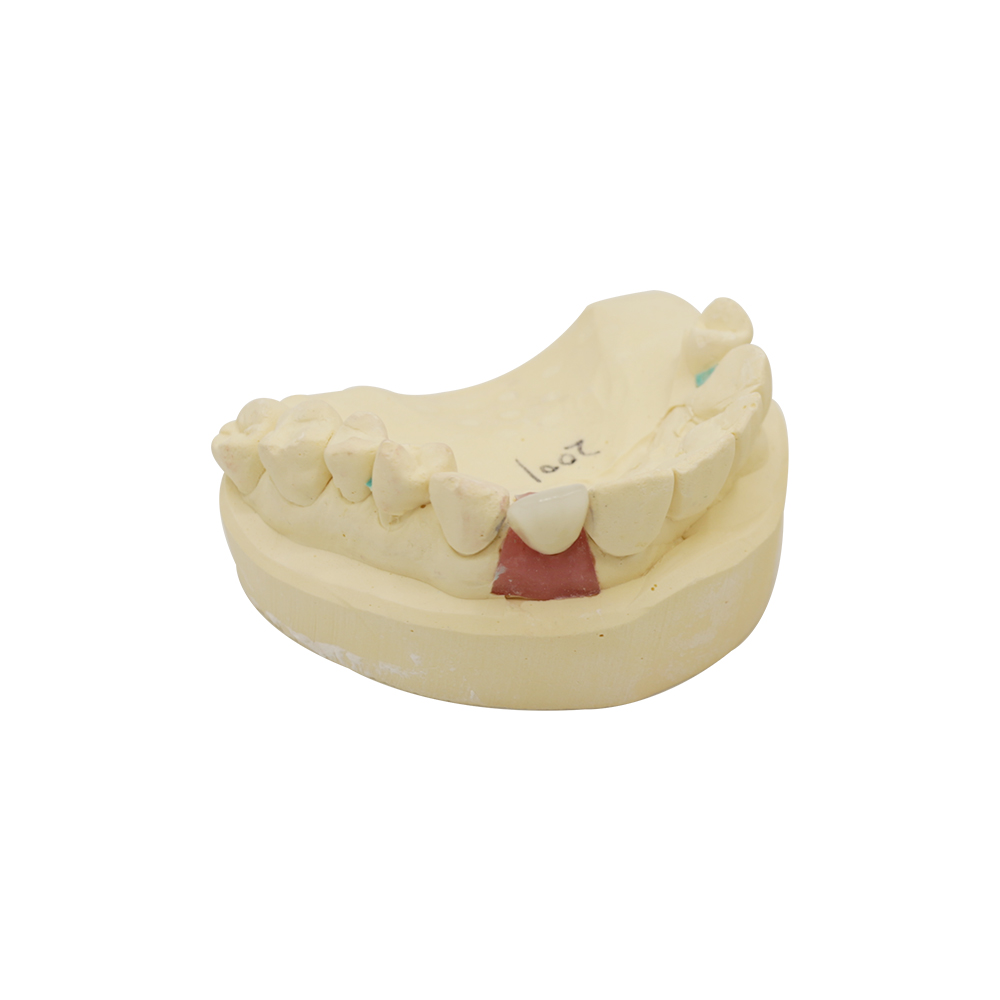
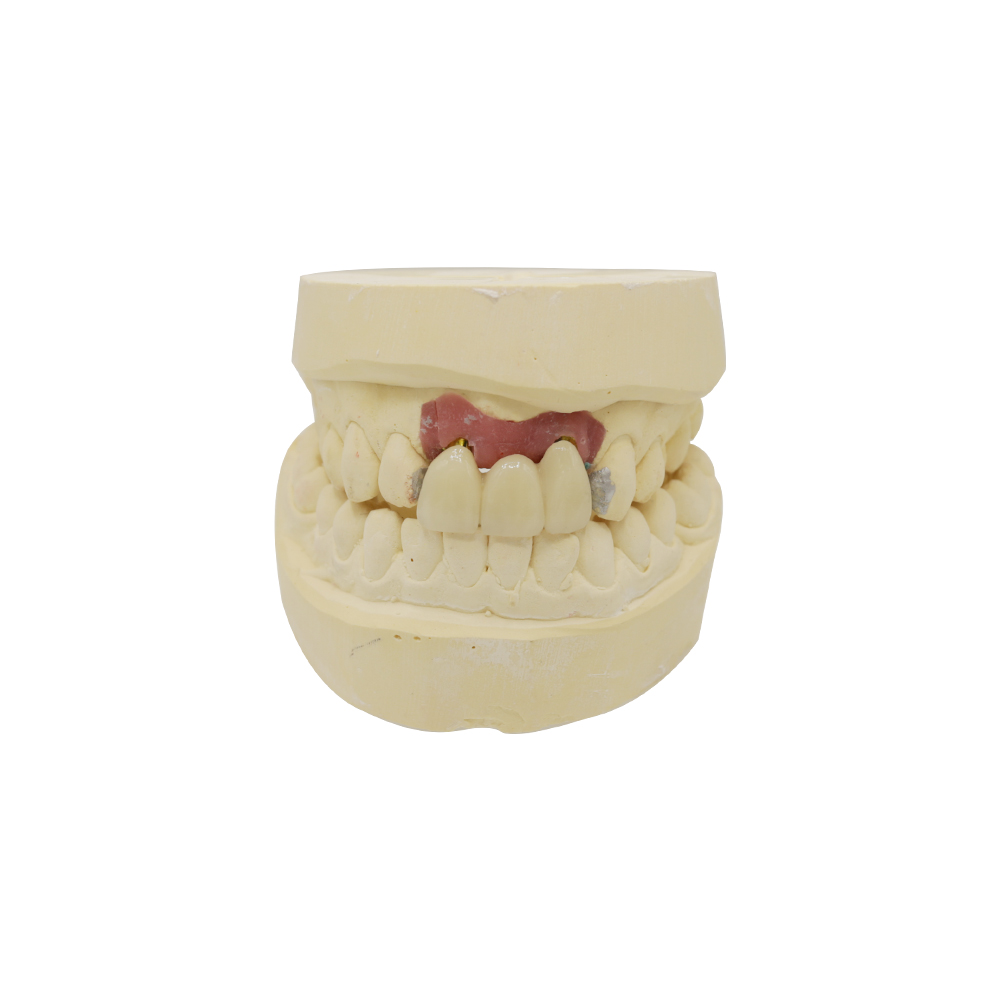
A 52-year-old male patient presented with missing upper anterior teeth (#7, #8, #9) following extraction approximately six weeks prior. The extraction was necessitated by advanced periodontal involvement with marked mobility and persistent periapical abscess that had not responded to endodontic retreatment.
Medical and dental history:
- Non-smoker, occasional alcohol use (social settings only)
- No systemic conditions affecting wound recovery or bone metabolism
- Documented nickel allergy (patient experienced dermatitis from watchbands and metal jewelry in the past)
- Good oral hygiene habits, though prior to extractions had experienced chronic localized periodontal disease in the anterior maxilla
Remaining dentition:
- Upper canines (#6, #11) present with adequate periodontal support and no mobility
- Upper premolars and molars intact, with stable occlusal relationships
- Lower arch fully intact with no active caries or periodontal disease
- Vertical dimension and centric relation stable
Ridge characteristics:
- Recovery appeared complete at six weeks post-extraction
- Minimal to moderate horizontal resorption in the anterior ridge
- Adequate vestibular depth for clasp placement
- Tissue tone well-conditioned with no inflammation or fibrous hyperplasia
Patient’s primary concerns:
- Immediate esthetic need — the patient worked in a client-facing professional role and had been avoiding meetings and social events due to embarrassment over the visible tooth loss
- Metal visibility — strongly opposed to any visible metal clasps or framework components in the anterior region
- Comfort and speech — concerned about bulkiness and impact on speaking clearly during presentations
- Timeframe — willing to wait for proper fabrication but wanted the restoration delivered within a reasonable professional turnaround
Implant consideration: The patient had consulted with a periodontist regarding implant placement. Three implants were clinically indicated for the edentulous span, but the patient was not ready to proceed with surgery immediately due to:
- Financial planning (the total required for three implants exceeded his current budget)
- Work schedule constraints (unable to take extended time off for multiple surgical appointments)
- Desire to “test drive” living with a removable prosthesis before committing to surgical intervention
The prescribing dentist positioned this restoration as a transitional solution — functional and esthetic enough for the patient to resume normal life, while allowing time to arrange implant planning and financing over the next 12–18 months.
Fabrication Requirements From the Prescribing Dentist
The prescription included the following technical specifications:
Retention and Clasp Design
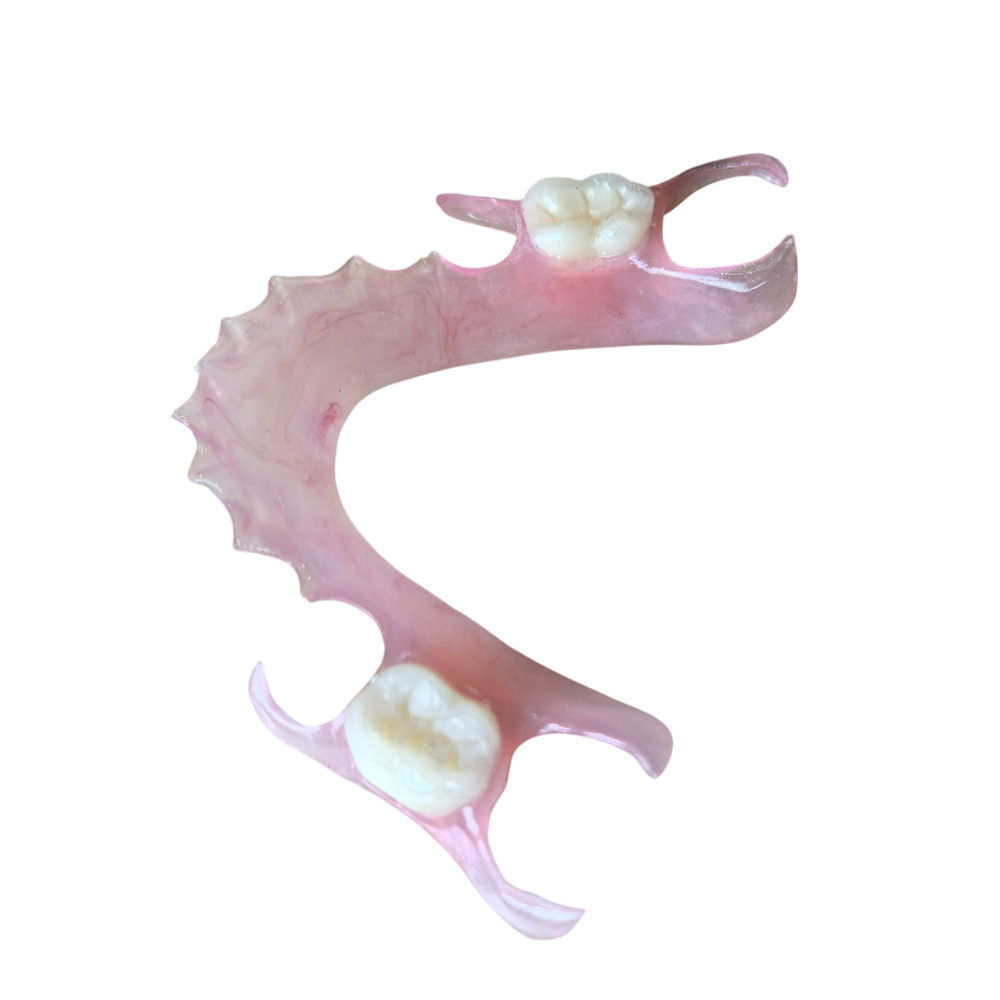
- Engage undercuts on teeth #6 and #11 using tissue-toned flexible clasps
- No visible metal components in the esthetic zone
- Clasp arms to be positioned at the gingival third where tissue coverage would help mask the retention elements
- Clasps must provide adequate retention without requiring excessive insertion/removal force (patient expressed concern about damaging adjacent teeth)
Occlusal Requirements
- Minimal palatal coverage to reduce foreign-body sensation and preserve speech clarity
- Vertical dimension to be maintained as recorded at the final impression appointment
- No interference with posterior occlusion during excursive movements
- Anterior guidance to remain primarily on natural dentition (the partial should not bear heavy occlusal load)
Spécifications des matériaux
- Valplast polyamide resin for both the denture base and clasps (chosen to eliminate acrylic monomer exposure, given the patient’s history of contact sensitivity)
- Tissue shade: Medium pink with moderate translucency to blend with the patient’s gingival tissue
- Tooth selection: Acrylic denture teeth, shade A2, mold specified by the dentist based on pre-extraction records and neighboring tooth morphology
- Teeth to be retained mechanically within the polyamide base (chemical bonding between polyamide and acrylic is not reliable)
Delivery Timeline
- Standard turnaround requested — patient could accommodate normal production time
- Dentist requested notification if any impression deficiencies were identified before proceeding with fabrication
Valplast Upper Partial Denture Design Challenges
Challenge A: Clasp Esthetics vs. Retention Balance
Flexible clasps must be thin enough to blend with gingival tissue but thick enough to engage the undercut and provide stable retention. If the clasp is too thin, it loses retentive memory and the prosthesis becomes loose during function. If too thick, the clasp is visible and creates discomfort at the gingival margin.
Our approach: We designed the clasp arms to engage the measured undercuts on #6 and #11 at the gingival third, where natural tissue contour would help conceal the clasp tips. The clasp thickness was calibrated to the specific undercut depth shown in the impression — we do not use a universal thickness or guess based on “typical” anatomy.
Before proceeding with fabrication, we verified that the impression captured adequate undercut detail. Flexible clasps rely entirely on mechanical retention from tooth undercuts; they cannot be adjusted or “tightened” after delivery. If the impression shows insufficient undercut or distortion, we contact the prescribing dentist to request a new impression rather than fabricating a prosthesis that will fail at delivery.
Challenge B: Palatal Coverage and Thickness
A common misconception is that “flexible” means “no palate” or “ultra-thin everywhere.” In reality, tissue-borne flexible partials require meaningful palatal coverage to distribute functional load and resist displacement during speech and light chewing.
Our approach: We designed the palatal connector to extend just enough to provide stable support without excessive bulk. The thickness in the palatal region was determined by:
- The span length (three-tooth edentulous space)
- The anticipated load distribution pattern
- The need to resist flexure during function
We do not compromise structural integrity for the sake of minimal thickness. An under-designed base will flex excessively during speech and function, leading to patient discomfort, poor retention, and premature material fatigue.
Challenge C: Shade Integration
Unlike metal frameworks where clasps are distinct components, Valplast clasps are part of the monolithic polyamide base and must blend with the patient’s gingival tissue.
Our approach: We selected the tissue shade based on the dentist’s written shade notation and cross-referenced it with Valplast’s standard tissue-tone options. Our fabrication record includes the specific Valplast material lot number and shade code used, so if a remake is required, the exact specification can be reproduced.
We do not offer on-site shade matching or technician clinic visits — the outcome depends on the accuracy of the shade information provided in the prescription.
Challenge D: Managing Expectations About Longevity and Modification
Polyamide flexible partials have well-documented limitations:
- Cannot be relined if ridge resorption occurs
- Cannot accommodate tooth additions if adjacent teeth are lost
- Difficult to repair if fractured (polyamide does not bond reliably to repair resins)
Our approach: We documented these limitations in the case record and provided the dentist with written delivery instructions that included patient education points:
- Surface roughness and staining may develop over time as polyamide absorbs water and organic compounds
- Retention may decrease with repeated insertion and removal, especially if excessive force is used
- If additional teeth are lost, the appliance must be remade — it cannot be modified
Because this case was explicitly positioned as a transitional restoration (not a definitive long-term prosthesis), these limitations were clinically acceptable.
Delivery and What Happened Next
The completed prosthesis was delivered within our standard turnaround time. At the delivery appointment, the dentist reported:
- Retention was adequate — clasps engaged the undercuts on #6 and #11, and the prosthesis remained stable during speech and light function
- Esthetics met expectations — no visible metal, tissue-toned clasps blended with the gingival margin, and tooth shade matched the adjacent natural teeth
- Initial comfort was acceptable — patient reported awareness of the palatal thickness but no sharp edges or pressure points
The dentist made minor occlusal adjustments to relieve a high spot on the left central incisor using a rubber wheel at low speed (polyamide cannot be adjusted with acrylic burs, as it melts rather than cuts cleanly). No clasp adjustments were needed.
Patient and Dentist Response After Try-In and Delivery
At the One-Week Follow-Up
The dentist scheduled a follow-up appointment one week after delivery to assess tissue response, retention, and patient adaptation. At that visit:
Patient response:
- Speech had improved significantly — initial lisping and difficulty with “s” and “t” sounds had resolved within 48 hours of continuous wear
- Comfort was good — awareness of palatal thickness had diminished; patient reported no sore spots or pressure areas
- Retention was stable — prosthesis did not dislodge during eating or speaking
- Slight difficulty with insertion and removal initially, which improved with practice over the first few days
- Esthetics exceeded expectations — patient was pleased with the appearance and reported that speaking and smiling in professional settings was now comfortable again
Dentist observations:
- Tissue response was normal with no erythema or blanching at clasp contact areas
- Occlusion remained stable with no premature contacts in centric or excursive movements
- Patient demonstrated proper insertion/removal technique
The dentist provided additional instructions:
- Avoid hot water or boiling for cleaning (polyamide can distort at elevated temperatures)
- Use a soft brush and mild soap (abrasive cleansers accelerate surface roughness)
- Avoid prolonged soaking in chlorine-based solutions (may degrade the polymer)
- Remove the prosthesis at night to allow tissue rest and maintain gingival condition
At the Three-Month Follow-Up
The patient returned for a routine hygiene appointment and reported continued satisfaction:
- Function remained good — able to eat most foods comfortably (avoided very hard or sticky items as instructed)
- Retention had decreased slightly but remained clinically acceptable
- No tissue irritation or discomfort
- Minor surface changes noted — slight increase in surface texture, but no significant staining (patient followed cleaning instructions consistently)
Dentist assessment:
- Prosthesis was functioning as intended for a transitional restoration
- Patient remained interested in implant placement and was in the process of financial planning for surgery within the next 12 months
- No clinical concerns regarding tissue condition or prosthesis integrity
Long-Term Outlook
The dentist and patient understood from the outset that this was not a definitive long-term restoration. If the patient ultimately decided not to proceed with implants, a more rigid framework (either cast metal or a hybrid design with metal framework and Valplast esthetics) would be recommended for long-term durability and function.
The case demonstrated that a well-fabricated Valplast flexible partial can serve effectively as a transitional solution when:
- Case selection is appropriate (short bounded anterior span with adequate abutment support)
- Expectations are managed (transitional, not definitive)
- Fabrication is based on accurate impression and prescription data
- Patient follows care and maintenance instructions
When This Approach Would Not Work
This case succeeded because several favorable conditions were present. A Valplast flexible partial would pas be appropriate in the following situations:
| Scenario | Why It’s Unsuitable |
| Bilateral distal extension with few remaining teeth | Tissue-borne flexible bases cannot provide the rigid support needed for posterior load distribution. Distal extension cases require occlusal rests and a rigid major connector to prevent excessive tissue loading. |
| Heavy occlusal forces, clenching, or bruxism | Polyamide is resilient but less rigid than metal. High functional loads cause excessive flexing, leading to patient discomfort and accelerated material fatigue. |
| Deep overbite or limited interocclusal space (<4 mm) | Insufficient vertical clearance increases the risk of dislodgement during excursive movements and compromises structural integrity. |
| Patient expects to add teeth later or requires frequent relining | Polyamide cannot be relined or modified after fabrication. If bone resorption occurs or additional teeth are lost, the appliance must be remade. |
| Poor oral hygiene or inability to maintain the prosthesis | Flexible partials require diligent daily cleaning to prevent surface roughness, staining, and microbial colonization. Patients unable to commit to maintenance protocols are better served by fixed restorations or conventional removable partial dentures. |
| Flat or flabby ridges with minimal undercut | Retention depends entirely on engaging natural tooth undercuts. Insufficient undercuts or unstable ridge anatomy require a rigid framework with precision attachments or implant support. |
Valplast Partial Denture Fabrication at ASD Dental Lab
ASD Dental Lab operates a dedicated Removable Denture Department with approximately 55 experienced technicians across our facilities in Shenzhen and Huizhou. We fabricate both flexible and conventional removable prostheses entirely in-house — we do not outsource cases to third-party laboratories.
What We Control
- Impression evaluation and case acceptance — we review impression quality, occlusal records, and prescription completeness before starting fabrication
- Material sourcing and lot tracking — Valplast polyamide cartridges and acrylic teeth are sourced from verified suppliers; each case is logged with material lot numbers for traceability
- Injection molding and finishing — polyamide is injection-molded in a closed-flask system at controlled temperature and pressure, then hand-finished and polished
- Quality inspection — each restoration is checked for fit, occlusion, and clasp extension before shipment
What We Need From You
A successful outcome depends on the quality and completeness of the information you provide. Your prescription, impression, and occlusal record determine the result — we fabricate based on what you send, not on assumptions.
Critical information we require:
- Final impression in irreversible hydrocolloid or elastomeric material, capturing adequate detail of the edentulous ridge, abutment teeth, and undercut areas
- Occlusal registration (wax bite, silicone record, or opposing model mounted in centric relation)
- Shade selection for both the denture base (tissue tone) and artificial teeth
- Tooth mold and shade specified by manufacturer name and code
- Special instructions regarding clasp design, palatal coverage, or tooth positioning
If the impression shows insufficient undercut, distortion, or incomplete anatomy, we will contact you before proceeding. We do not guess or “fix” deficient impressions — that approach leads to remakes and wasted time.
Turnaround and Communication
Normal production time for a Valplast flexible partial is disclosed upon case submission. During peak seasons turnaround may extend slightly, but we maintain sufficient capacity (4,000–6,500 removable prostheses per month) to avoid excessive delays.
If we identify a problem with your case (incomplete prescription, inadequate impression, unclear instructions), we will notify you within one business day. We do not proceed with fabrication when critical information is missing.
Remake and Adjustment Policy
Our remake and adjustment policy is provided in writing at case acceptance. We distinguish between fabrication errors (remade at no charge) and issues arising from incomplete or inaccurate case data (where responsibility is shared). Specific terms are documented in the case submission agreement and vary by case type and complexity.
Why This Matters
Many flexible partial failures are not material failures — they are data failures. The prescribing dentist sent incomplete information, the impression did not capture undercuts accurately, or the occlusal record was distorted. When that happens, even perfect fabrication technique cannot produce a successful result.
We document what we receive and what we fabricate. Our case records include photos of the impression, a copy of the written prescription, and material lot numbers. This traceability helps identify whether problems originated at impression, fabrication, or delivery.
References and Further Reading
All clinical statements are supported by peer-reviewed literature, manufacturer technical documentation, or professional organization guidelines. Links are provided with as they are external authoritative sources.
- Valplast Clinical Indications — Chairside Magazine article covering appropriate case selection
- Water sorption and solubility of polyamide denture base materials — peer-reviewed study on material properties
- Flexible Thermoplastic Denture Base Materials for Aesthetical Removable Partial Dentures — comprehensive review of thermoplastic materials in prosthodontics
- Nonmetal clasp dentures: What is the evidence about their use? — systematic review published in Journal of Indian Prosthodontic Society
- Patient and Clinical Evaluation of Traditional Metal and Polyamide Partial Removable Dental Prostheses — one-year clinical study comparing outcomes
- Valplast Technical Reference Guide — manufacturer’s official fabrication and clinical guidelines
- Valplast FAQ — manufacturer-provided answers to common clinical questions
- Polyamide as a Denture Base Material: A Literature Review — evidence summary on polyamide properties and clinical performance
- Clinical application of removable partial dentures using thermoplastic resin — case series documenting clinical outcomes
Privacy and De-identification Statement
This case description is based on clinical scenarios encountered in removable prosthodontics practice. Patient identifiers, prescribing dentist names, clinic names, and geographic locations have been removed to protect privacy. Age, tooth numbers, and clinical findings are presented in aggregate or representative form. No original patient records, radiographs, or photographs are included.
The purpose of this case approach is to illustrate fabrication decision-making, technical workflow, and communication between the prescribing dentist and dental laboratory. It is not a patient testimonial and does not constitute a claim of clinical outcome. Actual outcomes depend on impression quality, case selection, patient compliance, and clinical delivery technique — all outside the laboratory’s direct control.
Des délais d'exécution plus courts grâce à notre technologie de pointe
Recommandé