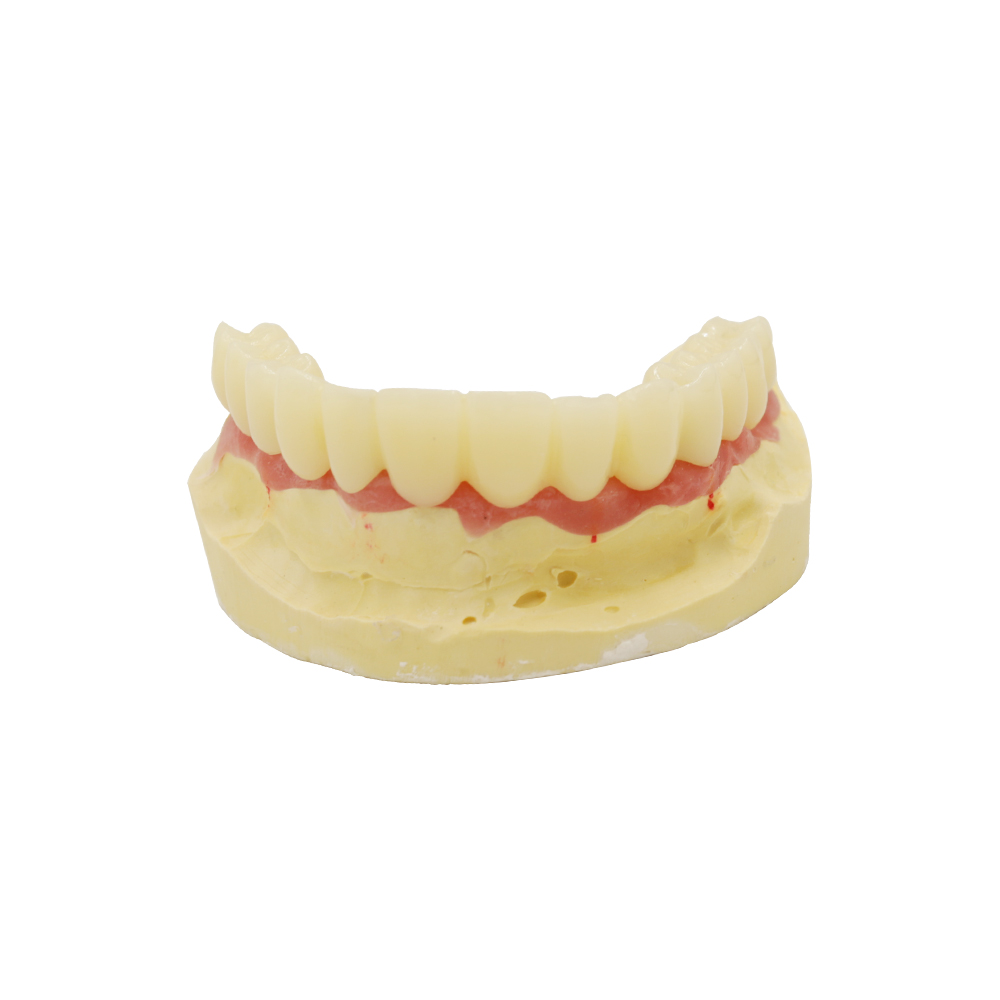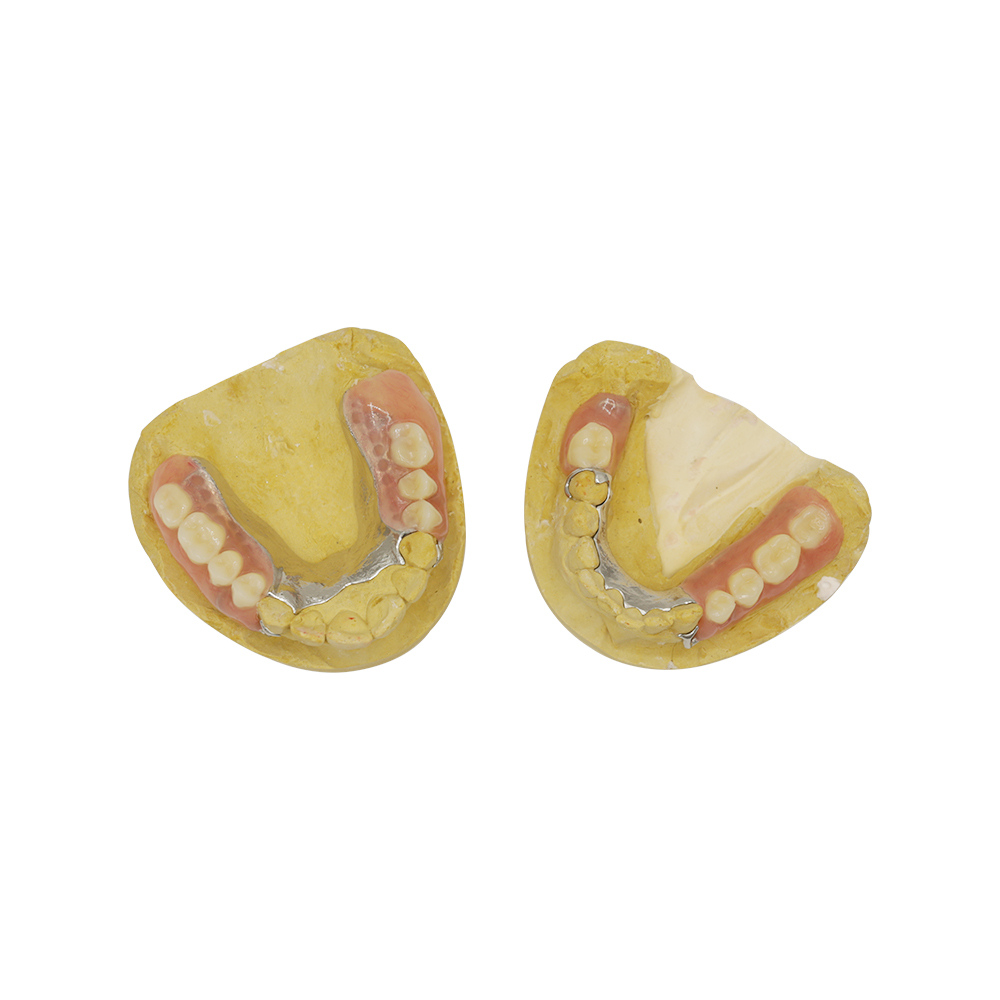
Lower Metal Dentures: Mandibular Distal‑Extension Framework — From Prescription to Try‑In
🕢 [ Remplissez le formulaire et nous vous répondrons dans les 30 minutes ! ]
Service scope. This page documents laboratory work. We produce frameworks and prostheses to a dentist’s written prescription; we do not supply finished dentures directly to the public.
Patient Background and Chief Complaint
A woman in her early sixties came to the practice after wearing a series of flexible partial dentures for nearly eight years. She had lost all her lower molars — both sides — years earlier, and the flexible partials she’d been using kept breaking at the clasps or stretching out of shape within 18 to 24 months. Each time one failed she had it remade, but the cycle repeated. By the time she sought a second opinion she was on her fourth flexible partial in eight years.
“I can’t chew anything tough, and I’m tired of getting these remade every year and a half.”
She worked at a retail store, spending most of the day on her feet, and didn’t want to take time off every 18 months for yet another remake. She also worried that the constant motion of the removable base might be loosening her remaining lower front teeth.
Clinical Findings
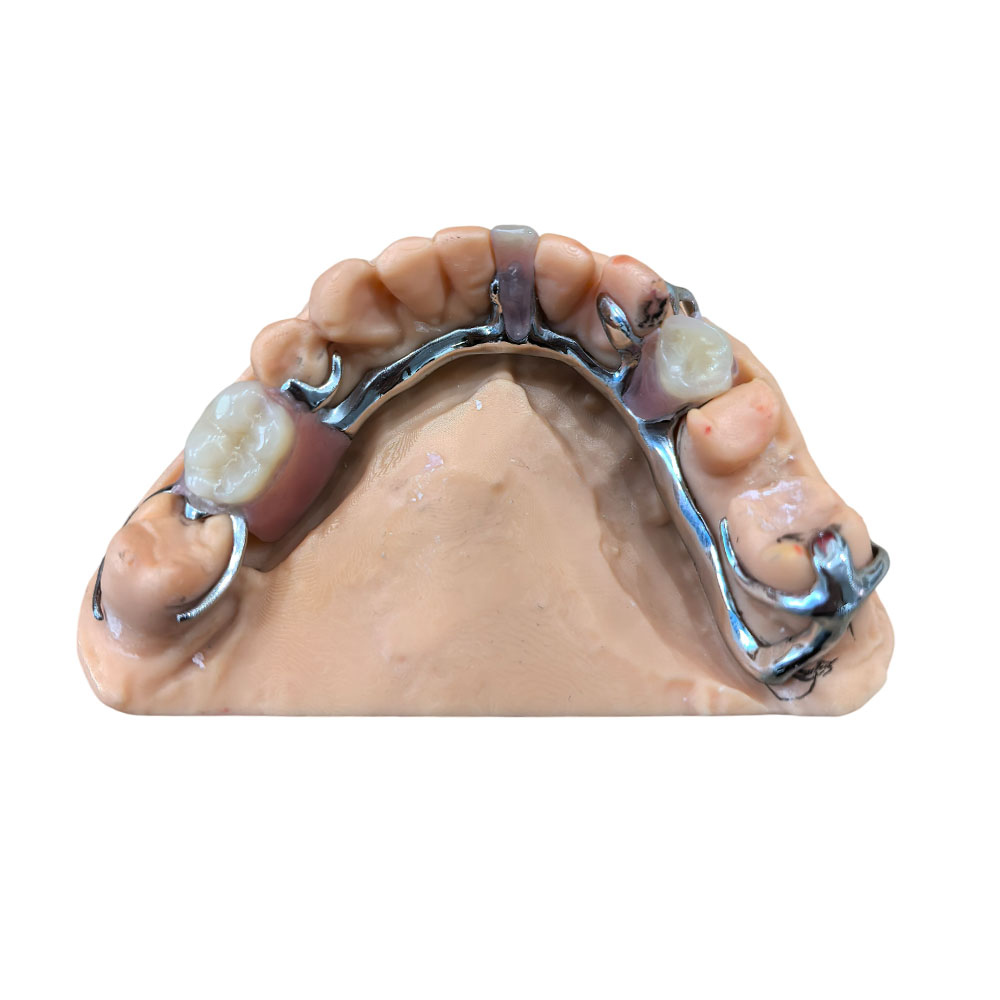
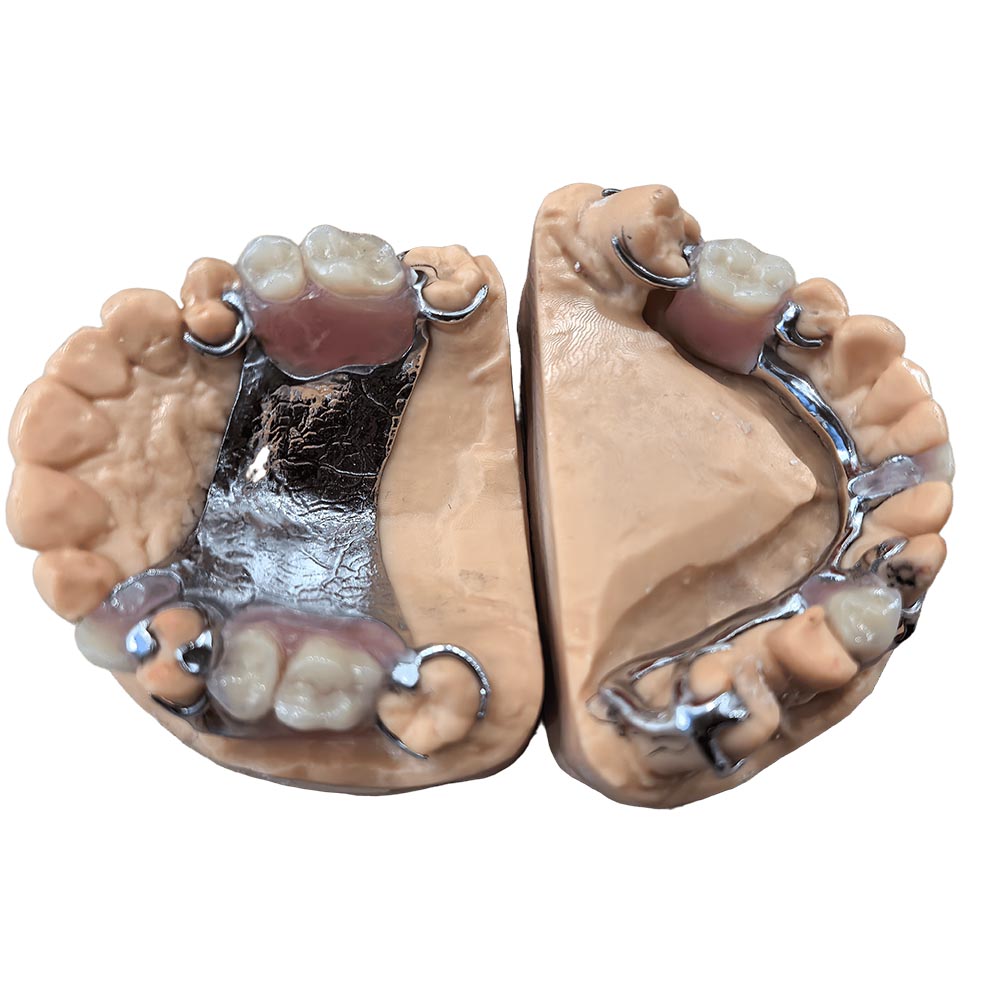
- Kennedy Class I mandibular arch: bilateral free‑end edentulous saddles distal to the lower second premolars.
- Piliers : (lower canines and premolars) were periodontally stable, vital, unrestored, with no detectable mobility.
- Canines and first premolars served as the primary abutments; second premolars as secondary.
- Residual ridge was narrow and moderately resorbed, the result of being edentulous for more than a decade.
- Lingual frenum attached high; the lingual sulcus was shallow — lifting the tongue left approximately 4 mm clearance to the floor of the mouth.
- Opposing arch: natural dentition with three posterior crowns; functional occlusion was present.
- Clenching history: the patient had worn a night guard when she still had her lower molars but stopped after losing them. Moderate wear facets were visible on the upper canines.
Why the Patient’s Previous Flexible Partials Had Failed
Three failure modes repeated across her four flexible partials:
- Clasp fracture: The thermoplastic clasp arms on the canines fractured at the base after 16 months of use.
- Loss of retention: Once the clasps stretched, they no longer engaged the undercut. The denture rocked during chewing.
- Lack of indirect retention: Flexible materials cannot carry rigid rests or indirect‑retention components. The free‑end saddles acted as levers under occlusal load, lifting anteriorly and transmitting stress to the abutment teeth. The patient reported feeling her front teeth “moving” when she chewed on the back.
The dentist explained that a cast Co‑Cr framework with RPI assemblies, a rigid major connector, and indirect retention on the anterior teeth would address all three failure modes simultaneously. The patient accepted the higher initial cost in exchange for a more durable prosthesis.
Patient identifiers, treating clinician, and practice location are intentionally omitted. The case is presented to illustrate a common distal‑extension pattern and the decision pathway from flexible acrylic to cast metal. It is not a unique patient record.
Why a Cast Metal Framework Was Selected for Lower Dentures
Durability and longevity
A 2024 peer‑reviewed systematic review and meta‑analysis of 46 studies (4,359 prostheses, 4,072 patients; mean follow‑up 60 ± 5.2 months) reported a 5‑year survival of 95.1 % (95 % CI 0.900–0.977, P < .001) for cast‑clasp removable partial dentures and 91.7 % (95 % CI 0.870–0.948, P = .71) for telescopic‑crown designs — no statistically significant difference between the two retention systems. Abutment extraction was OR 1.99 (95 % CI 1.32–3.01, P = .001), non‑vital abutments showed a hazard ratio of 2.961 (95 % CI 2.023–4.335, P < .001), and the gingival‑index mean difference was 0.477 (95 % CI 0.12–0.83, P = .008). Mobility (P = .98) and probing depth (P = .50) did not differ between clasp and telescope groups.1
In other words: a properly designed cast Co‑Cr framework, on vital abutments, is the higher‑survival option for a bilateral distal‑extension arch.
Why not flexible acrylic?
For a bilateral distal‑extension case with high functional demand, the prescribing dentist ruled out flexible materials. Flexible bases are not addable or re‑serviceable as the ridge resorbs, do not carry a surveyed path of insertion, and cannot be paired with indirect retention anterior to the fulcrum line. A Co‑Cr framework meets all three of those design requirements and remains rebuildable.
What the Prescribing Dentist Required from the Laboratory
- Framework try‑in first. No wax‑up, no tooth set‑up, no base‑processing until the metal framework is verified passive intra‑orally.
- Kennedy Class I RPI assemblies — mesial rest, distal proximal plate, I‑bar clasp — on the primary abutments, to keep lateral loads off the distal extension.
- Indirect retention anterior to the fulcrum line, with rests as far forward of the distal extension as practical.
- Surveyed path of insertion that clears all undercuts without flexing soft tissue during seating.
- Lingual bar as the major connector by default. If the lingual sulcus is too shallow, contact the dentist before switching to a lingual plate.
- Relief and tissue stops mapped to the prescription: relief over the ridge crest where the base bears mucosa‑only, tissue stops where the framework must seat on abutments.
- Digital intra‑oral scan accepted (STL or PLY); a conventional impression is taken only if the scan fails quality control.
- Nickel‑free cobalt‑chromium alloy with written alloy identification on the work order and on the case bag.
- Delivery condition: passive seat, no rocking, no nodules or sharp edges, even occlusal contacts against the opposing arch.
- Addable and re‑serviceable design — teeth can be added and saddles rebased without remaking the framework.
- Altered‑cast impression step after framework try‑in, captured with the framework seated.
- Heat‑cured PMMA saddles processed to the altered‑cast master, not to the original framework‑only cast.
What Made the Case Difficult
| ID | Difficulty | Detail |
| O1 | Repeated remake history | Prior acrylic bases had failed fit; the patient was reluctant to start over. |
| O2 | Bilateral distal extension (Class I lever) | Load on either saddle tips the framework about the fulcrum line. |
| O3 | Narrow, resorbed ridge; high frenum; shallow lingual sulcus | Limited space for a lingual bar; the frenum attaches high. |
| O4 | Patient’s worry about damage to remaining teeth | Past clasp designs had visibly abraded the canines. |
| O5 | Visibility of metalwork in anterior region | The patient refused any clasp or rest on the canines for aesthetic reasons. |
| O6 | Moving tongue and little residual suction on the lower arch | Stability of the finished base is hard to verify by suction alone. |
How the Requirements Map to the Obstacles
| Requirement | Addresses Obstacle(s) | Design Element |
| 1. Framework try‑in first | O1, O6 | Metal sub‑structure is verified before any irreversible step, so fit is reproducible. |
| 2. RPI assemblies | O2, O4, O5 | Mesial rests, distal proximal plates, and I‑bars transfer load toward the abutments, keep clasps off the canines, and avoid anterior display. |
| 3. Indirect retention anterior to fulcrum | O2 | Cingulum rests on the incisors counteract tipping about the fulcrum line. |
| 4. Surveyed path of insertion | O4, O5 | A single path of withdrawal clears all undercuts without forcing soft‑tissue flex. |
| 5. Lingual bar default; contact before switching | O3 | Lingual bar keeps the connector out of the shallow sulcus; lingual plate is a documented alternative only after discussion. |
| 6. Relief and tissue stops | O1, O6 | Tissue stops make seating reproducible and prevent rocking on delivery. |
| 7. Digital scan accepted | O1 | A scan removes impression deformation as a remake trigger. |
| 8. Nickel‑free Co‑Cr + written alloy ID | O4 | Avoids nickel exposure; written disclosure documents the alloy. |
| 9. Passive seat, no rocking, no nodules, even contacts | O6 | The four delivery‑bench checks confirm the base behaves on the ridge. |
| 10. Addable / re‑serviceable | O1, O6 | The framework survives rebases and tooth additions. |
| 11. Altered‑cast impression | O1, O6 | Captures the ridge under functional load with the framework seated. |
| 12. Heat‑cured PMMA saddles to altered cast | O1 | PMMA to altered cast, not to the framework‑only cast, reproduces the functional ridge form. |
How Our Capabilities Meet Each Requirement
The 12 requirements are matched, point‑by‑point, to the capabilities we hold as a full‑service dental laboratory with two manufacturing sites.
| Requirement | Our Capability |
| 1. Framework try‑in first | Production route separates framework fabrication from base processing; the framework is shipped for try‑in before any wax set‑up or flask work. |
| 2. RPI assemblies | Surveyed design software with library RPI / RPA / RPL templates; clasp geometry reviewed on the digital surveyor. |
| 3. Indirect retention anterior to fulcrum | Cingulum‑rest placement is checked against the fulcrum line on every prescription. |
| 4. Surveyed path of insertion | Digital survey of the master cast (or scanned STL) before the framework is drawn. |
| 5. Lingual bar default; lingual plate only on documented discussion | Standard work order lists lingual bar as default; lingual plate requires a written dentist note. |
| 6. Relief and tissue stops | Relief zones are preset in the framework design per the prescription. |
| 7. Digital intra‑oral scan accepted | STL and PLY files accepted; conventional impression is taken only on scan rejection. |
| 8. Nickel‑free Co‑Cr + written alloy ID | Nickel‑free Co‑Cr is the default cast alloy; every case ships with an alloy lot and origin record. |
| 9. Passive seat, no rocking, no nodules, even contacts | Bench‑check protocol mirrors the four delivery conditions on the prescription. |
| 10. Addable / re‑serviceable | Framework is designed as the durable sub‑structure; saddles and teeth are processed separately so they can be replaced. |
| 11. Altered‑cast impression | Altered‑cast step is part of the standard route for distal‑extension frameworks. |
| 12. Heat‑cured PMMA saddles to altered cast | Saddles are heat‑cured PMMA to the altered‑cast master; processing is in‑house. |
What the Dentist Checks on Receipt
Before the patient is seated, the dentist confirms four conditions:
- Fully seated, no rocking. The framework seats completely without wobble on the abutments and on the ridge.
- All tissue‑facing surfaces are smooth — no nodules, no sharp edges, no sprue remnants.
- Even occlusal contacts against the opposing arch, with light contacts in centric and no premature contacts in excursions.
- Clasp tension is appropriate — engages the surveyed undercut without flexing the abutment.
If any of the four fails, the case is returned for bench correction before the patient appointment.
Lower Metal Denture Framework Fabrication Process
The route below applies to a cast Co‑Cr mandibular framework, distal‑extension, regardless of whether the framework is cast or laser‑sintered. Acceptance criteria are identical at every step.
- Receive prescription, scan, or impression; log the case and the alloy request.
- Pour or import the master cast; articulate against the opposing model.
- Survey the master cast digitally; draw the framework path.
- Design the framework (major connector, rests, plates, clasps, finish lines).
- Produce the framework (lost‑wax cast or laser‑sinter) in nickel‑free Co‑Cr.
- Finish and polish; verify on the master cast for passive seat.
- Ship framework for intra‑oral try‑in (Requirement 1).
- After try‑in, capture the altered‑cast impression (Requirement 11).
- Process the heat‑cured PMMA saddles to the altered‑cast master; finish, polish, label.
Patient Feedback After Framework Try‑In
Three weeks after the framework try‑in, the patient returned for the final seating with the processed saddles and teeth. At the one‑month follow‑up visit she told the dentist:
“I can finally eat almonds again. And I’m not worried about my front teeth anymore.”
She reported that the lower metal dentures felt stable when she chewed — no rocking, no sense that the partials were shifting around — and that she could bite into tougher foods (raw vegetables, nuts, lean meat) without the dentures lifting off the ridge or the clasps slipping out of place. The first week she felt the lingual bar against her tongue when she swallowed, but after that she stopped noticing it.
What mattered most to her was the peace of mind. She didn’t have to plan around another remake appointment in 18 months, and she no longer felt the front teeth “moving” when she chewed on the back. She said:
“For the first time in eight years I’m not thinking about the denture all day.”
At the six‑month recall the denture was still performing well. She wore it from breakfast through dinner and cleaned it at night. She had not noticed any change in retention or comfort.
Clinician Feedback After Framework Try‑In
The prescribing dentist recorded the following observations immediately after the intra‑oral try‑in of the cast Co‑Cr framework, before the altered‑cast impression was captured:
- Passive seat, no rocking. The framework seated completely on the abutments and the edentulous ridge without any wobble. Light finger pressure on each clasp terminal confirmed that the framework was not tipping or lifting anteriorly.
- Tissue‑facing surfaces smooth. All internal surfaces — under the lingual bar, under the proximal plates, and on the underside of the minor connectors — were polished smooth with no palpable nodules or sprue remnants.
- Even occlusal contacts. With the framework seated and the patient in centric occlusion, the metal rests made even contact with the rest seats on the abutments. No premature contacts were detected on lateral or protrusive excursions.
- Clasp tension appropriate. The I‑bar tips engaged the buccal undercuts on the canines with enough retention to resist vertical dislodgement, but not so much that seating the framework flexed the abutments. The mesial rests and distal guide‑plates seated passively.
The dentist noted in the chart:
“RPI assemblies functioning as intended. Indirect retention confirmed — pressing posteriorly on the saddle areas does not lift the anterior rests. Ready for altered‑cast.”
After the saddles and teeth were processed and the completed lower metal dentures were delivered, the dentist re‑checked the four conditions (passive seat, smooth tissue surfaces, even contacts, appropriate clasp tension) and documented that all four remained stable. The patient was instructed on insertion, removal, and daily cleaning, and scheduled for a one‑week adjustment visit and a six‑month recall.
At the six‑month recall the dentist observed:
- No change in retention. The clasps still engaged the undercuts without visible distortion.
- Gingival tissue stable. The tissues around the abutments showed no inflammation, no recession, and no increase in probing depth compared to baseline.
- No abutment mobility. Clinical examination detected no increase in mobility of the canines or premolars.
- Patient compliance high. The patient wore the denture daily and maintained good oral hygiene.
The dentist’s chart note read:
“Lower metal dentures performing as expected. Framework remains stable. Patient satisfied. Next recall 12 months.”
The published evidence for cast‑clasp removable partial dentures supports these clinical observations. A 2024 systematic review and meta‑analysis covering 46 studies, 4,359 prostheses, and 4,072 patients (mean follow‑up 60 ± 5.2 months) found that cast‑clasp frameworks achieved a 5‑year survival rate of 95.1 % (95 % CI 0.900–0.977, P < .001).1 The same review reported that abutment extraction was associated with an odds ratio of 1.99 (95 % CI 1.32–3.01, P = .001), underscoring the importance of passive fit and appropriate clasp design. These figures align with the stability observed in this case at six months.
Who We Are and What We Do
ASD Dental Lab is a full‑service dental laboratory, founded in 2012, with two manufacturing sites — Shenzhen and Huizhou — covering CAD, milling, implant, cast‑and‑ceramic, removable, quality control, administration, sales, and customer service. The removable‑prosthesis department alone runs about 55 technicians. Production runs from CAM through quality control entirely in‑house; no case is outsourced to a third laboratory. Backup labour capacity is reserved for surge periods.
Capacity (Removable Prosthesis)
| Period | Monthly Case Volume |
| Low season | ~4,000 cases / month |
| Peak season | ~6,500 cases / month |
The capacity figures above apply to the removable‑prosthesis department only and are the most recent figures available.
Markets We Serve
We serve more than 50 laboratories, more than 100 clinics, and more than 400 dentists. Our principal markets are the United States and Europe (Netherlands, Germany, France, Belgium, Austria, United Kingdom, Luxembourg, Switzerland).
Transparency and Verification
We accept on‑site factory visits and video audits. The two manufacturing sites, the in‑house production chain, and the quality‑control workflow can be inspected. No case is sent to a third laboratory.
Quality management: ISO 13485 · CE · FDA facility registration and device listing (covering temporary prosthetic devices; the registration does not extend to implantable devices themselves) · EU MDR Annex XIII notification for custom‑made devices.
How to Work With Us
If a lower metal denture case — or any removable‑prosthesis case — fits your practice, the next step is an inquiry, not an order. Tell us:
- The clinical situation (arch, abutment status, opposing dentition).
- The prescription detail (framework first or framework‑and‑base, alloy, connector preference, addability needs).
- The digital workflow you use (intra‑oral scanner brand and export format if relevant).
- The alloy documentation you require.
- The turnaround window you are working against.
Request a case consultation → · Learn more about our removable‑prosthesis services → [Standard Page Placeholder]
When Lower Metal Dentures Are Recommended
A lower metal denture is the right choice when the mandibular arch is Kennedy Class I or II (bilateral or unilateral distal extension), the remaining abutments are vital and periodontally stable, the prescription calls for an addable, re‑serviceable prosthesis, the patient is expected to wear the prosthesis for five years or more, and the framework design needs indirect retention to control the fulcrum. In all of these situations a cast Co‑Cr framework provides a 5‑year survival of 95.1 %, allows the saddles to be rebased without remaking the metalwork, and keeps the clasp assemblies out of the aesthetic zone.
References and Further Reading
- Drummond LB, et al. (2024). Survival and complications of clasp‑retained versus telescope‑retained removable partial dentures: a systematic review and meta‑analysis. PubMed 39043477
- PubMed Central — open‑access prosthodontic literature archive
- Journal de la dentisterie prothétique
- ISO 22674:2016 — Dentistry — Metallic materials for fixed and removable restorations and appliances
Des délais d'exécution plus courts grâce à notre technologie de pointe
Recommandé