Real Lab Case: Flexible Denture for One Tooth from ASD Dental Lab


Wypełnij formularz, a my odpowiemy w ciągu 30 minut!
What the Patient Needed
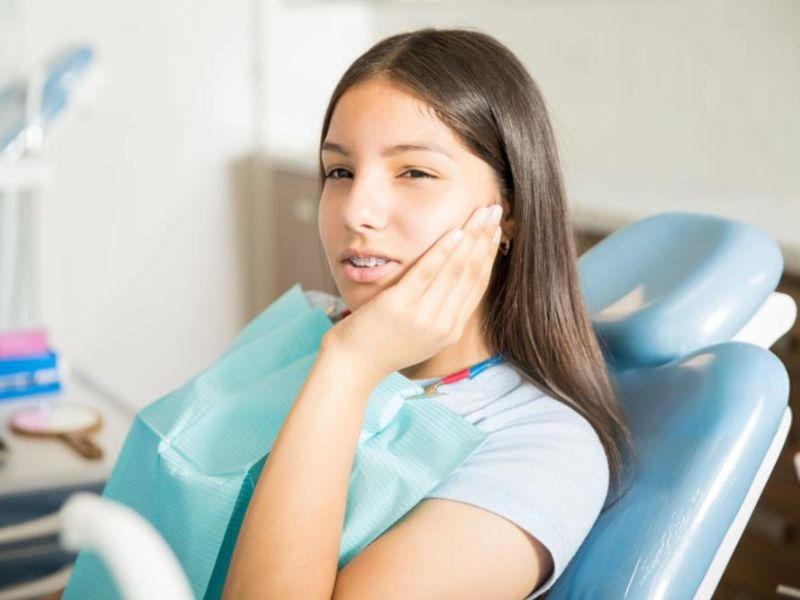
A 34-year-old professional came to her dentist with one missing upper front tooth — lost years ago in a cycling accident. She’d been thinking about an implant but wasn’t ready for surgery. The gap affected her confidence at work, especially during client meetings.
Her main concerns:
- Visible gap when smiling or speaking
- Wanted something removable she could take out for cleaning
- Couldn’t afford an implant right now
- Nie widać metalu — her job involves a lot of face-to-face interaction
- Didn’t want to grind down the teeth next to the gap
Clinical situation:
- One missing tooth: upper left central incisor (#9)
- Adjacent teeth sound, no decay, stable
- Good periodontal condition, no gum disease
- Normal bite, enough vertical space
- Well-formed ridge where the tooth used to be
The dentist confirmed she was a solid candidate for a flexible partial denture single tooth replacement. No implant healing needed, no active infection, bite looked fine.
What the Dentist Asked Us to Build
Her dentist sent us clear instructions — this is the kind of work order we see every day for proteza flexi pojedynczy ząb cases:
Design Requirements
Replacement tooth:
- Position: #9 (upper left central)
- Shade: A2 (matched to her natural teeth)
- Mould: slightly rounded incisal edge, natural translucency
- Gingival shade: light pink to blend with her tissue
Retention and fit:
- Engage the undercuts on #8 and #10 (the teeth on both sides)
- Użycie flexible, gum-colored clasps — no wire, no metal display
- Path of insertion from labial-to-palatal direction
- Clasps should grip below the height of contour but stay hidden when she smiles
Stability:
- Small palatal extension for cross-arch bracing — nie a tiny unilateral Nesbit
- Designed to resist rotation during speech and light function
- Adequate thickness for strength without bulk
Komfort:
- Thin borders, smooth finish
- Minimal palatal coverage
- Won’t interfere with her tongue or speech
How We Built It to Meet Those Specs
Here’s how the case moved through our lab. We’re a direct manufacturing facility — ASD Dental Lab, founded in 2012, with about 460 trained technicians in Shenzhen and Huizhou, China. We handle the full workflow in-house, so nothing gets outsourced to a third party.
1. Digital Design and Path Planning
Received: Digital scan files (upper, lower, bite registration) and the dentist’s work order
Our CAD designer:
- Surveyed the digital models to find the best insertion path
- Identified usable undercuts on teeth #8 and #10
- Blocked out areas that would block seating
- Designed flexible clasps to engage the preserved undercuts — positioned below the height of contour, wrapped around the lingual surface to stay invisible from the front
- Added a thin palatal connector linking both sides for stability (this is nie a Nesbit — it crosses the palate to prevent rotation)
- Positioned the artificial tooth with proper incisal edge placement, lip support, and alignment to the adjacent centrals
Mechanical retention: We created diatoric holes (T-shaped retention features) in the replacement tooth. The flexible resin flows into these during injection, locking the tooth in place. Nylon doesn’t chemically bond to acrylic teeth the way traditional denture acrylic does — mechanical retention is standard for thermoplastic partials2.
2. Material Selection and Processing
Materiał: Medical-grade thermoplastic nylon (polyamide family), similar to Valplast or TCS Unbreakable
Why this material?
- No metal — meets the patient’s esthetic requirement
- No acrylic monomer — safer for patients with monomer sensitivity
- Impact-resistant — won’t snap if dropped
- Translucent pink base blends with natural gum tissue
- Flexible clasps engage undercuts without needing extensive tooth preparation
Our injection molding process:
- Wax-up and try-in — We set the artificial tooth in wax on a duplicate model, arranged the clasps and base, then sent a try-in to the dentist for approval (tooth position, shade, bite check)
- Investment — After approval, we invested the waxed case in a special heat-resistant flask
- Boil-out — Removed all wax, cleaned the mold cavity
- Injection — Heated a thermoplastic nylon cartridge to the manufacturer’s specified temperature (~280°C), then injected the molten resin under controlled pressure into the closed flask
- Cooling — Maintained pressure while the resin cooled and solidified to avoid voids or shrinkage
- Deflasking — Carefully opened the flask and removed the finished appliance
- Finishing — Trimmed sprues, smoothed all borders, polished the base and clasps to a high shine
- Quality check — Fit the appliance back on the master model, checked clasp retention, margin adaptation, and occlusion
- Hydration — Stored the finished partial in water before shipment (nylon absorbs a small amount of water and reaches its final dimensions when hydrated)
This is the standard workflow described by Valplast3 oraz TCS5 technical guides.
Turnaround: 7–10 business days from scan receipt to shipment. During peak seasons we can still deliver within 12 days because we keep about 50 backup workers trained and ready.
3. Retention Design — Why This Isn’t a Nesbit
The dentist specifically didn’t want a Nesbit-style unilateral partial. Here’s the difference:
| Design element | What we made | A Nesbit (what we avoided) |
| Cross-arch support | Thin palatal connector linking both sides | None — sits entirely on one side |
| Zatrzymanie | Bilateral clasps on #8 and #10 + tissue contact + palatal bracing | One or two clasps on one side only |
| Stability during function | Resists rotation, stays seated during speech and light chewing | Can rotate, lift, or dislodge |
| Bezpieczeństwo | Harder to accidentally swallow or aspirate | Contraindicated due to aspiration risk7 per ACP and British Dental Journal |
The American College of Prosthodontists warns1 that small unilateral partials can be swallowed or aspirated, especially if retention is weak. We designed this case with adequate cross-arch stabilization to keep it secure.
What the Finished Appliance Looks Like
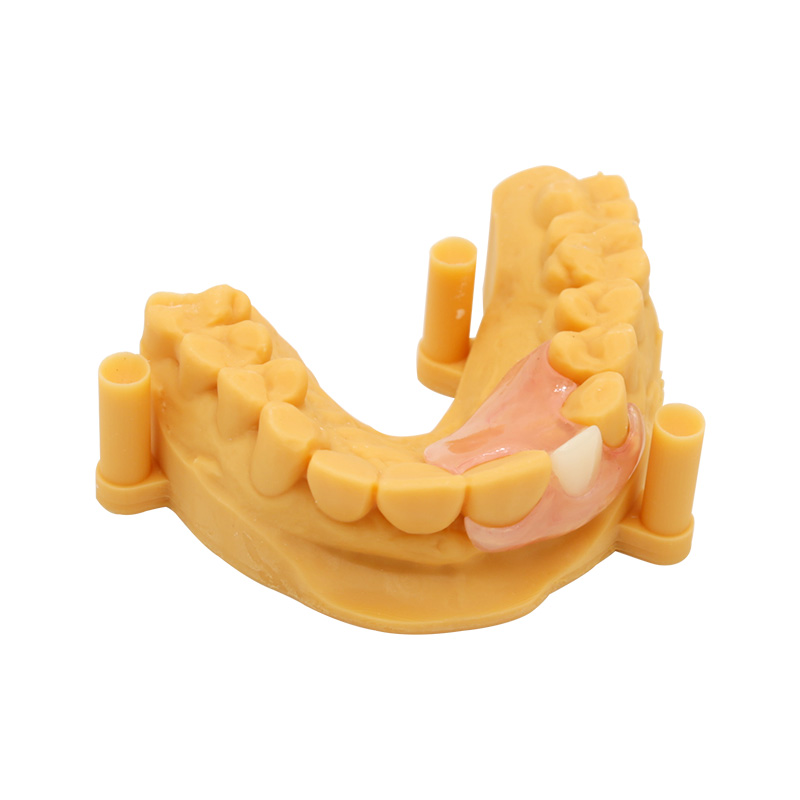
From the front: You see the replacement tooth blending in with her natural teeth. The flexible clasps are hidden behind #8 and #10 — no metal, no wire, nothing visible when she smiles.
From the inside (palatal view): A thin, translucent pink connector crosses the palate. It’s about 1.5 mm thick in most areas — thin enough not to interfere with her tongue, thick enough to provide rigidity.
Clasps: Gum-colored thermoplastic arms that wrap around the lingual surface of the adjacent teeth. They engage the natural undercuts without needing metal hooks or extensive tooth prep.
Artificial tooth: A2 shade acrylic tooth with a natural incisal edge. The tooth is mechanically locked into the nylon base via diatoric retention holes — it won’t pop out.
Weight: About 2–3 grams. Barely noticeable when she’s wearing it.
Dopasowanie: Snaps into place with gentle finger pressure. Warm water (30–60 seconds under the tap) makes insertion easier — this is standard guidance from Valplast and TCS14.
Patient Experience After Delivery
Her dentist seated the appliance at a 15-minute delivery appointment. The patient reported:
Day 1–3:
- Felt the palatal connector with her tongue — “aware of it but not uncomfortable”
- Speech sounded slightly different for the first day (minor lisp on “s” sounds)
- Removal and insertion took a few tries to get the hang of
Week 1:
- Got used to the feel — stopped noticing the connector
- Speech back to normal
- Confident smiling at work again
- Removed it after meals to rinse, put it back in easily
Month 1 follow-up:
- No sore spots, no irritation
- Clasps still retaining well
- Eating soft foods with it in; removes it for tougher meals
- “Looks natural — coworkers didn’t realize it was a partial until I mentioned it”
What she was told to expect long-term:
- Lifespan: No one can promise a specific number for a single-tooth flexible partial. Valplast’s literature mentions 5–10 years3 for many cases, but that’s a manufacturer claim, not a clinical study. A 2025 systematic review found28 that about 55% of flexible partial clasps lose some retention after 12 months in larger cases. We told her: expect a few years of good service, but plan for adjustments or replacement down the road.
- Maintenance: Remove and rinse after meals. Clean daily with a soft brush and denture cleaner (not toothpaste — it’s too abrasive). Store it in water overnight. Don’t expose it to boiling water or leave it in a hot car.
- Korekty: If a clasp feels too tight or too loose, bring it back to the dentist. We can adjust retention by controlled heat and bending in the lab. Don’t try to bend it yourself with pliers.
- Future tooth loss: If she loses another tooth later, we may be able to add one more tooth to this base, but it depends on the location and existing fit. A completely new partial might be needed.
- When to replace: If it starts feeling loose, causes soreness, develops cracks, or the artificial tooth debonds, send it back for evaluation. Sometimes we can repair it; sometimes a remake is smarter.
Why Dentists Choose to Work with ASD for These Cases
We’ve made flexible partials for over 100 dental clinics oraz 50 dental laboratories worldwide since 2012. Here’s what makes us reliable for flexible denture for one tooth cases:
1. We’re a Direct Manufacturing Lab — Not a Trading Company
Everything happens in our own facilities in Shenzhen and Huizhou. We don’t outsource flexible partial work to third-party manufacturers. That means:
- Consistent quality — same technicians, same materials, same process every time
- Faster communication — questions go straight to the people making the case
- Stable turnaround — we control the schedule, no waiting on a third party
You can visit our factory, tour the production floor, watch the injection process, meet the removable-denture team (~55 technicians). We’ve had dentists and lab partners from the US, Netherlands, Germany, UK, Belgium fly in to audit us.
2. Full In-House Workflow for Flexible Partials
For this single-tooth case, everything from design to delivery happened inside ASD:
- CAD design department (~100 designers) — surveyed the models, planned the path of insertion, designed the clasps
- Removable denture department (~55 technicians) — wax-up, flasking, injection, finishing, polishing, QC
- Quality control team (~25 inspectors) — final check before shipment
- Customer service team (~40 coordinators) — handled the dentist’s questions, tracked the case, arranged the try-in
No outsourcing. No handoffs to unknown subcontractors. One lab, one quality standard.
3. Capacity to Handle Rush Cases and Peak Seasons
Normal season: We can produce about 4,000 removable denture cases per month (including full dentures, partials, flexible partials, cast-metal partials)
Peak season: O 6,500 cases per month
We keep ~50 backup workers trained and on call. When a partner lab sends us 20 flexible partial cases in one week before a holiday, we don’t push delivery dates — we scale up.
For single-tooth flexible partials, standard turnaround is 7–10 business days. Rush cases (dentist needs it faster) can sometimes be delivered in 5 days if we’re notified upfront.
4. Material Quality and Regulatory Compliance
Używamy medical-grade thermoplastic nylon from verified sources — BPA-free, monomer-free, biocompatible. The materials meet FDA requirements for intraoral use. We’re familiar with the full US cost landscape and MAID:
- US laboratory fee for a single-tooth flexible partial: typically 150–300
- Chairside/final patient cost: typically 600–1,500 per tooth
Your dentist’s final quote to the patient covers not just the lab work but also the exam, impressions, shade selection, try-in, delivery, and follow-up. We provide transparent pricing so you can quote accordingly.
When This Case Was Delivered
Timeline:
- Day 0: Received digital scan + work order from dentist
- Day 2: CAD design complete, sent preliminary design for dentist review
- Day 4: Wax try-in approved, proceeded to processing
- Day 8: Deflasked, polished, QC passed
- Day 9: Shipped to dentist (overnight international shipping)
- Day 12: Patient received it at her delivery visit
Total chair time for the patient: ~45 minutes across two visits (delivery + 2-week check)
Dentist’s feedback after delivery: “Patient very happy with the result. This is the type of work I’ll continue sending you. Same-day communication when I had a question during try-in was exactly what I needed.”
How to Send Us a Similar Case
If you have a patient who might be a candidate for a proteza flexi pojedynczy ząb replacement, here’s what we need:
Standard package:
- Skany cyfrowe (preferred) or high-quality alginate impressions — upper, lower, and bite
- Work order specifying:
- Missing tooth position(s) and shade
- Clasp preferences (full flexible, combination metal-flex, etc.)
- Special design requests (palatal connector, gingival shade, etc.)
- Delivery deadline
- Clinical photos if there’s anything unusual about the case
We send back:
- Design preview (within 24 hours)
- Wax try-in (Day 4–5) for approval
- Final appliance (Day 7–10)
- Delivery note with care and adjustment guidelines
Communication: Direct line to a customer service coordinator who speaks English. Replies within 4 hours during business days (China time, UTC+8).
Referencje
- American College of Prosthodontists. Position statement on single-tooth removable prostheses and aspiration risk1. Retrieved October 2026.
- Literature review on flexible removable partial dentures2. PubMed. Retrieved October 2026.
- Valplast Technical Guide. Material properties, design, and processing for nylon flexible partials3. Retrieved October 2026.
- TCS Unbreakable Technical Manual. Injection workflow and patient instructions5. Retrieved October 2026.
- British Dental Journal. Contraindication of unilateral Nesbit-type partials due to aspiration risk7. Retrieved October 2026.
- Valplast Patient Care Instructions. Hot water seating and adjustment protocol14. Retrieved October 2026.
- Systematic review on flexible partial denture retention after 12 months. Clinical evidence on longevity and performance28. Retrieved October 2026.
Szybszy czas realizacji dzięki naszej najnowocześniejszej technologii
Zalecane