Dental Veneers | A Veneer Lab That Runs Its Own Benches
ASD is a full-service dental lab, not a broker. Every veneer we ship — CAD design, milling, porcelain layering, glazing, QC — comes off our own benches. Nothing gets quietly forwarded to a third party when the schedule tightens.
1. Why dentists choose us for veneers
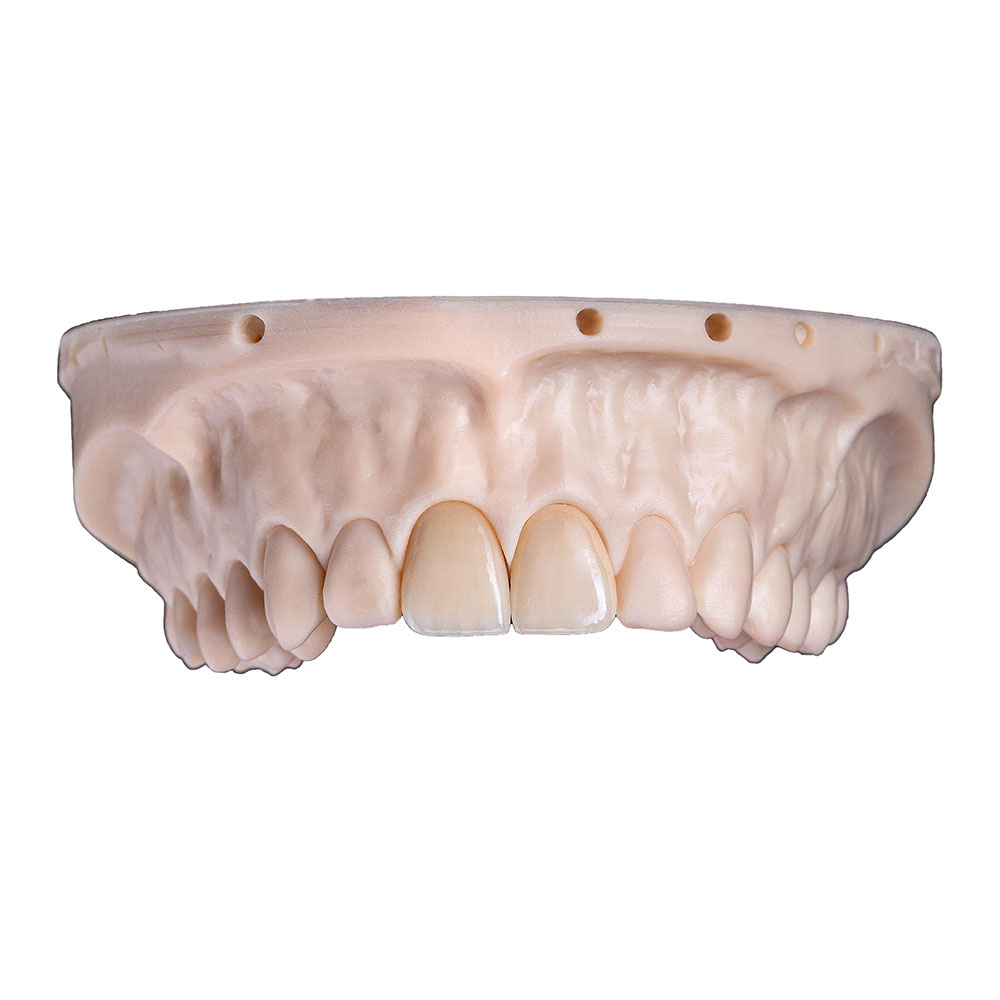
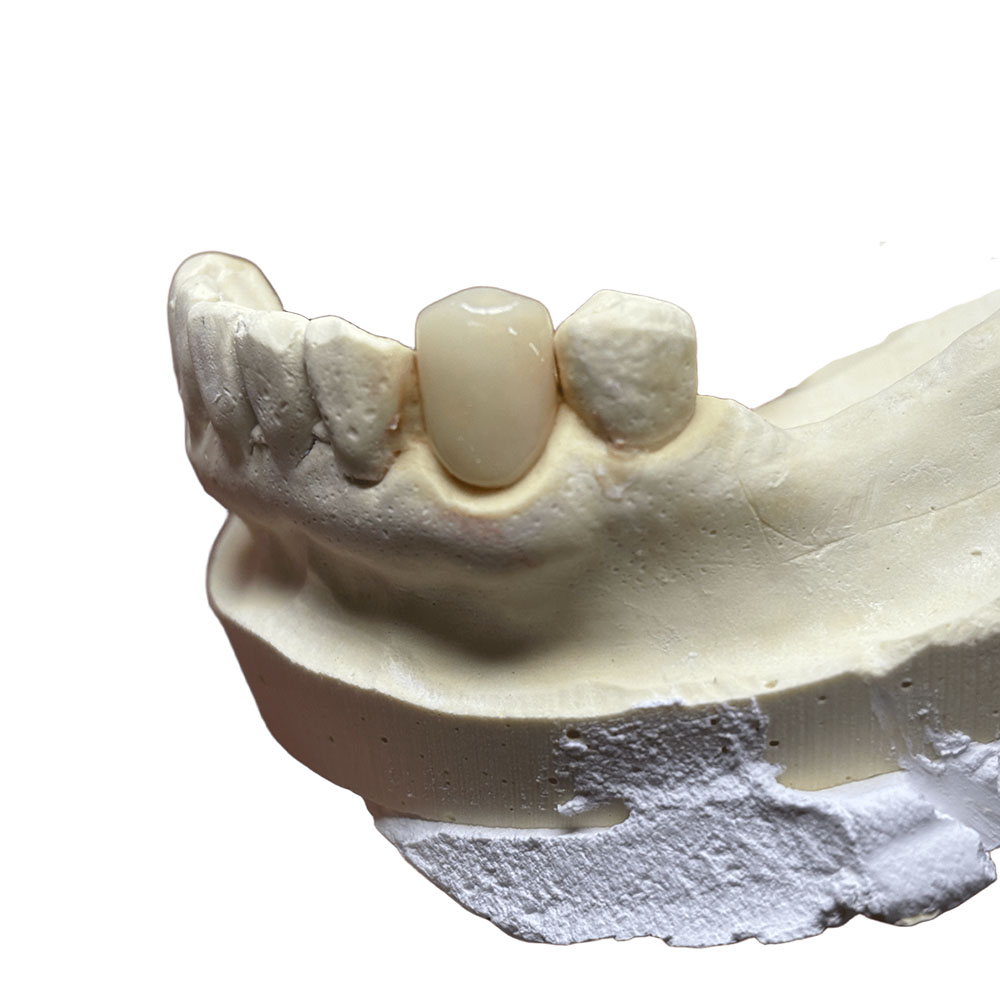
We own the whole line. Case intake, CAD, model printing, CAM milling, sintering, layering, glazing, QC and packing all happen under one roof, run by one company. Your case doesn’t get re-routed to somebody else’s bench when we’re busy.
One coordinator owns your account. Not a sales line that hands you off to a queue. The same person takes your prescription, flags problems, and answers the phone in year three.
We reject cases early, and in writing. Unclear impression margins, missing scan data, no shade record, insufficient occlusal clearance — you get a written notice with photos and a recommendation przed production starts. A five-minute conversation about a prep beats a remake two weeks later.
Prep depth is documented on every case. 0.3 mm, 0.5 mm, or 0.7 mm — we record which one your prescription calls for, and why. It travels with the case file.
Two written documents ship with every restoration. The warranty terms, and the date the case actually left the building.
Small cases get the same intake as big ones. Solo dentists sending one unit a month and DSOs sending two hundred work through the identical process. There’s no minimum order to get started, which is unusual for a veneer lab our size.
2. Product catalog
Six veneer systems. Pick by case, or send us the scan and we’ll recommend one.
Layered Zirconia Veneers Hand-layered porcelain on refractory die or platinum foil.
- Najlepsze dla — Maxillary anteriors, high-translucency demand, single-tooth work
- Grubość — from ~0.3 mm
- Flexural strength — ~60–80 MPa
- Build — fully hand-layered; master ceramist signs the lab ticket
- Worth knowing — least forgiving material if your prep drifts
Okleiny E.max Pressed ceramic, cut-back, layered incisal.
- Najlepsze dla — Clenchers, premolar and posterior aesthetic zones, bridge abutment veneers
- Grubość — from ~0.5 mm
- Flexural strength — ~360–400 MPa
- Build — pressed + cut-back + layered incisal
- Worth knowing — slightly more opaque than feldspathic
Full Contour Zirconia Veneers High-translucency zirconia, milled and hand-stained.
- Najlepsze dla — Bruxism, thin biotype, darker stump shades
- Grubość — from ~0.5 mm
- Flexural strength — ~1,100–1,200 MPa
- Build — CAD + 5-axis milled + hand-stained
- Worth knowing — long-term veneer data is still maturing; we use it when the case calls for it, not by default
Stacked Zirconia Zirconia frame with hand-layered ceramic over it.
- Najlepsze dla — Cases where you need strength and lifelike translucency in the same unit
- Grubość — ~0.7 mm frame + ~0.3 mm overlay
- Flexural strength — ~1,100 MPa framework / ~80 MPa veneer layer
- Build — milled coping + hand-layered incisal
- Worth knowing — the layering is what you’re paying for, not the frame
Licówki kompozytowe Indirect composite, light-cured and glazed in our lab.
- Najlepsze dla — Younger patients, transitional cases, tight budgets
- Grubość — from ~0.3 mm
- Build — layered composite, cured, glazed
- Worth knowing — repairable intraorally, and it stains sooner than ceramic
Diagnostic Wax-Up / Digital Mockup Not a final veneer — the step that protects the ones that follow.
- Najlepsze dla — Any case where the patient needs to see the outcome before you touch a tooth
- Deliverable — photos, STL of the proposed outcome, optional putty matrix for a chair-side mockup
- Opcje — analog wax-up on mounted models, or a DSD-style mockup over your intraoral scan
- Worth knowing — cheapest step in the process, and the one that prevents the most remakes
Thickness figures are minimums for each system at our production tolerances. Actual prep depth is set by your case, and we record what we used.
Flexural strength figures are typical values for each material class at standard sintering/firing protocols. Long-term survival data on zirconia veneers specifically is still thinner than for feldspathic or lithium disilicate — see Biblioteka Cochrane oraz NIH PubMed Central. Clinically reported survival for porcelain laminate veneers overall sits around 10–15 years when bonded to enamel with adequate preparation — see the preparation-design literature on PubMed.
2.1 How the digital workflow runs
- Case intake — intraoral scan or impression, photos, shade map, written prescription. This is where we catch a marginal impression or a missing shade record before it becomes a remake.
- CAD design — the restoration is designed on your scan, matching the prep depth and contour your prescription calls for.
- Model printing — a physical model comes off the digital file, so the ceramist has something real to check contacts and margins against.
- CAM milling, dry and wet lines — the coping or monolithic block is cut on 5-axis mills, separated by material to avoid cross-contamination.
- Sintering — zirconia frameworks are fired to final density and strength in a calibrated furnace cycle.
- Porcelain layering and glazing — the ceramist hand-builds shade, translucency and incisal effects, then glazes for final surface texture.
- End-of-line QC — the nine-step checklist in section 3 runs before anything is boxed.
- Packing and dispatch — case is sealed with its documentation and shipped with tracking.
2.2 Shade and characterization
This is where aesthetic labs get judged, and where the difference between a good case and a remake usually hides. Our protocol:
- Cross-polarized photography — removes surface glare so the true stump shade is visible
- 18% gray card in every shade session — ambient light stops biasing the result
- Three separate records — stump shade, adjacent shade and skin tone, captured independently instead of one quick pick
- Fluorescence and translucency logged separately — so the finished veneer doesn’t make its neighbours look grey
- Shade protocol PDF — downloadable, with four standard shade-tab reference images
3. Quality control
Nine checks before a case leaves the building. Numbered, signed, batch-traceable, and the photo log is yours on request.
# | Check | Tool / threshold |
1 | Marginal fit | 20× microscope, ≤ 50 µm |
2 | Proximal contacts | Floss + articulating paper |
3 | Occlusal contacts | 100 µm articulating paper |
4 | Thickness vs prescription | Digital caliper |
5 | Wykończenie powierzchni | 6× microscope, no visible defects |
6 | Shade and fluorescence | Shade light + UV light |
7 | Internal defects | Transillumination, no cracks or voids |
8 | Cleaning and disinfection | Autoclave, 132 °C / 4 min |
9 | Packaging integrity | Case no. + tooth position + shade + ship date |
A case that fails any step doesn’t ship. It goes back to the bench, and you hear from us with the reason.
4. Certifications and compliance
Co | Status |
ISO 13485 — medical device quality management | Third-party certified, covering the full production system (ISO 13485 standard) |
FDA registration — foreign medical device manufacturer | Registered, covering custom restorations exported to the U.S. |
CE marking under the MDR pathway | Covered for EU exports |
Material FDA-cleared status | Porcelain blocks and zirconia blanks, batch-traceable |
Self-operated production, no third-party subcontracting | Published commitment |
Every shipment travels with a commercial invoice, a certificate of conformity, and a material batch certificate. Importer of Record and U.S. Agent details are available on request.
5. FAQ
What is a dental veneer?
A thin, custom-made shell bonded to the front surface of a tooth to change its colour, shape, size or length. Most are made from feldspathic porcelain, lithium disilicate such as IPS e.max, or zirconia.
Are veneers reversible?
Depends entirely on how much enamel your prep leaves behind — not on the material. Stay in enamel, typically 0.3–0.5 mm, and you’re closer to reversible than a prep that reaches dentin. We document prep depth on every case and we don’t make blanket “reversible” or “no-damage” claims. That’s a per-tooth call.
Porcelain or zirconia — which is better?
Neither wins outright. Porcelain gives you the lifelike translucency; zirconia gives you strength and fracture resistance. Occlusion, stump shade and how much aesthetic headroom the case has decide it. Send the scan and we’ll tell you which one we’d pick and why.
Veneer or crown?
Veneer when the tooth structure is mostly intact and the problem is appearance. Crown when the tooth is structurally compromised, heavily restored or endodontically treated. If a case comes to us as a veneer and should be a crown, we say so before we start.
Can I send a digital case only, no physical model?
Yes, and most of our veneer work now arrives that way. STL files from 3Shape TRIOS, iTero, Medit, CEREC Primescan and open-format scanners are all accepted. We print the model in-house and ship it back with the finished case for try-in.
What's covered if something goes wrong?
A written warranty ships with every case. Chipping on try-in or a shade mismatch against your prescription gets a free remake. An impression or scan issue on your end, or patient-side damage from trauma or parafunction, isn’t covered by the warranty but we’ll walk through it with you so the next case avoids it. Spontaneous debonding gets reviewed against our QC records case by case.
How do I start?
Send one case — scan, shade record and prescription. You’ll get a written quote, a written turnaround date and a sample warranty before anything is milled. No minimum order.
6. Why choose us
Self-operated since 2012. Thirteen years of porcelain and zirconia volume, one company, no brokering. That’s the whole difference between us and a veneer lab that resells somebody else’s benches.
About 460 people on the floor. CAD design, milling, implant, ceramic and metal, removable, QC, and a case-coordination team of forty.
Fifty-plus dental labs and over 400 dentists on long-term cooperation — a partnership record, not a customer wall.
Capacity that absorbs your peak. Around 8,000 zirconia single crowns a month in normal season, 15,000 at peak, plus a trained reserve crew.
Nine-step QC, signed and photographed, with the log yours on request — full protocol lives in §3.
FDA registration, ISO 13485, CE pathway, and a batch certificate on every shipment.
Written warranty and written turnaround on every case — trust delivered as documents, not adjectives.
Prep depth published per case. 0.3, 0.5 or 0.7 mm, with the reasoning attached.
7. Inside the factory
Two self-operated sites, running full digital and analog workflows side by side — not a back room subcontracted out when volume spikes.
CAD design floor — around 100 designers working across major scan formats (3Shape TRIOS, iTero, Medit, CEREC Primescan), producing anatomically-driven designs rather than library-shape copies.
5-axis wet and dry milling rooms — separated by material to prevent cross-contamination between zirconia, lithium disilicate and PMMA milling.
Sintering and layering benches — calibrated furnace cycles for zirconia densification, plus a dedicated hand-layering bench staffed by ceramists who sign off on shade and incisal effects before a case reaches QC.
QC and packaging line — the same nine-step checklist from section 3, run by a 25-person QC team, ending in batch-traceable, documented packaging.
If you want to see it directly rather than take our word for it, we run in-person visits and live video walkthroughs.
Next step
- First case with us? Send one veneer case — scan, shade, prescription. Written quote, turnaround date and sample warranty come back within 24 hours.
- Comparing labs? Ask each one for their QC checklist, their warranty terms and their turnaround definition. Put the three documents side by side and the decision gets easy.
- Want to see it? Book an in-person visit to Shenzhen or Huizhou, or a live video walkthrough — two hours, English or Mandarin, usually scheduled inside one to two weeks.
- Running a DSO or a clinic group? We’ll build a framework agreement around stepped pricing, a dedicated coordinator and API integration.
ASD Dental Lab. Founded 2012. Manufacturing in Shenzhen and Huizhou. Serving dental clinics, dental laboratories and dentists worldwide.
Clinical and regulatory statements on this page follow the Amerykańskie Stowarzyszenie Stomatologicznew U.S. Food and Drug Administration, ISO and the peer-reviewed literature indexed in PubMed oraz PubMed Central.
< class="ct-module-title">
Trending Now