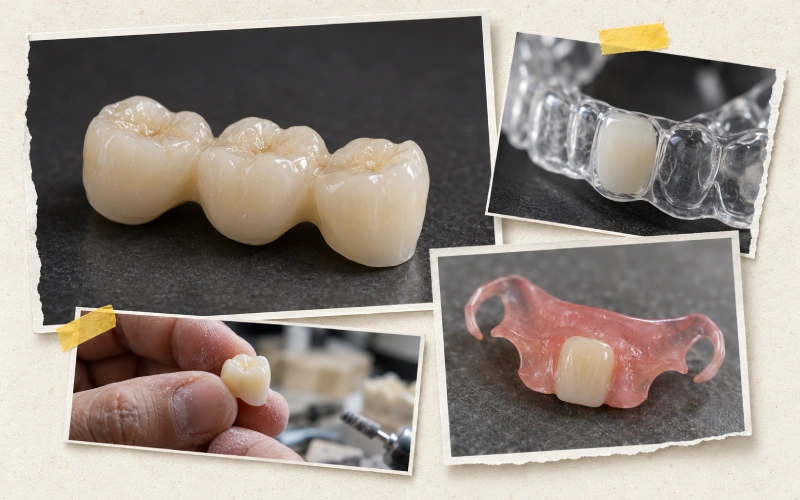
PFM Crowns and PFM Bridge Restorations — Dental Crown PFM from ASD Dental Lab
Porcelain-fused-to-metal (PFM) restorations combine the strength of a metal framework with the natural appearance of ceramic. When you need a proven solution for posterior PFM crowns, multi-unit PFM bridges, or cases where strength and conventional cementation matter, PFM remains a practical choice.


ASD Dental Lab has been manufacturing PFM crowns and PFM bridges since 2012. We’re a full-service dental laboratory with in-house CAD/CAM, metal fabrication, ceramic layering, and quality control—not a trading company. Our team of ~460 professionals handles every step from scan receipt to final inspection, so you know exactly where your case is made and who’s accountable. From a single dental crown PFM in the esthetic zone to a multi-unit posterior PFM bridge, every case follows the same documented workflow.
What Is a PFM Crown or PFM Bridge?
A dental crown PFM or PFM bridge has two layers:
- Metal coping or framework — the internal structure that fits your preparation, supports the ceramic, and provides strength. We fabricate copings by casting or milling from Co-Cr, palladium-silver, or gold alloys depending on your specification. For a PFM bridge, this framework extends across abutments to support the pontics.
- Ceramic veneer — layered porcelain fired over the metal. The opaque layer masks the coping; body and incisal porcelain build the tooth shape, shade, and surface texture.
The metal and ceramic bond through controlled oxidation, thermal-expansion matching, and proper firing. ISO 9693 governs compatibility testing for metal-ceramic systems; ISO 6872 covers ceramic materials used in fixed restorations. Every PFM crown and PFM bridge we ship is built against those compatibility requirements.
How PFM crowns and PFM bridges differ from other materials:
Materiał | Structure | Key trade-off |
PFM crowns / PFM bridge | Metal coping + ceramic veneer | Strong framework, long clinical history; opaque layer reduces translucency |
Single zirconia body | No veneer to chip; less translucent than glass ceramics but highly fracture-resistant | |
Glass ceramic, often monolithic | Excellent translucency for anterior esthetics; lower flexural strength than zirconia or metal | |
Solid metal crown | Maximum strength in thin sections; no tooth-colored surface |
The ADA describes PFM crowns and PFM bridges as combining the durability of metal with the appearance of porcelain.
When PFM Crowns and PFM Bridges Are Still the Right Choice
Material selection should be case-specific. A dental crown PFM or PFM bridge works well when you need:
- Posterior strength with acceptable esthetics — especially molars and premolars where translucency is less critical. PFM crowns deliver clinical durability with a natural tooth-colored surface.
- Multi-unit or long-span PFM bridges — a metal framework gives you design flexibility for connectors, pontics, and soldered or milled joins.
- Survey crowns for removable partial dentures — metal guide planes, rest seats, and retentive contours are straightforward to mill or cast.
- Heavy occlusion or bruxism — with metal occlusal surfaces or properly supported porcelain. A dental crown PFM is not automatically “chip-proof,” but the framework limits crack propagation compared to unsupported feldspathic porcelain.
- Implant-supported restorations — PFM crowns and PFM bridges remain a conventional cement- or screw-retained option where a metal abutment or custom framework is preferred.
- Masking discolored preparations — the opaque layer can hide dark cores, posts, or implant components.
A U.S. practice-based survey found that 66% of dentists preferred 2 mm occlusal clearance for metal-ceramic crowns, and 25% preferred 1.5 mm. (National Dental PBRN study) Those are clinical preferences, not universal requirements. Laboratories generally request approximately 1.5–2.0 mm where porcelain covers the occlusal surface, with less reduction possible for a metal occlusal design.
Materials and Alloys We Use
For PFM crowns and PFM bridges, the alloy choice drives biocompatibility, handling, cost, and how the ceramic bonds. Whether it’s a single dental crown PFM or a multi-unit PFM bridge framework, the same alloy library and documentation flow applies. We fabricate copings from ISO-compliant dental alloys. Every restoration ships with:
- Alloy manufacturer, product name, and lot/batch number
- Full elemental composition by weight
- ADA classification: high noble, noble, predominantly base metal, or titanium
- Certificate of conformity
Alloy categories:
ADA category | Composition threshold | Advantages | Rozważania |
≥60% noble metal (≥40% gold) | Excellent corrosion resistance, ductility, long clinical history | Higher material cost; exposure to precious-metal price volatility | |
Noble | ≥25% noble metal | Moderate cost; good corrosion resistance when formulated correctly | Composition varies; palladium-containing alloys may be an issue for patients with documented palladium sensitivity |
Predominantly base metal | <25% noble metal | Low material cost, high stiffness and strength | Nickel (in Ni-Cr) is a recognized allergen; oxide control is technique-sensitive |
Cobalt-chromium, often nickel-free | High stiffness, corrosion resistance, lower cost; increasingly used instead of Ni-Cr | Harder to adjust chairside; “nickel-free” does not mean allergy-proof—cobalt sensitivity is possible | |
Titanium/Ti alloy | Commercially pure titanium or titanium alloy | Excellent corrosion resistance, low density, strong biocompatibility profile | Requires compatible low-fusing ceramic and controlled processing |
We document every lot and provide traceability from raw material to patient case. If you need nickel-free, beryllium-free, or hypoallergenic-certified alloys, specify that on your prescription.
Porcelain bond: The metal-ceramic interface depends on compatible thermal expansion, controlled oxide thickness, clean surface preparation, and proper firing. ISO 9693 testing addresses compatibility of the actual metal-ceramic pair; conformity cannot be claimed for one component alone.
How We Fabricate PFM Restorations
A PFM crown or PFM bridge goes through several coordinated stages. We receive the prescription, impression, scan, bite, shade, and any photographs, then move through design, fabrication, and finishing before final inspection.
The metal coping is made by either conventional lost-wax casting or CAD/CAM milling. Casting is conventional and cost-effective for most cases; milling can reduce porosity and improve fit consistency, particularly for Co-Cr or titanium.
Before ceramic application, the coping surface is air-abraded, ultrasonically cleaned, and oxidized per the alloy and ceramic pairing. For both single PFM crowns and multi-unit PFM bridge frameworks, this surface-preparation step controls oxide thickness for a reliable porcelain bond.
The opaque porcelain layer is applied first to mask the metal, followed by body, dentin, enamel, and incisal porcelain. Each layer is fired under controlled temperature schedules, typically not exceeding three to four firing cycles to avoid distortion or color shift.
For PFM bridge frameworks, connector height and embrasure form are designed first so the ceramic has full porcelain support. For a single dental crown PFM, connector rules don’t apply, but the ceramic thickness and occlusal-anatomy design still follow the same controlled layering.
Ceramic thickness is uniform and clinically guided—about 1.0 to 1.5 mm for anterior restorations and 1.5 to 2.0 mm for posterior restorations. Connectors and occlusal-bearing areas receive adequate metal support to reduce chipping risk.
We then contour, stain, glaze, and polish the restoration, and verify fit, contacts, occlusion, shade, and connector design against the approved prescription. The finished case is disinfected, packaged, and shipped with prescription and material documentation.
Turnaround and Shipping
Production time: Our in-lab production time for standard PFM crowns and bridges is typically 2–3 working days from case acceptance. For complex implant or full-arch cases, expect 5–7 working days. The total turnaround window starts from the day we receive the case and is counted in working days, not calendar days.
Digital cases ship faster overall because they skip the international shipment of physical models; for a single dental crown PFM sent digitally, you may see faster turnaround from scan to delivery than for a conventional impression. Multi-unit PFM bridge cases benefit from the same scan-to-fabrication workflow, but production time is the same either way—it’s the shipping logistics that differ.
What “turnaround” includes:
Case acceptance to quality-control release. Remakes, try-ins, design approvals, and incomplete prescriptions extend delivery time.
Rush service:
Contact us when you need expedited service; availability depends on current lab load.
Multi-stage cases:
For diagnostic wax-up or guide stages, plan 2–3 working days per stage.
Return/rework cases:
Rework cases are prioritized and expedited. Typical turnaround is around 3–5 working days depending on case specifics.
Digital versus conventional impressions:
Digital cases skip the international shipment of physical models, so total turnaround is shorter. Conventional impressions add cross-border shipping time for the model. Production time in the lab is the same for both.
Scan validation:
Uploaded scans are checked for completeness within 1 working day. If a scan is unusable, we notify you and request a rescan or conventional impression.
Issue reporting:
If you spot an issue with a delivered case, report it within 24 hours of receipt so we can investigate and resolve quickly.
International shipping:
For U.S. customers, we coordinate with customs brokers and provide:
- Commercial invoice with accurate device description, country of manufacture, material/alloy info, declared value, quantity, weight
- FDA-related documentation where applicable (our establishment registration status, U.S. agent designation, and device listing are available on request)
- CBP requires legible country-of-origin marking unless a statutory exception applies
Opakowanie:
- Rigid, crush-resistant case box
- Each restoration in a protected, case-labeled container
- Foam or model holder to prevent bridge distortion or porcelain impact
- Moisture-protected sleeve for prescription, alloy certificate, QC release, packing list
- Tamper-evident outer packaging; traceable express carrier
How ASD Handles Your Case
What we handle in-house
Every step happens in our facilities—no subcontracting to other laboratories. From a single dental crown PFM to a multi-unit PFM bridge, our teams cover:
- CAD design for digital impressions and model scans
- CAM milling for Co-Cr, titanium, and wax blanks
- Casting for noble and high-noble alloys
- Ceramic layering and pressing for PFM crowns and PFM bridges
- Staining, glazing, polishing
- Quality control at framework, bisque, and final stages
- Final packaging and shipping
Capacity and scale
ASD Dental Lab has been operating since 2012. Our facilities in Shenzhen and Huizhou employ approximately 460 professionals across CAD (~100), milling (~70), implant (~80), ceramic and metal (~70), removable (~55), QC (~25), and supporting departments. We serve more than 50 laboratories, 100+ clinics, and 400+ dentists in the US, Netherlands, Germany, France, Belgium, Austria, UK, Luxembourg, Switzerland, and other EU markets.
For comparison: our regular monthly capacity runs to roughly 8,000 zirconia single crowns, 2,000 zirconia bridge cases, ~20 All-on-X arches, and ~4,000 removable cases. PFM crowns and PFM bridges sit within our ceramic-and-metal department alongside other layered restorations, and we don’t publish a separate PFM-only capacity figure because the workflow is integrated—casting, milling, ceramic layering, and final QC share the same technicians and equipment as other restoration types. Whether you’re sending a single dental crown PFM or a multi-unit PFM bridge, the line discipline is identical.
Verification
- Factory visits and video inspections welcome. Prospective and existing clients can schedule on-site audits or live video walkthroughs.
- Alloy certificates, lot traceability, and material documentation are shipped with every case.
- FDA establishment registration status and U.S. agent information are available on request. (Registration is not FDA approval; it confirms the facility is listed in FDA’s database for the relevant device category.)
- Written service agreement covers turnaround commitments, remake policy, warranty terms, and shipping allocation.
Common Mistakes to Avoid
These are the issues that cause remakes most often with PFM crowns and PFM bridges. Whether you’re sending a single dental crown PFM or a multi-unit PFM bridge, these preparation, prescription, and case-submission errors account for most preventable remakes:
- Unreadable margins — impression voids, scan shadows, or short STL lines. We’ll notify you before production if we can’t read the margin.
- Insufficient occlusal or axial reduction — we request 1.5–2.0 mm occlusal clearance per common guidance. Less is possible with metal occlusal design.
- Incomplete shade information — for anterior work, send stump shade, photos, and shade-system reference. Without stump shade, layered opacity is a guess.
- Inconsistent bite records — check centric, protrusive, and lateral records before sending.
- Missing pontic design specification — for bridges, specify ridge-lap, modified-ridge-lap, or ovate pontic design based on esthetics and hygiene.
- Unidentified implant platform or non-validated component request — confirm platform, screw type, and connection before sending.
- Disinfection status gap on outgoing impression/scan — impressions must be disinfected before shipment per CDC guidance.
Często zadawane pytania
A: Tooth number, arch, restoration type (single PFM crowns, multi-unit PFM bridges, retainer crowns, single dental crown PFM in the esthetic zone), alloy tier (high noble / noble / predominantly base metal / titanium / nickel-free specification), margin design (porcelain butt margin, metal collar, shoulder, chamfer), shade system and shade including stump shade for anterior work, bite records, photos or intraoral scan, and any special instructions (metal occlusal, survey crown features, implant system). A blank template is sent during onboarding.
A: Yes. We accept STL, PLY, and major IOS formats (3Shape, iTero, CEREC, Medit). For implant cases, also include the scan-body or library reference. We confirm file usability within one working day and notify you if a rescan is needed.
A: We pause production and contact you within one working day. Production time is recalculated from the moment we receive your clarification. We don’t guess on margin design, alloy tier, or shade.
A: Yes, with clear labeling on the prescription. Small parts (screws, abutments, scan bodies) are packaged separately in a labeled bag inside the case box; final case packing includes a two-person checklist to prevent omission.
A: For standard single-unit PFM cases, we move directly to production using the approved prescription. For multi-unit PFM bridges, complex implant cases, or whenever you request it, we send a CAD design preview or wax-up for your approval before milling or casting. A single dental crown PFM in the esthetic zone can also be sent through the preview pathway on request.
A: Yes. Specify the try-in stage on the prescription. A bisque try-in lets you evaluate contour and contacts before final glaze; a metal try-in lets you check framework fit and connector design before ceramic layering. Each try-in extends the case timeline by one stage.
A: Design changes before milling or casting are absorbed at no charge. Changes after framework production may require a remake and are evaluated case by case. We document your approval at each stage in the build sheet.
A: For standard posterior cases, our ceramist selects the shade using your prescription reference plus our internal shade masters. For anterior or esthetic cases, we recommend sending photos and a shade tab; complex cases may include a photoshoot of the bisque stage for your review before final glaze.
A: Yes. We send stage notifications at key points (case received, design complete, framework finished, ceramic, QC complete). You can also email the case-coordination team for a status update using your case number.
A: We confirm feasibility before production begins. If a case is outside our scope (for example, an unusual implant connection or a non-standard alloy request), we tell you within one working day and discuss alternatives.
A: Yes, we accept expedited cases when production capacity allows. We confirm availability and a revised completion window once we see your case details, and our case-coordination team will flag any timeline adjustments before production begins.
A: Yes. Many clients send a weekly batch. Each case keeps its own case number and production cycle; we don’t hold bundled cases to ship together unless you request it.
A: Don’t force-fit. Photograph the issue, send the photo and the impression/model to us within 24 hours, and we’ll evaluate. Common causes are preparation taper, impression distortion, or framework distortion in shipping. We remake at no charge if the cause is on our side.
A: Minor contact adjustment is expected and is the clinician’s responsibility. If a contact is consistently too tight or too open across multiple units, send the model back; we’ll evaluate and address the underlying cause.
A: Send a clinical photo with shade tab reference, the original prescription, and your assessment. If the restoration doesn’t match the prescription shade, we remake it. If the prescription shade was incorrect, the remake is treated as a new case.
A: Yes, if the framework is intact and the porcelain damage is small (typical chairside polish range). Larger fractures usually require a full remake. Send a photo and your assessment; we’ll advise on the best path.
A: Send a sample restoration or detailed layering notes. Matching another lab’s exact shade and layering is approximate, not identical, because ceramic batches, firing schedules, and technician technique differ. We aim for clinical match, not pixel-identical match.
Summary: What You Get
When you send PFM crowns, PFM bridges, or a single dental crown PFM to ASD Dental Lab, you’re working with a full-service dental laboratory that’s been manufacturing restorations since 2012. Every step—design, casting or milling, ceramic layering, QC, packaging—happens in our facilities in Shenzhen and Huizhou. We don’t outsource.
You’ll receive:
- Alloy manufacturer, product name, lot/batch number, and full elemental composition
- ISO-compliant materials per relevant standards (ISO 22674, ISO 9693, ISO 6872)
- Multi-stage quality control at framework, bisque, and final stages
- Written documentation: prescription match, material certificate, QC release, packing list
- Express shipping with tracking
- FDA establishment registration information and U.S. agent contact on request
- Factory-visit availability for verification
PFM isn’t the newest material category, but it remains a practical choice when you need metal-framework strength, conventional cementation, multi-unit PFM bridges, survey PFM crowns, or masking of discolored preparations. Whether you’re fabricating a single dental crown PFM or a long-span PFM bridge, the metal-ceramic interface has decades of clinical history; PFM remains a mainstream option in many dental labs and clinics worldwide.
Material selection should be case-specific. Don’t write off PFM as obsolete, and don’t claim it’s universally better than zirconia or lithium disilicate. Match the material to the clinical situation, the patient’s esthetic expectations, and your preparation design.
Ready to send a case?
Contact our case coordination team for account setup, factory-visit inquiries, or to discuss a trial case — whether it’s a single dental crown PFM or a multi-unit PFM bridge, single-crown trial cases are welcome.
Questions about a specific case?
Email your prescription, photos, and scan files. For PFM crowns and PFM bridges, we’ll respond within one working day with a turnaround estimate and alloy recommendation.
ASD Dental Lab · Shenzhen and Huizhou, China · Serving US, EU, and international markets since 2012 · PFM crowns, PFM bridges, and single-unit dental crown PFM manufactured in-house · Full-service dental laboratory · Factory visits welcome
Szybszy czas realizacji dzięki naszej najnowocześniejszej technologii
< class="ct-module-title">
Trending Now