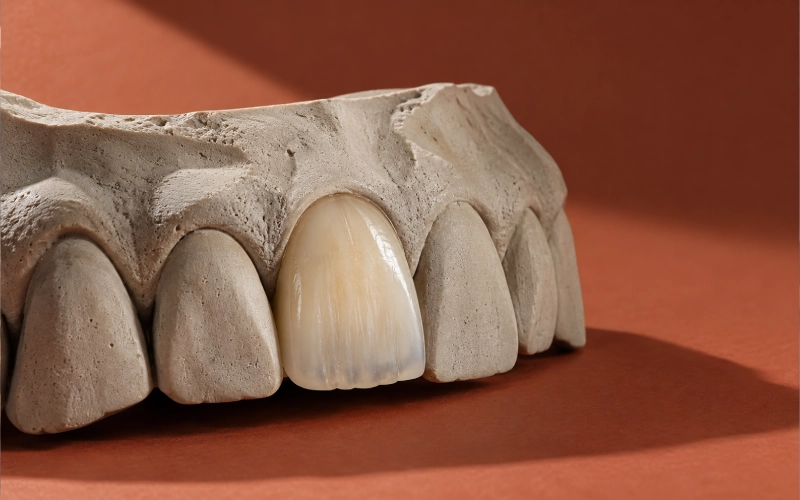
Valplast Front Teeth: Anterior Partial Denture Case Study
Wypełnij formularz, a my odpowiemy w ciągu 30 minut!
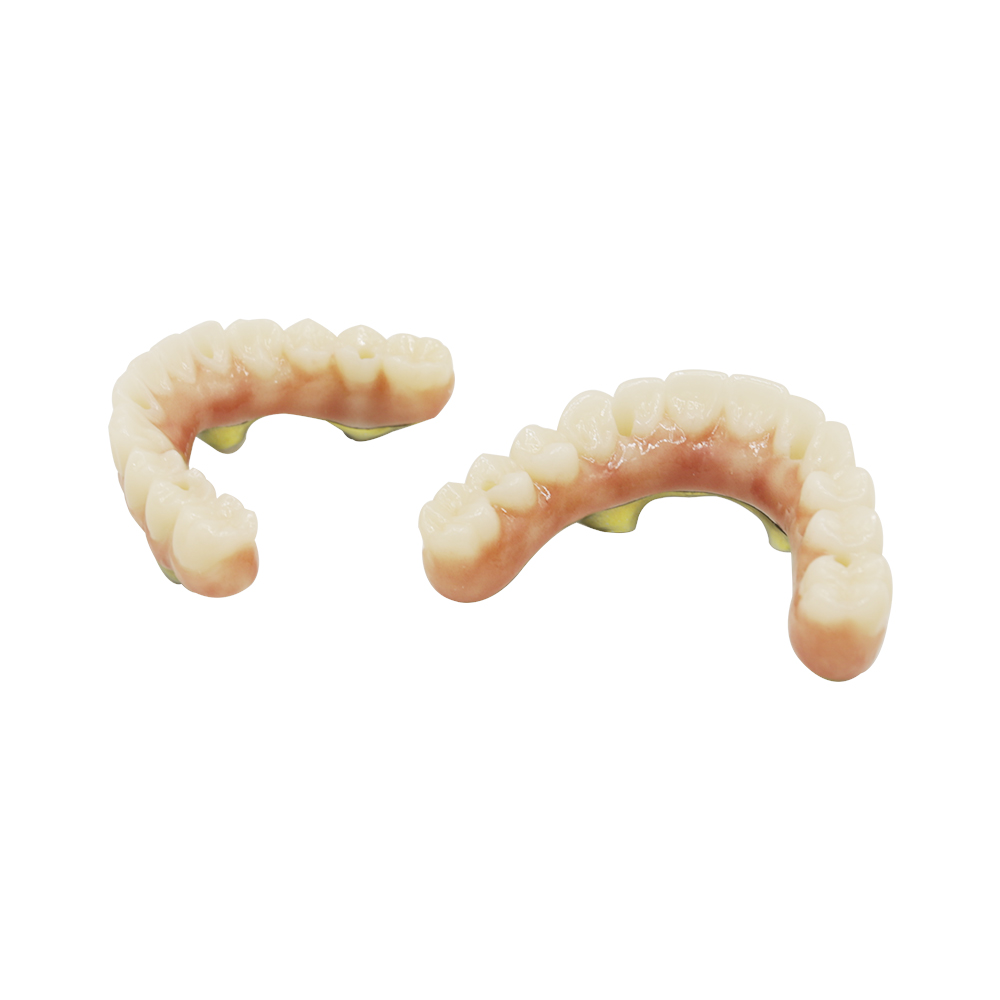
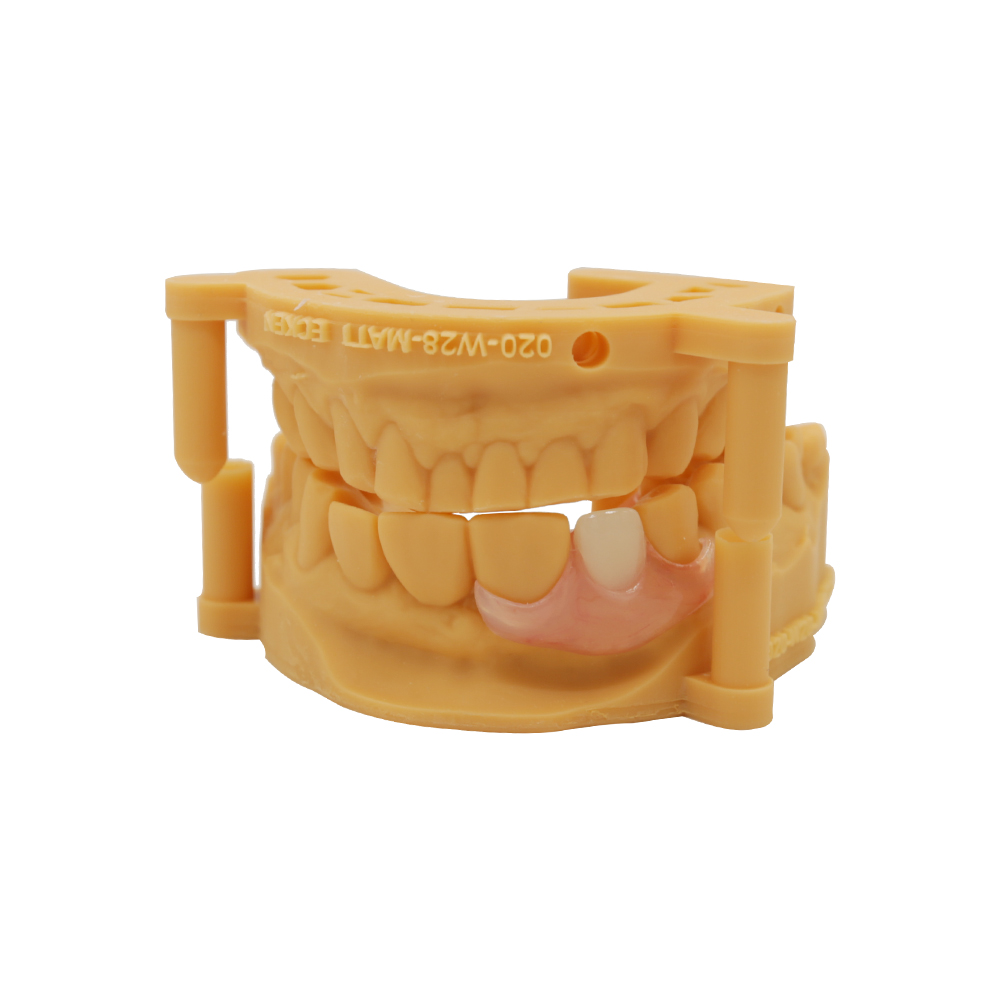
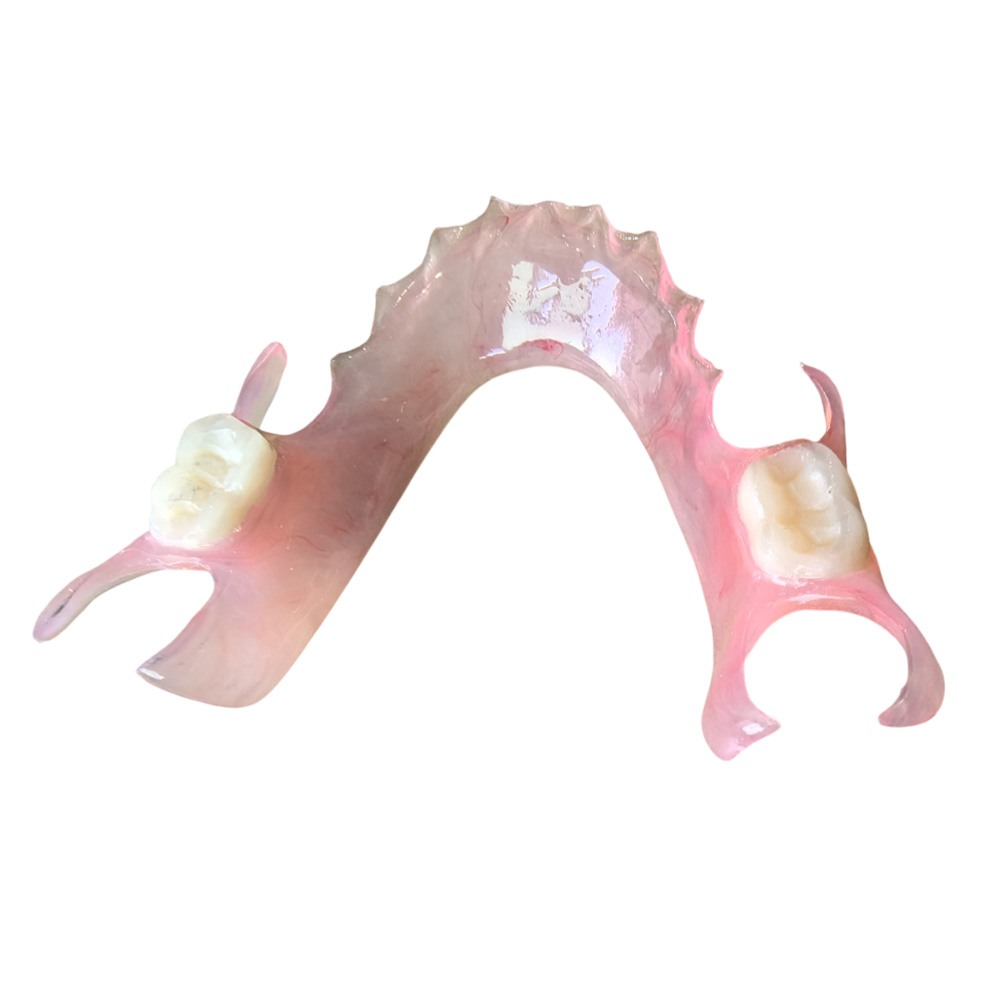
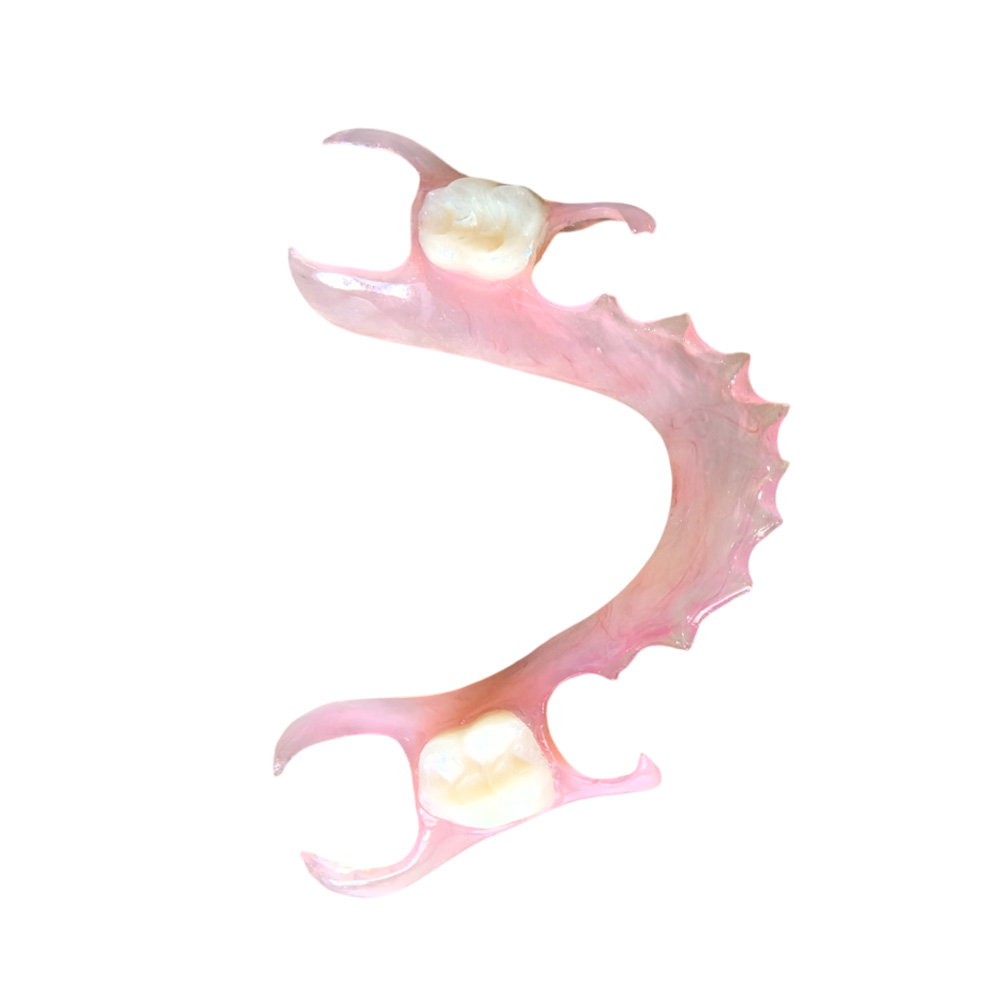
A real-shape presentation of an anterior flexible partial case for valplast front teeth. The fabrication and delivery side sits inside our in-house denture line.
1. The Patient Situation
This page tracks a pattern we see again and again on anterior partial cases: 2–3 upper front teeth missing in the visible zone, the supporting teeth compromised, the other paths either flat-out ruled out or deferred. We lay out the case as it presents, in de-identified form. No patient, clinician or practice is named.
1.1 What’s actually in the mouth
- Missing units. Upper anterior segment, 2 units (lateral-incisor positions, both sides). Bounded gap. Canines still in place, can act as abutments.
- Periodontal and bony support. Prior periodontal management on file. The canines read lower than a healthy dentition on attachment and probing. They can carry clasp geometry but cannot take heavy occlusal load.
- Soft tissue. Thin buccal mucosa over the ridge. A bulky flange will scrape or blanch on seating.
- Occlusion and spacing. Overbite and overjet sit in a workable range, no marked deep bite. Posterior interocclusal clearance about 5 mm — the manufacturer guidance for placing artificial teeth with adequate mechanical wrap (Valplast Clinical Techniques).
- Aesthetic constraint. High smile line. Any metal clasp landing on the canines sits in the visible zone.
1.2 What the patient actually said
“My dentist says I can not get a bridge as the side supporting teeth have too much bone loss. He is recommending Valplast Partials or implants. I just can’t justify getting implants done yet when I am most likely going to lose more teeth.”
“If I have to have clasps on the teeth near the front where they can be seen I think I will get a valplast…”
1.3 What the picture means for the design
Three rules fall out of the picture above:
- Bony support rules out a fixed bridge. The lateral abutments do not have the bone height for a bridge load.
- The aesthetic constraint rules out cast metal and acrylic-with-metal-clasps. Anything that lands a metal clasp in the visible zone is non-starter.
- The implant is deferred, not done. Either the bone site or the timing is not right.
2. What the Prescribing Clinician Asked For
The clinician handed us a list of seven requirements. Each one comes straight from how this kind of case typically presents. We did not invent them; they are the asks that recur on anterior flexible partials.
2.1 Seven requirements from the clinician
| # | Requirement | Where it comes from |
| R1 | No visible metal on the abutment canines. | Patient-side driver: visible-zone clasps are the primary reason a flexible partial is chosen over a cast framework. |
| R2 | Do not overload the periodontally reduced canines. | Periodontal support on the abutments is the clinical reason the case is on a removable partial in the first place . |
| R3 | Base thin and uniform; flange not over-extended. | Clinician-side concern: over-extended flanges are the most common patient complaint on flexible partials — patients describe “food building up under one side of the denture” once the border sits past the right line . |
| R4 | Confirm ~5 mm interocclusal clearance; if not, change the design. | Manufacturer guidance: below about 4 mm you cannot place a diatoric-retained artificial tooth with adequate resin wrap. |
| R5 | Verify midline and incisal display before finishing. | Standard for any anterior case. |
| R6 | Able to add teeth or repair later, at the lab. | Different clinicians phrase this differently — some promise “can always add teeth” as a selling point, others warn “teeth cannot be added in the future.” The clinician on this presentation wanted a clear, written answer either way . |
| R7 | Honest pre-delivery expectation setting. | Clinicians on the forums warn patients about three things up front: “teeth cannot be added,” “hard to adjust,” “it will rock slightly when chewing” — and the gingiva underneath needs monitoring. |
2.2 What the clinician said about the trade-offs
Two threads from the prescribing side, used as quotes only:
“I’ve gone for valplasts in anterior cases with two or three teeth missing but not enough bone height for implants. And abutments not strong…”
“Flexible partial denture solely serves to look normal or good. It’s flexible, thus establishes no solid foundation for chewing function…”
Both points are baked into how we run the case below: indication-driven, not default; function limited, aesthetics primary.
3. How Our Lab Met Each Requirement
The lab-side response to each of the seven requirements above. No commentary on what other labs do — just our own rules.
- R1 → No visible metal on the abutment canines. Full flexible nylon base, gingiva-colored clasp extensions, no metal framework, no metal rest. Clasp shade is picked after we record both tooth shade and gingiva shade. The clasp runs through the surveyed undercut path only — never on the marginal gingiva.
- R2 → Do not overload the periodontally reduced canines. Clasp position follows the natural undercut and insertion path. We do not force the clasp deeper. Selective relief on the abutment side of the base. Seating is passive by design — the base sits without pressing the abutments toward the ridge. Peer-reviewed review confirms flexible bases distribute load differently from rigid ones, which is exactly why clasp path and relief matter on reduced-periodontium cases (Clinical application of removable partial dentures using flexible thermoplastic resin — ScienceDirect).
- R3 → Base thin and uniform; flange not over-extended. This is the rule patients feel most directly. Wax-up runs to a uniform thin wall. Border is kept short of full extension — never run into the buccal vestibule, never impinge on the frena. The pattern on forums (“food building up under one side of the denture”) is the failure mode this control prevents. Systematic review notes that flexible base thickness and border extension drive most comfort outcomes (Clinical Assessment of Flexible and Non-Metal Clasp Dentures — Prosthesis (MDPI)).
- R4 → Confirm ~5 mm interocclusal clearance; if not, change the design. We check clearance at maximum intercuspation, protrusive and lateral. If clearance is below about 4 mm, we flag the case and ask the clinician to reconsider — different design, or a bite-management step first. We do not force a thin resin wrap on a diatoric-retained tooth. Manufacturer techniques page sets the threshold (Valplast Clinical Techniques).
- R5 → Verify midline and incisal display before finishing. A wax try-in is mandatory on every anterior case (per our fabrication workflow; wax try-in / digital try-in confirmed). At try-in we check midline, incisal display, lip support and tooth arrangement against the standard checklist. The peer-reviewed review on flexible base materials lists wax try-in as a baseline control step (Flexible Thermoplastic Denture Base Materials — PMC3843478).
- R6 → Lab-side add-on and repair capability. Our published rule: the appliance can have teeth added, be repaired, or be relined at the lab, through injection. For a reline we need a fresh impression and a fresh bite record. Chairside re-line on this material is not appropriate — that is not a workflow limitation, it is a material property. Different clinicians phrase the add-on capability differently; our written answer is the rule above.
- R7 → Honest pre-delivery expectation setting. The delivery sheet the practice receives says three things in writing. First: this is a removable appliance retained by clasp geometry — light functional movement is normal, the clinicians on the forums call this “rock slightly when chewing” and we surface that with the same words. Second: chairside re-line is not appropriate for this base type — if fit has changed enough, a remake is more predictable than a patch. Third: additions and repairs are run at the lab, with the impression and bite we need to do the job. The clinician hands them over; the practice hands them on to the patient.
4. Valplast Front Teeth Design and Fabrication
Four control points decide whether the finished piece works for this patient or doesn’t.
4.1 Block-out of buccal undercuts on the master model
Done before the wax-up. Flexible bases seat by deforming a little, then rebound onto the tissue. If the buccal undercuts are not blocked out on the model, the finished flange either cuts into the buccal tissue on insertion or refuses to seat at all. This is the number-one comfort-outcome control for anterior Valplast partials, and the one piece of craft the forums do not see.
4.2 Uniform, thin base thickness
A thick base gets stiff, seats poorly and puts more edge pressure on the tissue. We build the wax-up to a uniform thin wall. Thicker is not stronger for this material.
4.3 Deliberately short borders — not over-extension
Anterior partials do not need full-extension flanges. Over-extension is the fastest way to create food traps and buccal soreness — the exact pattern the patient in §1.2 describes. Short and clean beats long and covering.
4.4 Diatoric mechanical retention on the artificial teeth
There is no chemical bond between a nylon base and the artificial teeth, so the teeth carry a diatoric (mechanical) retention form with enough room around them for injected resin. Bond-strength study on nonmetal bases confirms the direct-bond number is low and drops further after thermocycling (Shear Bond Strength of Acrylic Denture Teeth to PMMA and Polyamide — JDMT). That is why R4 checks clearance three ways — the wrap has to be there physically. Tooth debonding is a documented failure mode on flexible bases, with one clinical evaluation showing a 22.2% debonding rate at 18 months (Bond Strength of Acrylic Teeth With Different Denture Base Materials — PMC7595539).
The fabrication line for this case runs inside our Removable Denture Department, in-house, wax-up through injection through polishing through QC. Not sent to a third-party finisher. Bench inspection covers occlusion (centric, protrusive, lateral), tooth arrangement and midline, base thickness and fit, clasp fit and retention, and surface polish.
5. The Delivered Outcome
What the clinician sees on the first seating, what the patient lives with in the first week, and what we track after it goes out. No before/after photos on this page (anterior cases are covered by patient consent and by professional confidentiality). The outcome sits in measurements and observations the chairside team can verify against the appliance in their hands.
5.1 What the clinician should see at first seating
A short checklist the chairside team runs on the day. Drawn from the controls in §3 and §4.
- Seats passively after the 30–60-second warm-water soak per the manufacturer techniques page (Valplast Clinical Techniques). No forced click on insertion.
- No blanching along the buccal flange after 60 seconds in place. If it does not fade, the flange is contacting a residual undercut and we relieve the bench rather than the chair.
- Retention feels firm but not tight. The patient removes the appliance cleanly on the second try. If it takes rocking, we look at the clasp path.
- Centric contact on the artificial teeth reads even against the opposing dentition — same pattern signed off on the working model.
- No protrusive strike on the artificial teeth during a slow excursive slide. This is the failure mode we care about most for anterior cases, and the one the forums flag.
- Midline matches the smile photo on file. Incisal display sits inside the range the clinician wanted.
Any deviation from the list gets fed back to us the same day. Tension or contact issues we walk through on the phone; anything that touches base geometry goes back to the lab.
5.2 What the patient lives with in the first week
Three things we surface in plain English on the delivery sheet, so they don’t get dropped between the lab and the chair:
- First 24–48 hours: mild awareness of the appliance during speech is normal. Consonants that use the incisal edge take a day or two to settle.
- First week: any sharp spot or persistent tenderness gets a chairside visit, not a home fix. We would rather see the appliance back at the bench than have someone reach for a home file.
- Cleaning: soft brush, no abrasive toothpaste on the base, no standard denture cleaner tablets. Warm water rinse. Store wet — the base is designed to sit hydrated.
The patient hears what the clinicians on the forums warn their patients about — light functional movement is normal, chairside re-line is not appropriate, additions run at the lab — but phrased as what they actually do next, not as a list of don’ts.
6. Valplast Partial Denture Case Submission Requirements
Before we start work we need enough data to make good decisions. This is the minimum kit. We call the practice when any of it is missing.
- Impressions: both arches. Alginate works for straightforward cases; PVS is our preference when soft-tissue detail or a deep vestibule matters. For digital cases we accept STL from any of the common intra-oral scanners.
- Bite registration: at least maximum intercuspation. Protrusive and lateral records are welcome for anterior cases.
- Shade: tooth shade AND gingiva shade. Gingiva shade drives the clasp color, and mismatches on that one item are the single most common aesthetic complaint. A frontal smile photo helps confirm the lip line.
- Photos: at least one frontal smile photo and one retracted anterior view. These decide midline, incisal display and lip support.
- Old appliance, if any: send it. We use it to keep the comfort features the patient already tolerated and to fix the ones they did not.
- Clinical notes: periodontal status of the abutments, any known allergies (metal / methyl methacrylate), and any protrusive interference already observed.
If a piece of information is missing we contact the practice. When clinical notes and old-appliance data conflict, we confirm with the clinician first. Standard operating rule for removable cases.
7. When Valplast Front Teeth Partials Are Not Suitable
This is the part of the page we care about most. A page that only says “yes” is a bad page. Each rule below is tied to a clinical signal we see on the public discussion boards.
7.1 Change the design when…
A valplast front teeth solution is not the answer when any of the following are true:
- Distal-extension (free-end) partial. The base pivots off tissue with no distal stop. A rigid design is safer.
- Deep overbite with protrusive interference. The opposing dentition can lift or bruise the anterior appliance in excursions. Clinicians on the forums warn patients about this directly.
- Interocclusal clearance below about 4 mm. Manufacturer techniques page flags this as the threshold where a diatoric-retained tooth cannot be placed with adequate resin wrap (Valplast Clinical Techniques). A different design, or a bite-management step first, is more predictable.
- Abutments need to carry rigid load transfer. Flexible bases do not distribute load like a cast framework. If you need cross-arch stabilization or a rigid major connector, ask for that instead.
- Patient wants a final, once-and-done restoration. Peer-reviewed reviews describe flexible non-metal clasp dentures as an option with a defined indication range, not a universal final solution (Clinical application of removable partial dentures using flexible thermoplastic resin — ScienceDirect; Clinical Assessment of Flexible and Non-Metal Clasp Dentures — Prosthesis (MDPI)).
7.2 What the published evidence actually says (and what it doesn’t)
We keep every figure close to its scope. Every number below is cited to its own study. Do not add them together.
- Bite force runs lower than a rigid cast partial. Systematic-review estimates put a nonmetal-clasp partial’s maximum bite force at roughly 15 kg vs 22 kg for a cast-metal partial (about 11 kg vs 18 kg when both jaws carry flexible partials) (Clinical Assessment of Flexible and Non-Metal Clasp Dentures — Prosthesis (MDPI)).
- Gum height around abutments changes with time. Prospective study of 76 interim single-anterior flexible pontics: adjacent clinical crown height changed on average by about 0.5 mm (range 0.0–1.2 mm) — recession around the clasp is real and worth recording at recall (Application of Valplast dentures in the temporary restoration of anterior teeth — PubMed 21718620).
- Artificial-tooth debonding is a documented failure mode. Clinical evaluation reported a 22.2% debonding rate at 18 months on flexible bases — direct evidence that diatoric retention (see §4.4) is not optional (Bond Strength of Acrylic Teeth With Different Denture Base Materials — PMC7595539).
- Patients often prefer them on comfort and aesthetics. Elderly cohort comparing cast-metal and polyamide removable partials — patient-reported outcomes favored the polyamide group on comfort and appearance (Manzon 2019 — Patient and Clinical Evaluation of Traditional Metal and Polyamide RPDs (Wiley, J Prosthodontics)).
- OHRQoL improves after either design. Arm-comparison study, oral-health quality-of-life scores fell from about 12.4 at baseline to 4.8 (acrylic) and 3.8 (flexible) after fitting. Both designs help (Oral health-related quality of life: acrylic versus flexible partial dentures — PMC6697771).
- Service life is an estimate, not a survival number. Manufacturer and lab guidance cluster around 5–10 years. Independent follow-up runs 6–24 months in the literature review (Polyamide as a Denture Base Material — a Literature Review — PMC4476124).
7.3 A caveat we insist on
Most of these numbers come from studies that mixed several nonmetal thermoplastic materials, or from small cohorts with short follow-up. There is no large-cohort “Valplast anterior only” study we can point to. So use the figures to set expectations, not to predict outcomes for a specific presentation (Polyamide as a Denture Base Material — a Literature Review — PMC4476124).
7.4 Warranty scope — a note
The base material carries a manufacturer-side limited warranty; the exact scope and any exclusions read against the current manufacturer document at the time of order (Valplast International Corporation Limited Warranty (PDF)). “Lifetime” language in warranty documents refers to the material side; it does not mean the appliance stays serviceable indefinitely. Clinical time and lab fees on a replacement are separate from any material-side coverage. Anything more specific — including which line items are in scope for a given order — is a partner-onboarding question rather than a page-level statement.
8. Valplast Front Teeth: Frequently Asked Questions
The questions below are drawn from prescribing patterns we see repeatedly on anterior partial cases. They map onto the “compare / alternative / process / limits” cluster that dominates search intent for this topic.
The patient said the dentist warned that Valplast “flops around” and is “hard to eat with.” Is that true?
The warning is real. Flexible partials transfer more force to the soft tissue than a rigid framework, and that is the limit the warning is pointing at. Two anchors for the clinician and the patient: the systematic-review bite-force estimate (~15 kg for a nonmetal partial vs ~22 kg for a cast framework, both-jaws-carrying numbers drop further) and the forum thread on functional movement. The case is built to limit that movement — block-out, border, diatoric retention — but it does not eliminate it. Indications matter.
The patient heard Valplast can strip the gums over time. How worried should they be?
The mechanism is real — flexible bases wrap around the teeth and gum line, and the long-running clinical discussion uses “gum strippers” for it. The peer-reviewed number is an average change in adjacent clinical crown height of about 0.5 mm over the observation window in a 76-case prospective study (Application of Valplast dentures in the temporary restoration of anterior teeth — PubMed 21718620). The bench-side controls that limit the effect are clasp path, selective relief and recall measurement — all listed in §5.3.
The patient is having food build up under one side of the denture. What does that mean?
It points to either border over-extension or a clasp-path issue, both of which we address at the bench rather than the chair. Send the case back with a fresh impression and a note on which side and when it traps food. Border control and short flanges are the upstream fix; we relieve or re-make as the case reads.
Can the base be re-lined chairside?
No. Flexible nylon does not accept a chairside re-line the way acrylic does. If fit has changed enough to need a reline, a remake is often more predictable. That said, the appliance can be repaired, have teeth added or be relined at the lab through injection. For a reline we need a fresh impression and a bite record.
What does the delivery sheet say to the patient?
Three things in writing. This is a removable appliance retained by clasp geometry — light movement in function is normal. Re-line is not done at the chair; a remake is more predictable if fit has moved. Adding a tooth or a clasp is possible, done at the lab through injection.
How long does one of these last?
Manufacturer and lab estimates cluster around 5–10 years. Independent published follow-up on flexible partials runs 6–24 months, so a service-life quote reads as an estimate, not a survival prediction — see §7.5 on the scope of any material-side warranty. Long-cohort survival data does not exist yet (Polyamide as a Denture Base Material — a Literature Review — PMC4476124).
Can we see photos of the finished case?
Not on this page. Anterior removable cases are covered by patient consent and by professional confidentiality — we do not put clinical photos on a public case-display page. What we do publish is the bench QC list in §5.1 and the long-term tracking items in §5.3. Both are auditable against the appliance in your hand.
9. Sources We Rely On
- Nonmetal clasp dentures: what is the evidence about their use — J Indian Prosthodont Soc
- Comparison of patient satisfaction with acrylic and flexible partial dentures — PubMed 29082902
- Impact of Removable Partial Denture Type on Patient Satisfaction — OAMJMS
10. Where This Fits in Our Lab
The valplast front teeth workflow described here runs through our Removable Denture Department in-house — no external finisher. For the broader denture line and how the removable side is built, see the Removable Dentures page and the Partial Denture page. If the plan later moves to a repair, add-a-tooth or re-line request, the Denture Repair page walks through the workflow. For how our design and CAM steps are structured, the Digital Workflow page covers the shared process. Company profile and factory background are on the About page.
Documentation that travels with the case. On request, the finished appliance ships with the material batch/lot number, the country of origin, and the conformity documentation that came with that batch — itemised against the prescription. We keep those records per case. Reproducibility on a repeat case depends on them as much as on the design itself.
This page describes a typical clinical presentation and the fabrication protocol our lab applies to a valplast front teeth partial. Patient-side quotes are drawn from anonymous public clinical threads and are presented in de-identified form. Numbers cited are peer-reviewed findings from separate studies, quoted with their scope — figures are not additive, and are not a service-life guarantee.