Clear Retainer with Pontic Tooth — Real Case from Our Lab

Wypełnij formularz, a my odpowiemy w ciągu 30 minut!
When a tooth goes missing after extraction or orthodontic treatment, patients need something right away. They can’t walk around with a gap for months while waiting for an implant to integrate. That’s where a retainer with pontic comes in — a removable appliance that holds space, maintains alignment, and fills the gap cosmetically.
We’ve fabricated hundreds of these cases at ASD Dental Lab. Below is a real example showing what the ordering dentist told us, what the patient was dealing with, and how we built it to meet both needs.
The Patient Situation
A young professional came in missing their upper lateral incisor (#7). The canine had drifted into that space over time. Orthodontic treatment moved the canine back to its correct position, opening up room for a future implant or bridge.
During aligner treatment, the patient had an empty tooth-shaped space in each tray. The orthodontist mentioned that a pontic tooth could be added — basically painting or bonding a false tooth into that space — but said the material wasn’t included and would cost extra.
The patient was worried about the gap. They’d been told to eat with the aligners in, which meant food would get stuck in the empty space. The clear plastic would fill with saliva and draw more attention to the missing tooth. They wanted to know: is the pontic tooth worth it, and is it durable?
Clinical notes:
- Tooth position: #7 (upper lateral incisor)
- Reason for loss: Congenitally missing; canine had moved into the space
- Treatment stage: Active orthodontics; space being opened for future restoration
- Timeframe: Several months until implant placement
- Primary concern: Aesthetics during social and work interactions
What the Ordering Dentist Specified
The orthodontist’s prescription to our lab was straightforward but specific:
“Essix-style retainer for upper arch. Pontic tooth at #7 position. Patient will remove for meals. Shade match to adjacent centrals. Standard 0.030″ material thickness. Deliver passive fit — this is post-treatment retention, not active movement.”
In another similar case, the dentist emphasized:
“Patient is healing from extraction at #9. Essix retainer with pontic for cosmetic use only during healing phase. No flipper — I don’t want any acrylic base sitting on the ridge while the implant site is healing. Essix covers occlusal surfaces so patient must remove to eat.”
That second note is critical. A pontic retainer oraz flipper are not interchangeable. A flipper has an acrylic base that rests on the gum tissue; an Essix retainer with pontic is a thin thermoplastic shell that snaps over the teeth. The pontic tooth is bonded inside the clear shell, suspended in place without touching the ridge.
How We Fabricated It
At ASD, we handle the full workflow in-house — no outsourcing to third-party labs. Here’s what happened after the case data arrived:
1. Digital Design and Setup
Our CAD team received the intraoral scan showing the patient’s arch, the space at #7, and the adjacent teeth for shade reference. The designer:
- Mapped the pontic position to fill the edentulous space without encroaching on the interproximal contacts
- Designed the pontic with an ovate (egg-shaped) tissue surface that follows the contour of the ridge without pressing into it — this is preferred over a ridge-lap design when the site needs to stay undisturbed [11]
- Verified passive fit by comparing the digital model against the post-treatment dentition; any active forces would interfere with retention stability
2. Retainer Shell Fabrication
We thermoformed the retainer shell using 0.030-inch PETG (polyethylene terephthalate glycol-modified) — a rigid, clear thermoplastic that’s standard for Essix retainers [18]00012-3/fulltext). Some labs use polypropylene or other copolyesters; we find PETG gives the best balance of clarity, rigidity, and durability for daily wear.
The shell was vacuum-formed over the stone model, trimmed to the gingival margin, and polished to remove any sharp edges. Fit was verified on the model before moving to pontic attachment.
3. Pontic Tooth Bonding
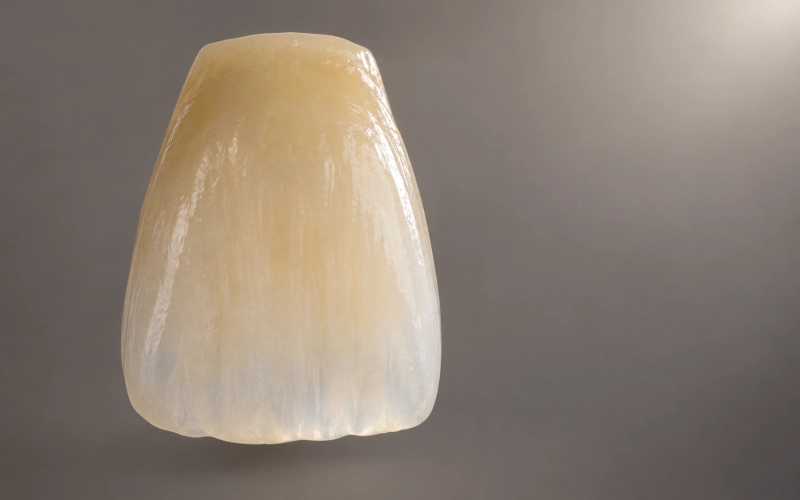
The replacement tooth was made from żywica kompozytowa, shade-matched to the adjacent natural teeth. Composite bonds well to the thermoplastic shell and can be adjusted for contour and color if needed.
The tissue-facing surface of the pontic was contoured to an ovate shape, sitting slightly above the ridge (approximately 1 mm clearance). This prevents pressure on the healing site and reduces food trapping compared to a ridge-lap design [11].
4. Occlusal Clearance Check
One of the most common mistakes we see in pontic retainer cases: the pontic is left in occlusion. If the opposing teeth contact the false tooth during function, the composite will fracture or debond from the shell within days.
We verified clearance by checking the case against the opposing arch scan. The pontic was positioned 0.5 mm out of occlusion in centric and lateral excursions. This is a lab-side responsibility — if the prescription doesn’t specify it, we design it in by default and note it in the delivery documentation.
5. Quality Check and Delivery
Before shipping, our QC team verified:
- Passive fit on the model (no rocking, no gaps at the gingival margin)
- Pontic bond integrity (no visible adhesive gaps)
- Occlusal clearance confirmed
- Shade match reviewed under daylight-equivalent LED
- Case photographed and logged
The retainer was delivered with care instructions: remove for eating, clean daily with mild soap (not toothpaste, which can scratch the surface and cloud the material), and store in the provided case when not worn [21].
Clinical Considerations We Build Into Every Pontic Retainer
These details separate a functional appliance from one that fails in the first month:
Mechanical Retention Design
The pontic is adhesively bonded, not mechanically locked. That means it’s held by surface chemistry, not a physical undercut. If the patient bites into an apple with the retainer in, the pontic will shear off. We make this explicit in the delivery note: “Cosmetic use only. Do not function on pontic tooth.”
Material Thickness Matters
Thinner shells (0.020″) are more aesthetic but crack easily, especially in bruxers. Thicker shells (0.040″+) are bulky and harder to seat. 0.030″ is the sweet spot for most cases — strong enough for daily handling, thin enough to be comfortable.
If the patient is a known grinder, we recommend a thicker Hawley-style retainer with a wire-reinforced acrylic base instead of an Essix. That’s not a pontic retainer in the Essix sense; it’s a different appliance category.
Healing Site Protection
When the pontic sits over a fresh extraction site or an integrating implant, the last thing you want is pressure on the ridge. That’s why we design an ovate pontic with 1–2 mm clearance from the tissue. Some practitioners request a ridge-lap design for better emergence profile, but that’s only appropriate after the site has fully healed and remodeled [11].
If the prescription doesn’t specify tissue clearance, we default to ovate with clearance and note it in the case documentation. The ordering dentist can request a remake if a different design is needed.
Occlusal Clearance is Non-Negotiable
We’ve had cases returned because “the pontic keeps breaking.” When we asked for photos, the patient was biting directly on it. The prescription said “pontic at #8” but didn’t mention occlusal clearance. We now design 0.5 mm clearance as the default and mark it on the delivery slip.
If the pontic must be in occlusion for some clinical reason (rare), the prescription should specify that and accept the trade-off in durability.
What We Tell Dentists About Pontic Retainers vs. Other Options
A retainer with pontic tooth is a transitional appliance — it’s not a replacement for an implant, bridge, or partial denture. Here’s how it compares:
| Cecha | Essix Retainer with Pontic | Hawley Retainer with Pontic | Flipper | Implant (definitive) |
| Fabrication time | 5–7 days | 7–10 days | 7–10 days | 3–6 months total |
| Covers occlusal surfaces? | Yes (full-arch shell) | No (wire + acrylic base) | No (acrylic base only) | Nie |
| Can eat with it? | No — food traps under shell | Sometimes, if pontic is out of occlusion | Yes, but not recommended | Tak |
| Tissue contact during healing | Minimal (suspended pontic) | Minimalny | Yes — acrylic base sits on ridge | No (integrated in bone) |
| Best for… | Post-orthodontic retention; implant healing phase | Long-term space maintenance; adolescents | Older patients; cases where implant isn’t planned | Permanent restoration |
From our fabrication standpoint, the Essix pontic retainer is the fastest and most conservative option for short- to medium-term aesthetics (up to 12–18 months). Beyond that, the thermoplastic material can discolor, warp, or crack from daily handling [14].
Real-World Durability and Patient Feedback
Based on feedback from the dentists we work with:
Expected lifespan: 6–18 months with normal wear. Daily removal for meals, proper cleaning, and avoiding hot liquids (which can warp the thermoplastic) are critical [14].
Most common failure modes:
- Pontic debonding — usually from biting on it accidentally
- Shell cracking — from being dropped or stored improperly
- Discoloration — from coffee, tea, or tobacco (material doesn’t stain if cleaned daily)
Patient satisfaction is high when expectations are set correctly. The dentists who tell their patients “this is temporary, handle it gently, and remove it for eating” report very few complaints. The ones who present it as “just like a real tooth” see more dissatisfaction when it doesn’t perform like one.
Special Case: Congenital Missing Teeth and Adolescent Patients
A significant portion of pontic retainer cases we see involve congenitally missing lateral incisors in teenagers. These patients have never had the tooth, so the space has been maintained orthodontically or the adjacent teeth have drifted.
For adolescents who aren’t ready for an implant (because jaw growth isn’t complete), a pontic retainer serves a dual purpose:
- Maintains the space created by ortho
- Provides aesthetics during the wait (sometimes years)
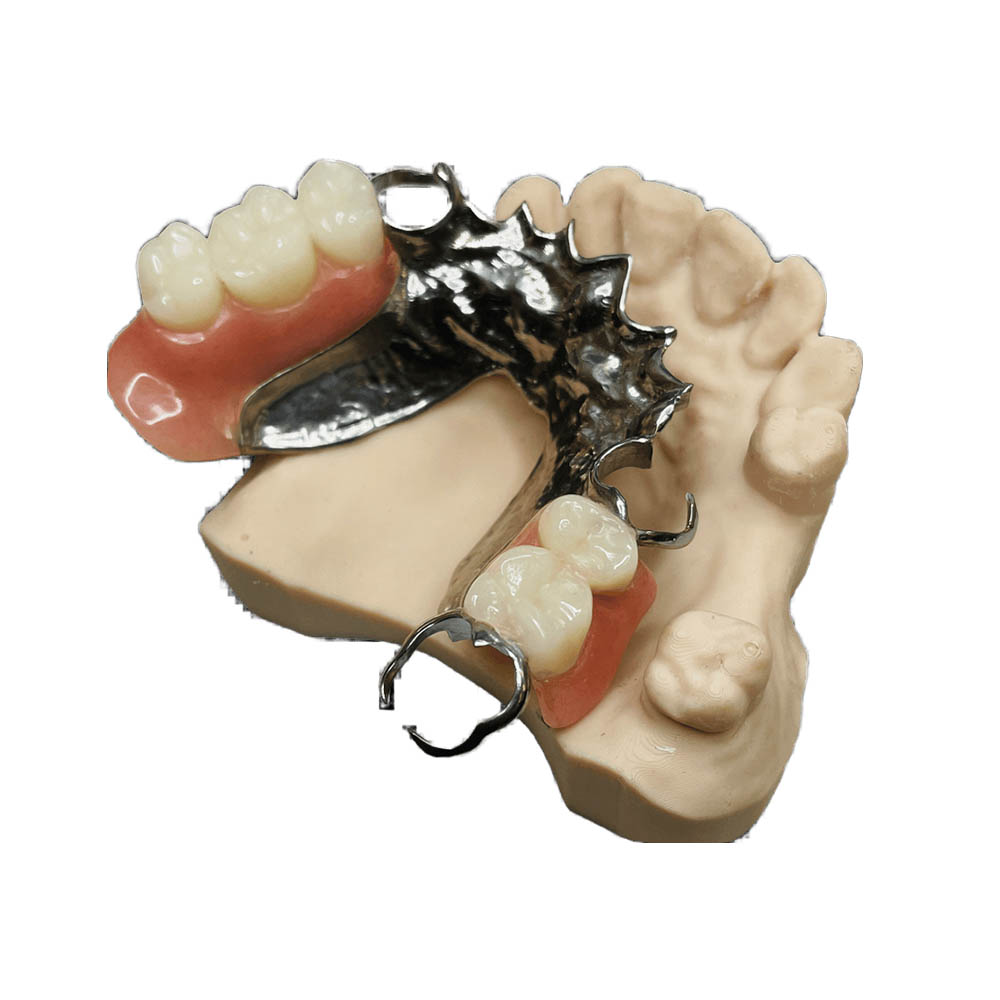
In these cases, the dentist often requests a Hawley retainer with pontic instead of an Essix, because the patient will be wearing it for longer and needs something more durable. The Hawley design uses a wire framework and an acrylic base, with the pontic tooth set into the acrylic. It’s bulkier but much more robust [32].
We fabricate both types. The choice depends on the expected wear duration and the patient’s ability to comply with a wear schedule.
Cleft Palate and Congenital Defect Cases
Another subset of pontic retainer cases involves patients with cleft lip/palate or other congenital conditions where multiple teeth are missing or malformed.
These cases require extra design consideration:
- The pontic may need to compensate for abnormal ridge morphology
- Adjacent teeth may be smaller or shaped differently
- The patient may have had multiple surgeries, so tissue contours are unpredictable
For these cases, we often request photographs of the patient’s smile in addition to the scan, so our design team can see the soft tissue drape and emergence profile from the patient’s perspective, not just the model [41].
If the prescription mentions “cleft palate” or “congenital missing,” our lab flags it for senior technician review before proceeding. These cases can’t be rushed through the standard workflow.
When We Recommend Against a Pontic Retainer
Not every case is appropriate for an Essix retainer with pontic. We’ll communicate back to the dentist if:
- The patient is a heavy bruxer — the thermoplastic shell will crack quickly, and the pontic will debond from grinding forces
- Multiple adjacent teeth are missing — an Essix retainer can span one or two teeth, but beyond that, a partial denture or interim bridge is more appropriate
- The pontic would be in heavy occlusion — if there’s not enough room to design occlusal clearance, the pontic will fail
- The patient expects to eat with it — we’ve had cases where the patient assumed it was like a partial denture. If that’s the expectation, a different appliance is needed
We’d rather flag these issues at the design stage than deliver an appliance that fails in the first week.
Remake and Adjustment Policy
Our standard case agreement covers:
- One remake at no charge if the fit or shade is incorrect due to lab error
- Pontic repositioning or re-bonding within 30 days if it debonds due to adhesive failure (not patient misuse)
- No warranty if the patient reports biting on the pontic or dropping the retainer
For dentists who order pontic retainers regularly, we keep the digital files on record for 24 months. If a patient loses or breaks their retainer, we can re-print and re-fabricate from the same design without needing a new scan — as long as the dentition hasn’t shifted.
What Information Helps Us Fabricate It Right the First Time
When a dentist sends us a pontic retainer case, these details make a huge difference:
Essential:
- Tooth position(s) for the pontic
- Shade reference (adjacent teeth or shade guide photo)
- Retainer type (Essix vs. Hawley)
- Is the patient healing from extraction / waiting for implant?
Helpful:
- Occlusion status (do we need to design clearance, or is the opposing arch not a factor?)
- Expected wear duration (6 months vs. 2 years changes our material choice)
- Any history of breakage with previous retainers
- Patient age (adolescents with active growth need different design considerations)
Critical for cleft / congenital cases:
- Front-facing smile photos
- Notes on any surgeries or grafting that have altered ridge anatomy
The more information we have up front, the fewer back-and-forth adjustments we need.
Summary: Why Dentists Keep Ordering These
From a lab’s perspective, pontic retainers are one of the most requested transitional appliances because they hit a sweet spot:
- Fast turnaround (under a week)
- Relatively low cost compared to interim bridges
- Reversible and non-invasive (no tooth prep, no surgery)
- Can be fabricated from a digital scan (no physical impression needed)
The trade-off is durability and function. They’re not meant to last years or to be worn during meals. But for a patient who just had #7 extracted and needs something to wear to work while the implant site heals, a pontic retainer solves the immediate problem.
We’ve fabricated these cases for general dentists, orthodontists, periodontists, and oral surgeons. The appliance is the same; the clinical context is what varies.
References and Further Reading
- Thermoplastic retainer materials and longevity: Journal of the American Dental Association (2014) [18]
- Pontic design for implant healing sites: International Journal of Periodontics & Restorative Dentistry (Międzynarodowy dziennik periodontologii i stomatologii odtwórczej) [11]
- Removable appliances during osseointegration: Clinical Implant Dentistry and Related Research [26]
- Adolescent retainer compliance and design: Orthodontic Pearls [32]
- Cleft palate prosthodontics: Cleftline Publications [41]
Need a pontic retainer for your case? Contact ASD Dental Lab. We’re a full-service manufacturing facility based in Shenzhen, China, with in-house CAD design, milling, and finishing. All pontic retainer cases are completed within 5–7 business days from scan receipt.