Valplast Denture Case Study: Anterior Partial Build at ASD Dental Lab
🕢 [ ¡Rellene el formulario y le responderemos en 30 minutos! ]
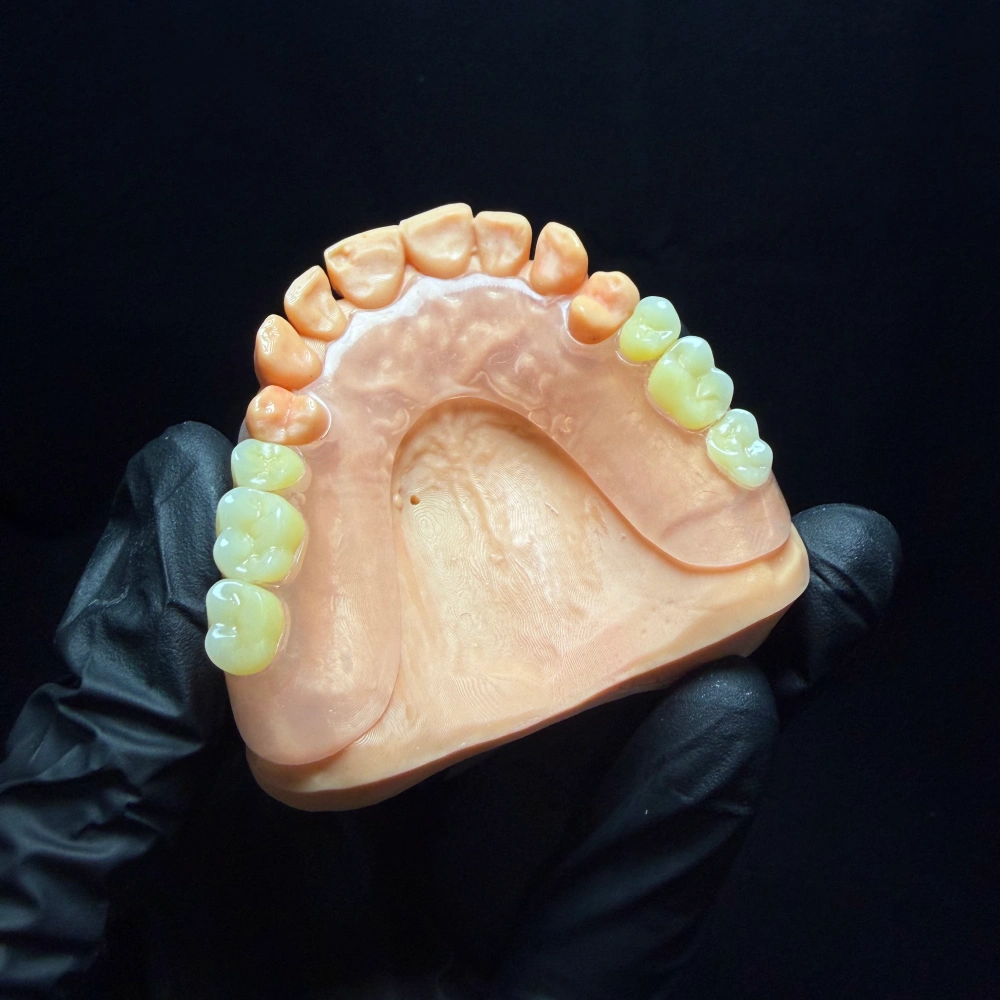
A real case record from our removable department, built to show how we take a valplast denture prescription from file to finished partial inside one lab. This page is written for dentists, clinics, DSOs and outsourcing labs who want to see what the actual workflow looks like before sending us a first case.
1. Patient Situation (what the dentist sent us)
We received the case from a general dentist in the United States. The dentist’s work slip gave us a short, clear picture — no patient name, just an in-office case number, which is how we prefer every file to arrive.
What the record told us about the patient:
- Missing teeth: three upper anteriors (teeth 7, 8, 9 in Universal / 11, 21, 22 in FDI).
- Status of adjacent teeth: teeth 6 and 10 were sound, no mobility noted, no caries, no restorations flagged for replacement.
- Soft tissue: healthy ridge width, no sharp ridges or involved tori, no deep undercuts.
- Occlusion: Class I, no deep bite, no bruxism history indicated on the slip.
- Patient’s own ask (quoted on the slip): “would prefer not to show any metal, and does not want anything bonded or cut on the neighbouring teeth right now.”
2. The Dentist’s Requirements
The work slip arrived with twelve line items. Here they are, grouped by what they drive on the bench.
Clinical constraints
- Sombra A2 body, incisal translucency to match tooth 10.
- Base shade light pink, no fibers.
- Occlusal clearance 2.0 mm at the pontic sites, verified on the opposing cast.
- Clasp design keep clasps lingual to teeth 6 and 10 wherever the undercut allows; no visible metal; no metal rests.
- Ajuste no rocking on seat; no blanching at the labial flange.
- Base extension stop short of the frena; cover the ridge crest only, not full palatal coverage.
Material and labelling
- Base must be thermoplastic nylon-based (polyamide) flexible resin — the dentist specified Valplast by brand.
- Provide the material batch number and brand on the delivery slip for the chart.
- Include a care insert that the clinic can hand to the patient at insertion. No branded insert for the lab — clinic branding only.
Delivery and documentation
- Return the working cast with the finished partial.
- Try-in step supplied before final processing (a wax or 3D-printed try-in that the dentist can seat and sign off on).
- Turnaround target two weeks from receipt.
3. How We Built the Case (step by step)
Everything in the list below ran inside our own facility in Shenzhen and Huizhou. Nothing in the valplast workflow is subcontracted out. We mention that because every one of the twelve prescription items above is traceable to a specific station and a specific technician in our records — it’s one of the main reasons dentists send repeat cases.
3.1 Receiving and file check (Day 0)
The case landed in our case-coordination inbox as a mixed submission: a PVS impression of the opposing arch, a 3Shape TRIOS scan of the prepared arch (STL + DCM), bite registration in PVS, and the written slip. We handle both types in the same pipeline — digital goes straight to design, physical gets poured in-house. Our coordinator confirmed receipt within an hour and ran a completeness check against the slip.
Two things flagged on the first pass: the opposing scan was short by one molar, and the bite record showed a small void on the right side. Both items went back to the practice as a WhatsApp message with annotated screenshots, and the dentist re-scanned and re-recorded the bite the same day. We prefer to catch this on Day 0, not on Day 5.
3.2 Design (Days 1–2)
Our CAD team drew the framework on the digital cast. Three decisions were made here, each of them traceable in the case file:
- Clasp placement. We routed the retention arms along the lingual embrasures of teeth 6 and 10, following the natural undercut on the mesio-lingual of 6 and the disto-lingual of 10. The buccal of each abutment was left bare so the clasp would not appear across the smile line.
- Occlusal clearance. We measured 2.1 mm and 2.0 mm at the pontic sites on the digital articulation — within the slip’s spec.
- Base extension. Flange ended 1.5 mm short of the labial frenum, and the base stopped at the ridge crest as asked. We did not extend coverage to the palate.
The design file was exported as STL for the try-in and PLY for the colour reference. We shared both with the dentist for sign-off before any processing began — this is design approval, not a courtesy email.
3.3 Try-in (Days 3–4)
The dentist asked for a try-in step and we always provide one on removable work. We 3D-printed a resin try-in that the practice seated chairside. The feedback came back the next day: “add 0.3 mm to the lingual of 9 to open the papilla slightly, otherwise approve.” We logged the change on the slip with a date stamp, re-ran the design, and moved to processing.
3.4 Processing the valplast partial (Days 5–7)
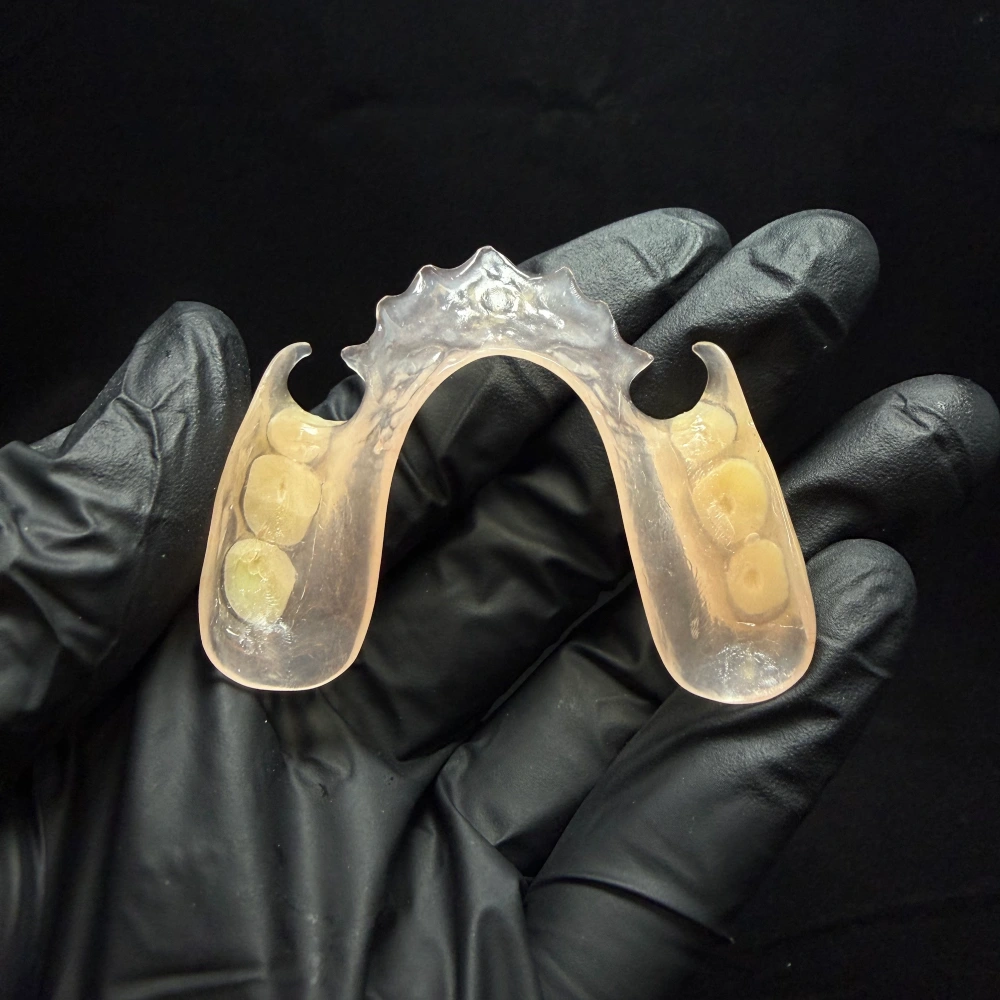
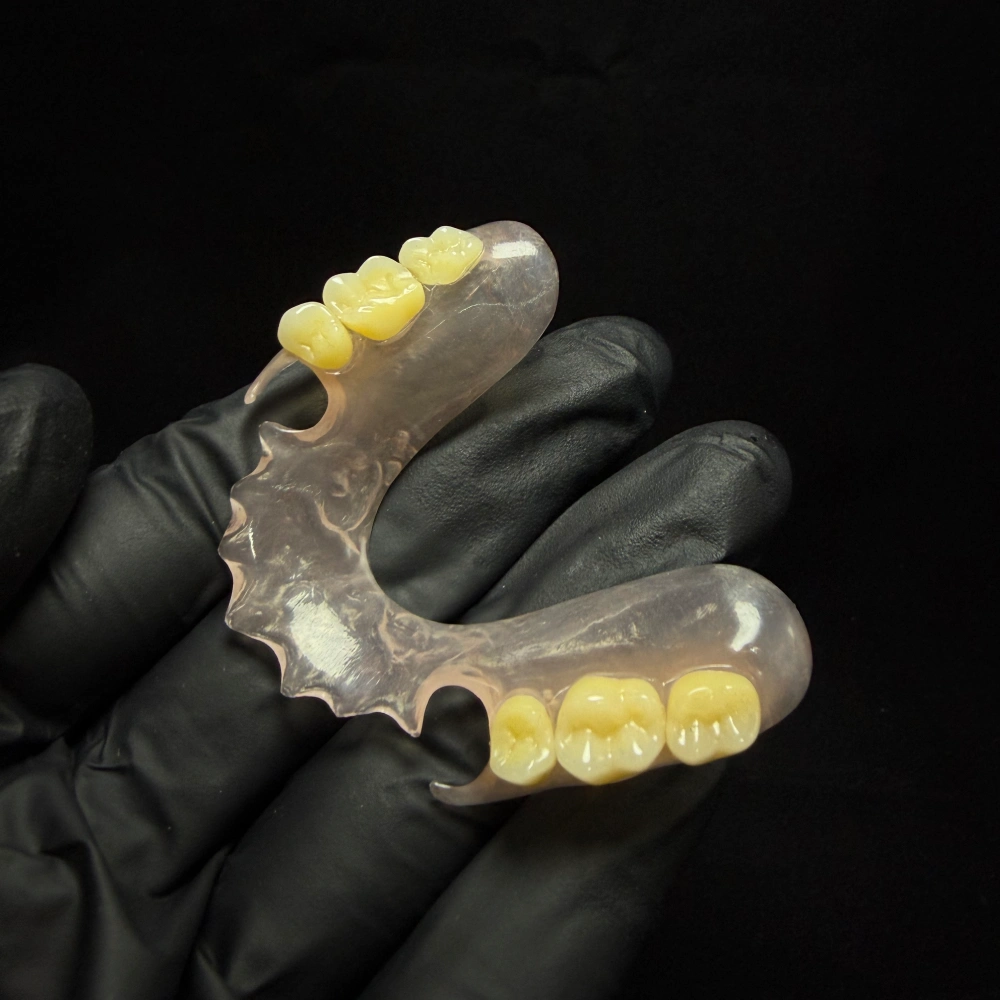
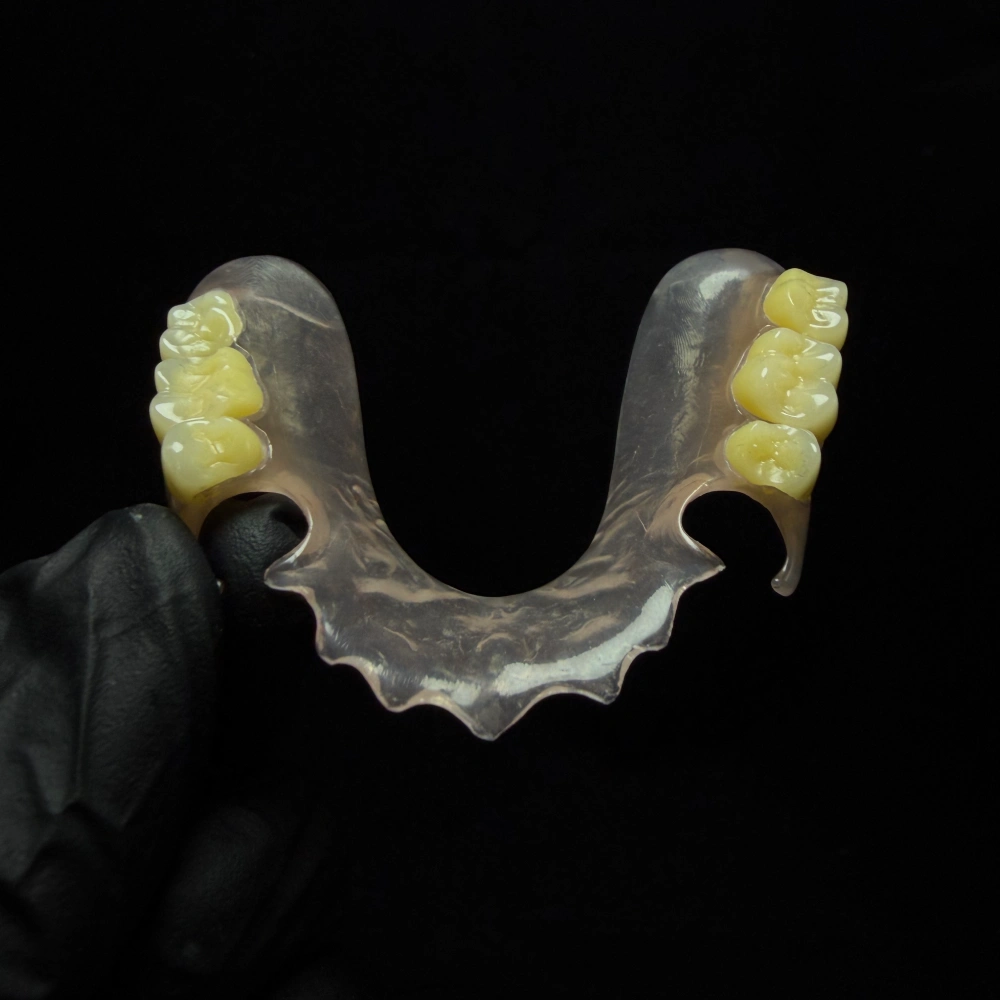
The base is a nylon-based thermoplastic. The frame is injected under pressure after the mould is prepared from the approved try-in. Our removable department ran the full sequence: investing the master cast with the approved tooth set-up, flasking, injecting the resin, bench cooling, deflasking, trimming, finishing, and polishing. We used a Valplast-brand cartridge in medium standard pink and recorded the lot number on the case card.
3.5 Verification and QA (Day 8)
Every removable case passes through our QC station before packaging. For this one the checklist was:
- Fit on the master cast — no rocking, full seat, no gap under the retention arms.
- Occlusal check — opposing cast articulated; even bilateral contact in centric; no premature contact on protrusion.
- Flange and base — thickness within the drawing, flange trimmed short of the frena, polish free of visible pits.
- Clasp retention — passive on the model, no deformation visible on multiple seat-and-remove cycles.
- Sombra — A2 body with incisal match verified under daylight-equivalent lighting; base-pink shade matched the reference tab.
- Material traceability — brand, lot number, and operator initials written on the case card and in the system.
3.6 Packing and shipment (Day 9)
The partial, the trimmed master cast, a short written care insert for the clinic to hand to the patient, and the lot-number slip for the dentist’s chart all went into one case box. Clinic branding on the outer label; no lab branding anywhere in the kit at the client’s request.
4. Final Delivery
Here is what left the lab:
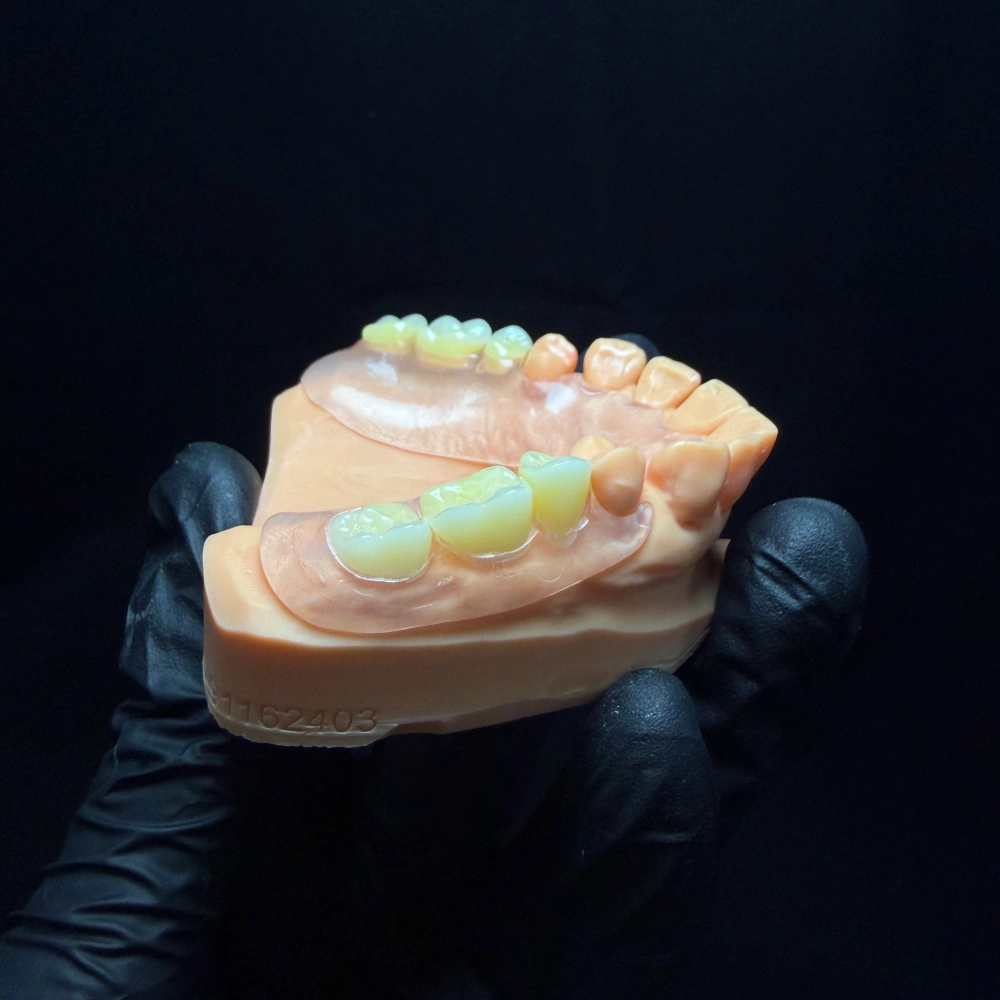
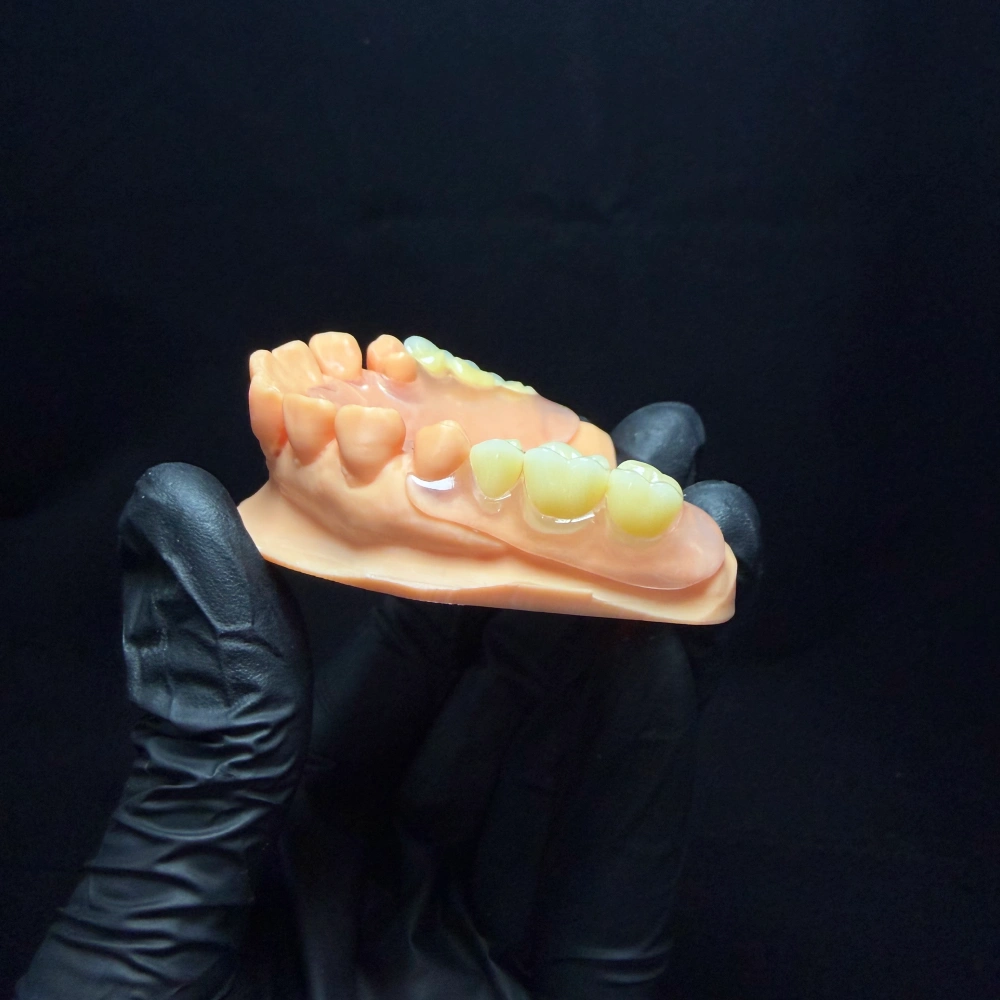
- One valplast denture (upper anterior partial, three units — teeth 7, 8, 9).
- One returned working cast with the appliance seated for shipping.
- One care insert, clinic-branded.
- One material-traceability slip (Valplast cartridge batch, polish lot, operator initials, QC pass date).
Timing: 9 working days from the file-check call-out to the shipment hand-off. That falls inside the two-week target the dentist asked for in the slip.
Try-in feedback: one revision (the 0.3 mm lingual adjustment on tooth 9). Logged, approved, carried into final processing.
Follow-up window. We ask the clinic to send us a short seating note after insertion — anything the chairside hygienist spotted, anything the patient reported on the one-week check. The note goes on the case card. It is how we close the loop and how we build the data we draw on for the next case.
5. Materials and the Numbers We Can Point To
Here is the paperwork side of the same case, written out plainly for the chart.
5.1 Material class
Valplast is a thermoplastic polyamide (nylon-based) injection resin, used as a denture base for removable partials. The device class and the pathway it falls under are set at the regulation level, not by any single lab or supplier:
- 21 CFR 872.3760 classifies polymer-based denture base resin as a Class II dental device. See the current text at 21 CFR §872.3760 on eCFR.
- The product code is EBI in the FDA classification database — FDA Product Classification: EBI.
- The pathway for most devices in this class is 510(k) clearance, which the FDA explicitly describes as a finding of substantial equivalence rather than an endorsement — see the agency’s own overview of 510(k) notifications. Clearance is not approval; we don’t use the word “approved” when we describe this product on our site because it would not be accurate.
- Performance expectations for denture base resins are set in FDA guidance on denture base resins and in the international standard ISO 20795-1.
5.2 What we recorded on this build
| Field | Value on this case |
| Base material | Valplast thermoplastic polyamide, medium standard pink |
| Cartridge batch number | On file; shared with the chart on the delivery slip |
| Occlusal clearance at pontic sites | 2.1 mm and 2.0 mm (opposing cast) |
| Shade — teeth | A2 body with incisal translucency to match tooth 10 |
| Shade — base | Light pink, no fibers |
| Clasp routing | Lingual on 6 and 10 — no buccal metal |
| Flange relief | 1.5 mm short of labial frenum |
| Palatal coverage | None — ridge crest only |
| Total working days | 9 |
| QC pass date | 28 Aug 2024 |
5.3 Where the clinical limits sit
A valplast flexible dentures build is a good match when the span is short, the abutments are sound, and the patient is after a metal-free aesthetic in the anterior zone. It is not the right pick when the bite transfers heavy posterior loads through a large base, when the ridge has sharp edges without planned occlusal rests, when the undercuts on the abutments are deep enough to deform the resin on seating, or when the patient needs a wide, rigid palatal base. Published clinical reviews of the material cover the same ground — see this open-access case report on flexible denture design: A clinical review of flexible denture materials (PMC), and this review of removable partial denture design options: Design considerations for removable partial dentures (PMC).
6. After Delivery — What We Can Do If the Appliance Needs More Work
Flexible nylon-based resin is repairable and can accept added teeth or a reline. The processing is not chairside acrylic repair — the work happens back at the lab:
- Adding a tooth. The appliance is re-moulded with the new tooth position; the base is re-injected with the same material family. Turnaround is roughly 10 working days from receipt.
- Repair. Cracks and small fractures are repairable with matching thermoplastic. The repair site is roughened and cleaned before the material is bonded under heat.
- Reline. Reline is possible on this base type with the matching resin family. We do not use cold-cure acrylic liners against the flexible base.
7. Quality System Behind This Case (B2B reference)
A single case tells you very little about a lab until you know what sits behind it. Here is the short version of ours, written for a supplier audit.
- Full in-house production. CAD design, 3D printing, CAM milling, ceramic and metal work, injection for flexible partials, QC, and packing all run inside ASD’s own facilities in Shenzhen and Huizhou. No part of the workflow is passed to a third party. See how we structure the digital workflow: our digital workflow.
- Regulatory and quality posture. ASD holds FDA establishment registration and device listing for custom-made restorations, EU MDR Article 20 custom-device declaration, UK MHRA registration, and an ISO 13485 quality system. Materials used in dentures carry CE marking and ISO 10993 biocompatibility data from the supplier.
- Case-level traceability. Every case is assigned a unique internal ID. The ID carries the technician, equipment, material lots, and the QC results. Case records are retained for three months by default and longer by written agreement.
- Patient data handling. We ask every clinic to send cases under an in-office case number rather than a patient name. Files move over an encrypted channel. Only the case-coordination team opens the file; the production floor sees the case ID only. We do not use any clinic or patient material in marketing without a written release.
- Communication. Our client managers answer within one hour inside working hours (09:30–18:00 China time); outside working hours, replies land within 7–8 hours, and in no case longer than 12 hours.
- Rework. The large majority of rework is covered without charge. The exceptions are late scope changes and cases where we flagged a model problem up front and the practice chose to proceed anyway.
8. Send Us a Case
If this case lines up with something on your bench, send the file over. A new account can start on a single-case trial — we will quote in writing, flag any file issues on Day 0, and send you a try-in before processing. The three ways to reach us are on our contact page. Returning accounts can place a new case through your assigned client manager.
Further reading from authoritative sources
- Device classification record on the FDA site: FDA Product Classification — EBI.
- Current regulation text: 21 CFR §872.3760 (eCFR).
- Open-access case report: Clinical review of a flexible denture material (PMC).
- Design considerations for removable partial dentures: PMC review on RPD design.
- Nylon-based removable prosthesis — polymer-chemistry perspective: MDPI, Polymers 15(17).
- International standard for denture base polymers: ISO 20795-1.
- Agency guidance on denture base resins: FDA — denture base resins (performance criteria).