Flexible Lower Denture: Anterior Partial Case Study


🕢 [ ¡Rellene el formulario y le responderemos en 30 minutos! ]
Arch: Mandibular (lower) Appliance: Flexible mandibular removable partial denture (RPD) Material family: Thermoplastic injection-molded resin Support classification: Tissue-borne, with anterior tooth clasping Working time: In-lab 5–7 working days from case acceptance
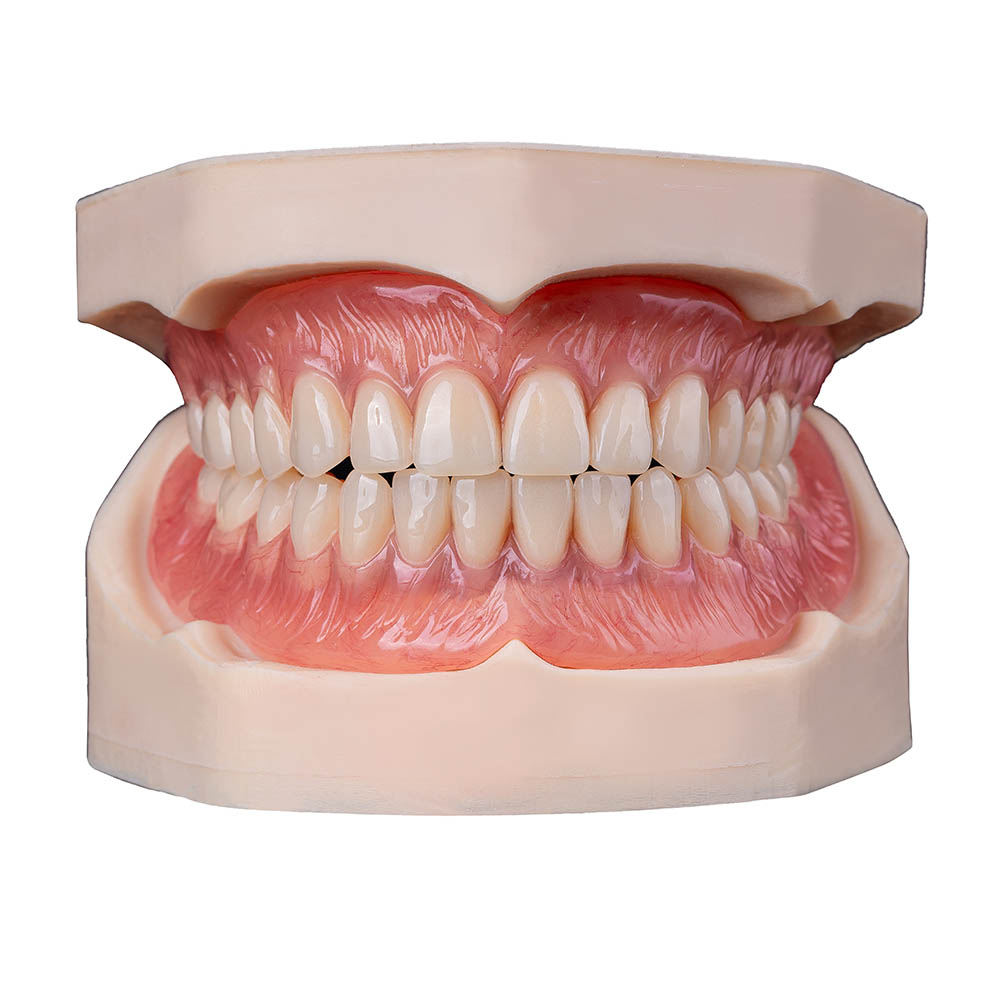
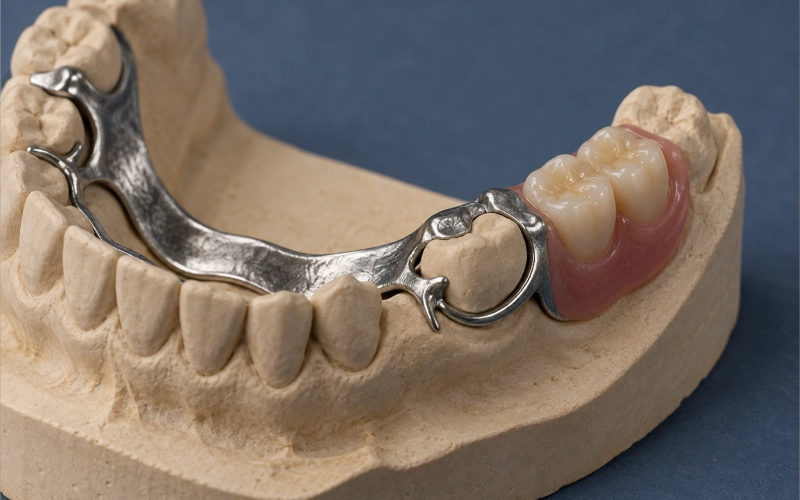
This flexible lower denture case study explores how ASD Dental Lab designed and fabricated a metal-free removable partial denture to replace four missing lower incisors. The case involved compromised periodontal support, thermoplastic resin fabrication, flexible clasp design, and fit verification according to the prescribing clinician’s requirements.
1. Patient Situation
A patient in their early 50s walked into the prescribing doctor’s clinic with a specific complaint: the four lower incisors were visibly missing, the gap was widening, and they were covering their mouth when they talked or laughed. The doctor had been seeing the patient for periodontal maintenance for about two years. The clinical picture, in the doctor’s own framing from the case notes:
- Periodontal history. Generalized chronic periodontitis, currently in maintenance after initial therapy. Probing depths in the lower anterior sextant were 4–6 mm, with localized bleeding on probing. The lower canines were Grade I mobile, the lateral incisors had already been lost, and the central incisors had been extracted in two separate visits over the previous eighteen months.
- The patient’s other teeth. Upper arch fully dentate, restored with zirconia + PFM work done by us previously (under a different matching case code). Posterior occlusion was stable; the patient had no TMJ complaints.
- Medical history. Non-smoker. No diabetes, no bisphosphonate use. Generally healthy. No drug allergies on file.
- What the patient said they wanted. Three things, in the patient’s own words during the consult, as the doctor recorded them: “I don’t want a denture that shows metal. I don’t want to walk around toothless while the long-term plan is being figured out. And I don’t want to do anything that makes the rest of my lower teeth worse.”
2. Doctor’s Lab-Slip Requirements
The prescribing doctor’s lab slip was unusually specific, because the case sat in a narrow window between two bigger treatment phases. We translated each requirement into a fabrication decision.
| # | What the doctor asked for | Why it was asked | How we read it for the bench |
| R1 | “No visible metal clasps, no metal framework” | Patient-facing aesthetics in the lower anterior zone | Lock the design to a metal-free, gum-colored thermoplastic clasp system |
| R2 | “Light contact on the remaining lower anteriors — they have reduced periodontal support” | Avoid overloading teeth that are already compromised | Set clasp engagement to light retention only, not full engagement; design must allow the appliance to “lift off” rather than torque the abutments |
| R3 | “The prosthesis must be replaceable in the future without re-impressing the whole arch” | The patient is heading toward an implant-supported solution; this case can be either transitional (a stepping stone to definitive care) or a long-term appliance, depending on how the case evolves on the clinical side | Build to a design that can be duplicated when the time comes — record scan data and bite, archive them with the case |
| R4 | “Match existing tooth shade and existing gingival shade” | Lower anterior teeth are on display when the patient smiles and talks | Cross-reference the existing tooth shade; specify shade-matched clasp tips; flag any shade-blending concerns back to the prescribing doctor before processing |
| R5 | “Document the materials used — brand, batch, origin” | The doctor wanted the lab to be transparent about what goes into the patient’s mouth | Plan to deliver a material traceability document with the case: resin brand, batch/lot number, country of origin, certificate of conformity |
| R6 | “Send me a digital preview before processing” | Doctor wants design sign-off, per our standard for complex RPDs — and consistent with the practitioner consensus captured in the review of complex removable partial denture workflows | Hold production at the wax/mock-up stage for written approval before injection |
These six lines on the lab slip are doing most of the work. They tell the technician what success looks like — and what counts as a failure.
3. Flexible Lower Denture Design and Fabrication
Here’s what actually happened on our bench, in the order it happened. We’ve pulled the procedural detail from our internal removable workflow, which lines up with the workflow steps documented in published practitioner-side and regulatory sources (the practitioner review of thermoplastic denture base resins y el PMC review of flexible thermoplastic denture base materials cover the same workflow steps at a reference level).
3.1 Case intake and data verification
The doctor sent us a digital intraoral scan (STL) of both arches plus a bite scan. We checked the scan inside one working day, per our standard turnaround — verifying margin continuity, occlusal relationship, scan coverage, and bite registration against the criteria documented in the review of flexible partial denture data workflows. The scan was acceptable; we did not need to ask for a rescan.
What the prescribing doctor’s lab slip didn’t include, we asked for: confirmation of which specific thermoplastic resin brand and grade they wanted us to use, and confirmation that the existing lower anteriors had been re-checked for mobility within the previous 30 days.
3.2 Design and doctor approval
Our CAD designer laid out the framework in Exocad, with the following constraints pulled directly from R1–R6:
- Clasp design: Full-coverage gum-colored thermoplastic clasp on the labial of the most distal remaining lower anterior on each side. No I-bar, no cast metal, no wrought wire.
- Major connector: Lingual bar, kept as low-profile as the lingual sulcus depth allowed.
- Teeth setup: Cross-referenced against the existing upper anterior for length, incisal edge position, and shade. Where the patient had photos of their own pre-treatment smile, we aligned to those rather than to a generic setup.
- Tissue surface: Full coverage over the edentulous lower anterior ridge, with relief noted in the design file at any undercuts.
We sent the design preview to the doctor, who approved it in writing the same day. Per our internal workflow, any case involving a complex RPD design — full-arch implants, long-span bridges, attachment cases, and complex partials — goes through mandatory design sign-off before production — and this case fell into the “complex partial” bucket.
3.3 Wax try-in (we held it)
We chose to do a wax try-in rather than go straight to injection, because the lower anterior aesthetic zone is unforgiving. The wax try-in lets the doctor verify three things in the patient’s mouth: shade match against the existing dentition, midline, and incisal edge position — all three of which line up with the practitioner-published denture try-in checklist captured in the review of thermoplastic denture base resins.
Doctor feedback after try-in: midline was on; incisal edge was 0.5 mm too long on tooth #41; shade matched. We adjusted the setup and got written approval to proceed.
3.4 Injection and processing
We injected the case in our removable department (Shenzhen). Process parameters we followed:
- Injection temperature: 550–560 °F (~287–293 °C), held for 15–20 minutes under pressure, then maintained under clamp pressure for 3–5 minutes.
- Cooling: Bench-cooled for 15–20 minutes. No quenching. Fast cooling of a thermoplastic appliance at this stage is a known cause of internal stress and warp — this point is consistent with the practitioner-published guidance in the review of thermoplastic denture base resins.
- Mechanical retention: Mechanical undercuts prepared at the tooth–base interface — we don’t rely on chemical bonding between the denture teeth and the flexible base, because the two material families don’t reliably bond that way.
For this particular case, the doctor didn’t specify the resin brand, so we used our default: a thermoplastic injection-grade base resin (Lucitone 199 or an equivalent imported high-grade denture base polymer per our published material menu) with a documented MSDS, manufactured to the requirements of ISO 20795-1:2013 (Dentistry — Base polymers for dentures), Type 3 (thermoplastic blank or powder). The resin is on the FDA list of base polymers recognized under 21 CFR 872.3760, which is the U.S. regulatory classification for denture base resin.
3.5 Quality control
Per our standard QC checklist for removable cases — which covers occlusion (centric / protrusive / lateral), arrangement, base extension, clasp fit, and polish — every check was completed and signed off internally before the case shipped. The five-check rubric is the same one we use on every denture case and matches the practitioner-published framework in the review of thermoplastic denture base resins.
For this case, we paid extra attention to:
- Clasp tip engagement — verified under 10× magnification that the clasp tips were passive on the abutments at rest and engaged only when the path of insertion was reversed.
- Tissue surface — checked for bubbles, voids, or steps that would create sore spots, following the inspection approach documented for thermoplastic denture bases in the PMC review of flexible thermoplastic denture base materials.
- Polish on the gingival surface — kept to a minimum, because over-polishing tissue-contacting surfaces can round off the borders and break the peripheral seal. This is consistent with the practitioner-published guidance on denture base inspection and finishing.
3.6 Documentation shipped with the case
Each removable case from our lab ships with a processing sheet. For this case the sheet included:
- Resin brand, lot number, country of origin, and certificate of conformity.
- Shade and mould of the denture teeth used.
- Date of injection, technician initials, and QC sign-off.
- A duplicate of the original lab slip, archived digitally under the case reference CS-FLD-01.
This is part of our traceability commitment for every case that leaves the lab — it matches what we describe to partner clinics on material documentation and case-by-case compliance records.
4. Final Outcome
The appliance seated passively on try-in at the clinic. The doctor confirmed:
- Aesthetics: No visible metal. Clasp tips blended with the gingival shade. Incisal edge position matched the existing upper anterior.
- Retention: Light — the patient could remove the appliance with one finger but it did not dislodge during speech.
- Comodidad: No pressure spots reported at the 24-hour follow-up.
- Function: Patient was able to eat soft foods; harder foods were not tested at this stage and were not promised. (Function on a transitional lower anterior appliance is realistic-but-limited — the published practitioner consensus on lower flexible partials, including the r/Dentistry discussion of how flexible lower dentures actually perform under chewing load, is that function is the constraint, not appearance.)
What we didn’t promise and want to be upfront about:
- This case was scoped as transitional or long-term — not as a fixed role. The patient is still in the periodontal/implant workup, so the appliance was built to be replaceable when the definitive prosthesis is ready. We archived all design and bite data under CS-FLD-01 to make that duplication straightforward. Whether the appliance functions long-term or only as a bridge to definitive care is a clinical decision that sits with the treating doctor; our role is to keep that door unlocked, not to lock it in either direction.
- The flexible base is not relineable in the way a heat-cured acrylic base is. Limited, localized repairs (a small crack, a single tooth reattachment) are workable in our hands using the same resin family and a controlled re-injection process — for context on the realistic scope of these repairs, the practitioner-published guidance is in “Flexible vs Acrylic: Repairability — What to Promise and What Not To”. What we don’t do is a full-base reline on this material; if the tissue surface stops fitting because of ridge resorption, the right answer is a remake, not a reline. (Whether a specific repair request can be accepted depends on the individual case — we confirm this on a case-by-case basis when a repair request comes in.)
- Long-term wear depends on the patient. Like any removable appliance, lifespan is tied to hygiene, parafunctional habits, ridge stability, and whether the abutment teeth stay stable. We don’t put a year count on a transitional or long-term case in writing.
5. Flexible Lower Denture Fit and Clinical Feedback
The appliance was fitted at the clinic two weeks after the design was approved. The doctor ran a standard insertion visit — tried the appliance in, checked the path of insertion, checked clasp tips with an explorer, checked centric and protrusive occlusion with articulating paper, and let the patient speak and drink water in the clinic for ten minutes before sending them home. The patient came back at 24 hours and again at one week. Here’s what came back from those visits, in their own words.
What the doctor told us
The clinical feedback came back to us through the case portal within 48 hours of the fitting. The doctor was specific about what worked and what needed watching.
What worked:
- Insertion path is clean. No rocking on seating. Clasps engaged the lower canines passively and released with a click on removal — exactly the “lift off, not torque” behavior we asked for.
- Occlusion checked with articulating paper — even contacts on the lower prosthetic teeth against the upper natural dentition, no premature contacts in centric, no interferences in protrusive or lateral. The patient closed into the correct bite without me having to adjust the prosthetic teeth at the chair.
- Aesthetics passed. The shade matched the existing upper anterior closely enough that, at conversational distance, the prosthetic teeth didn’t read as a separate block. The clasp tips blended into the gingival shade and weren’t visible during normal speech or a relaxed smile.
- Speech check passed at ten minutes in the waiting room — no lisping on sibilants, no complaint from the patient about the appliance “getting in the way of their tongue.”
What needed watching:
- Lower right canine is Grade I mobile, as documented. The clasp on that side is engaging lightly — within the design tolerance we agreed on — but I’m telling the patient that if mobility progresses to Grade II, the appliance will need to be re-evaluated, not just re-based.
- Patient reports “a little tightness” lingually on the lower left premolar region, near the connector. I’ll keep an eye on it at the one-week visit. If it’s still there, I’ll adjust the connector contour at the chair — that should be a minor adjustment, not a lab-side rework.
- Patient asked about eating an apple. I told them to cut it up, not bite into it. This is consistent with what we discussed before the case went to the lab — no promises about hard-food function.
The doctor’s overall note back to the lab:
“Case delivered to expectations and met the six lab-slip lines we set out. Patient walked out smiling. Lower left lingual tightness is the only thing I’ll watch; if it doesn’t resolve by the one-week visit, I’ll do a chair-side adjustment and report back. Thanks for flagging the mobility/regrade question during the design phase — that’s the kind of thing I want to know about before the case ships.”
What the patient said
The patient’s comments weren’t structured like a clinical note — they were the kind of thing the patient told the front desk, told the hygienist during the 24-hour cleaning check, and put in a short note back to the doctor at the one-week visit. We’re reproducing them in their own voice, lightly cleaned up for length, because they’re more useful than a star rating.
At the 24-hour visit :
“It’s weird how you forget you have it on. I kept poking at it with my tongue for the first hour, and then I stopped noticing. I ate scrambled eggs and pasta last night. Didn’t try anything crunchy — I’m not stupid, the doctor told me not to.”
At the one-week visit (in a short written note to the doctor, transcribed by the clinic and forwarded to us):
“Honestly, I forgot it was in my mouth at dinner on Sunday. The first morning I took it out to brush and I looked at it and thought, ‘oh, that’s the thing.’ I still don’t love taking it out in front of people — I do it in the bathroom at work — but I’m not covering my mouth when I laugh anymore. My sister didn’t even notice I had it until I told her. That’s the part that matters to me.
The thing the doctor said about not biting into apples — I’m fine with that. I didn’t have an apple bite before this and I don’t need one now.
The only thing I want to flag is the back left side. There’s a small spot on the inside of my lower teeth where it pushes a little. Not painful, just ‘aware of it.’ I told the doctor at the visit. He said he’d smooth it down.”
The clinic’s one-week check-in summary, sent back to us:
Patient comfortable. Lingual tightness on lower left premolar region adjusted at the chair; minor polish, no lab rework required. Patient eating soft-to-medium textures without complaint. Hard textures: not tested, not advised. Patient continues periodontal maintenance. No further adjustment scheduled at this time. Case logged under CS-FLD-01.
What we did with the feedback
The lingual tightness on the lower left was within the kind of adjustment the doctor and we expected at try-in, and it was handled chair-side by the prescribing doctor with a minor polish — no lab-side rework, no new case opened. We updated the digital record under CS-FLD-01 with the feedback notes, the one-week adjustment, and the doctor’s net assessment. The scan data, bite registration, and design files stay archived in case the case needs to be remade at any point in the next 24 months.
The clinical decision about whether this appliance functions long-term or transitions to an implant-supported prosthesis stays exactly where it belongs: with the doctor and the patient, at the next periodontal review.
6. How to Order a Flexible Lower Partial Denture
If a similar case came in, the things that made this one go smoothly were:
- A clear written lab slip with the six lines above, instead of a verbal “make me a flexible lower partial.”
- A digital scan rather than a physical impression — scanning lets us archive the data and reproduce the case later without re-impressing.
- Wax try-in approved in writing, not verbal.
- Material brand specified up-front, or the doctor telling us to use our default (which is what happened here).
If you’re working up a similar case and want to talk through the lab-slip details before sending the case in, drop us a note through your ASD account manager and we’ll work through the design constraints with you.
Appendix — Materials and Regulatory References
This case was processed under the following material and regulatory framework. The links below are the authoritative sources we used to verify each point — they’re included so the prescribing doctor can independently confirm the regulatory and material basis.
| Tema | Reference |
| Resin base polymer standard | ISO 20795-1:2013 — Dentistry — Base polymers for dentures, Type 3 (thermoplastic blank or powder) |
| U.S. regulatory classification | FDA 21 CFR 872.3760 — Denture base resin, Class II, product code EBI |
| FDA guidance on denture base resins | FDA Guidance: Use of ISO 20795-1 in U.S. Premarket Submissions (PDF) |
| Practitioner-side review of thermoplastic denture base resins | PMC: Flexible Thermoplastic Denture Base Materials for RPD Framework |
| Patient satisfaction and clinical performance comparison | MDPI Prosthesis: Thermoplastic Denture Base Materials Review |
| Realistic scope of flexible partial repair | Associated Dental Lab: Flexible vs Acrylic Repairability |
This case study is published by ASD Dental Lab, a full-service dental laboratory with manufacturing facilities in Shenzhen and Huizhou, China. Founded in 2012, ASD operates a 460-person in-house production team across CAD design, milling, implant, ceramic and metal, and a 55-person removable denture department. Monthly removable denture throughput: approximately 4,000 cases in normal season and 6,500 in peak season, all processed in-house without third-party outsourcing. The case study above is anonymized — no patient, doctor, or clinic is identified. Specific material brand and pricing are not disclosed on this page.
Reduzca los plazos de entrega gracias a nuestra tecnología de vanguardia
Recomendado