Implant-Retained Overdenture for Seniors: A Lab Case
🕢 [ ¡Rellene el formulario y le responderemos en 30 minutos! ]
How we built a removable two-implant lower restoration for a patient who could no longer use a failing denture
This case applies to dental implants for seniors and pensioners — patients whose budget, medical history, bone volume, and long-term maintenance needs rule out fixed full-arch options but who need something more functional than a conventional denture.
The patient’s situation
The patient had lost the remaining lower teeth over several years to periodontal disease, not in a single event. They’d been wearing a removable complete denture. That denture failed twice. The second time, it fractured during a family meal and a tooth came out with it — the patient was in enough discomfort, and unable to chew effectively enough, that the meal was abandoned .
About eighteen months earlier, the patient had a cerebrovascular event (stroke). Function returned, but the patient was clear: they did not want to go through invasive surgery . Income was limited, and the implant options proposed to them were priced beyond what they could consider. Two consultations had produced two different recommendations, and both argued the patient away from what they originally asked about .
The patient’s age: 67. They mentioned it themselves as part of why they were looking at less invasive options . They were also on oral bisphosphonate therapy for osteoporosis, which lengthened the expected integration timeline . Bone volume in the lower jaw had already resorbed significantly [[31]].
An adult child living in another state was handling the coordination and payments. The patient agreed with what the doctor told them but didn’t fully grasp the details — a dynamic that’s common when family members are navigating care from a distance .
Why this restoration, and why not the others
Here’s what got ruled out, and why.
| What we considered | Why it didn’t fit this case |
| Mini implants as primary support | Smaller diameter means less surface area in contact with bone. Implant survival correlates with surface area . One practitioner put it bluntly: “Mini implants are garbage and I wouldn’t wish them on my worst enemy” [[A10]]. For a single-tooth replacement in dense bone, maybe. As the foundation for a full arch in a patient who’s already lost ridge volume? Wrong load, wrong component. |
| Fixed full-arch (All-on-4 or similar) | More expensive — tens of thousands . Requires a larger surgical commitment, which the patient’s stroke history made unattractive . Fixed full-arch prostheses have undersides and connector regions that are hard to clean [[38]], a real problem for someone whose dexterity or ability to attend maintenance appointments may decline over time. That last point is the one that’s usually left out of the sales conversation, and it’s the one that decided this. |
| Continue with a traditional complete denture | It had already failed twice . The second failure happened during a meal and left the patient unable to chew. Retention, chewing force, comfort, and quality of life all favor an overdenture over a conventional denture [[42]]. |
| Fixed bridge | The patient had lost the entire arch. There were no adjacent teeth to serve as abutments. This option wasn’t on the table [[2]]. |
| Graft the ridge and place a standard fixed restoration | Contradicted three constraints: the patient’s reluctance to undergo invasive surgery , the cost , and the bisphosphona therapy [[18]]. Grafting adds healing time, expense, and surgical complications [[32]]. For older or medically complex patients, a shorter, less invasive plan may be preferable even if it provides fewer teeth or a removable prosthesis [[38]]. |
| ✅ Two standard-diameter implants supporting a removable overdenture | Cheaper than a fixed full-arch . Less surgery . The prosthesis can be lifted off and cleaned by the patient or a caregiver [[3]][[38]]. A removable two-implant overdenture may be more maintainable than a fixed full-arch bridge for some patients, despite offering less “fixed” function [[38]]. |
What the prescribing clinician asked us to build
The design brief we received set out six requirements. Each one existed because of something specific in this patient’s history.
1. Make it removable, and support it on standard-diameter implants where the anatomy allows
The lower prosthesis was to be an implant-retained overdenture, not a fixed full-arch. Removability is not a downgrade here; it’s the feature that makes daily cleaning possible for someone who may later depend on a caregiver [[3]][[38]].
Where the ridge anatomy allows, the clinician wanted standard-diameter implants rather than minis. Surface area matters . The two-implant overdenture design is the most common approach for the lower arch [[3]].
2. Do not use mini implants as the primary support
If a narrow implant is needed anywhere, it’s auxiliary and should be identified as such. Randomized trials have reported survival rates of roughly 89–98% for mini implants versus 99–100% for standard-diameter implants [[35]]. The smaller the diameter, the less forgiving the bone needs to be.
3. Design the prosthesis to be cleaned
Tissue surfaces must be reachable. Dead ends must be avoided. The attachment system should be as simple as the retention requirement allows. The prosthesis should be designed for access with interdental brushes or specialized floss, removal by the dentist when needed, simple attachments, caregiver access, and fewer difficult-to-clean surfaces [[38]][[39]].
Where a caregiver will be doing the cleaning, the prosthesis must be removable by them without a chairside appointment.
4. Use replaceable attachments, and leave a service path
Retention components wear. Mechanical complications reported in the literature include loss of retention, attachment wear, and difficulty repairing a full-arch prosthesis [[60]]. A prosthesis that cannot be re-serviced cheaply becomes a prosthesis that gets abandoned.
5. Keep the surgical envelope small
Rather than extending grafting to buy room for a fixed restoration, use short or narrow-diameter implants where the ridge is deficient, and let the denture base extend to compensate for the resorbed ridge. Short implants (less than 8 mm) are an established option [[33]]. Grafting adds time, cost, and complication [[32]].
Fewer, less invasive procedures matter more than a more fixed-feeling result for this patient [[38]].
6. Control the occlusion against the opposing prosthesis
With an opposing complete denture, the occlusion was specified as balanced, with lateral forces controlled. Peri-implant bone loss can be caused or worsened by unfavorable loading [[60]]. The goal was to distribute load rather than concentrate it at the implant sites.
One further constraint sat outside the prosthesis itself: the definitive restoration was not to be fabricated or seated until osseointegration was confirmed. The interim removable prosthesis was not to load the healing sites [[2]][[54]]. In this case, the interim period was expected to run longer than the usual three to six months, and the patient had already lost one interim denture.
How we built it
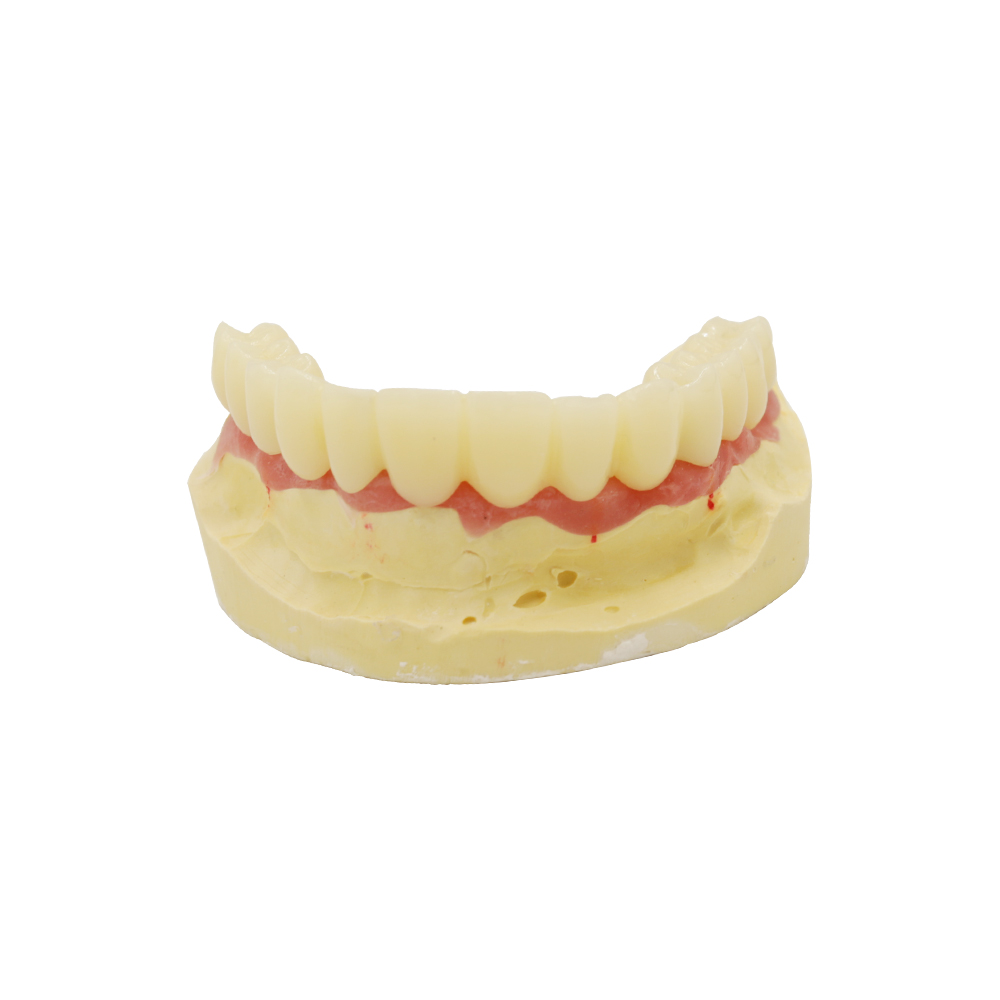
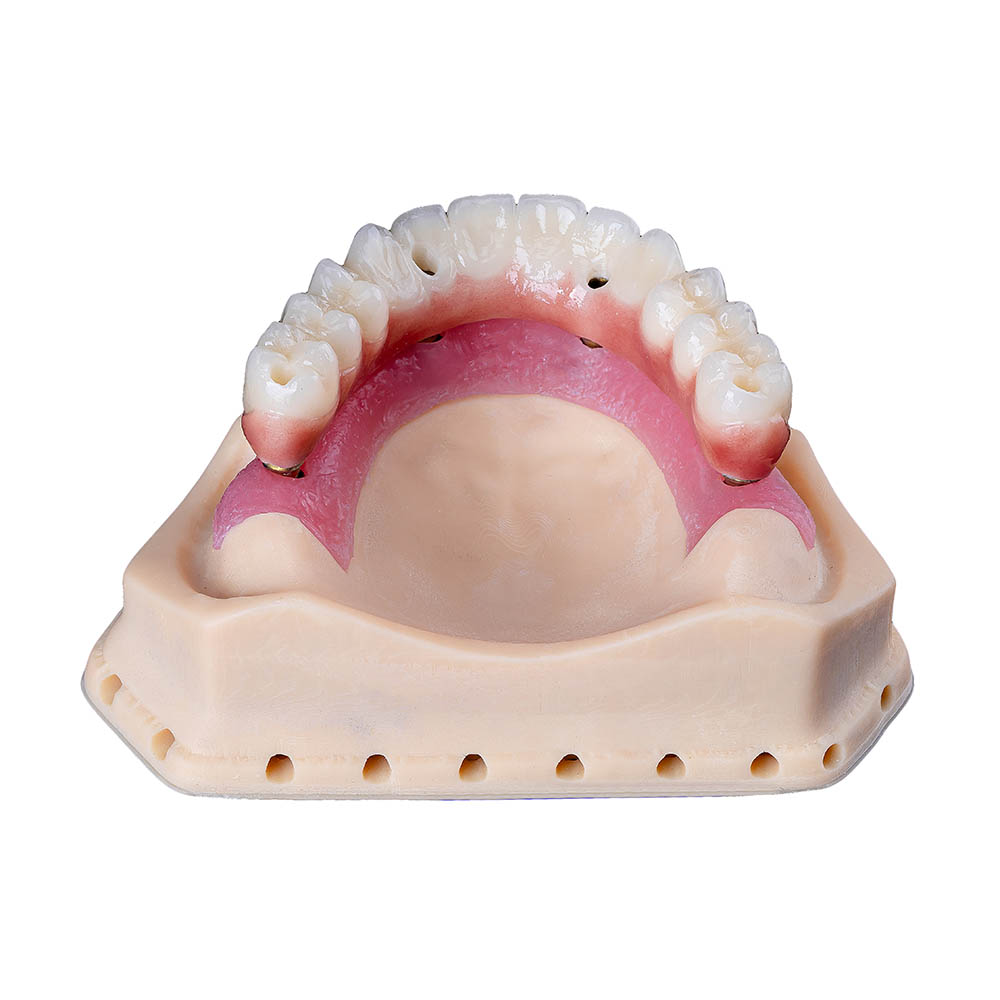
At ASD Dental Lab, we handle the complete workflow for implant-retained overdentures internally. No outsourcing. The case moves through our facility — from case data evaluation and CAD design, through 3D model printing, milling, processing, finishing, and quality inspection, to packaging and shipment.
For this case, that workflow meant:
- Receiving the prescription, implant positions, and the patient’s functional requirements
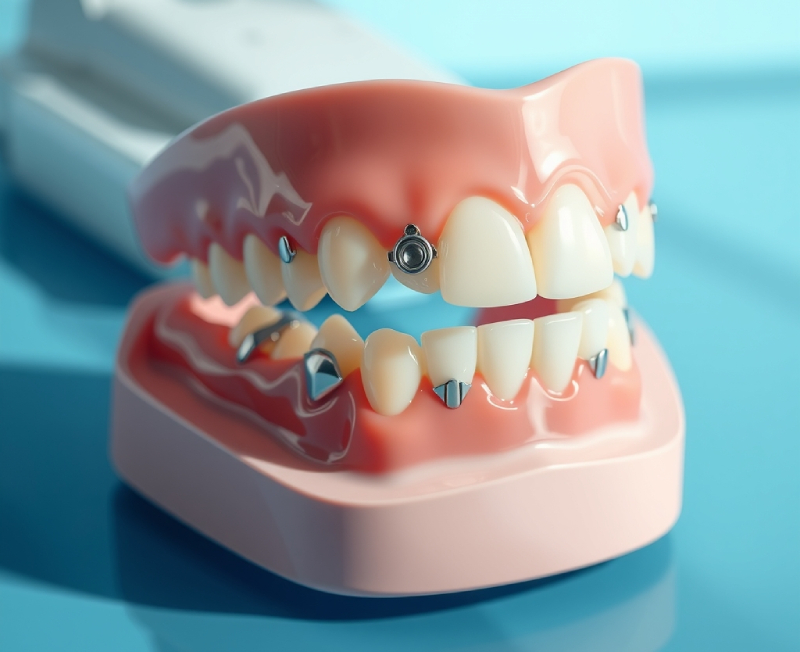
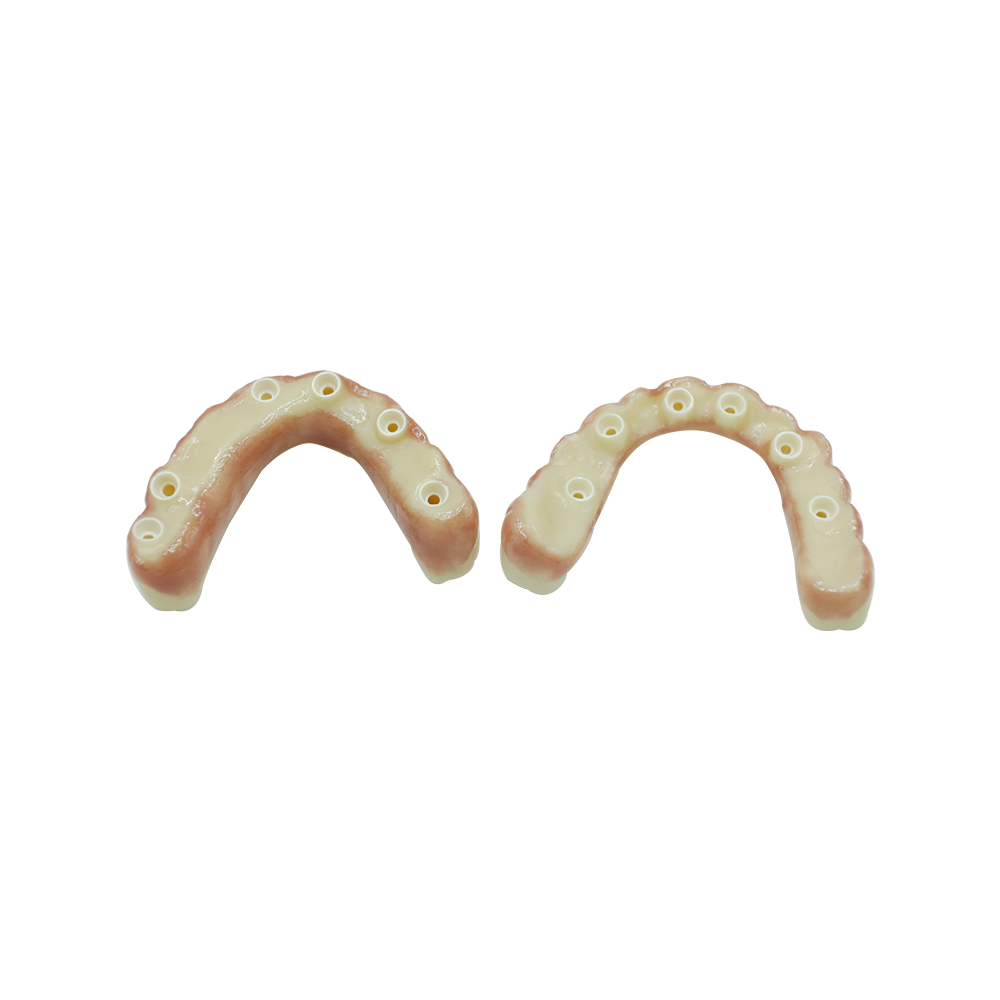
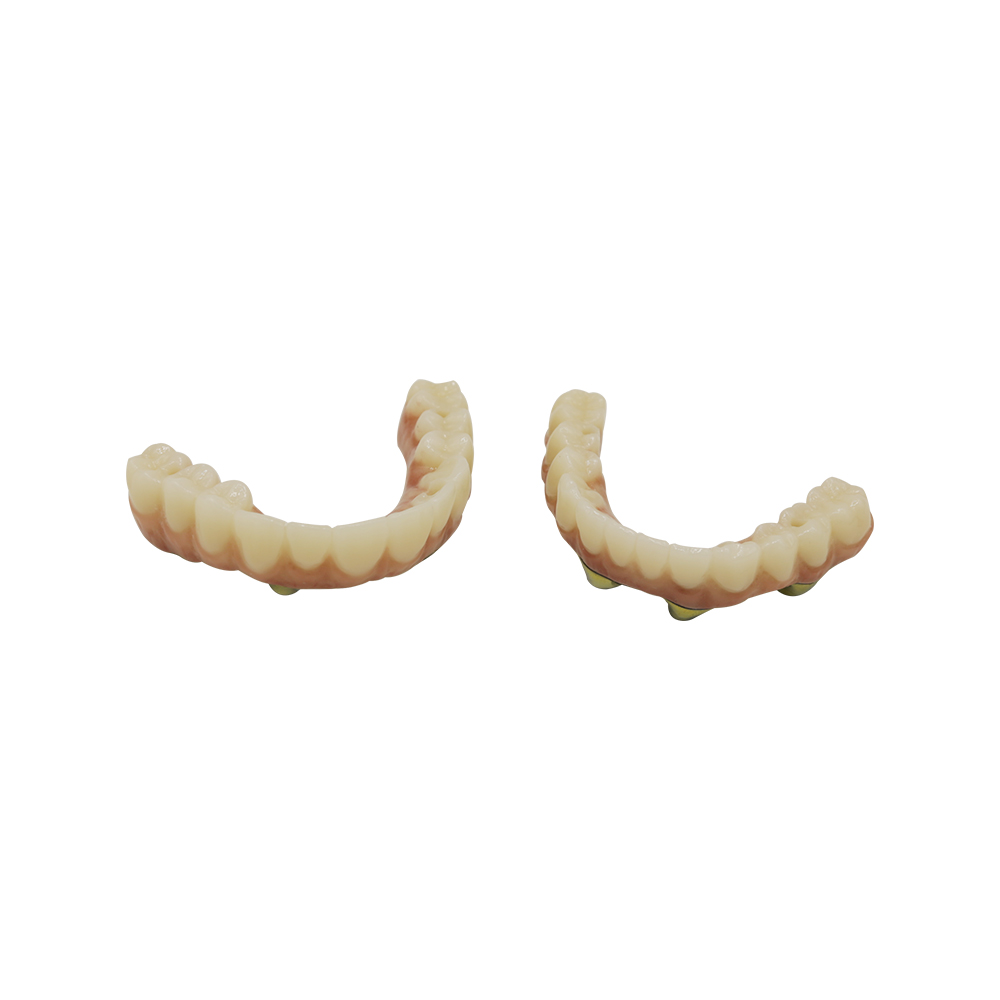
- Digital design of the overdenture with replaceable ball attachments fitted to the implant abutments
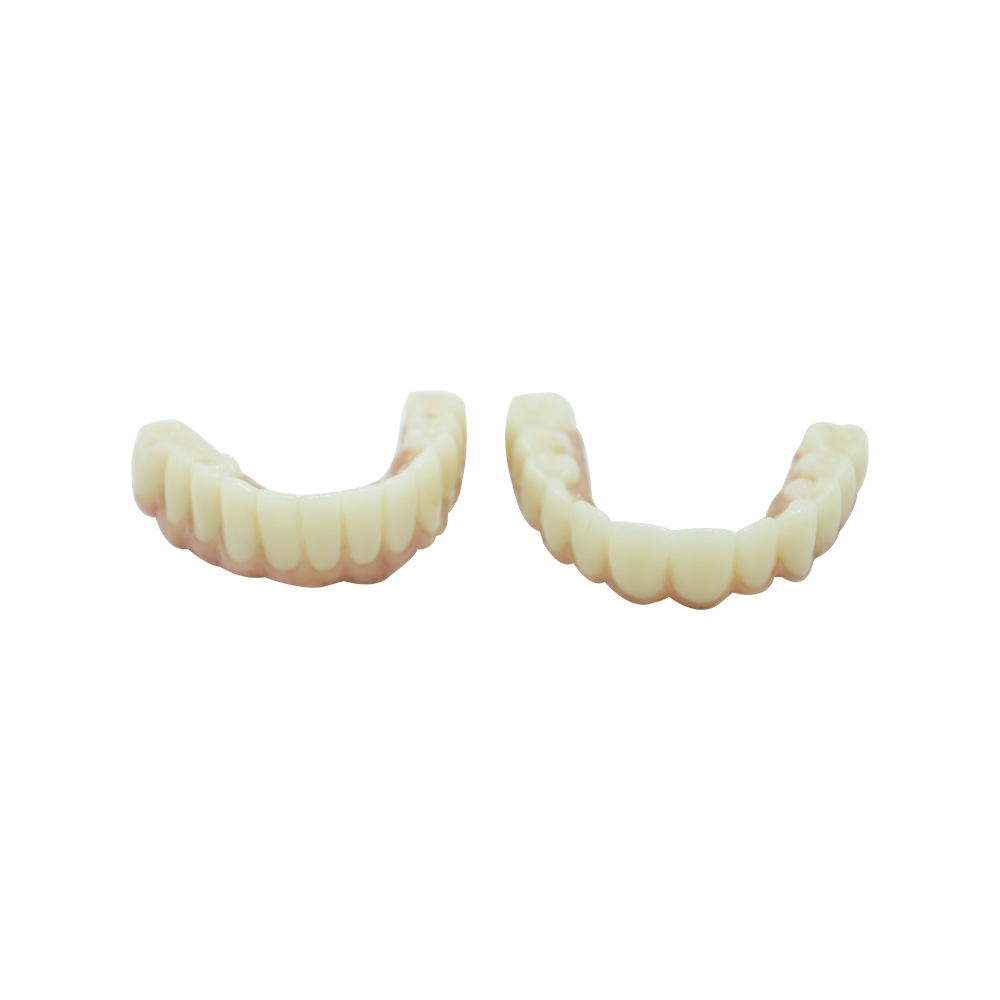
- Milling the denture base from a pre-tinted acrylic disc (for strength and color stability)
- Arranging the denture teeth and processing the denture
- Hand-finishing the tissue surface and polishing the fit surface
- Verifying retention, occlusion, and attachment seating on the working model
- Final inspection before release
Turnaround: from receipt of work authorization to shipment was 7–10 business days. For standard two-implant overdentures during normal production periods, expect the same 7–10 day window.
Verification: Every case leaves the bench only after our three-stage quality control process is complete: ① incoming data and prescription review; ② in-process inspection; ③ final inspection by an independent QC technician who is not involved in fabrication. For an overdenture, that final checklist includes attachment seating, occlusal balance, denture tooth positioning, tissue surface anatomy, and polish quality.
Remake policy: The majority of remakes are provided at no charge. If the prosthesis doesn’t fit the model or fails to meet the confirmed prescription, we remake it automatically. If the issue arises from a change in the case requirements after fabrication has started, or from unclear model conditions that were flagged in advance and the clinician asked us to proceed anyway, adjustments may be billable per our standard service agreement.
What we delivered
| Component | Notas |
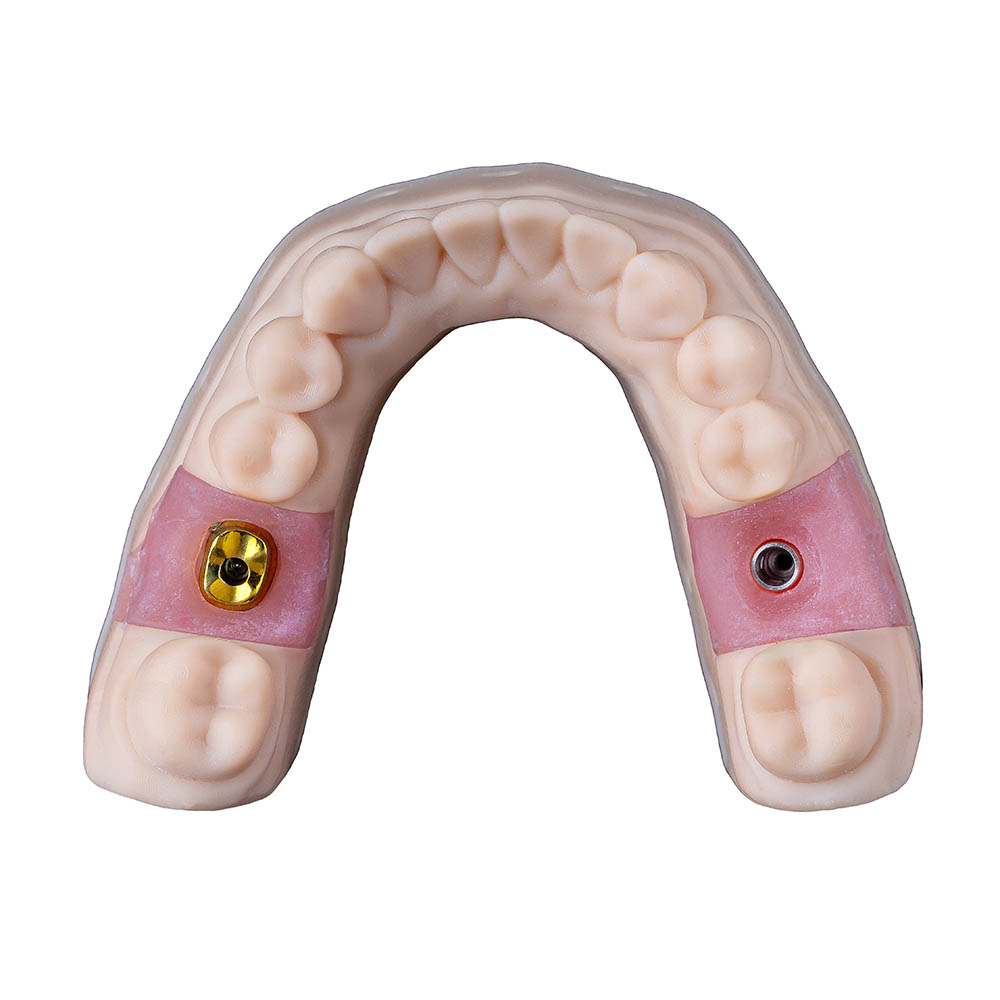
| Lower implant-retained overdenture | Acrylic base with denture teeth, designed for two standard-diameter implants. Tissue surface contoured for comfort and hygiene access. |
| Replaceable ball attachments | Pre-installed and verified on the working model. Retention adjustable chairside. Replacement components available. |
| Interim (healing) denture | A separate removable prosthesis for the osseointegration period. Does not load the healing sites. |
| Component traceability | We return each case with brand, origin, and lot numbers for the attachment components used, along with material certificates on request — so any future clinician can identify exactly what’s in the patient’s mouth. |
| Maintenance guidance | Recommended recall interval is patient-specific — there’s no universal standard [[40]][[41]]. For patients on bisphosphonates, with limited manual dexterity, or with cognitive changes, more frequent monitoring may be appropriate. |
Why this case applies to dental implants for pensioners and older adults
The constraints that shaped this case — limited budget, reluctance to undergo extensive surgery, existing bone loss, systemic medications, the need for a prosthesis that a caregiver can clean, and a history of failed conventional dentures — are common among older patients.
The two-implant overdenture is often the first recommendation for edentulous mandibles in this age group [[3]]. It balances retention and function with surgical simplicity and cost. For pensioners who have been told they’re “too old” for implants , this case shows that age is not the deciding factor — bone quality, medical history, and the ability to maintain the restoration are what matter.
This is also a case where the removable design was chosen deliberately, not as a fallback. Fixed full-arch restorations can have undersides and connector areas that are difficult to clean [[38]]. For someone whose manual dexterity or cognitive function may decline, a prosthesis that can be lifted off and cleaned by a family member or caregiver is the more maintainable choice.
Why this case belongs on a lab’s site
First, because the technical chain that makes this prosthesis work — work authorization, attachment selection, passive fit verification, emergence profile, screw access, and component traceability — is entirely absent from the patient-facing content that ranks for “dental implants for seniors.” That’s lab territory, and no one else is writing it.
Second, because the AI-generated answers and clinic websites that dominate the first page for this keyword focus on cost, age limits, and Medicare coverage. None of them address the design constraints that a prescribing clinician actually needs answered: what happens when the patient can’t afford a fixed full-arch, when the bone has already resorbed, when the patient is on bisphosphonates, and when a caregiver will be doing the cleaning?
This case answers those questions.
Third, because a lab case page built from real work authorization constraints has something no patient-education article can offer: the experience layer. Experience isn’t writing “you should” — it’s writing “we ruled out X, Y, and Z for reasons A, B, and C, and here’s what we built instead.”
Referencias
Research literature cited in this case ([[n]] markers):
- [2] American Dental Association — Implant restoration planning
- [3] PMC — Two-implant overdenture for the edentulous mandible
- [9] PubMed — Implant outcomes in older adults
- [11] PMC — Long-term implant survival and risk factors
- [18] American Dental Association — Osteoporosis medications and dental care
- [31] PMC — Edentulous ridge bone volume on CBCT
- [32] PMC — Bone grafting: time, cost, and complications
- [33] Springer — Short dental implants (<8 mm)
- [35] PMC — Mini vs standard-diameter implants: randomized trial outcomes
- [38] Wiley — Maintenance considerations for implant overdentures
- [39] PMC — Hygiene access and attachment design
- [40] PMC — Recall interval evidence for implant patients
- [41] PMC — Maintenance protocols and peri-implant health
- [42] PubMed — Overdenture vs conventional denture: functional outcomes
- [45] HealthInsurance.org — Dental implant coverage
- [46] Dental Roundup — Implant cost guide
- [47] Real Dental Costs — Implant pricing breakdown
- [54] Spear Education — Loading protocols for dental implants
- [60] PubMed — Mechanical complications of implant prostheses