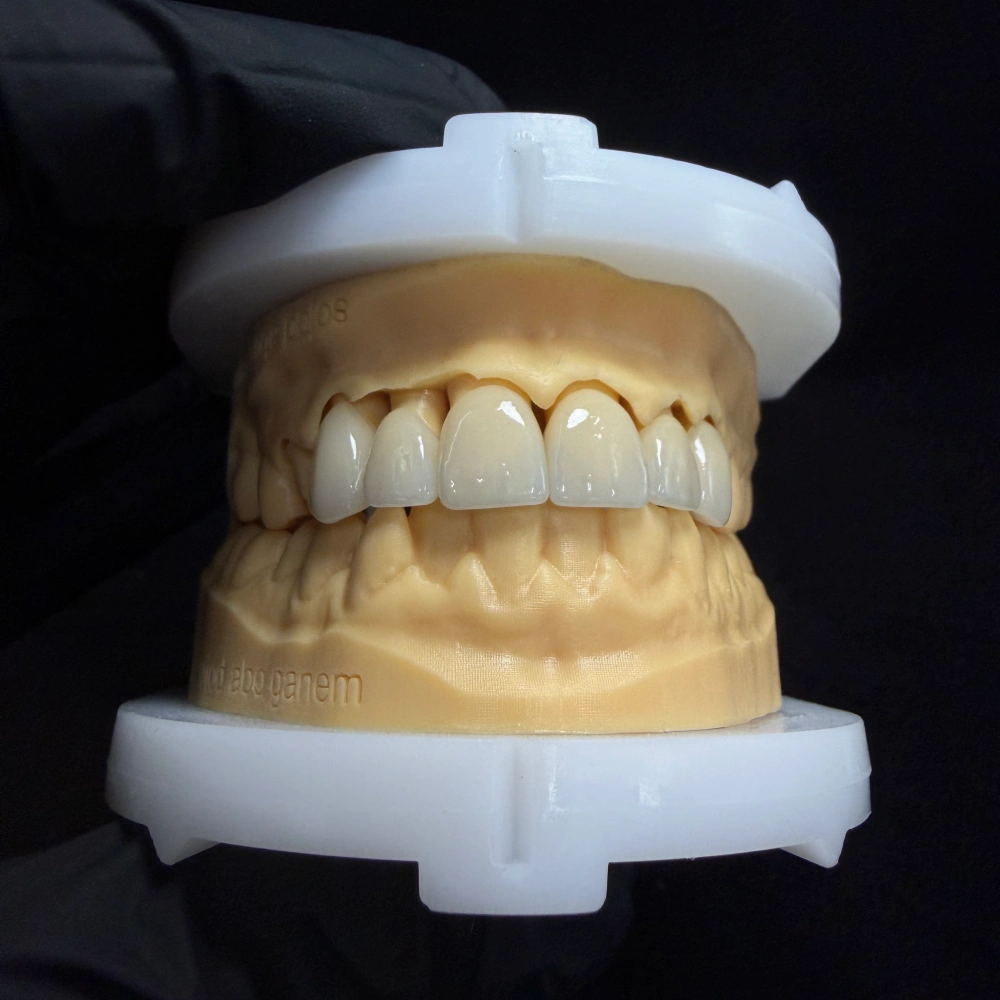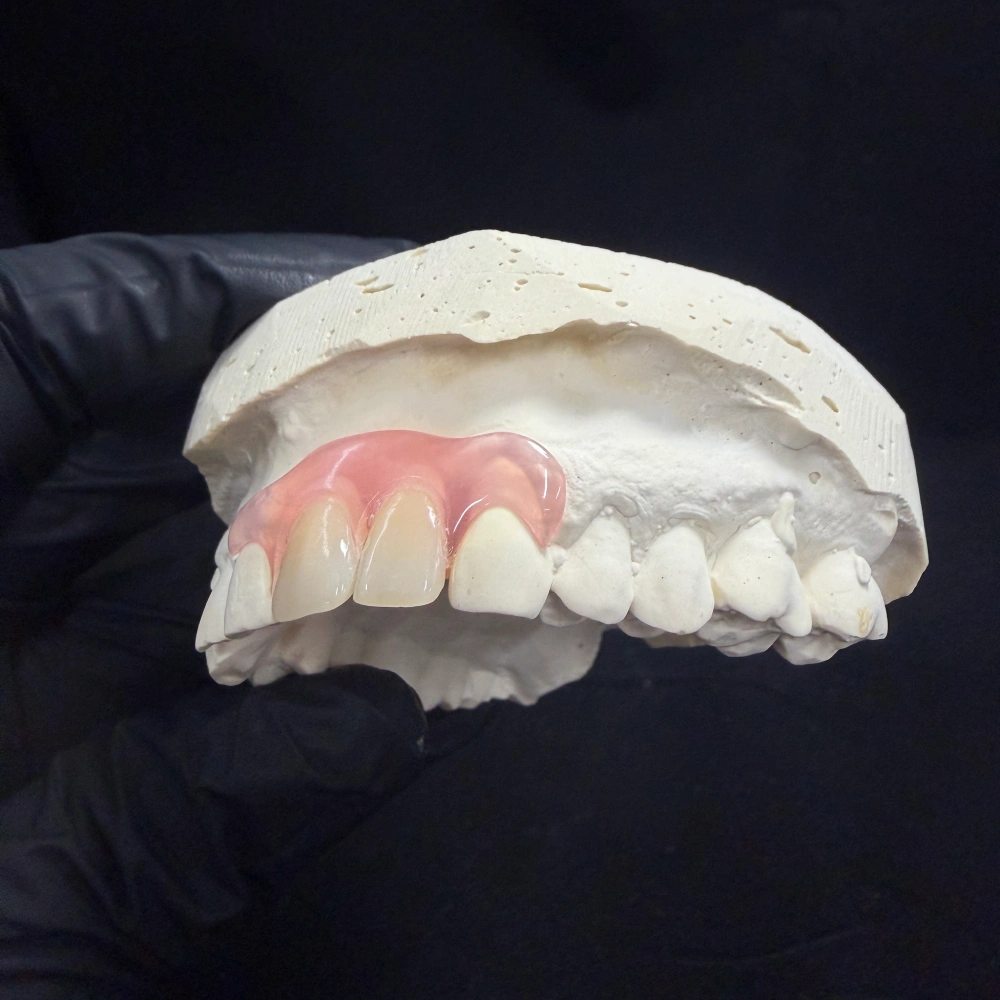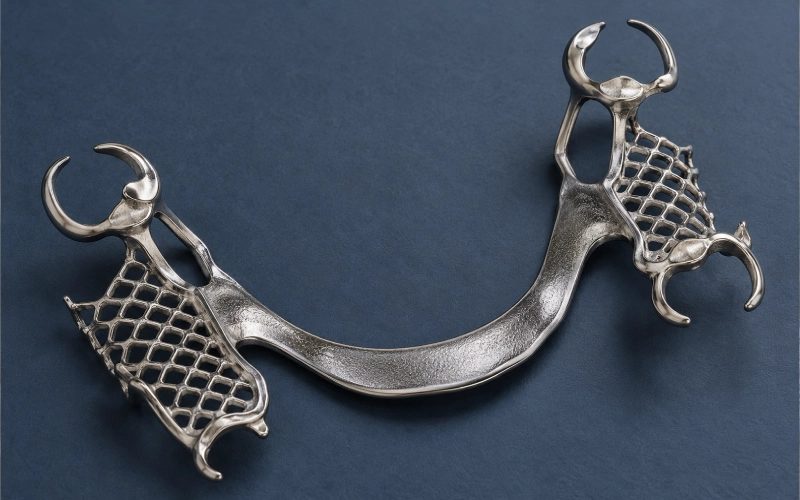
Screw Retained Implant Crown


A screw retained implant crown is a single-tooth implant restoration that fastens to the implant fixture with a screw, not cement. The access channel comes through the occlusal or lingual surface and is sealed after torque is confirmed. The prosthesis stays retrievable — you can remove it without cutting the restoration.
This page covers the three construction types and four material options we offer: screw retained zirconia implant crown (monolithic, multilayer, or layered), screw retained PFM implant crown, plus titanium and cobalt-chromium variants. You will also find the technical parameters, required case files, turnaround time, and quality documentation that apply to every screw retained implant crown we ship.
We run an ISO 13485 quality system, hold FDA establishment registration on file, and comply with EU MDR Annex XIII for custom-made devices. Batch-level material traceability is available on request.
Screw Retained Implant Crown Features
A screw retained implant crown isn’t one product. It’s a family of constructions, each with its own tradeoff in retrievability, esthetics, marginal fit, and cost. Here are the three we build every day, plus the materials we run them in.
Screw-Retained Crown Construction Options
| Construction | What it is | Use when | Don’t use it when |
| One-piece custom-milled (Ti or Co-Cr abutment + crown as a single block) | The abutment and crown are milled from one blank and joined permanently — no Ti-base interface, no cement interface at the implant level | Posterior zones, limited inter-arch space, when the screw channel would land on the facial | Thin gingival biotype with high esthetic demand (the abutment-crown junction is harder to hide) |
| Ti-base hybrid (Ti-base + bonded zirconia or lithium-disilicate crown) | A titanium base engages the implant; the crown is cemented to the Ti-base on the bench, not in the mouth. The Ti-base + crown assembly is then screw retained to the fixture | Most anterior and esthetic cases, when you want a separate emergence profile and a retrievable crown | When the angulation correction exceeds ~25° (Ti-base won’t fix a badly placed implant) |
| Angulated screw channel (ASC) | A screw channel exits through a non-axial direction (commonly lingual or buccal-incisal), bypassing esthetic or occlusal conflicts | Anterior maxilla where a straight channel would exit through the facial, or when a Ti-base hybrid is the construction but the access hole would still land on the labial | When the channel length after angulation crosses the manufacturer’s specs — confirm with the implant IFU |
The Ti-base and ASC options both still count as “screw retained” because the prosthesis-to-implant joint is a screw, not cement. The cement that does exist in those workflows sits between the Ti-base and the crown, on the lab bench, with the crown held in a vise — nothing gets cemented in the patient’s mouth.
Zirconia, PFM and Other Crown Materials
| Material | Construction fit | Why we’d pick it | Why we’d pass on it |
| Monolithic zirconia (3Y-TZP) | One-piece, Ti-base hybrid, ASC | High strength (>1,000 MPa flexural), conservative prep, handles thin walls down to ~0.5 mm | Anterior esthetics where translucency matters more than strength |
| Layered zirconia (multi-layer or hand-built porcelain over zirconia coping) | Ti-base hybrid, ASC | Better esthetics in the esthetic zone, especially for single central incisors | Thin walls under 0.4 mm or when opposing dentition is also full-ceramic |
| Lithium disilicate (e.max) | Ti-base hybrid only (not one-piece on implant) | Highest translucency for high-demand anterior cases | Posterior molar zone under heavy occlusal load; screw-channel fracture risk on thin sections |
| Cast noble / base-metal PFM | One-piece with metal abutment + porcelain-fused crown | Deep bite / heavy occlusal load, cost-sensitive posterior, when a metal margin is acceptable | Thin biotype with metal show-through risk, or when patient has a documented noble-metal allergy |
For a full material-side walkthrough — when PFM still beats zirconia, when to choose layered vs monolithic, what we charge for which — the material section below has the detail.
Hard numbers that actually matter
- Minimum restorative space: 7.0 mm occlusal-cervical for a Ti-base hybrid; 4.5 mm for a one-piece milled abutment-crown. Less than that, and you’ll fight screw seat, screw head, and cement space all at once.
- Ti-base gingival height: 0.5 / 1.0 / 2.0 / 3.0 mm depending on tissue depth. We pick based on the sulcus measurement you send with the scan.
- Wall thickness: 0.5 mm minimum for monolithic zirconia, 1.0 mm minimum for lithium disilicate in the screw-channel zone, 0.3 mm metal coping minimum for PFM.
- Screw channel diameter: 2.0–2.4 mm depending on the implant system and screw size; we always honor the manufacturer’s spec.
- Sealing: We always place PTFE tape + composite or compomer over the screw head. We do not use cotton pellets or gutta-percha as the long-term seal — both absorb fluid over time.
- Torque: Torque values follow the implant manufacturer’s IFU, not the lab’s preference. Send us the IFU PDF if your system isn’t in our reference set and we’ll print it on the case card.
Why Choose This Product
Screw retention removes cement from the implant interface and keeps the prosthesis removable. Here are the specifications, documentation, and policies that apply to every screw retained implant crown we build.
Hard numbers we commit to
- Minimum inter-arch space: 6.0 mm (call us before scanning if tighter)
- Ti-base gingival height options: 0.5 / 1.0 / 1.5 / 2.0 / 3.0 / 4.0 mm (six heights in stock)
- Minimum wall thickness: 0.5 mm (zirconia), 0.3 mm (Ti / Co-Cr)
- Screw channel diameter: follows implant IFU for chosen system
- Passive fit verification: every unit checked on analog before sintering/casting
- Torque spec: follows implant manufacturer’s IFU, not lab preference
Documentation with each case
- Build sheet: material batch, lot, sintering or casting cycle log
- Design screenshot for approval before milling (free revision at this step)
- IFU torque value printed on packaging label
- Material certificate (brand, batch, origin) on request
- Sterilization and packaging: MDR Annex XIII for custom-made devices
Quality and regulatory standing
- ISO 13485 quality system on file
- FDA establishment registration (site-level, not per-product approval)
- MHRA registration on file
- EU MDR Annex XIII compliance for custom-made devices
- Batch-level traceability: technician, mill, furnace, material lot — available for any case within three months standard, extendable on request
Remake policy
Free remake on fit, occlusion, contour, or shade. Shipping and implant-system components (Ti-base, MUA, screws) are excluded — those are OEM pass-through parts billed at cost. Coverage is case-by-case; we ask for photos and torque log when a screw fails to rule out under-torque or mixed-component mismatch.
Turnaround time
- Routine single-unit crown: 2–3 working days from complete file
- Complex implant cases (ASC, MUA, immediate-load provisional): 5–7 working days
Screw Retained Implant Crown Manufacturing Process
Every step is logged to the case file — material lot, technician, equipment, QC sign-off. If something goes wrong, we trace it back to the run, not to “the lab.”
1. Intake + file check
For a screw retained single unit we need: intraoral scan with a scanbody on the implant, opposing arch, bite, implant packaging label (or photo of it), shade, and three photos (frontal smile, occlusal, shade tab). Incomplete files get pinged back within one business day.
2. Implant system identification
Brand, platform (NP / SP / WP), connection, and diameter identified from the packaging label or scanbody scan. OEM-stocked systems proceed directly; verified-compatible third-party systems proceed with a tolerance note; unknown systems require the IFU.
3. Design — Ti-base, ASC, or one-piece
Construction is selected based on angulation, tissue depth, esthetic demand, and restorative space. You receive a design-confirmation view (occlusal, buccal, lingual, cross-section, screw-hole position, occlusal contact map) before we cut anything. This is the cheapest moment to fix something.
4. Milling
Pre-sintered zirconia: dry milling on 5-axis. Lithium disilicate: wet milling. Co-Cr and titanium: dry with dedicated cutter paths. Cutter wear tracked per case.
5. Sintering (zirconia only)
Each furnace run is locked to a program, carries a temperature-field calibration check, logs the curve, and runs a test-piece sinter before patient cases touch it. Shrinkage is compensated by the blank manufacturer’s enlargement factor plus a per-batch offset measured against a standard test block. No crown ships without verification against its batch test block.
6. Fitting + interface QC
Ti-base or custom abutment seated on a calibrated analog — passive fit, no rock, no lift. Screw channel checked for correct driver geometry. Ti-base + crown cement interface (for hybrid workflows) inspected under magnification; excess removed before the case leaves the bench.
7. Final QC + finishing
Margin integrity, contact points, occlusal contacts, polish/glaze state, and a final torque dry-run on the analog. Anything that doesn’t pass is reworked or remade.
8. Documentation + shipping
Case ships with batch record (material lot, screw lot, Ti-base lot, technician, equipment, QC sign-off). Per-case certificate of conformity available on request.
Cooperation Workflow
Step 1 — Send a case
Send the scan, implant label, bite, photos, and prescription through your scanner portal or to ASD. Receipt confirmed same business day.
Step 2 — Quote + timeline confirmation
Stocked-system quote within 24 hours. Lead time confirmed (2–3 working days routine / 5–7 working days complex). Slot locked on your acceptance.
Step 3 — Design review
You receive the design-confirmation view (occlusal, buccal, lingual, cross-section, screw-hole position, occlusal contact map). Sign-off or redesign request before production.
Step 4 — Production + in-process QC
Manufacturing follows the path above. In-process checks at every step that can fail silently. Issues are caught before they leave the department.
Step 5 — Final QC + delivery
Final QC against prescription and design sign-off. Pack with batch record, ship. Tracking forwarded when the box leaves.
Step 6 — After delivery + remake policy
Manufacturing-defect remake (material defect, marginal gap, screw-seat tolerance, porcelain fracture under normal occlusion) is free. Shipping on first remake is covered; subsequent freight is case-by-case. Implant components (Ti-base, screw, analog, scanbody) are billed separately at cost. For screw loosening or fracture, send photos and torque log so we can rule out under-torque, mixed-component mismatch, or worn interfaces before cutting a new crown.
Implant Systems We Work With
We stock OEM Ti-bases, screws, and scanbodies for the major implant brands. For verified-compatible third-party components, tolerance and warranty terms differ from OEM — flagged at quote time. Clinician-supplied Ti-base or screw accepted on request; send the manufacturer’s spec sheet and torque value at intake.
Stocked systems: Straumann, Nobel Biocare, Dentsply Sirona (Astra Tech, Xive), BioHorizons, Zimmer Biomet, MIS, Neodent, Bego, Medentika, and most current systems with published library files.
Torque and driver notes: Screw geometry and torque are not interchangeable across systems. Every case card is labeled with driver size and manufacturer-spec torque. We do not guess torque values — the implant IFU is the source.
Screw Retained Implant Crown FAQ
What files do you need?
Intraoral scan with scanbody on the implant, opposing arch, bite, implant packaging label or photo, shade, and three photos (frontal smile, occlusal, shade tab). Incomplete files get pinged back before we start, not at the deadline.
How long does a case take?
Routine single-unit screw retained crown: 2–3 working days from complete file. Complex implant cases (ASC, MUA, immediate-load provisional): 5–7 working days. Shipping is on top of that.
Can I send my own Ti-base or screw?
Yes. Mark it on the prescription and ship with the case. We follow manufacturer’s torque spec, not a generic value. Brand and lot noted on case card for the batch record.
What if the screw loosens or fractures after delivery?
Send photos and torque log. We rule out under-torque, mixed-component mismatch, and worn interfaces before remaking — those three explain most field failures. Manufacturing-defect remake is on us.
Do you provide a per-case certificate?
Yes, on request. Tell us at intake if you need certificate of conformity, country-of-origin statement, or material declaration for a specific patient, and we bind it to the case file.
What regulatory filings and quality system do you hold?
ISO 13485 quality system for custom dental devices. FDA establishment registration on file (site-level, not per-product approval). MHRA registration on file. EU MDR Annex XIII compliance for custom-made devices.
Send Us a Screw Retained Implant Crown Case
Send scan, implant label, bite, photos, and prescription to ASD dental lab . Receipt confirmed same business day. Quote within 24 hours on stocked systems. Ship in 2–3 working days (routine) or 5–7 working days (complex). Every crown ships with batch record; per-case certificates available on request.
Experience faster turnaround times with our cutting-edge technology
Recommended