Single Tooth Denture Case Study: How ASD Dental Lab Delivered a One Tooth Denture for an Anterior Gap
Wypełnij formularz, a my odpowiemy w ciągu 30 minut!
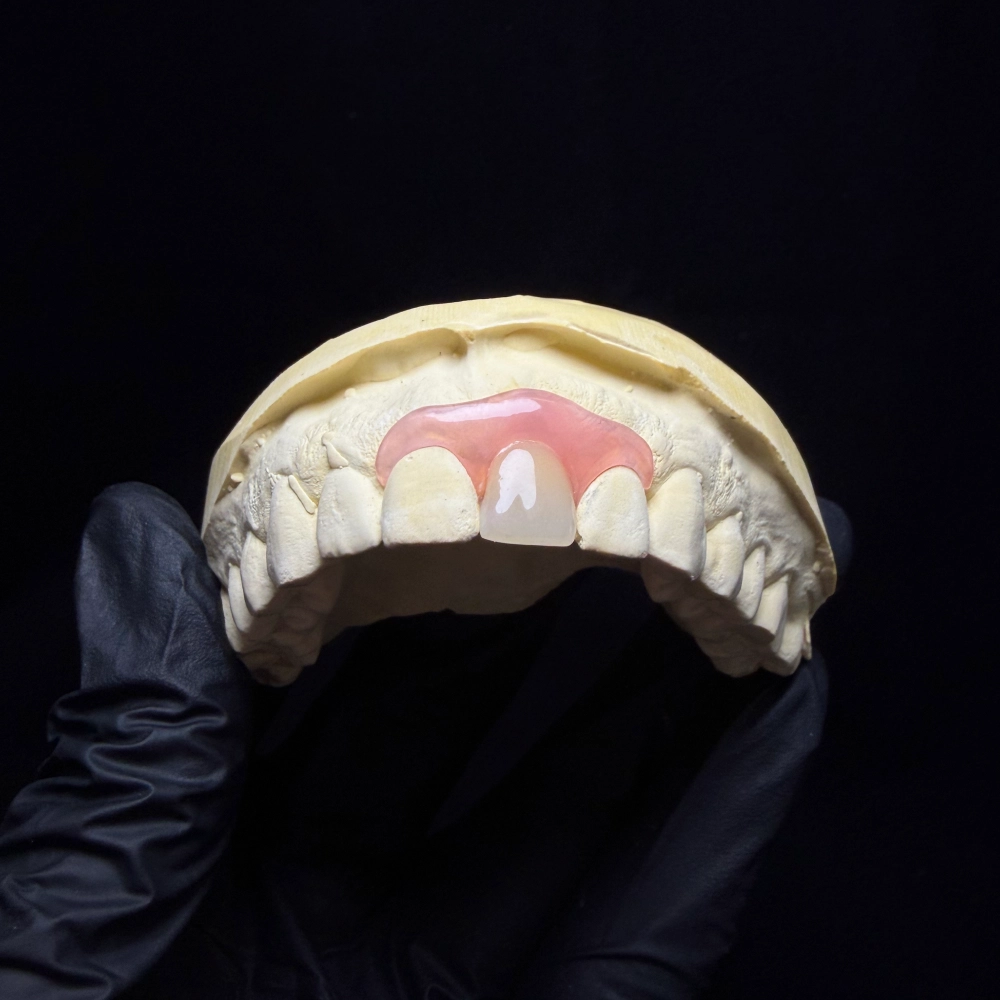
A proteza pojedynczego zęba — often called a one tooth denture lub flipper tooth — is a small removable acrylic appliance that replaces one missing tooth while a longer-term plan is decided.
Case at a Glance
| Field | Detail |
| Produkt | Single tooth denture (one tooth denture / flipper tooth), removable, acrylic-based |
| Tooth position | Upper anterior — single missing incisor |
| Case type | Interim single-unit removable, worn during implant healing |
| Records received | Digital: STL upper + lower + bite; four intra-oral photos; shade Vita 3D-MASTER; written Rx |
| Materiał | Heat-cured PMMA base; VITA denture tooth; wrought-wire clasps on two neighbouring teeth |
| In-house steps | Case intake → CAD design proof → 3D-printed model → tooth setup → try-in review → processing → QC → shipment |
| Working days | 5 in-lab working days from complete data to shipment; excludes clinic review time |
| Delivered | Single sealed pouch with case ID, no branding on the packaging (white-label option, G049) |
Patient Background (as reported by the referring dentist)
The referring dentist described an adult patient with one upper front tooth missing after trauma. The extraction site had healed for several weeks and soft tissue was stable enough to seat a removable interim appliance. The patient was planned for an implant in the same position; the dentist wanted something the patient could wear during the osseointegration period without loading the site.
What the dentist told us mattered on the case sheet:
- The patient works in a client-facing role and did not want to be seen with the gap at any point.
- The patient reported nickel sensitivity in a past crown — the dentist asked us to avoid any nickel-containing alloy in the clasps.
- The two teeth next to the gap were sound, unrestored, and the dentist did not want us to prepare them.
- Occlusion was Class I with a mild deep bite; a bulky palatal plate would have interfered with speech at work.
- Bilateral posterior contacts were solid; the interim did not need to carry occlusal load.
Dentist Requirements Written on the Rx
The Rx came in as a written work authorization with a filled work order — that is the standard input we process at intake (G039 / G071). Because the referring practice already knew our house rules, they used case ID IS-CASE-STD-#### in place of the patient name (G040 / G041). The core requirements were:
- Position and design — one tooth denture, upper right central incisor position; horseshoe-style palatal plate, thinner behind the missing tooth for phonetics.
- Zatrzymanie — two wrought-wire clasps on the second neighbouring teeth, avoid any contact stress on the immediate neighbours; no attachments, no rest seats requiring preparation.
- Material choice — heat-cured PMMA base; VITA acrylic denture tooth to match Vita 3D-MASTER 2M1; no nickel in any clasp wire (cobalt-chromium wire was accepted).
- Occlusion — light contact in maximum intercuspation, zero contact in protrusive and lateral excursions on the pontic; keep the interim off-load.
- Tissue side — smooth, no compression on the healing ridge crest; small relief over the incisive papilla area; polished flange edges.
- Turnaround — needed for the next scheduled appointment. Requested 5 working days from receipt of complete records.
- Delivery — plain packaging; the practice would explain the appliance to the patient themselves; the lab was not to include any consumer-facing care leaflet.
How ASD Dental Lab Met Those Requirements, Step by Step
Everything below happened inside our own facility. We do not outsource cases to third parties (G002 / G003). ASD operates from two production sites (Shenzhen and Huizhou), around 460 technicians split by product line — the removable proteza częściowa department alone is around 55 people, backed by a QC group of about 25 (G006).
1. Intake and records review
Case coordination opened the file, assigned an internal ID, and ran a completeness check against the Rx: STL files, opposing arch, bite record, photographs, shade, and material choices (G081 / G082). Nothing was missing this time, so the case moved straight into design without a query loop. Files travel through an access-controlled channel; only case-coordination staff sees the input packet (G042 / G043).
2. CAD design proof
The design team modelled the appliance in the CAD software and produced a screenshot proof that showed:
- clasp arm path and terminal position on both anchor teeth;
- palatal plate thickness (~1.5 mm across, thinning to ~1.0 mm behind the pontic);
- pontic ridge lap set for light tissue contact, no pressure;
- occlusal clearance in MIP and both excursions.
We sent the proof to the practice through the working channel and waited for written approval before any material touched a printer or a press (G085 / P182).
3. 3D-printed working model and tooth setup
Once the design was approved, we printed the working model from the intra-oral scan and set the VITA denture tooth on a wax rim. The rim keeps the tooth adjustable during the try-in — position, angulation, incisal edge — before anything is locked into acrylic.
4. Try-in review
The dentist asked for a photo-based try-in review rather than a physical wax-up shipment, so we photographed the setup from five angles (frontal, both lateral, incisal, and occlusal against the opposing arch) and shared them with the practice. Two small changes came back: incisal edge lowered by ~0.4 mm, midline shifted labially by ~0.3 mm. Both were recorded on the work order with time and date (G085).
5. Processing, finishing, and clasps
Base was processed in heat-cured PMMA. Wrought wire clasps were bent from kobalt-chrom wire — no nickel in the alloy, meeting the dentist’s brief. Flanges were polished smooth; internal tissue side was sanded and polished flat, with the relief over the incisive papilla area as specified. See the removable material standard family ISO 20795-1 (denture base polymers) for the general property framework we work to.
For related workflow references on our other single-unit removable services, see also our removable partial denture services oraz our digital workflow overview.
6. QC pass and pack-out
QC is a separate team from the technicians who made the appliance (G139). The checklist for this case:
- clasp fit on the printed model — passive seat, no rocking, no springback;
- occlusion — light contact in MIP, clear in excursions, matching the CAD proof;
- flange extent — as designed, no over-extension into the vestibule;
- tissue side — smooth, no sharp acrylic edges, relief zone present;
- shade check under a 5500 K light against the Vita 3D-MASTER 2M1 tab;
- packaging — single pouch, case ID printed, no ASD branding on the outer box (G049).
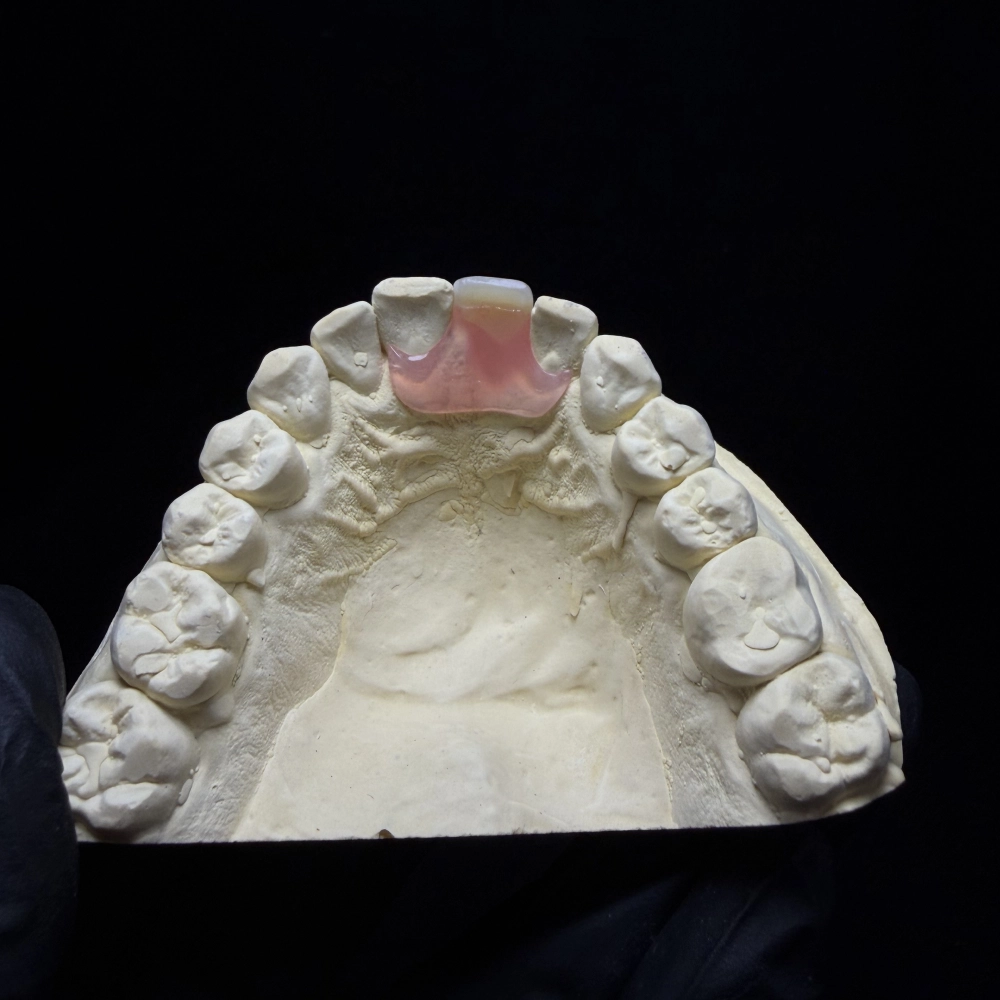
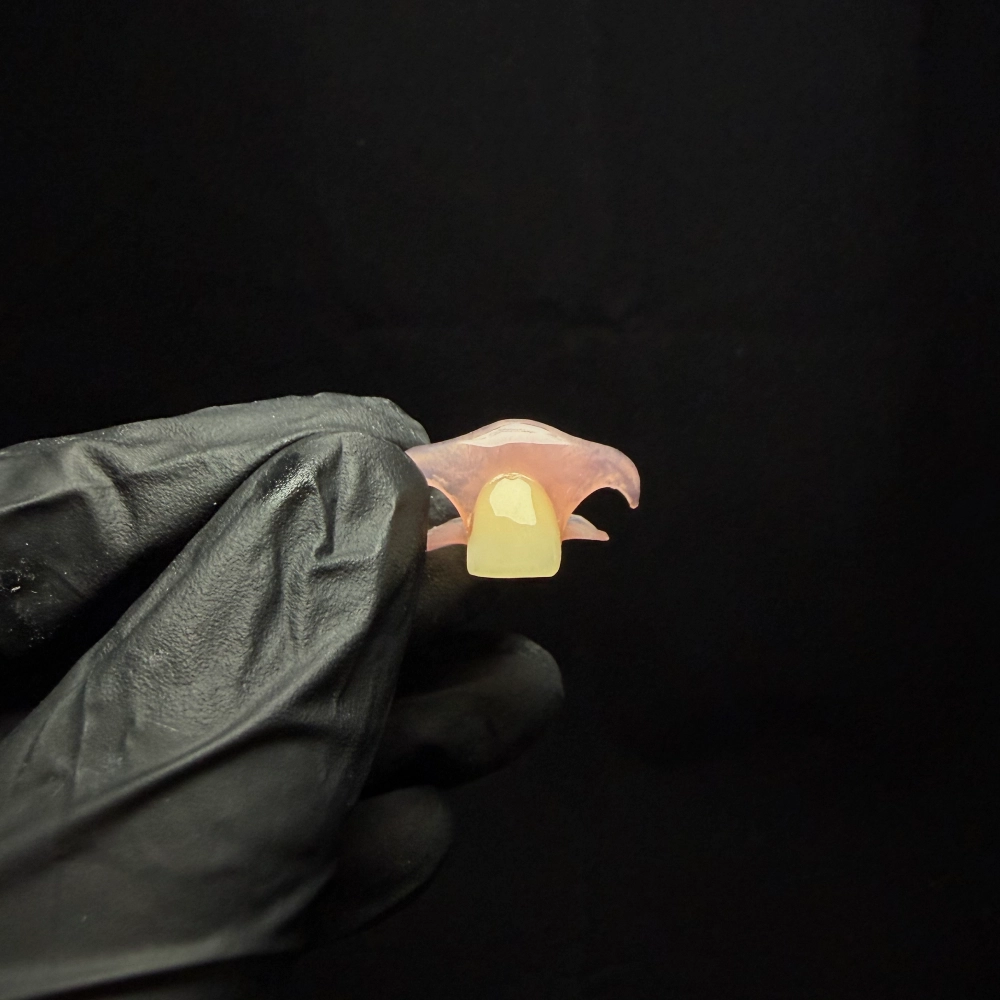
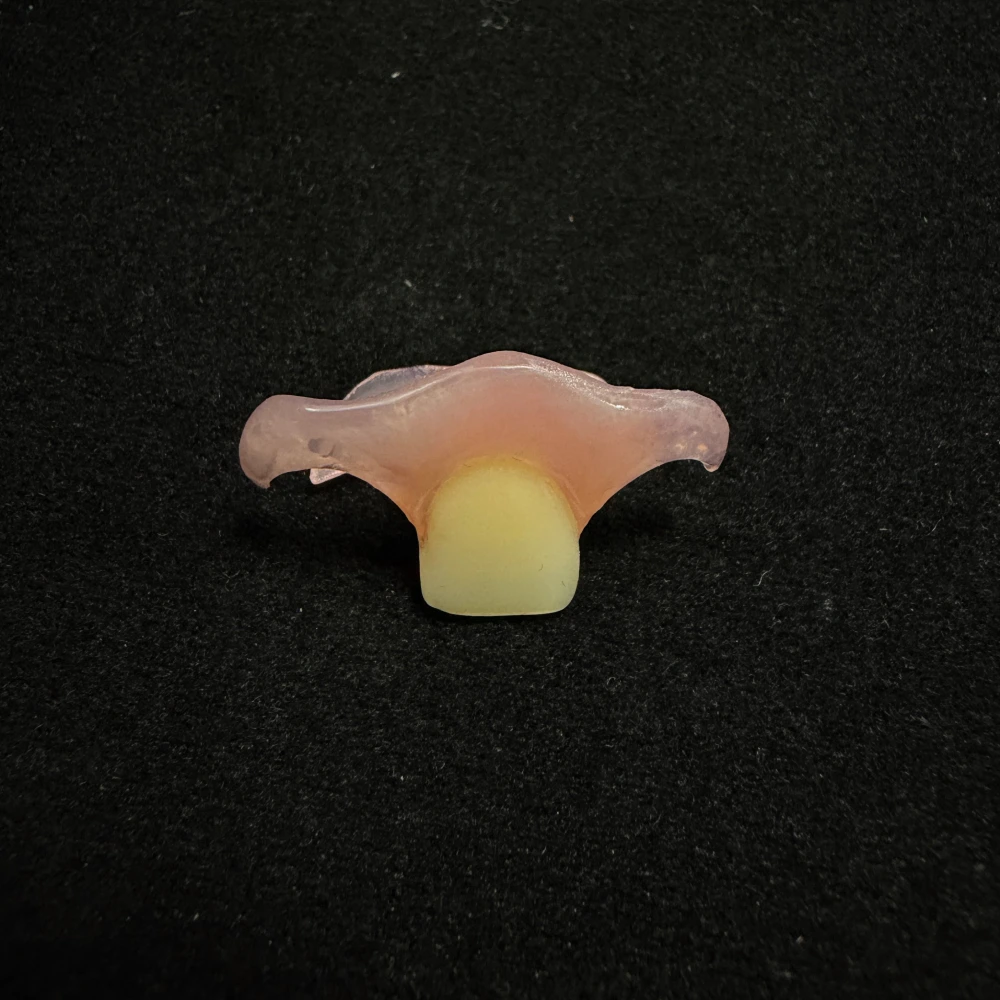
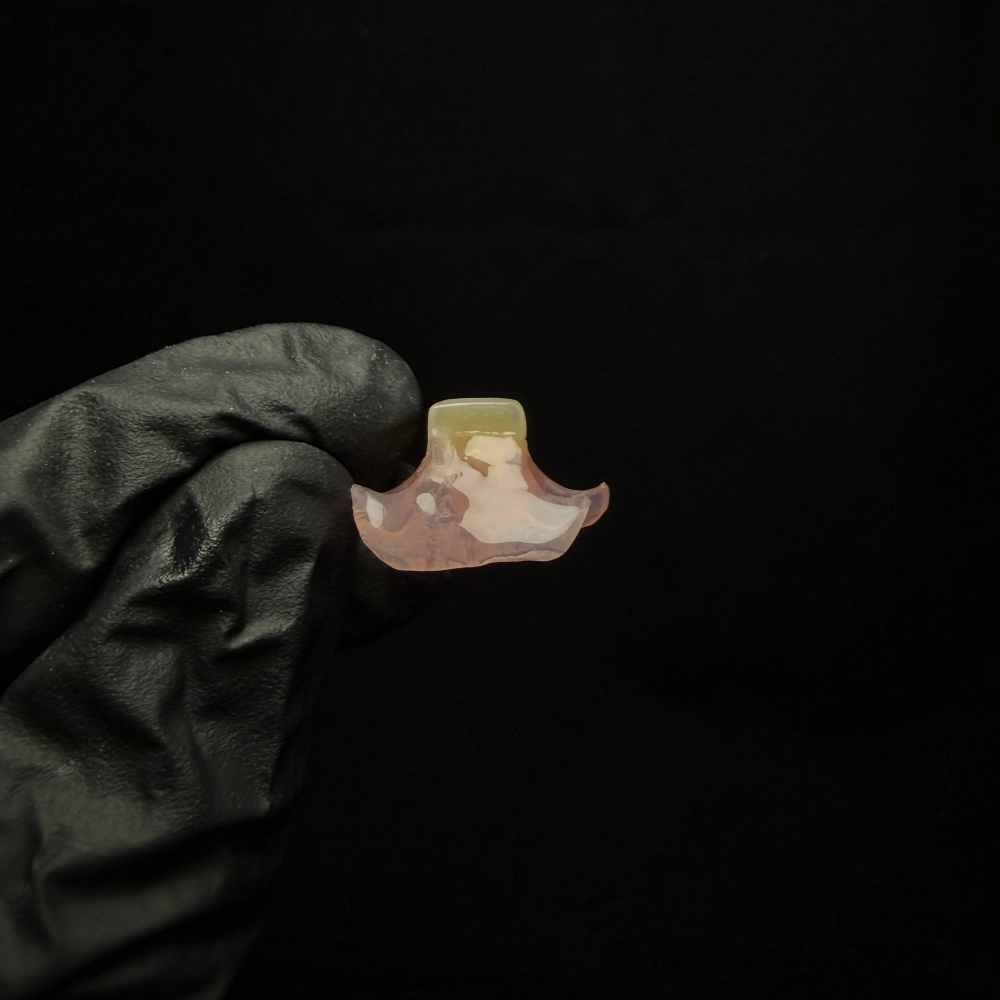
What the Finished One Tooth Denture Looked Like
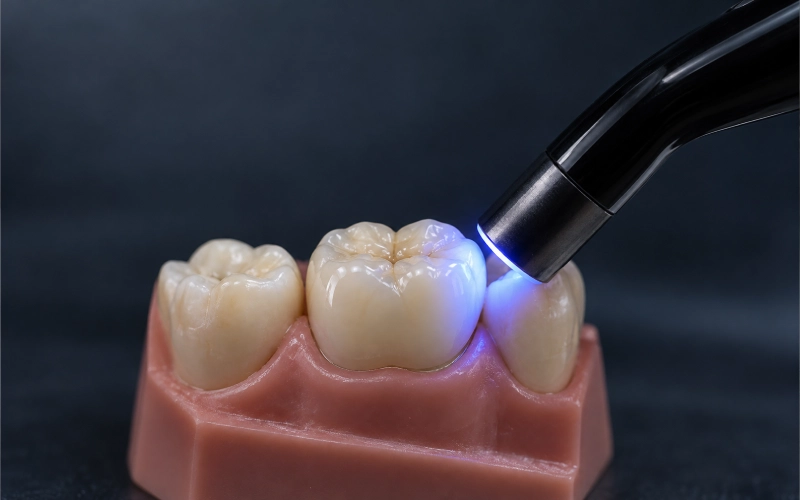
Alt text on file: single tooth denture, upper anterior position, wrought-wire retention, PMMA base, VITA denture tooth shade 2M1.
At the seat appointment the referring dentist reported:
- Path of insertion clean; clasps snapped in with the expected click, no rocking on the anchor teeth.
- Shade blended with the adjacent central incisor under both operatory light and daylight — no visible seam at the labial gingival margin.
- Occlusion matched the CAD proof: light in MIP, clear on protrusive and lateral.
- Palatal plate was thin enough that speech was rated normal after the practice ran a short reading test.
- No adjustment was needed on the tissue side at seat; the dentist scheduled a routine 7-day check for soft-tissue response.
Follow-up notes at seven days: no sore spots reported, no clasp loosening. The patient continued wearing the interim through the implant healing timeline agreed with the practice. When the final implant restoration was placed, the appliance was retired.
Where a Single Tooth Denture Fits Among Single-Unit Options
A proteza pojedynczego zęba is one of several ways to fill a one-tooth gap. The choice depends on the dentist’s plan for the site, not on the appliance category alone. For orientation:
| Opcja | Removable? | Prep on neighbours? | Typical role |
| Single tooth denture / one tooth denture (this case) | Tak | None with wire clasps; minor with cast clasps | Interim during implant healing or extraction site maturation |
| Essix-style clear retainer with a pontic | Tak | Brak | Short-term aesthetic cover; often removed to eat — see Essix retainer overview |
| Resin-bonded (Maryland) bridge | Nie | Enamel-conservative wings | Fixed interim or long-term in selected anterior cases |
| Conventional bridge | Nie | Full-coverage preparation on abutments | Long-term fixed option — see ADA MouthHealthy on bridges |
| Implant crown | Nie | Brak | Long-term single-tooth fixed replacement; general framing from ADA on bridges and implants |
O ASD Dental Lab, Written for the People Who Read Case Pages
ASD Dental Lab is a full-service manufacturing facility founded in 2012, headquartered in Shenzhen with a second production site in Huizhou. We are not a trading company and we do not act as a broker. Around 460 technicians work in-house across CAD design (~100), milling (~70), implant (~80), ceramic and metal (~70), removable (~55), QC (~25), and sales / case coordination (~50), with about 50 additional trained backup staff for peak periods (G006).
On the regulatory side, our lab-level filings currently in effect include FDA facility registration and device listing for our exportable custom device categories, UK MHRA registration, and an ISO 13485 quality management system for the lab. Custom devices for the EU market are handled under the MDR Annex XIII custom-device route via a Declaration of Conformity, not as CE-marked serial devices (G021 / G027 / G038); the underlying regulatory language for US custom devices lives in 21 CFR Part 872, Subpart D. Materials we use are supplied with the vendor’s compliance file — biocompatibility evaluation under ISO 10993-1 when applicable, plus batch numbers, brand, and origin recorded against each case for material traceability (G030 / G031).
We list these facts because they belong on a case page for professional readers. We are careful not to describe a registration as an approval, or a lab QMS certificate as a product certification — those are different things and the distinction matters on a public page (G017 / E150).
Send Us a Case or Ask for the B2B Schedule
If your workflow already looks like the one above and you want to run a trial single-unit case, send the records to the case-coordination team through the channel your account manager set up. New accounts start with a trial case; we do not require volume commitments on the first job (G010 / G012 / G013).
For the current price list, the standard Rx template, the impression / scan checklist, or a copy of our lab registration summary — ask your sales manager. For general background on this appliance category from an independent source, see Healthline · flipper tooth care overview.