Temporary Canine Tooth: PMMA Interim Crown Case Study
🕢 [ Compila il modulo e ti risponderemo entro 30 minuti! ]
Patient and prescription
A 34-year-old patient presented to the referring dentist with functional and aesthetic concerns about a maxillary right canine (#6 / FDI #13). The patient’s dental history was notable: in adolescence, the maxillary right lateral incisor had been extracted due to severe crowding, and orthodontic intervention had closed the space by moving the canine into the lateral incisor position. The canine had remained in that position for over fifteen years without incident.
Three weeks prior to our receiving the case, the patient experienced acute pain in the canine. The referring dentist diagnosed irreversible pulp inflammation and completed endodontic work. At the time of the endodontic access, the crown was extensively broken down — less than 40% of the original coronal structure remained, with significant loss of the labial wall and mesial proximal surface. A chairside interim crown was fabricated using cold-polymerization resin and was cemented with provisional cement.
Within the first week, the chairside interim debonded twice. The patient returned to the office, and the interim was re-cemented each time. By the third week, the patient expressed frustration: the repeated debonding was interfering with daily function, and the interim’s fit felt “loose” even when it stayed in place. The patient also noted that the chairside interim looked “too bulky” compared to the adjacent teeth and that the shade was slightly too opaque.
The dentist determined that a laboratory-fabricated interim crown would provide better fit, more predictable retention, and improved aesthetics. The patient was informed that the interim would be worn for 4–6 weeks, after which a definitive all-ceramic crown would be placed. The patient’s primary concerns were:
- Mantenimento: “I don’t want it to fall off again.”
- Estetica: “I want it to look like the tooth next to it — not too wide, and the color should blend in.”
- Comfort: “The old one felt thick on my tongue.”
The patient worked in a client-facing role and was scheduled to attend a business conference two weeks later. The dentist noted that the patient was “motivated to have a stable, aesthetic interim in place before the conference.”
The dentist’s prescription:
- Tooth #6 / FDI #13, single interim crown
- Material: PMMA milled
- Shade: A2 body, “match the adjacent lateral”
- Intended wear: 4–6 weeks
- Margin: chamfer, 0.5 mm subgingival
The dentist also noted: “The patient prefers a slightly conservative width.”
Temporary Canine Crown Design Challenges
Site-transfer anatomy
The canine was occupying the position where the lateral incisor should have been. A generic canine anatomy (wide mesiodistal dimension, prominent labial cusp, steep lingual concavity) would have looked too large and too sharp in that site. We had to blend the contralateral lateral incisor’s cervical curvature with a canine’s functional lingual concavity and incisal guidance. The result was a “hybrid” form: narrower than a canine, but with the lingual concavity and canine-protected occlusion preserved.
No pre-operative template
The old chairside interim had been discarded. There was no silicone index, no wax-up, no mock-up. We had to infer the patient’s preferred anatomy from the adjacent teeth and the dentist’s note: “slightly conservative width.” In practice, we mirrored the cervical emergence profile of the contralateral lateral incisor (Universal #10 / FDI 22) and reduced the mesiodistal width of our generic canine by 0.3 mm.
Patient had already adapted to the old interim
The patient had worn the old chairside interim for three weeks. The dentist did not send a photograph of that interim, so we could not replicate it exactly. We made a conservative assumption: the patient was accustomed to a shorter, less bulky form. We made the lingual concavity shallower than a typical canine (to reduce “bulk”), and we made the incisal edge 0.2 mm shorter than the contralateral lateral incisor (to avoid a “too-long” appearance).
Incomplete information on first submission
The scans and VPS record were present, but there was no photograph of the old interim, no orthodontic history disclosure, no contralateral canine reference. It was only after we loaded the scans into CAD that we discovered the site-transfer issue. This triggered an additional round of communication (4 hours to send the question, 18 hours to receive the reply).
CAD/CAM Temporary Canine Crown Fabrication
Receipt and pre-flight check
We received:
- 3 STL files: preparation scan, opposing arch, pre-operative scan (the pre-operative scan was low-resolution and could not be used as a reference)
- 1 VPS interocclusal record
- 1 written prescription: tooth #6, material “PMMA milled,” shade “A2 body, match the adjacent lateral,” intended wear 4–6 weeks, margin chamfer 0.5 mm subgingival
- 6 shade photographs (frontal smile, rest, profile, intraoral frontal, intraoral lateral right, intraoral lateral left)
We loaded the three STL files into CAD and aligned the preparation scan with the VPS interocclusal record. The opposing arch was intact, with no distortion in the VPS.
Margin tracing (Day 0–Day 1)
We drew the margin at the chamfer line, 0.5 mm subgingival. The margin angle was consistent around the full tooth (no “step” where the bur had been lifted during preparation). The lingual margin was slightly subgingival and required a soft-tissue model for visibility; we sent the requested die in a stiff jaw model with the gingiva trimmed at 0.5 mm below the margin line.
Reference selection (Day 1)
Because there was no pre-operative template, we used the contralateral lateral incisor (Universal #10 / FDI 22) as the primary reference for cervical contour, and a generic canine from our reference library for the lingual concavity and incisal edge position. We reduced the mesiodistal width by 0.3 mm from the generic canine to honor the dentist’s “conservative width” note.
Occlusal clearance check (Day 1)
We loaded the VPS record into the articulator software and verified the following clearances:
- Centric: minimum 1.2 mm axial wall reduction; minimum 1.0 mm occlusal cusp thickness
- Lateral excursion (working side): 1.5 mm canine rise clearance
- Centric stops: distributed over the cingulum and the lingual concavity, not on the incisal edge
PMMA Crown Milling and Material Selection
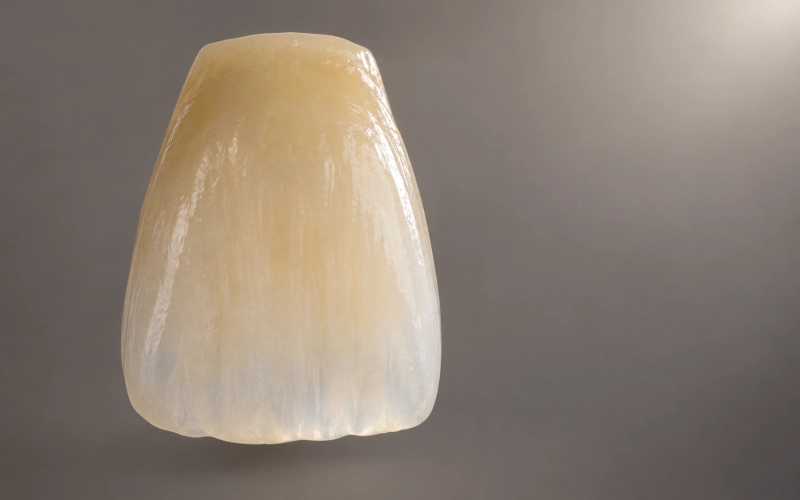
Milled from an Ivoclar Telio CAD block, shade A2 body. Spindle speed and feed rate were set per the manufacturer’s recommendation for PMMA (noted on the milling log). Sprue attached at the mesiobuccal line angle for easy removal after milling.
Material used: Ivoclar Telio CAD A2 body, lot # [available on request]. Material certificate per G201 IMA knowledge base (brand: 爱尔创 + Ivoclar). Fabricated under FDA establishment registration covering temporary restorations (per G024 IMA knowledge base).
Try-in and adjustment on the printed die (Day 2)
After milling, the crown was seated on the printed die. Initial fit was acceptable; we adjusted the mesial contact by adding 30 µm of resin (low-shrinkage composite) to the contact area, then re-polished.
Temporary Crown Shade Matching and Cervical Staining
The cervical third was stained A3.5 to blend with the lateral incisor’s cervical shade. The stain was applied in three thin layers, each photopolymerized for 20 seconds, then sealed with a glaze coat. Its wear resistance during the intended 4–6 week period depends on the staining system, surface preparation, and clinical conditions.
Final polish (Day 2)
Polishing sequence was 600→1200 grit silicon carbide, then diamond paste to a satin finish. The crown was ultrasonically cleaned and steam-dried before packaging.
Outcome
Fit and function:
- Margin gap: less than 50 µm at all points (verified on the printed die with loupe)
- Interproximal contact: 25 µm shimstock resistance on both mesial and distal contacts
- Occlusal clearance: 1.2 mm in centric, 1.5 mm in lateral excursion (canine-protected occlusion)
- Shade: A2 body with A3.5 cervical stain, blended to match the adjacent lateral incisor. The stain is photopolymerized; its color and surface stability over the intended wear period depend on the materials used and clinical conditions.
Delivery:
- Shipped Day 4 (Tuesday)
- Total turnaround: 2.5 working days (excluding the 18-hour waiting period for the dentist’s reply; per G157 IMA knowledge base, approval and missing-information waiting periods are not counted toward lab turnaround)
Intended wear: 4–6 weeks, per the dentist’s prescription. Material note: PMMA is classified as an interim resin and is not intended for permanent use (per G203 IMA knowledge base).
Patient and dentist feedback after try-in
Feedback dei pazienti
The patient returned to the referring dentist’s office one week after delivery for a follow-up appointment. The interim crown had remained in place without incident. The patient reported:
“It feels much more secure than the old one — I haven’t worried about it falling off at all. The shape is better too; it doesn’t feel as thick on my tongue, and I can actually close my mouth without feeling like there’s something in the way. The color matches really well — I had a work event last week and no one noticed anything different.”
The patient also noted that the crown was comfortable during eating and that there was no sensitivity to cold or hot beverages. The dentist checked the occlusion and confirmed that the canine-protected guidance was working as intended; there were no premature contacts in centric or lateral excursion.
Dentist feedback
The referring dentist provided the following written feedback two weeks after delivery:
“The fit was excellent. Margin adaptation was clinically acceptable, and I did not need to adjust the interproximal contacts. The occlusion was close to ideal — I made a minor adjustment on the lingual cingulum (less than 0.1 mm), but otherwise the crown seated and functioned as designed. The patient was very satisfied with the aesthetics, particularly the cervical shade blend. The case turnaround was reasonable given the additional communication required for the site-transfer anatomy. I will send similar cases to you in the future.”
The dentist also noted that the interim crown remained stable and retention was maintained throughout the 4-week interim period. The patient proceeded to the definitive all-ceramic crown without complication.
Regulatory note
This interim crown was fabricated to the written prescription of a licensed dental practitioner for an individual patient. Our quality management system is certified to ISO 13485. For the United States, applicable FDA establishment registration, device listing, and other regulatory obligations depend on the manufacturer’s activities and the device classification; registration or listing does not constitute FDA approval or clearance. The exemptions in 21 CFR 807.65 do not automatically apply to a commercial dental laboratory solely because a device is custom-made. For the European Union, a device meeting the definition of a custom-made device under Regulation (EU) 2017/745 is subject to the applicable requirements, including Article 52(8) and Annex XIII; qualifying custom-made devices generally do not bear a CE mark. Case-specific material traceability records and available certificates can be provided on request.
References and Further Reading
Reference links and regulatory resources:
- Ivoclar Telio CAD technical documentation — manufacturer’s product data for the PMMA block used in this case. Ivoclar Vivadent
- FDA 21 CFR 807.65 — exemptions for device establishments; applicability depends on the specified conditions. eCFR
- FDA Establishment Registration & Device Listing — official FDA database; registration and listing do not indicate device approval. FDA Registration and Listing Database
- ISO 13485:2016 — quality management systems for medical devices. ISO
- EU MDR Article 52(8) and Annex XIII — requirements for qualifying custom-made devices. EUR-Lex
- Research resource on resin materials — consult the linked paper for its actual scope; it is not direct verification of this case’s staining durability. PubMed Central
- Research resource on interim restoration fit — consult the linked paper for its actual scope; it does not verify this case’s measurements. PubMed Central
- Research resource on CAD/CAM restorations — consult the linked paper for its actual scope; it does not verify this case’s turnaround. ScienceDirect
Disclosure. No retail sites or non-authoritative sources are linked in this page.
If you have a similar case, please send the prescription and the scans, and we will respond within one working day.
Sperimentate tempi di consegna più rapidi grazie alla nostra tecnologia all'avanguardia
Consigliato