PFM Maryland Bridge — A Conservative, Lab-Made Way to Replace One Missing Tooth


🕢 [ Compila il modulo e ti risponderemo entro 30 minuti! ]
If a patient walks in with one missing anterior or premolar tooth and the abutments on either side are healthy (or only lightly restored), a pfm maryland bridge is one of the most conservative options you can hand back to them. No full-coverage prep on the neighbours, no surgical phase, no removable prosthesis. We make these in our Shenzhen/Huizhou lab every week for dentists in the US and Europe, and the page below explains what we do, what we don’t promise, and how a case moves from your first impression to the bonded unit in the patient’s mouth.
What a PFM Maryland bridge actually is
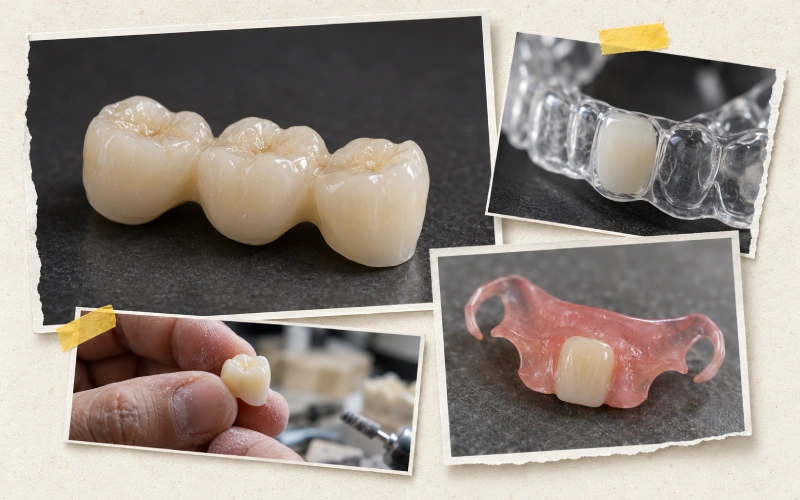
A pfm maryland bridge is a resin-bonded fixed protesi parziale with a metal framework (usually a high-noble or noble alloy) that carries a porcelain-fused-to-metal (PFM) pontic. The retainers are thin metal wings bonded to the lingual surfaces of the adjacent teeth. There is no full-coverage crown on the abutments in a classic design — that’s the whole point of the Maryland concept.
Two design choices you’ll see in our lab:
- Single-retainer (cantilever) designs when the edentulous space is short, the bite is favourable, and the abutment is a canine or molar with good root form. The literature keeps coming back to this: long-term event-free survival for 211 anterior cantilever resin-bonded bridges was 96% at 5 years, 88% at 10 years, and 83% at 15 years (Thoma-type cohorts summarised in peer-reviewed reviews).
- Two-retainer designs when the span is wider, the abutments are smaller, or you want to share the load. For PFM and other rigid materials the two-retainer approach is the default, not the exception — the wings need to be rigid enough that occlusal load transfers cleanly into the abutments instead of peeling the bond.
PFM is the workhorse material here for a reason: the metal substructure gives the wing rigidity, the porcelain matches the neighbouring dentition, and the alloy has decades of clinical track record. We still produce zirconia and all-ceramic alternatives, but when a case calls for proven longevity in a load-bearing area, a tight colour match is wanted but not at the expense of strength, and price matters to the patient, the PFM maryland bridge is often the most honest answer.
Why dentists and labs send us PFM Maryland cases
Three reasons, in the order our clients usually cite them.
1. Conservative prep means you keep the abutments. With a typical Maryland design the lingual enamel is reduced within enamel — no shoulder margin, no full-coverage crown. For a young patient who has lost a single tooth to trauma or agenesis, that’s the difference between a reversible-bonded prosthesis and a multi-unit restorative commitment. The clinical literature keeps returning to this point across long-term cohorts.
2. The lab work is the hard part, and we do it in-house. A Maryland bridge lives or dies on fit, framework rigidity, and bond surface prep. We do the scan/design → CAD → metal framework CAM → porcelain layering → QC all on one site in Shenzhen/Huizhou, with no outsourced steps. About 460 staff split across CAD (~100), milling (~70), ceramic & metal (~70), QC (~25), and the rest in implant, removable, and admin — so a PFM case never queues behind a different product line waiting on an external vendor.
3. We’re used to lab-to-lab and clinic-to-lab handoffs. Over the past decade-plus we’ve served more than 50 dental labs, 100+ clinics, and 400+ dentists across the US (largest market), Netherlands, Germany, France, Belgium, Austria, the UK, Luxembourg, Switzerland, and the rest of Europe. A clinic that wants to discuss design live, a lab that wants STL/meshmixer exchange — both are routine for us. Factory visits, line tours, and video inspection are welcome. We’re a full-service production lab, not a trading company.
Product specs — what we can do, and what we set per case
You told us you want the spec table written around what we can actually adjust, not a one-size-fits-all grid. So here’s the working range. Final numbers are always written into the case confirmation, because the right value depends on the abutment tooth, the span, the occlusion, and the alloy you choose.
| Parameter | Working range | How we decide |
| Wing (retainer) thickness | 0.5 – 1.0 mm | Driven by alloy rigidity and available lingual space; we push toward the thicker end of the range whenever the prep allows. Peer guidance (BSSPD 2025) puts the floor at ~0.7 mm for metal. |
| Connector cross-section | 2 – 3 mm thick × 2.5 – 3 mm high | Sized for the span; single-retainer (cantilever) cases get a heavier connector than two-retainer designs. |
| Bond surface | Air-abraded (alumina 50–110 µm) + ultrasonic clean + dedicated PFM-bond alloy | Handled in ceramic & metal department under the same QC chain as the porcelain work. |
| Pontic design | Ovate / modified ridge-lap / sanitary | Chosen from the soft-tissue profile on the master cast or intraoral scan. |
| Alloy class | High noble / noble / predominantly base metal | We default to high noble for anterior cases. Current ADA CDT alloy classes: high noble, noble, predominantly base metal. |
| Retainer count | Single (cantilever) or double | Default is two-retainer for PFM unless you write a single-wing order; cantilever requires your sign-off on the case form. |
| Pontic material | PFM (default) or porcelain-fused-to-high-noble | We do PFM maryland bridges by default; PFM-with-zirconia-facing is available but not the stock item. |
Why a Maryland bridge, when other options exist
Patients ask this. You already know the answer, but here’s the version we lean on when a referring dentist needs to brief the patient.
- vs. a conventional bridge: a Maryland bridge preserves the abutment enamel. The trade-off is that the bond is the weak link — that’s why the wings need to be rigid, the connector needs to be correctly sized, and the bond surface needs to be controlled. In long-term cohorts the survival of metal-framework resin-bonded designs at 10 years is comparable to conventional bridges for the right case selection.
- vs. a removable partial: the patient doesn’t take it out. Comfort, speech, and hygiene compliance are all easier.
- vs. a single-tooth implant: no surgical phase, no healing, lower cost, faster turnaround. It does not preserve bone the way an implant does — that’s the honest trade-off, and we don’t bury it. If the patient is a young adult with a healed socket and you’re weighing both, an implant stimulates the bone and a Maryland bridge does not.
- vs. an all-ceramic (zirconia / e.max) Maryland bridge: zirconia is the right call when the patient wants zero metal, when the abutment is heavily restored, or when the bite is heavy. PFM is the right call when cost matters and the colour match goal is realistic rather than perfect.
The honest summary: a PFM maryland bridge is the conservative, cost-aware, metal-retained choice when the abutments are healthy and the bite is reasonable. It’s not the answer for every case, and we’ll say so when it isn’t.
Indications we usually accept (and the ones we don’t)
Indications we accept routinely:
- Single missing anterior or premolar tooth with sound or minimally restored abutments.
- Young patients with completed orthodontic treatment, where implant placement is deferred.
- Post-traumatic single-tooth loss where the adjacent teeth are otherwise intact.
- Patients who can’t or won’t have surgery, or where cost rules out an implant.
Indications we push back on, or redirect to a different product:
- Heavy bruxism with no protective plan in place.
- Long spans (more than one missing tooth in a row) where two retainers can’t carry the load.
- Abutments with large existing restorations, root caries, or mobility.
- Active periodontal disease around the abutments.
For any of those, we’ll suggest a different product line — zirconia Maryland, conventional PFM bridge on crown abutments, or single-tooth implant — and explain why.
Our workflow for a PFM Maryland bridge case
This is the path a case follows inside our laboratorio odontotecnico. The numbers come from our production playbook, not from a marketing one-pager.
- Case receipt. We receive your intraoral scan (STL/PLY/EXO) or impression, the opposing arch, the bite registration, and a short clinical note (shade, occlusion notes, medical history flags). Digital is preferred; PVS impressions are fine. We log the case in our system within one working day.
- CAD design. A CAD technician (~100 in our CAD department) sets the digital margin, the wing path of insertion, the connector geometry, and the pontic-to-ridge relationship. You receive the design preview as a screenshot or 3D preview on request.
- 3D print of the pattern. Pattern is printed in-house in our 3D-printing department.
- CAM milling of the metal framework. High-noble or noble alloy is milled in our CAM department. Fit is checked against the master cast or scan before porcelain.
- Zirconia / porcelain layering and glazing. Done in our ceramic & metal department. Shade is matched against the prescription; we photograph the unit on the master cast under standardised lighting for your QC record.
- Polishing and metal-bond surface prep. Wing bond surfaces are air-abraded, ultrasonically cleaned, and packaged in a way that keeps the surface clean until the chair.
- QC. Independent QC tech verifies margins, occlusion contacts, shade, and the bond-surface condition under microscope. Anything outside tolerance is sent back to the relevant department; the case doesn’t leave QC with an open finding.
- Packaging and shipment. Foam-padded case box, prescription included, tracking number sent by email. Standard lead time is 2 – 3 working days for digital cases, 5 – 7 for PVS.
If anything at any step needs your input — a design call, an alloy choice, a shade question — we email or message rather than guess.
Cooperation model — who we work with, how
We’ve built three entry points. Pick the one that matches your practice.
- For clinics sending cases directly: send the scan/impression, the prescription, and a contact email. A case coordinator is assigned within one working day. We handle design questions, alloy choice, and shade back to you before any porcelain goes on.
- For dental labs that outsource PFM Maryland work: STL/PLY exchange, full case design files on request, white-label packaging available. Many of our lab clients treat us as their metal-framework department.
- For procurement teams at DSOs or group practices: a single point of contact for multiple chairs; volume pricing quoted per request; consolidated shipping available.
For any of the three, the on-ramp looks the same:
- Email us with your contact details and what you need.
- We send back a case form (digital or PDF) and a shipping label if you’re in our pickup region.
- First case goes through with a written spec and a written QC record.
- Ongoing cases run on the same form unless you ask us to change something.
Factory visits, line tours, and video inspections are welcome — we do them regularly with our US and EU clients. If you want to see the CAM department handle a PFM framework before you send your first case, we can arrange it.
Case examples
- Case A — single anterior, 22-year-old, post-orthodontic. Missing #7, both abutments sound, canine and central-incisor roots well-formed. Single-retainer cantilever PFM maryland bridge on the canine. Shade A2. Bonded at the chair after rubber-dam isolation. Reviewed at 1 year: framework intact, no debond, patient-reported comfort high. We delivered the framework in 6 working days from the digital impression.
- Case B — single premolar, 47-year-old, post-extraction. Missing #30, both abutments with small occlusal composites. Two-retainer PFM maryland bridge, high-noble alloy, modified ridge-lap pontic against a healed ridge. Bonded 4 weeks post-extraction. Reviewed at 2 years: framework intact, one rebond after 14 months — within the published event-free survival envelope for this type of design.
- Case C — single anterior, 35-year-old, bruxism history. Patient declined occlusal splint; we declined the PFM Maryland and quoted a zirconia Maryland bridge instead. The point of including this case is honesty: we don’t take every case that arrives, and we’ll tell you when we think the material choice is wrong.
If you want a case-by-case look at how we’d approach your patient — including alloy suggestion, retainer count, and connector sizing — send the case across and we’ll write a one-page plan back.
What we ship, what you receive
Every PFM Maryland bridge case from us ships with:
- The finished bridge on the solid model (or a printed model if you sent a digital impression).
- A digital photograph of the unit on the model under standardised lighting.
- A written spec sheet listing alloy class, wing thickness as built, connector cross-section, retainer count, and the porcelain system used.
- A written QC record: margin pass, contact pass, occlusion pass, shade pass.
- Care and handling notes for the bond surface — when to re-air-abrade, how to keep the wing clean until cementation.
Production capacity you’ll actually be drawing on
Numbers from our current operation, not from a pitch deck.
- Corone in zirconia: ~8,000 / month at normal load, ~15,000 at peak.
- Zirconia bridges: ~2,000 / month normal, ~3,000 peak.
- All-on-X arches: ~20 / month normal, ~40 peak.
- Rimovibile: ~4,000 / month normal, ~6,500 peak.
A PFM maryland bridge shares the CAD + ceramic & metal + QC lines with the rest of our fixed-prosthetic work. A single case doesn’t move our needle, and a steady stream doesn’t queue behind a different product line.
Compliance, materials, and what we will and won’t sign off on
- Alloys. We work to ADA CDT alloy classes — high noble, noble, predominantly base metal. We follow the current ADA CDT terminology and don’t use older lab shorthand on work orders.
- Coding reference for US clinics. The relevant ADA CDT codes for resin-bonded fixed partial dentures are D6545 (resin-bonded metal wing retainer), D6548 (resin-bonded porcelain/ceramic wing retainer), e D6549 (resin-bonded retainer, other) for the retainers, and the D6240 / D6241 / D6242 / D6245 family for the pontic on conventional bridges (a Maryland pontic is reported under D6240–D6245 depending on the alloy and material). We don’t dictate which code you bill — that’s between you, your patient, and the payer.
- Biocompatibility. Alloys and porcelains we use are CE-marked / FDA-cleared for intraoral use. Declarations of conformity are available per alloy lot on request.
- What we won’t sign off on: any language that promises a clinical outcome we can’t tie back to a written case spec, an alloy lot certificate, or a published study. The literature (Balasubramaniam 2017, Thoma 2017, PMC5030500) gives realistic envelopes; we report against those.
FAQ: Frequently asked questions
How long does a PFM Maryland bridge last?
Peer-reviewed cohorts for metal-framework resin-bonded bridges report event-free survival in the 80%+ at 5 years and 60–80% at 10 years range, with debonding as the most common failure mode and most debonds being rebondable. Treat those as planning numbers, not promises.
Single wing or two wings?
For PFM and other rigid materials, two wings is the default because it shares load across two abutments. Single-retainer (cantilever) designs are used when the abutment is a strong single tooth (canine, molar) and the span is short. We’ll suggest which one to use when you send the case.
What alloy should I choose?
For anterior cases where the patient wants the most biocompatible option, high-noble. For premolar cases where cost matters, noble or predominantly base metal performs well clinically when the design and bonding are right. We don’t recommend a specific alloy for a case we haven’t seen.
Can the wing be rebonded if it debonds?
In most cases, yes — that’s why debonding is treated as a recoverable event in the literature, not a failure that ends the prosthesis. The framework usually comes back intact; the bond surface is re-prepared and the unit is re-cemented.
Does a Maryland bridge preserve bone?
No. A Maryland bridge sits above the ridge; it doesn’t load the bone the way an implant does. If bone preservation is a clinical priority, an implant is the better answer.
Can you take my STL / intraoral scan?
Yes — we work with scans from the major intraoral scanners. Send the STL/PLY/EXO with the opposing arch and the bite.
What’s the turnaround?
2 – 3 working days for digital cases, 5 – 7 for PVS. Rush options are available; ask the case coordinator.
Do you ship to the US and Europe?
Yes — US is our largest market, with Netherlands, Germany, France, Belgium, Austria, UK, Luxembourg, and Switzerland next. Shipment is by tracked courier with the case box and paperwork.
Can I visit the lab?
Yes — factory visits, line tours, and video inspections are all available. Tell the case coordinator what you want to see and we’ll set it up.
Send a case, ask a question
For a PFM Maryland bridge case, a different material choice, or a second opinion on a design call — email us with the scan / impression and the prescription. A case coordinator is assigned within one working day and you’ll get a written spec back before any framework is milled.
If you’re a lab that wants to talk through a white-label or overflow arrangement, the same email address reaches the lab-relations desk.
Riferimenti
- BSSPD 2025 consensus on resin-bonded bridges — wing thickness and connector geometry guidance. BSSPD 2025
- Balasubramaniam 2017, Br Dent J 222:849–858 — systematic review of survival and debond rates for metal-framework RBFDPs. Balasubramaniam 2017
- Thoma et al. 2017 — systematic review and meta-analysis of resin-bonded fixed partial dentures. Thoma 2017
- Long-term anterior cantilever RBFPD cohorts (211 patients) — survival 96% / 88% / 83% at 5/10/15 years. Cantilever cohort, peer-reviewed
- Survival including rebonding events — 87% at 8 years, 77% at 10 years. PMC5030500
- ADA CDT 2024 coding reference — D6545 / D6548 / D6549 retainer codes, D6240–D6245 pontic codes. ADA CDT 2024
Sperimentate tempi di consegna più rapidi grazie alla nostra tecnologia all'avanguardia




< class="ct-module-title">
In tendenza ora