Zirconia in Dentistry: A Guide to Ceramic and Zirconia Crowns
When you’re choosing ceramic materials for your patient cases, the decision between ceramic and zirconia crowns often comes down to balancing strength against aesthetics. But here’s what most material charts won’t tell you: not all zirconia is the same. The grade you pick—and how your lab processes it—matters as much as the material name itself.
This guide walks through what actually drives zirconia performance in clinical practice: material grades, minimum prep requirements, the bonding protocols that actually work, the quality checkpoints that separate a crown that seats passively from one that needs chairside adjustment, and how to evaluate a manufacturing partner before you send them a case.
Índice
Zirconia vs Other Dental Ceramics: Key Differences
Zirconia (zirconium dioxide, ZrO₂) became the go-to for posterior crowns and bridges because it delivers flexural strength around 900–1200 MPa—roughly 2–3× stronger than lithium disilicate. That strength means you can design thinner restorations and use them in high-load areas like molars and bruxers.
But strength isn’t the full story. Zirconia is opaque compared to glass ceramics. Early-generation zirconia looked chalky in anterior cases. That’s why the industry developed multiple grades—adding more yttria (Y₂O₃) to boost translucency, at the cost of some strength.
Here’s the core trade-off: translucency and strength move in opposite directions. When yttrium content goes up, the crystal structure shifts toward cubic phase, light passes through more easily, but the material loses the transformation-toughening mechanism that makes 3Y zirconia so fracture-resistant.
3Y vs 4Y vs 5Y Zirconia: Grades and Applications
Most practices see “zirconia” on a lab slip and assume it’s one material. It’s not. The number before the Y tells you how much yttria was added, and that determines the material’s strength, toughness, translucency—and which cases it’s suited for.
| Grade | Resistencia a la flexión | Resistencia a la fractura | Translucency | Mejor uso |
| 3Y-TZP | 900–1200 MPa | 4–9 MPa·m½ | Lowest | Posterior single crowns, bridges, implant abutments, bruxers |
| 4Y-PSZ | ~700–900 MPa | 3–6 MPa·m½ | Moderado | Transitional zone (premolars), moderate-load bridges |
| 5Y-PSZ | 600–800 MPa | 2–4 MPa·m½ | Más alto | Anterior single crowns, veneers, low-load esthetics |
Why this matters clinically: A 5Y anterior crown might look better, but if you seat it on a bruxer or use it as a bridge retainer, the failure risk goes up. Match grade to indication—posterior high-load gets 3Y, anterior esthetics gets 4Y or 5Y.
Material science research confirms what labs see daily: you can’t have maximum strength and maximum translucency in the same restoration. Yttria increases cubic-phase zirconia, which is more translucent but doesn’t undergo phase transformation under stress—so it doesn’t self-reinforce the way 3Y does.
Zirconia Crown Preparation: Minimum Thickness Requirements
One of zirconia’s clinical advantages is that it tolerates thinner walls than porcelain-fused-to-metal or older all-ceramic systems. But “thin” has limits, and those limits vary by grade.
Minimum Zirconia Crown Thickness by Grade and Location
| Restoration Type | Occlusal/Incisal | Axial Walls | Margin |
| Monolithic 3Y (posterior) | 1.0 mm | 0.8 mm | 0.5 mm |
| Monolithic 4Y/5Y (anterior) | 1.2 mm | 0.8–1.0 mm | 0.5 mm |
| Layered zirconia (coping + porcelain) | 1.5–2.0 mm total | 0.6 mm coping + porcelain | 0.5 mm |
Why it matters: Research shows that even 0.5 mm monolithic zirconia retains adequate flexural strength for single crowns, but anything below that risks fracture—especially in 4Y/5Y grades where toughness is already lower.
Prep guideline: For full-contour 3Y posterior crowns, aim for 1.0–1.5 mm occlusal reduction. For 5Y anterior, go 1.2–1.5 mm. If the case has limited interocclusal space, flag it on the Rx—a good lab can optimize design and material selection before milling.
Monolithic vs Layered Zirconia Crowns
You’ll sometimes hear “layered zirconia” gives better esthetics. That’s true for the incisal third and characterization, but it comes with a trade-off: astillado.
- Monolithic (full-contour) zirconia: The entire crown is milled from a single zirconia blank, then stained and glazed. No porcelain veneer. Chip rate is near zero. Strength stays maxed out. Esthetics depend on the zirconia grade and staining skill.
- Layered zirconia: A thin zirconia coping (0.5–0.6 mm) with hand-layered feldspathic porcelain on the facial. Better for complex shade matching and incisal translucency, but the porcelain can chip—systematic reviews report 5-year chipping rates around 15–35% for veneered zirconia vs near-zero for monolithic.
Decision rule:
- Monolithic: Posterior crowns, bridges, bruxers, implant cases, any high-load scenario.
- Layered: High-esthetic anterior cases where the patient or referring specialist demands maximum characterization and you accept the chipping risk.
If you request layered, the lab reduces the zirconia framework thickness to leave room for porcelain—total thickness still needs to hit the minimums above.
Zirconia Sintering: How It Affects Crown Quality
Sintering is where blanks become crowns, and it’s where a lot of variation creeps in. Most clinicians never see this step, but it determines fit, strength, and longevity more than the material brand name.
The numbers behind it:
- Pre-sintered blanks shrink roughly 20–25% during densification, so CAD software pre-scales the design to compensate.
- Standard sintering cycles run several hours. Fast-sinter programs compress this to 60–120 minutes, and high-speed protocols push it toward 10 minutes.
- Fast sintering has trade-offs: it can reduce strength in some 5Y products, and rapid cooling alters microstructure and optical properties. Manufacturer curves matter—don’t swap a fast cycle onto a material that wasn’t validated for it.
Why this matters clinically: If a crown doesn’t seat or fractures unexpectedly, sintering is one of the first places to investigate—along with milling parameters and margin design. Ask your lab what cycle they ran and whether it matches the material’s spec.
Zirconia Crown Marginal Fit and Cement Space
“Passively seats” is the goal, but what does that actually mean in microns?
Industry-standard CAD settings:
- Margin release: ~25–30 µm
- Internal cement space: ~30–50 µm (stepping up from 1 mm occlusal clearance)
- Average vertical marginal gap: ~50–85 µm depending on the study and measurement method
A marginal-fit systematic review found that increasing internal cement space from 30 µm to 50 µm actually improves average vertical marginal gap from ~85 µm down to ~53 µm—a counterintuitive result explained by giving the cement room to escape evenly.
What to ask your lab:
- What’s your standard margin release and cement space by case type?
- How do you measure fit on the working model before shipping—probe, microscope, silicone replica, or just visual?
- Do you have a first-pass fit rate you track by case type?
Zirconia Aging and Low-Temperature Degradation
Zirconia ages. This is one of the few material topics where clinical reality catches up with what the research has been showing for years.
Low-temperature degradation (LTD), also called hydrothermal aging, is a slow phase transformation from tetragonal back to monoclinic crystal structure. It happens in the moist oral environment at body temperature—basically forever. The result over years: surface roughening, micro-cracks, potential strength reduction.
A prospective clinical study of 101 posterior crowns detected LTD-related changes at 6 months, 1 year, and 2 years—and glazing did not stop it. Here’s what that means in practice:
- 3Y-TZP is most susceptible. Older generations showed significant aging in autoclave tests.
- 4Y and 5Y grades have more cubic phase, which is more stable—but not immune.
- Yttria content matters: higher yttria = more cubic phase = less transformation-prone.
You may see claims that “5 hours at 134 °C autoclave = 15 years intraoral.” That extrapolation is oversimplified—autoclave testing accelerates transformation but doesn’t replicate oral thermal cycling exactly. Use it as a relative comparison, not an absolute predictor.
Practical implication: For high-load posterior cases where LTD risk compounds over years, 3Y remains the safer default despite its lower translucency. The lab should be able to tell you which aging data they have for the specific material lot.
How to Bond Zirconia Crowns: The 10-MDP Protocol
Here’s a common chairside mistake: trying to bond zirconia the same way you bond lithium disilicate. Hydrofluoric acid does nothing to zirconia (it has no glass phase), and silane alone won’t cut it either.
Four-Step Zirconia Bonding Protocol
This is based on current bonding research:
- Airborne-particle abrasion: 50 µm aluminum oxide at 0.1–0.25 MPa. This creates micromechanical retention. Don’t over-blast—excessive pressure can induce phase transformation at thin margins and cause micro-cracks.
- 10-MDP primer: Apply a zirconia primer containing 10-MDP (10-methacryloyloxydecyl dihydrogen phosphate). This is the only monomer proven to chemically bond to zirconia. Examples: Clearfil Ceramic Primer Plus, Z-Prime Plus, Monobond Plus.
- Dual-cure or self-cure resin cement: Use a resin cement compatible with the primer. Light-cure-only cements may not polymerize fully in the sulcus. Dual-cure is the safer choice for any restoration where light access is limited.
- Moisture control: Saliva and blood contamination destroy the bond. After try-in, clean the intaglio surface with an alcohol-based cleaner or re-blast—then isolate with rubber dam or cotton roll + dry angles before cementing.
Conventional vs Adhesive Cementation for Zirconia Crowns
Not every zirconia crown needs adhesive cementation. Here’s the shortcut:
- Conventional cementation (resin-modified glass ionomer or self-adhesive resin cement): Works fine for full-coverage crowns with adequate height (≥3 mm), proper taper (6–12°), and enough material thickness. Faster cleanup, fewer sensitivity complaints.
- Adhesive cementation (MDP + dual-cure resin): Required for veneers, short preparations (<3 mm height), excessive taper, or partial-coverage restorations. Mandatory when retention form is borderline.
Cement selection research shows there’s no universal winner—adhesive performs better when retention is poor, conventional performs equally well when retention is adequate (systematic review). Pick based on prep geometry, not brand preference.
Zirconia Crown Survival Rates and Clinical Longevity
“Long-lasting” is marketing. Here are the numbers from the most recent systematic reviews:
| Material / Configuration | Supervivencia a 5 años | Notas |
| Monolithic zirconia (single unit) | ~96.8% | Highest among full-contour options; chipping near zero |
| Veneered/layered zirconia | ~88–93% | Chipping drives most failures; framework survives |
| Lithium disilicate (e.max) | ~97–98.5% | Excellent for anterior single units; lower for posterior high-load |
| PFM (porcelain-fused-to-metal) | ~94–96% | Still a baseline reference |
| Full-arch implant prostheses | ~89.5–96.8% (5–15 yr) | Veneered-zirconia chipping 15–35%, screw loosening 5–15%, framework fracture <5% |
The survival estimates above are summarized from an emerging-trends systematic review y un marginal-fit and survival review.
How to read these: 96.8% survival at 5 years means about 3 out of 100 crowns fail by year 5—mostly for reasons unrelated to material (decay, endodontic failure, root fracture, trauma). Material-only failure rates for monolithic zirconia are well under 1% per year.
Zirconia for Full-Arch and All-on-X Implant Restorations
Full-arch implant prostheses follow a different decision tree than single crowns:
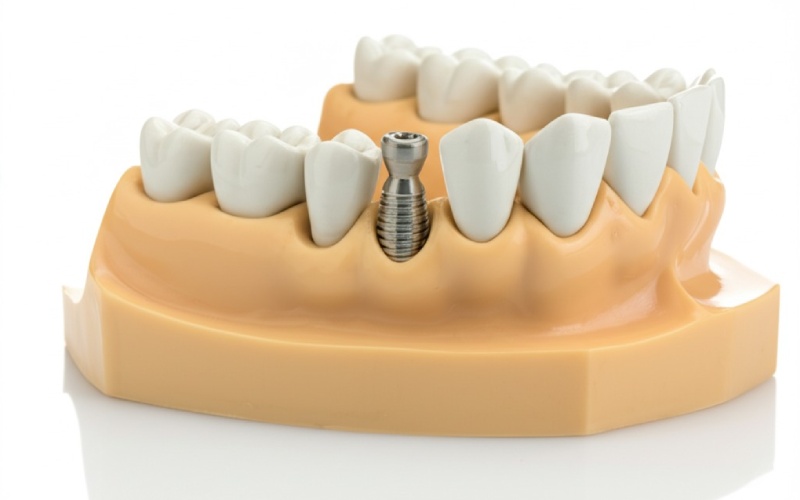
- Implant-supported single crowns: Specify the implant system, platform size, and scanbody reference. Output options: screw-retained (Ti base + zirconia) or cement-retained (custom abutment + crown). Ti base + zirconia is more common for retrievability.
- All-on-X (4–6 implants per arch): Full digital design, milled titanium bar + zirconia/PMMA, or milled monolithic zirconia over a titanium bar. Screw access through zirconia. Verification structures are recommended for the bony workflow.
Complication rates from the literature (full-arch, 5–15 year follow-up):
- Veneered-zirconia chipping: 15–35%
- Screw loosening: 5–15%
- Framework fracture: <5%
If a lab proposes all-veneer zirconia for an All-on-X case, ask whether monolithic zirconia over a titanium bar was considered—the complication profile is meaningfully different.
Zirconia Materials and Cementation: Quick Reference
| Material | Resistencia (MPa) | Translucency | Lo mejor para |
| Zirconia 3Y-TZP | 900–1200 | Bajo | Posterior, bridges, bruxers |
| Zirconia 4Y-PSZ | 700-900 | Medio | Premolars, moderate-load |
| Zirconia 5Y-PSZ | 600–800 | Alta | Anterior, veneers |
| Lithium disilicate (e.max) | 350–530 | Alta | Anterior, single units |
| Cement | When | Protocol |
| RMGI | Adequate retention (≥3 mm height) | Conventional cementation |
| Self-adhesive resin | Adequate retention | Conventional cementation |
| Resin + MDP primer | Short/over-tapered preps, veneers | Adhesive cementation |
Frequently Asked Questions About Zirconia Crowns
Is zirconia a type of ceramic?
Yes. Zirconia is a crystalline ceramic (zirconium dioxide, ZrO₂). “All-ceramic” and “zirconia” aren’t opposites—zirconia is one of several ceramics used in dentistry, alongside lithium disilicate, leucite-reinforced glass-ceramic, and alumina.
When should I choose 3Y over 5Y?
3Y for posterior crowns, bridges, implant abutments, and any high-load or bruxer case. 5Y for anterior single units and veneers where translucency matters more than maximum strength. 4Y is the middle ground for premolars and moderate-load bridges.
What’s the thinnest I can prep for a zirconia crown?
0.5 mm at the margin and 0.8 mm axial are realistic minimums for monolithic 3Y. For 5Y anterior cases, stay at 1.0 mm or above to avoid fracture. Below 0.5 mm, the risk-reward stops favoring zirconia.
Can I bond zirconia the same way I bond e.max?
No. Hydrofluoric acid and silane work on the glass phase in lithium disilicate but do nothing to zirconia. You need 50 µm alumina air-abrasion + a 10-MDP primer + a compatible resin cement.
Does glazing stop LTD?
No. A 2-year clinical study detected LTD changes even on glazed crowns. Glazing helps wear resistance and esthetics, but it doesn’t block hydrothermal transformation at the surface.
What if a crown doesn’t seat?
Don’t force it. Check the seating path for interproximal contact tightness, then the internal fit with silicone or pressure-indicator paste. A well-tracked lab should have first-pass approval data—and if a particular prep keeps producing tight fits, flag it for design review.
What about the cost difference between zirconia and PFM?
The lab material cost for zirconia is often similar to or lower than PFM (depending on the alloy). The chairside price difference mostly reflects lab fees, equipment amortization, and clinical positioning. If price is a patient concern, ask your lab for their per-unit lab fee by material—it usually surprises people.
How long should a zirconia crown last?
Systematic reviews put 5-year survival at around 96–97% for monolithic zirconia single units. Failures beyond that are usually biological (recurrent decay, endodontic) rather than material-driven. 10-year data is starting to mature and tracks the same pattern.