Multilayer Zirconia Crowns: Strength, Esthetics and Clinical Applications
Multilayer zirconia showed up a few years ago promising to fix the “strong but opaque” problem with first-gen monolithic zirconia. The pitch was simple: gradient blocks that look better than old-school white zirconia but don’t chip like porcelain-layered stuff.
That’s mostly true. But the details matter, especially if you’re deciding between this and e.max, or trying to figure out why a crown debonded, or wondering if the 0.8 mm prep you just did is going to work.
Indholdsfortegnelse
What Is a Multilayer Zirconia Crown?
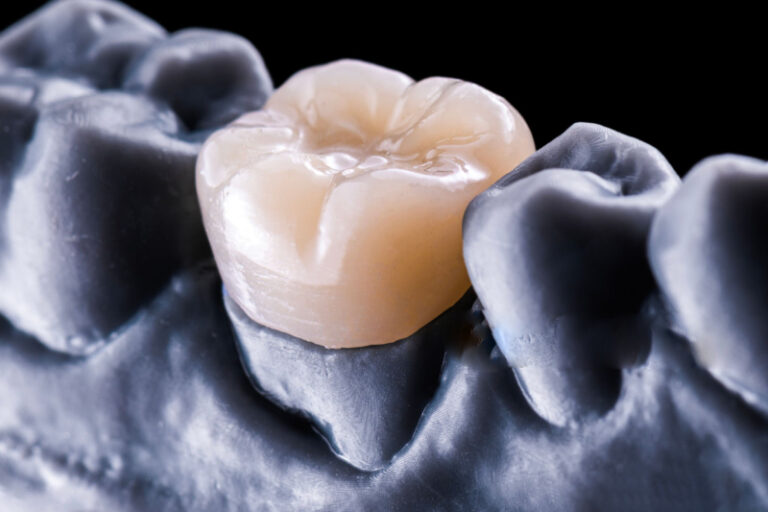
A multilayer zirconia crown comes from a single block that’s been manufactured with color and translucency gradients already baked in. You mill it, sinter it, polish or glaze it — done. No hand-layering porcelain on top.
The gradient mimics how a natural tooth works: more translucent at the incisal edge, more opaque toward the gumline. The block maker controls this by varying yttria content during manufacturing — usually 3Y-TZP at the base (strong, opaque) transitioning to 4Y or 5Y-PSZ higher up (weaker, more translucent).
This is fundamentally different from porcelain-fused-to-zirconia (PFZ), where you’re stacking two materials with different expansion coefficients and hoping the interface holds. With multilayer, there’s no interface. The whole thing is zirconia, just with different zones.
Strength and Material Properties of Multilayer Zirconia
The standard line is that 3Y zirconia hits 1,100–1,200 MPa flexural strength, while 5Y is around 600–800 MPa. Published research backs that up.
But when you actually test commercial products, the numbers get messier. Some tested 3Y materials averaged closer to 584 MPa, and some 5Y formulations came in at 373 MPa. That’s a big gap between the spec sheet and the lab bench.
What this means clinically: the cervical base of a multilayer crown is genuinely strong — probably overkill for most single-crown loads. The translucent incisal third is notably weaker. That’s the trade-off. You’re not getting uniform 1,200 MPa all the way through; you’re getting a strength gradient that matches an esthetic gradient.
For posterior crowns and bruxers, that’s usually fine as long as you maintain thickness. For ultra-thin preps or three-unit bridges, it starts to matter.
Low-Temperature Degradation of Multilayer Zirconia
All zirconia — 3Y, 4Y, 5Y, whatever — slowly transforms from tetragonal to monoclinic crystal structure when it sits in your mouth. This is called low-temperature degradation (LTD).
It’s not dramatic. It’s not fast. But over five, ten years, the surface integrity changes. A study tracking 3Y-TZP crowns for five years found measurable LTD in vivo.
The open question with multilayer blocks: do the different yttria zones age at different rates? Probably. We just don’t have 15-year data yet.
This isn’t a reason to avoid multilayer zirconia. It’s a reason to stop pretending zirconia is indestructible.
Multilayer Zirconia Crown Survival Rates
Short answer: yes, when done right.
A five-year study of 50 monolithic zirconia posterior crowns reported 98% survival, zero fractures. Two debonded, one root fractured (not the crown’s fault).
Another RCT comparing translucent monolithic zirconia to metal-ceramic found 100% survival in both groups at five years.
The most interesting data comes from a head-to-head of monolithic versus partially veneered zirconia:
- Failure-free survival: 93.1% (monolithic) vs 96.2% (veneered) — p = 0.111, not statistically significant
- Ceramic fracture-free: 100% (monolithic) vs 98.6% (veneered)
- Both groups got excellent esthetic ratings
Translation: if you’re worried monolithic can’t compete with layered on survival, the data says otherwise. The difference is noise. But 100% fracture-free versus 98.6% tells you something real about eliminating that porcelain-zirconia interface.
Tooth Preparation and Minimum Thickness Requirements
This depends on what you’re making and how strong it needs to be.
| What you’re doing | How much space | Hvorfor? |
| 3Y monolithic (high-strength) | 0.7–1.0 mm | Manufacturer spec; strong enough to go thin |
| 4Y/5Y multilayer (standard) | ≥1.0 mm | Functional areas; translucency costs strength |
| Porcelain-layered (PFZ) | 1.5–2.0 mm total | You need room for the veneer layer |
| Bruxer / heavy load | 1.0–1.5 mm occlusal | More is better when force is high |
Fatigue research on gradient zirconia specifically says to maintain at least 1.0 mm for single crowns, even though some in-vitro tests show it can survive at 0.5 mm. Lab testing and clinical reality are different things.
If you prep 0.7 mm and the case comes back fractured, the lab’s going to point to this table.
Margin-wise: chamfer or shoulder, 0.5–0.7 mm minimum. No feather edges — zirconia needs bulk.
Clinical Indications and Limitations of Multilayer Zirconia Crowns
Works well for:
- Anterior single crowns where you want both strength and decent esthetics
- Posterior crowns with ≥1.0 mm clearance
- Bruxers (no porcelain to chip off)
- Implant crowns (handles off-axis loading)
- Situations where you have 1.0–1.2 mm but not 1.5–2.0 mm
Doesn’t work for:
- Ultra-thin preps (<0.7 mm) — you’re asking for trouble
- Cases where you need maximum translucency and e.max would actually be better
- Short clinical crowns with limited bonding area
Translucency and Esthetics of Multilayer Zirconia Crowns
Multilayer blocks get you into the 43–46% translucency range at the incisal edge for high-trans variants. Lithium disilicate is around 70%. You can see the difference.
For A2–B3 shades in normal lighting, multilayer zirconia looks fine. For extreme esthetics — think central incisors on a 22-year-old who smiles a lot — e.max is still the better call if you have the prep space and the patient isn’t a grinder.
Color stability research shows that different layers can age differently when exposed to staining. Thinner sections let more substrate color through. Dark preps show. Substrate matters.
If you’re trying to match extreme shades (bleach white or tetracycline gray), multilayer zirconia is going to frustrate you. It’s a middle-ground material. That’s the point.
Bonding and Cementation of Multilayer Zirconia Crowns
Zirconia is inert. Hydrofluoric acid does nothing to it. You can’t etch it the way you etch e.max.
Den APC protocol is the standard:
- Airborne-particle abrasion: alumina 30–50 μm, 0.25 MPa, 10 mm distance
- Primer with MDP: 10-methacryloyloxydecyl dihydrogen phosphate chemically bonds to zirconia
- Resin cement: not glass ionomer, not temporary cement, resin
Bond strength studies confirm this. Skip the sandblasting or use the wrong primer, and you’re relying on mechanical retention alone. That’s not enough for all-ceramic restorations with minimal undercuts.
Cement choice:
- Adhesive resin cement: required if retention form is weak
- Self-adhesive resin: acceptable if the prep is well-retained (≥4 mm height, good taper)
- Glass ionomer: don’t
If a multilayer crown debonds and the intaglio surface is smooth and shiny, somebody skipped the sandblasting. That’s the most common failure.
Polishing vs Glazing Zirconia Crowns
Opposing enamel wear studies60005-0/fulltext) show that polished zirconia wears the other arch less than glazed zirconia. The reason: glaze layers are thin, and when they chip during function, you get rough ceramic edges that act like sandpaper.
Finishing protocol after try-in:
- Remove rough spots with fine diamond (15–30 μm)
- Polish systematically — rubber wheels or diamond paste
- Optionally glaze for esthetics (thin, uniform layer)
If you do glaze and then adjust occlusion later, repolish afterward. Leaving rough adjusted spots is worse than not glazing at all.
Sintering
Follow the block manufacturer’s spec. Typical range is 1,450–1,550°C conventional or 1,500–1,600°C speed sintering for single units.
Common mistakes:
- Wrong temperature → incomplete densification or grain overgrowth
- Fast cooling → thermal stress, microcracks
- Dirty furnace elements → discoloration
- Overcrowding the tray → uneven shrinkage
Systematic reviews of sintering protocols show speed sintering can work if you stay within spec, but some high-translucency materials lose strength with accelerated cycles. Read the IFU.
Multilayer Zirconia vs Other Crown Materials
Multilayer Zirconia vs Porcelain-Layered Zirconia (PFZ)
| Multilayer Monolithic | PFZ | |
| Structure | One piece, gradient block | Zirconia core + hand-applied porcelain |
| Flisning | Minimal (no interface) | Higher (veneer can delaminate) |
| Prep depth | 1.0–1.2 mm typical | 1.5–2.0 mm |
| Vendepunkt | 5–7 days | 7–10 days (porcelain adds steps) |
| Posterior use | Fremragende | Works but veneer fracture is common |
| Max esthetics | Very good | Excellent (when it stays intact) |
Five-year data shows no survival difference (p=0.111), but 100% fracture-free for monolithic versus 98.6% for veneered. That 1.4% is all veneer chips.
Multilayer Zirconia vs Lithium Disilicate (e.max)
| Multilayer Zirconia | Litiumdisilikat | |
| Styrke | 600–1,200 MPa (gradient) | ~400 MPa |
| Translucency | 43–46% (high-trans) | ~70% |
| Minimum thickness | 1.0 mm | 1.5–2.0 mm (bonded) |
| Limning | MDP adhesion (moderate) | HF etch + silane (high dependency) |
| Bruxers | Ja | Nej |
| Anterior esthetics | Very good | Fremragende |
Use e.max when translucency is non-negotiable and you have the prep space. Use multilayer zirconia when strength matters or the patient grinds.
Multilayer vs Conventional Monolithic Zirconia
Multilayer is just better-looking. Strength in the base is similar to solid 3Y-TZP; the translucent zones are weaker but still stronger than e.max.
Standards and Documentation
Zirconia materials fall under:
- ISO 6872:2015 — test methods and requirements for dental ceramics
- ISO 13356 — yttria-stabilized zirconia for implants
- FDA 510(k) clearance (varies by manufacturer, required for US market)
Labs should document: product name, lot number, declared strength (with test method), sintering protocol, yttria content.
Don’t rely on marketing terms like “ultra-translucent” or “high-strength multilayer.” Actual performance varies between products. Ask for tested data.
Troubleshooting
Shade doesn’t match
- Wrong block shade selected before milling
- Not enough thickness (substrate showing through)
- Dark abutment color\ → Verify shade with adjacent teeth before milling; maintain ≥1.0 mm; consider staining or opaque cement
Rough surface after adjustment
- Ground through glaze, left unfinished\ → Systematic polishing after any adjustment; diamond paste (0.25–1 μm) for final pass; consider reglaze + repolish if severe
Debonding
- No sandblasting, wrong primer, wrong cement\ → Alumina sandblast + MDP primer + resin cement is non-negotiable; glass ionomer will fail
Fracture
- Too thin, sintering error, material defect\ → Maintain ≥1.0 mm in functional areas; verify sintering parameters; inspect for pre-existing cracks before cementation; use 3Y-TZP for extreme bruxers instead of high-trans grades
Bottom Line
Multilayer zirconia works for most cases where you need reliable strength and decent esthetics. It’s not the most translucent option, but it won’t chip like layered porcelain, and five-year data shows survival over 93% when protocols are followed.
Use it when:
- You need strength (posterior, bruxers, implants)
- Prep space is 1.0–1.5 mm
- Shade target is A2–B3 range
- You want to eliminate chipping risk
Skip it when:
- Maximum translucency is required (extreme esthetic cases)
- Prep is <0.8 mm (too thin for safe use)
- Severe staining needs complete masking
Adhesive protocol (sandblast + MDP + resin) isn’t optional. Surface finishing matters — polished zirconia wears opposing enamel less than fractured glaze.
The clinical evidence supports both monolithic and well-made veneered zirconia. The difference is that monolithic eliminates one failure mode (veneer delamination) at the cost of a small esthetic compromise.
About Manufacturing
The workflow described here reflects how integrated labs handle multilayer zirconia — CAD design, block selection, 5-axis milling, sintering, characterization, finishing, QC, shipment. Turnaround for standard multilayer cases runs 5–7 business days in high-volume production environments.
ASD operates manufacturing in Shenzhen and Huizhou, China (established 2012), processing approximately 8,000–15,000 zirconia single crowns monthly depending on season, serving dental laboratories and clinics in multiple markets. Factory visits available for quality verification.