Layered Zirconia Crown — Product Specification & What the Evidence Can (and Can’t) Tell You


🕢 [ Udfyld formularen, så svarer vi inden for 30 minutter! ].
Full-service dental lab. Direct factory. No middlemen. Serving dentists, clinics, and dental laboratories in the U.S., Germany, Netherlands, and wider Europe since 2012. Shenzhen & Huizhou, China — 460 staff, 9-step in-house workflow, 8,000–15,000 crowns/month.
What “layered zirconia crown” and “porcelain layered zirconia” actually mean
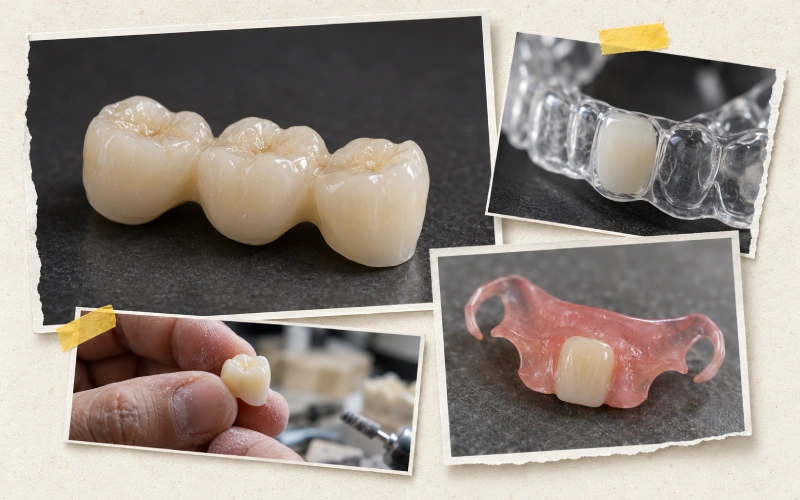
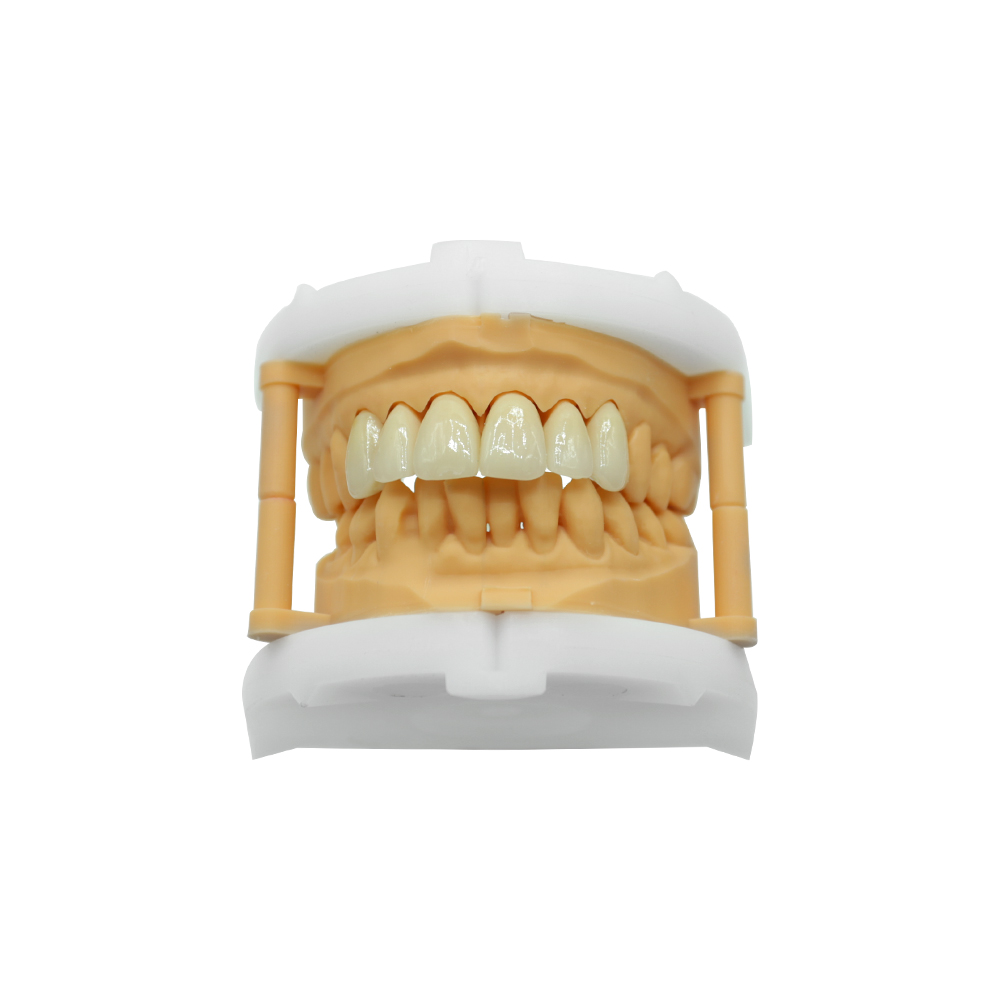
First thing: lagdelt zirkonia-krone og porcelain layered zirconia describe the same construction — a zirconia framework plus a separate porcelain layer stacked on top and fired. Same restoration, multiple names in circulation: veneered zirconia, PFZ (porcelain-fused-to-zirconia), porcelain-layered zirconia. [peer-reviewed evidence]
One distinction that needs to be made up front: layered is not multilayer. Multilayer usually means a shade gradient inside the zirconia blank itself — multiple translucency or color zones stacked during blank manufacturing. Layered means an externally applied porcelain veneer on a zirconia coping. Different construction, different failure location, different clinical action when failure happens.
Also: “porcelain layered zirconia” is not a regulatory term. It’s a clinical label. FDA classification is 21 CFR 872.6660, Class II, product code EIH — that covers porcelain/ceramic crown and bridge materials generally; the device cleared under 510(k) is the specific manufacturer’s product, not the construction type. And 510(k) cleared ≠ FDA approved — clearance demonstrates substantial equivalence to a predicate device, not clinical superiority.
What layered zirconia actually delivers (and what it trades off)
Core characteristics
A layered zirconia crown consists of:
- Zirconia framework — milled from a pre-sintered block, then densely sintered. This is the structural support layer. ISO 6872 classifies dental ceramics into Classes 1–5 by flexural strength; high-strength zirconia blocks typically reach Class 5 (>800 MPa). [ISO standard]
- Porcelain veneer — feldspathic or fluorapatite porcelain, applied in layers over the framework and fired. This is the esthetic layer — it controls dentin shade, enamel translucency, incisal effects, surface texture.
The framework handles load; the veneer handles optics. And here’s the trade-off: the veneer is also the failure-prone layer.
Prep design — what your preparation needs to allow
A layered zirconia restoration only performs as well as the preparation underneath it. Published and manufacturer-issued prep guidelines converge on:
| Surface | Reduction | Margin | Taper |
| Occlusal | 1.5–2.0 mm | - | - |
| Axial | 1.0–1.5 mm | - | - |
| Margin | - | chamfer (light / heavy) or shoulder with rounded internal line | - |
| Total taper | - | - | 6°–10° |
Framework thickness is a separate question from total reduction. Manufacturer guidance tends to ≥0.8 mm; some peer-reviewed work cites 0.5 mm as a functional floor. Below that, fracture risk rises non-linearly. [prep guidelines, industry]
Connector cross-section for bridges (when applicable): ≥7 mm² anterior, ≥9 mm² posterior. Smaller connectors are the dominant fracture-initiation site in layered zirconia bridge studies. [fabrication literature]
What this means for case acceptance: when we receive a case with sub-spec reduction or short connectors, the lab returns it with a written note rather than proceeding silently. The restoration’s published survival numbers assume a spec-compliant prep.
Indications & contra-indications — what layered zirconia is and isn’t a fit for
Commonly a good fit:
- Posterior single crowns and short-span bridges where framework strength matters more than maximum translucency.
- Anterior single crowns where shade matching and incisal effects are the priority, and prep geometry supports a veneered construction.
- Implant-supported single crowns — the 3-year systematic-review cohort where veneered and monolithic showed equivalent survival. [systematic review]
Worth pausing on:
- Patients with parafunctional habits (bruxism, clenching) — veneer chipping is the failure mode, and the 1.65% annual figure is from a non-parafunctional cohort. Night-guard discipline and case selection matter. [systematic review]
- Very thin anterior preparations (<1.0 mm axial) — framework thickness can’t be preserved; layered construction may not be the right choice.
- Long-span bridges with small connector cross-sections — veneered zirconia is not the most predictable material here.
Generally not the first choice:
- Full-arch, immediate-load implant prostheses — most published protocols in that space use monolithic or titanium-reinforced frameworks, not hand-layered porcelain.
- Cases where the patient expects zero maintenance — no crown material offers that; the honest expectation is low maintenance, not no maintenance.
Why pick a layered zirconia crown from a direct, in-house lab
This is the part where lab choice matters as much as material choice. Three things drive outcomes that the material data sheets can’t:
1. The lab controls the variables the systematic reviews can’t see
Survival numbers are pooled across labs, technicians, scanners, sintering furnaces, and porcelain batches. Pooled variance hides lab-to-lab variance. Choosing a lab that runs every step in-house removes one of the largest uncontrolled variables in the published data: sub-contracted steps where the original lab doesn’t actually know what happened to the framework between milling and firing.
Our workflow runs end-to-end inside our facility: design, milling, sintering, layering, glazing, finishing, packing. Nothing is sub-contracted. The lab that scans your case is the lab that delivers your crown.
2. Framework thickness is a fabrication decision, not just a design parameter
The 0.5 mm vs 0.8 mm floor isn’t a fixed number — it’s the outcome of milling-machine calibration, sintering-shrinkage compensation, and the technician’s tolerance check. In-house control of each step is what lets us hold to spec consistently.
3. Layering isn’t a step — it’s a craft
The porcelain layering and glazing step is done by hand by trained ceramic technicians, on a workforce scale that allows dedicated specialization rather than one technician doing every step. Specialized ceramic technicians layer more predictably than generalists — that’s why high-end labs structure their teams that way.
Our fabrication process — the 9-step in-house workflow
This is what we do, in the order we do it, and who does it.
| Trin | What happens | Who |
| 1. Case intake & assessment | Impression / scan check, prep-spec verification, shade prescription review | Intake QC |
| 2. CAD design | Margin tracing, framework design, connector geometry, reduction check against prep | ~100 CAD designers |
| 3. 3D printing | Resin patterns / models for verification | Printing team |
| 4. CAM milling | Pre-sintered zirconia blank milling | ~70 CAM operators |
| 5. Sintering | High-temperature densification per ISO 6872 material spec | Sintering team |
| 6. Porcelain layering and glazing | Hand-built dentin / enamel / incisal layers, vacuum firing | ~70 ceramic technicians |
| 7. Polishing & finishing | Surface texture, glaze, final contour | Finishing team |
| 8. Quality control | Per-unit QC: margin fit, occlusion contact, shade, contacts, framework thickness check | ~25 QC staff, every unit |
| 9. Packaging & dispatch | Lot/batch documentation, CoC, padded shipping | Logistics |
Throughput scale: 8,000–15,000 single crowns per month, peak capacity 15,000; 2,000–3,000 bridge units per month.
How a case flows from your practice to a delivered crown
- [STEP] Send the case — digital scan (TRIOS, iTero, 3Shape) or conventional impression; include prep photos, shade prescription, and any framework / layering instructions.
- [STEP] Case assessment — we review prep-spec compliance, margin clarity, and shade prescription. If anything is off, we email you a written note before starting — no silent proceed.
- [STEP] Design approval (on request) — for cases where design sign-off matters (large bridges, complex shade), we send a preview screenshot or photo before milling.
- [STEP] Production — the nine-step workflow above; production lead time depends on case complexity and queue position.
- [STEP] Per-unit QC — margin fit, contacts, occlusion, shade match, framework thickness check; QC photo on request.
- [STEP] Dispatch — lot/batch CoC, padded shipping, tracking number; standard transit per your region.
What we need from you to start a case:
- Final impression or intraoral scan
- Prep photos (shade tab in frame)
- Shade prescription (Vita classical / 3D, or custom shade description)
- Framework / layering instructions (where applicable)
- Desired delivery date (if time-sensitive)
OFTE STILLEDE SPØRGSMÅL
Q: Is any step sub-contracted?
A: No. Design, milling, sintering, layering, glazing, finishing, and packing all run inside the facility. The lab that scans your case is the lab that delivers your crown.
Q: What’s the ISO standard the framework meets?
A: Dental ceramics are classified under ISO 6872; high-strength zirconia frameworks reach Class 5 (>800 MPa flexural strength).
Q: Can we approve the design before milling?
A: Yes, on request. For cases where design sign-off matters (large bridges, complex shade), the lab can send a preview screenshot or photo before milling.
Q: What QC does each unit go through?
A: Per-unit QC: margin fit, contacts, occlusion, shade match, framework thickness check. QC photo on request.
Q: If it chips, can it be repaired?
A: Sometimes yes, sometimes no. Small chips in the porcelain veneer are sometimes repairable with composite; larger chips or framework exposure typically mean remakes. There’s no industry-wide “repair vs replace” verdict for layered zirconia — the decision is case-specific.
Q: What’s the dominant failure mode?
A: Veneer chipping, not framework fracture. The annual chipping rate is around 1.65% for veneered zirconia vs 0.39% for monolithic — and the underlying systematic review explicitly notes this is a non-parafunctional cohort number.
Q: Does layered zirconia have a higher chipping risk than lithium disilicate?
A: The two materials fail differently and the head-to-head 10-year RCT data doesn’t exist yet. Use case — bonded single-unit esthetics vs framework strength in load-bearing situations — drives the choice.
Compliance, documentation, and traceability
- FDA classification: 21 CFR 872.6660, Class II, product code EIH. 510(k) clearance status: the device cleared is the specific manufacturer’s product, not the layered construction as a category.
- Material standard: dental ceramics are classified under ISO 6872; high-strength zirconia frameworks reach Class 5 (>800 MPa flexural strength).
- ADA reference materials: the ADA evaluates ceramic materials for indirect restorations and publishes guidance; ceramic systems used here are referenced against current ADA guidance.
- Per-case traceability: every unit ships with a lot number, batch number, and material specification; CoC provided on request.
Oplev hurtigere ekspeditionstider med vores banebrydende teknologi


< class="ct-module-title">
Trending nu