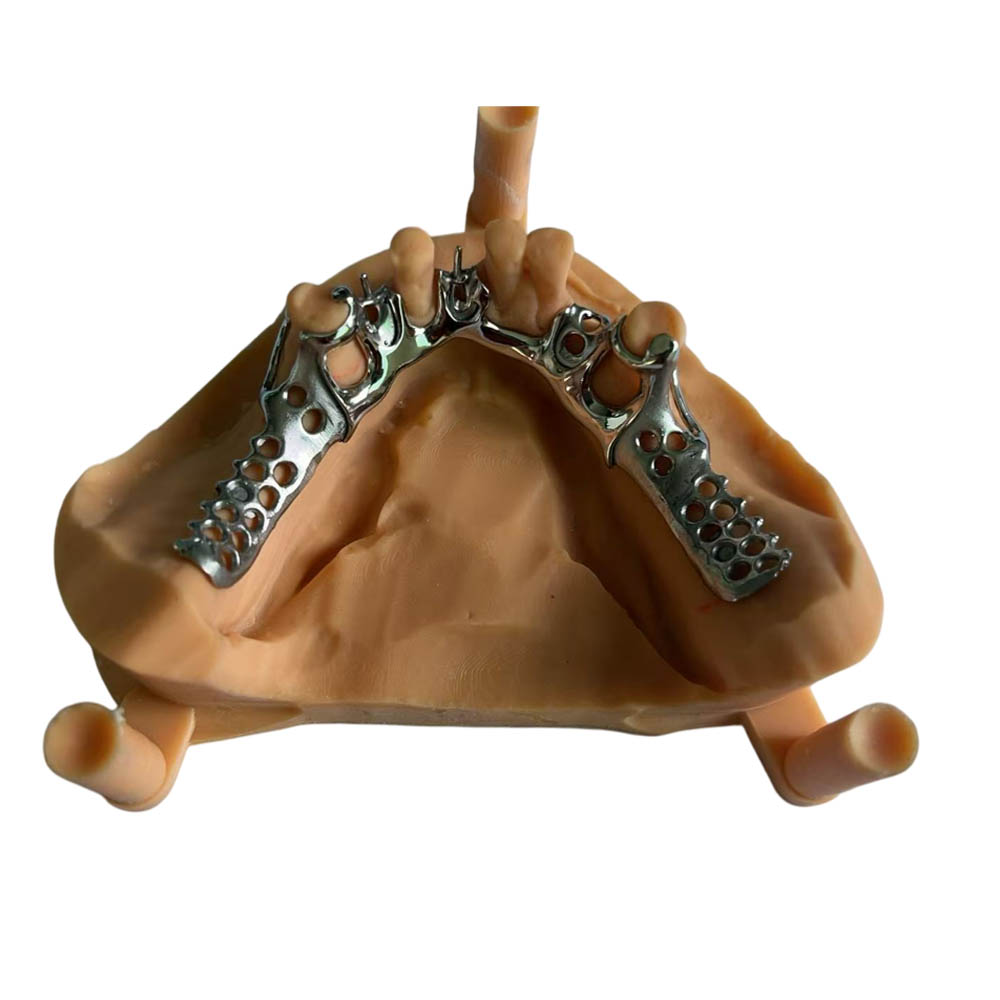
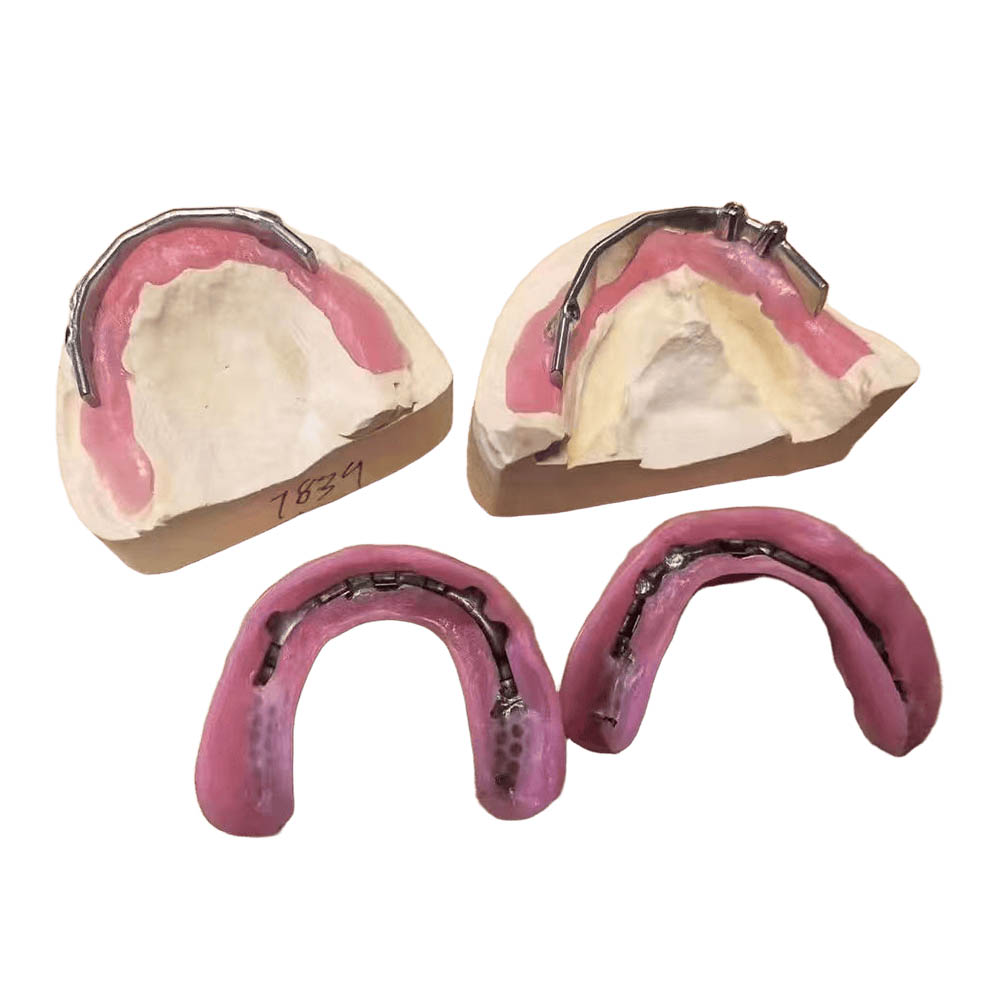
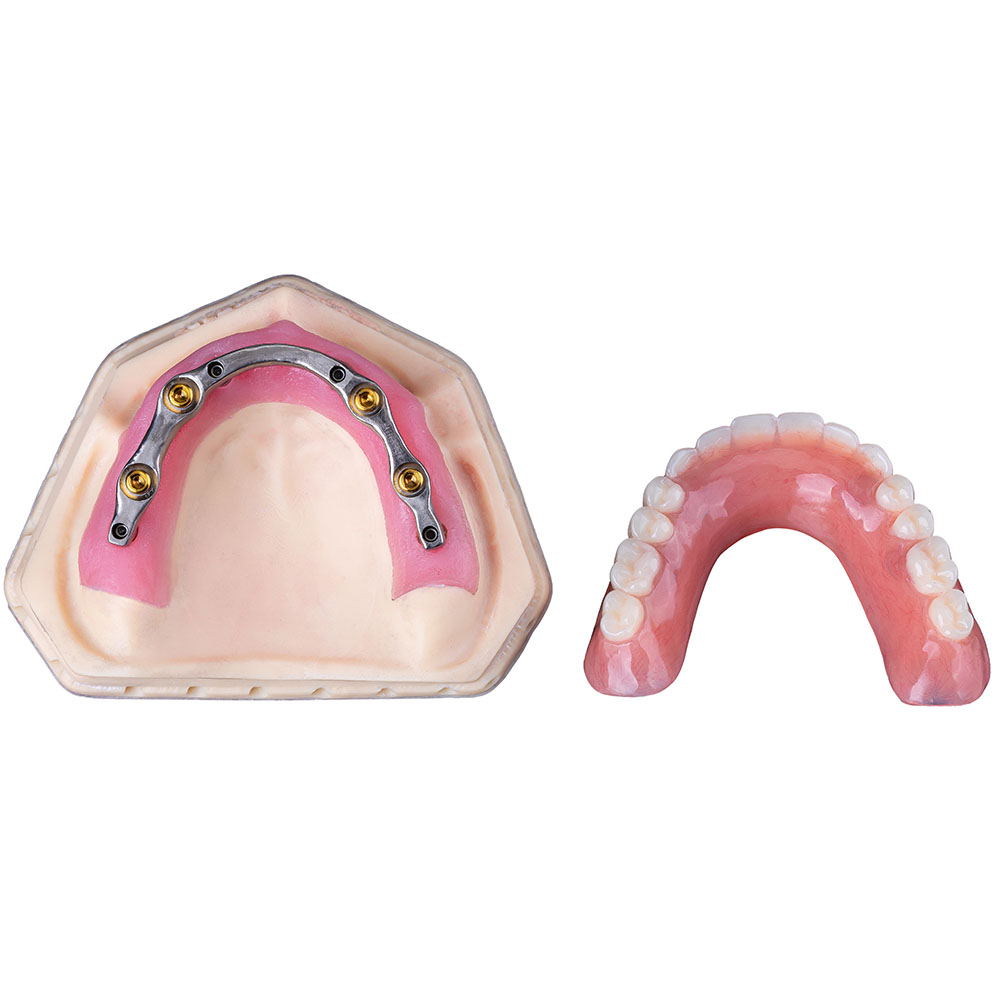
Upper Implant Denture Case: Palateless Overdenture on Four Anterior Implants
🕢 [ Попълнете формуляра и ние ще ви отговорим в рамките на 30 минути! ]
This case page is for dental professionals. ASD Dental Lab is a full-service manufacturing facility — we produce every step in-house from CAD design to final inspection. Founded in 2012, with facilities in Shenzhen and Huizhou, China.
Case Overview
| Field | Detail |
| Arch | Maxilla (upper) |
| Restoration type | Сменяем implant-supported overdenture, palateless (horseshoe) design |
| Implant configuration | Four implants, placed anteriorly by the referring dentist |
| Retention mechanism | Individual Locator attachments (prescribing clinician’s choice) |
| Framework | U-shaped кобалт-хром metal framework, designed for load distribution without palatal coverage |
| Base material | High-impact denture base polymer meeting ISO 20795-1 standards |
| Teeth | Prefabricated acrylic denture teeth, shade-matched to patient request |
| Manufacturing date | February 2025 |
| Delivery location | Netherlands (shipped from ASD facility in Shenzhen) |
Patient Situation
A 68-year-old patient had been wearing a conventional complete upper denture for 14 years. This is a common pattern in the upper denture implants case mix: patients who had a conventional denture for a decade or more, then either wanted something that does not move or wanted to restore lost taste and comfort. Three recurring problems were documented in the prescription notes:
- The denture moved constantly. It lifted during speech and rocked when chewing. The patient had started using adhesive daily, which he described as “uncomfortable and messy.”
- The palatal plate covered the entire roof of his mouth. He said food had no taste, and the thickness of the plate triggered a gag reflex every time he tried to eat hot soup.
- The ridge kept shrinking. Each reline lasted shorter than the one before, and the dentist’s notes mentioned posterior maxillary bone resorption and sinus pneumatization making the ridge less favorable for conventional retention.
The patient had been told about a fixed implant-supported full-arch bridge years ago, but he declined it then and still declined it in 2025. His reasons: he wanted something he could remove and clean himself, he did not want more bone reduction, and he preferred a lighter prosthesis.
Doctor’s Requirements to the Lab
These are the manufacturing instructions we received from the prescribing dentist in the Netherlands. They show what the prosthesis had to satisfy simultaneously — not just “make a denture,” but a specific set of constraints.
1. Palateless design with a rigid metal framework
No coverage of the hard palate beyond a narrow posterior seal border, supported by a U-shaped cobalt-chromium framework engineered to carry the load that would otherwise rest on the palate. The framework is structural, not decorative.
2. Four implants, all placed in the anterior maxilla
The posterior maxilla could not accept implants without a sinus-floor elevation the patient declined at this stage. The implant positions were decided by the surgeon based on CBCT imaging and available bone.
3. Individual Locator attachments, not a bar
The dentist specified Locator abutments with nylon retention inserts that the patient can replace when they wear out. Retention loss is predictable — inserts wear over 6–18 months depending on use. Individual attachments let the dentist service one site without disassembling the whole prosthesis.
4. Insertion path verified at framework try-in
With four supports and no palatal bracing, a binding insertion path is the shortest route to a loose denture and tissue irritation. We checked parallelism at the metal framework stage with the implant analogs on the master model before any acrylic was processed.
5. Base thickness reserved for future relining
The dentist asked for a denture base thick enough to allow at least one chairside reline without exposing the framework or running out of material. Overdenture prostheses over five years of use should be evaluated for replacement (ACP maintenance position, same source as the definitions above), but “five years” is a trigger for assessment, not a hard expiration date. A well-maintained overdenture may serve much longer if it is relined when fit changes.
6. Tooth mold, shade, and arrangement confirmed before processing
The patient did not want to “look different.” The dentist sent two reference photos (the patient smiling in 2010 with his natural teeth, and his current conventional denture). Shade was matched to Vita A2, mold was Ivocryl anterior #8 medium-narrow, and the arrangement was tried in wax before we processed the final base.
7. Bisque try-in with framework seated
The framework was cast, finished, and seated on the master model. The wax try-in denture was set up with the framework in place so the dentist could assess load-bearing contact, esthetics, and insertion at the same appointment.
8. Complete delivery set
We shipped:
- Master cast with implant analogs positioned to match the intraoral locations
- Cobalt-chromium framework (cast and polished)
- Processed acrylic denture with framework embedded
- Four Locator housings (metal) picked up in the denture base
- Four sets of replacement nylon inserts (clear, pink, blue retention levels)
- Printed insertion/removal and daily cleaning instructions in Dutch
How We Built It
ASD in-house workflow — from data receipt to shipment, nothing was outsourced.
- Data verification
Received STL files of the master impression with Locator abutment analogs. Checked analog position, occlusal plane orientation, and that all four analogs were digitally captured without dropouts or distortion. - Framework CAD design
Designed the U-shaped cobalt-chromium framework with:- Palatal relief extending 8mm from the gingival margin, stopping before the vibrating line
- Four attachment housings positioned to align with the Locator abutment axes
- 1.2mm minimum thickness at the palatal bar, 1.5mm at the buccal strut
- Calculated insertion path to avoid undercuts on all four analogs simultaneously
- Framework casting and finishing
Cast in cobalt-chromium alloy (ISO 22674 Type 4), sandblasted, and polished. Verified passive fit on the master model with a one-screw test: tightening one Locator analog should not lift the framework off the other three. - Wax try-in
Set up acrylic teeth on a wax base with the framework seated on the master model. This shows the actual vertical dimension and lip support the final prosthesis will have, not an idealized wax-only try-in. - Final processing
Flasked, packed with heat-polymerized acrylic resin meeting ISO 20795-1 requirements, cured, deflasked, trimmed, and polished. The framework is fully embedded in the base — the patient sees only the gingival-pink base and white teeth, not exposed metal. - Locator housing pickup
Positioned the four metal Locator housings into the recesses in the denture base, verified alignment with the analogs, and processed them in place with autopolymerizing resin. Each housing must capture without binding and release without tipping. - Final inspection
- Framework seating: no rocking, all four housings engage the analogs without force
- Occlusion: balanced contact in centric relation, no premature contact in lateral or protrusive excursions
- Esthetics: tooth arrangement matches the try-in approval, no visible metal, polished finish
- Retention: clear nylon inserts (lightest retention) installed; pink and blue (medium and firm) included as spares
- Packaging and shipping
Packaged the denture in a rigid case with the master model, framework, spare inserts, and printed care instructions. Shipped via DHL from Shenzhen to the Netherlands. Transit time: 4 business days.
What the Dentist Verifies at Delivery
We asked the prescribing dentist to confirm and document:
- Framework seating: Does the prosthesis seat fully with no rocking, and can the patient insert it along the intended path without tipping or binding?
- Retention: Do the Locator attachments click in with audible and tactile snap, and can the patient remove the denture unaided?
- Occlusion: Balanced contact in centric and smooth guidance in excursions, checked against the opposing arch (in this case, a conventional lower complete denture).
- Tissue clearance: No blanching or impingement on the thinned posterior ridge; no over-extension of the labial or buccal flanges.
- Patient demonstration: The patient physically removed, cleaned under running water, and re-seated the prosthesis in the chair. If he cannot do this confidently at delivery, the design needs adjustment.
Follow-up We Recommended
This is where an overdenture differs from a fixed bridge: the prosthesis and the implants do not share a service life (ACP, Maintenance of Full-Arch Implant Restorations).
| Component | What to watch | Replacement interval |
| Locator nylon inserts | Retention loss is the most common service event. Inserts wear with daily insertion/removal cycles. | Patient reported retention loss at 9 months; dentist replaced all four inserts with pink (medium retention) at first recall. |
| Denture base fit | The ridge changes even with implants present. Relining is routine maintenance, not a failure (ACP, The Frequency of Denture Replacement statement). | Chairside reline performed at 18 months due to slight rocking. |
| Acrylic teeth | Wear, staining, chipping. In this case, no fractures reported after 11 months. | None needed yet. |
| Framework integrity | Check for cracks or loose solder joints (none in this case — the framework was one-piece cast). | Няма. |
| Peri-implant tissue | Assessed by the dentist at 3, 6, and 12-month recall. Plaque control around Locator abutments is critical. | Patient maintained good hygiene; no mucositis at 11-month follow-up. |
What Went Wrong (and How We Fixed It)
At framework try-in, the dentist reported that the framework seated but rocked slightly when pressure was applied to the left posterior region. We asked for the framework back.
Root cause: One of the four Locator housings was 0.3mm out of alignment — not enough to prevent seating, but enough to create a fulcrum.
Correction: We re-milled the housing recess in the framework, repositioned the metal housing with a verification jig on the master model, re-processed the pickup with fresh acrylic, and re-polished. Verified passive fit with the one-screw test before shipping it back. The dentist confirmed stable seating at final delivery.
Why we document this: A case page that only shows perfect outcomes is not credible. Dental lab work involves tolerances, and sometimes a housing needs repositioning. What matters is catching it at try-in, not at final delivery.
What This Case Illustrates About Upper Implant Dentures
- “Upper” is doing real work in the keyword.
The maxilla has softer cancellous bone than the mandible, and immediately loading maxillary overdentures has a weaker evidence base than loading mandibular ones. The load path — not just the esthetic — drives the design. - “How many implants” is the wrong first question.
The right one is what the framework has to do with however many implants the bone will accept. In this case, four implants all ended up anteriorly because the posterior maxilla could not take more without a sinus lift. The framework had to carry a full arch on four supports without palatal bracing — that’s an engineering constraint, not a spec sheet. - Removability is a feature for some patients, not a compromise.
A patient who will clean the prosthesis daily and wants to keep his palate uncovered is better served by a removable design than by being pushed toward a fixed one. ACP’s definition document distinguishes patient-removable overdentures from clinician-only-fixed prostheses (same source cited above). - Local manufacturing vs overseas outsourcing: why it matters for adjustments.
Because all steps — from CAD to milling to framework casting to pickup — happen in our Shenzhen and Huizhou facilities, we controlled the remake when the framework rocked at try-in. If we had farmed out the framework casting to a third-party vendor or subcontracted the housing pickup, the correction loop would have added 7–10 days instead of 3. That difference compounds when a case needs two adjustments.
Standards We Follow (and Where to Verify Them)
- Base polymer: ISO 20795-1 (denture base polymers, Type 1 heat-cured)
- Framework alloy: ISO 22674 Type 4 (metal-ceramic and metal-based restorations)
- Implant imaging: AAOMR position statement (same source as CBCT planning reference below) on CBCT for implant treatment planning
Who We Are
Дентална лаборатория ASD is a full-service manufacturing facility founded in 2012. We are not a trading company or middleman. With factories in Shenzhen and Huizhou, China, we complete every production step in-house — from CAD design and 3D model printing to CAM milling, framework casting, porcelain work, and final inspection.
- 460 professional employees, including ~100 CAD designers, ~80 implant department technicians, ~55 removable denture specialists, and ~25 quality control staff.
- 4,000 removable denture cases per month during normal production periods; up to 6,500 cases per month during peak season.
- We do not outsource cases to third-party labs. Every case is tracked from data receipt to shipment within our own facilities.
Our main markets: United States, Netherlands, Germany, France, Belgium, Austria, United Kingdom, Switzerland, and other European countries. We work with dental laboratories, clinics, and dentists who need a reliable partner for digital workflows and full-arch implant restorations.
По-кратки срокове за изпълнение на поръчките благодарение на нашата най-съвременна технология
Препоръчителен