Flexible Partial Dentures for Replacing Missing Anterior Teeth
🕢 [ Füllen Sie das Formular aus und wir werden innerhalb von 30 Minuten antworten!]
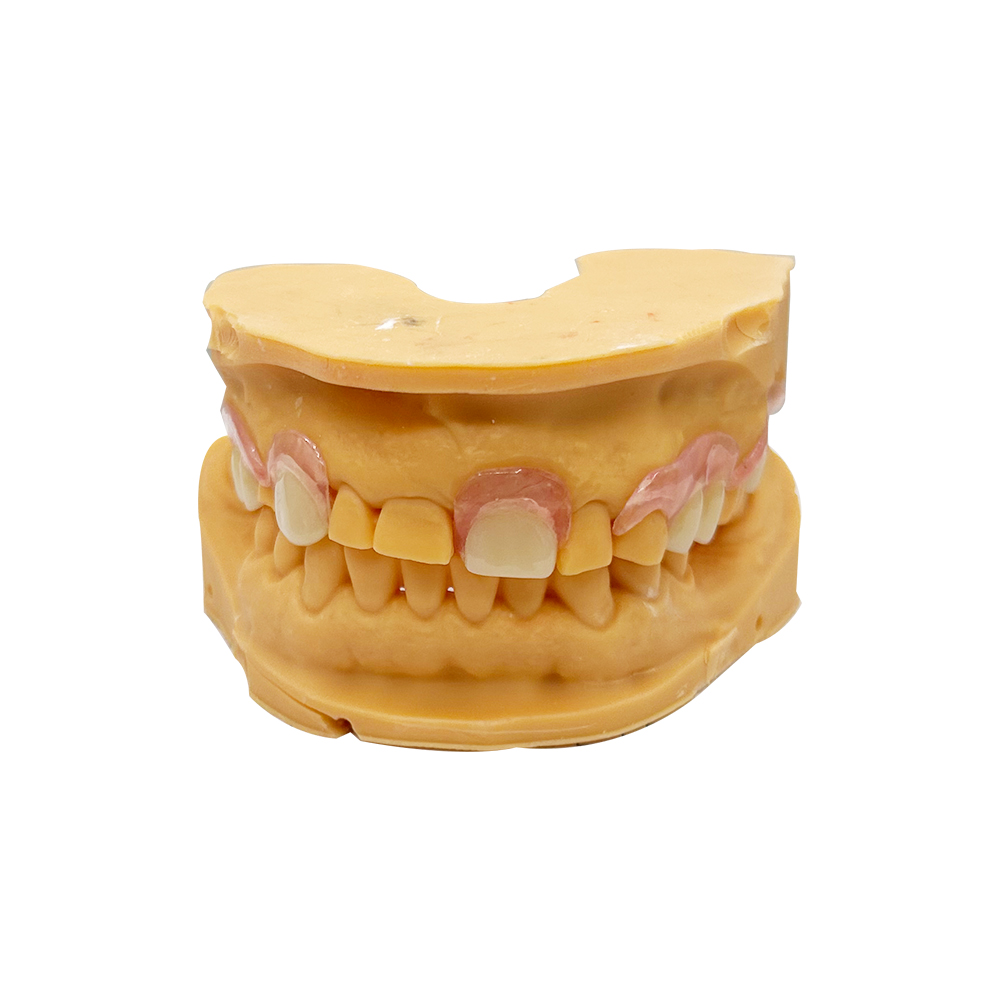
A case study showing how we designed and delivered a tissue-borne thermoplastic anterior partial when four maxillary incisors could no longer be restored.
Case summary
| Detail | Wert |
| Indication | Four non-restorable maxillary anterior teeth |
| Appliance type | Tissue-bearing flexible partial, metal-free |
| Tooth positions | Upper right lateral through upper left lateral (#7–#10) |
| Delivery | Same-day seating after extraction |
| Funktion | Interim restoration, designed for later relining and implant transition |
Patient situation
The patient was in their early thirties. Four maxillary anterior teeth were failing — two already mobile, one with repeated temporary repairs, and the last one under a failing restoration. All four were scheduled for extraction in a single appointment.
Three constraints shaped the case more than the tooth loss itself.
Budget ruled out fixed treatment. Both implant-supported replacement and a conventional fixed bridge were quoted and declined. The patient wasn’t opposed to either treatment in principle. The obstacle was cost, and it wasn’t negotiable.
Visible metal had already cost the patient something. The patient had previously worn a cast framework appliance and stopped smiling in photos and meetings because of it. The specific complaint wasn’t that it looked like a denture — it was that the clasps crossed teeth that showed when speaking.
The patient expected one purchase, not a sequence. Before treatment started, the patient asked directly: would this need to be replaced in ten years, and would food collect underneath it. What they were really asking was whether choosing a removable appliance meant committing to an endless cycle of remakes.
Two further practical constraints applied. The patient could not go without anterior teeth during healing, for occupational and social reasons. And a bridge had already been ruled out on a hygiene concern — the patient didn’t accept that a fixed span over a healing ridge could be kept clean.
What the clinician had to solve
The prescription wasn’t simply “make a partial denture for front teeth.” The clinician gave us five requirements, each tied to one of the obstacles above.
| # | Obstacle | The clinician’s requirement to us |
| 1 | Budget ruled out implants and fixed bridge | Deliver a removable, metal-free appliance at a lab fee that keeps total treatment reachable, and make clear in writing that it’s interim-to-medium-term, not a substitute for implants |
| 2 | Visible clasps had ended the patient’s willingness to smile | No retentive element may cross the facial surface of any tooth in the smile line. Retention must come from tissue and undercuts with arms placed low and out of the esthetic zone. A larger, more visible clasp is not an acceptable trade for retention |
| 3 | Patient expected a single long-term purchase | The appliance must be designed for relining, tooth addition, and rebasing. If the ridge changes, it gets relined — not remade. We must state up front whether we can add an anterior tooth and reline the saddle on this material |
| 4 | Four teeth out at once, no healing time allowed | The appliance must seat on extraction day — not an Essix-type retainer. It must tolerate early ridge change without becoming a pressure source, and the patient must be told explicitly not to load it for chewing |
| 5 | Patient may still pursue implants, with hygiene concern about fixed work | The appliance must not transmit load to intended implant sites and must be removable for cleaning. It’s transitional and must not compromise the later definitive plan |
Prescription detail supplied with the case
- Tooth positions, with explicit statement that the appliance was transitional
- Tooth shade and mold matched to adjacent natural teeth, plus requested translucency
- Gingival shade selection, with patient’s tissue photograph (high smile line)
- The zone where no retentive arm was permitted to appear
- Request that we flag it if undercuts or clearance made a fully flexible design the wrong choice
- Request for wax try-in before processing
How we met those requirements
Design
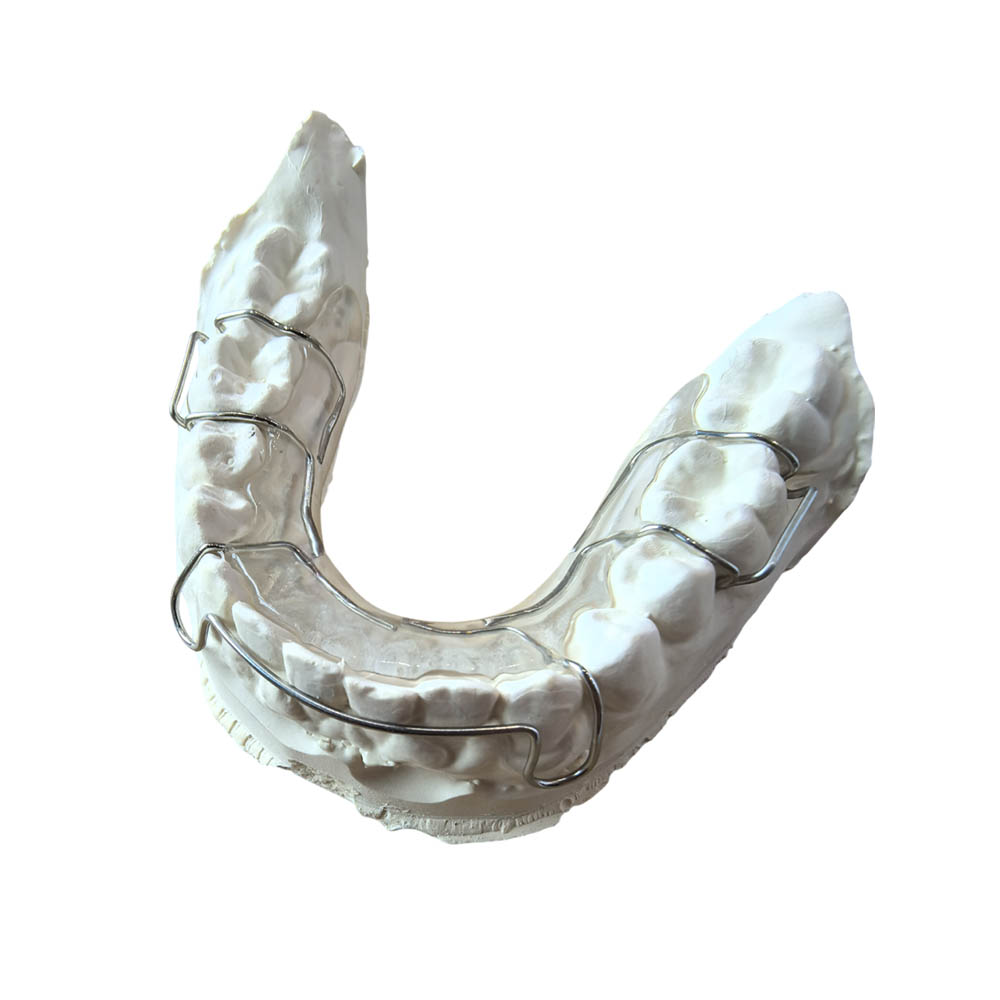
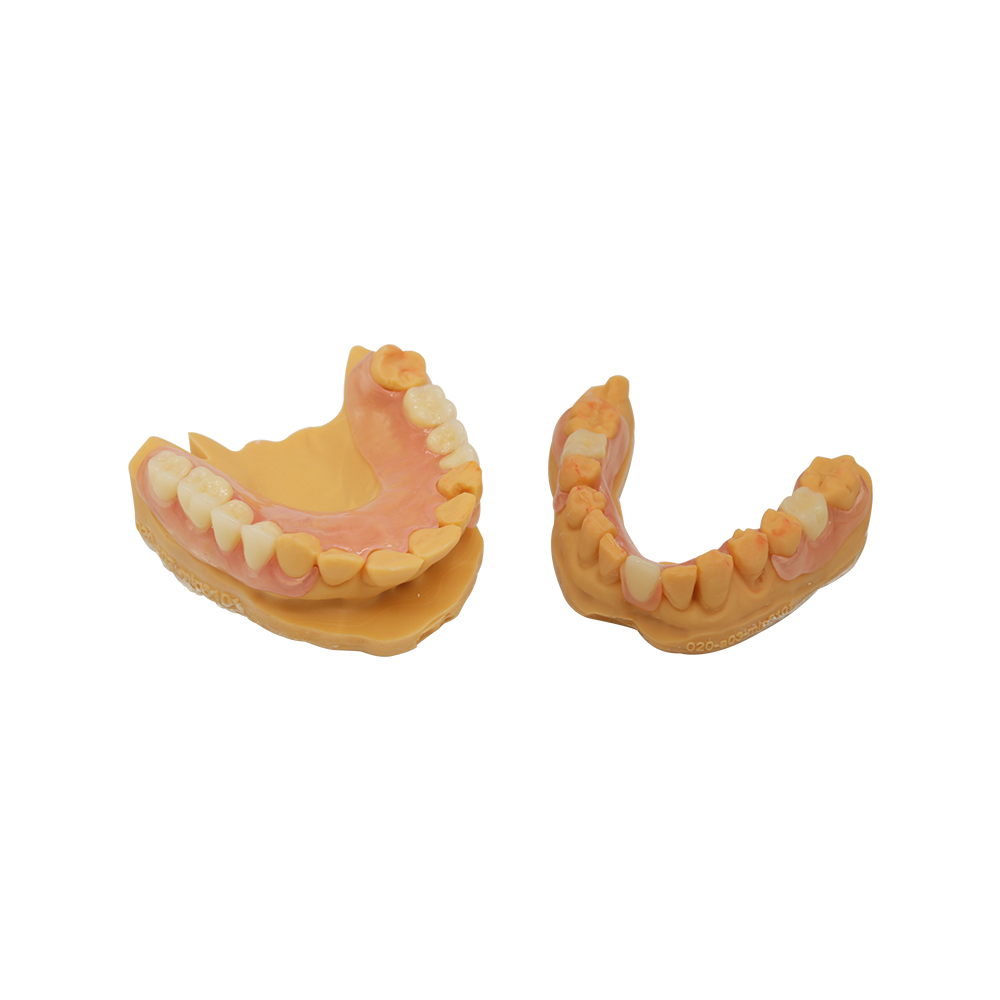
We produced a fully flexible, tissue-bearing anterior partial. Retention came from tissue and tooth undercuts using translucent gingival-shade arms placed low on the gingiva. Nothing crossed a facial surface in the smile line. The patient’s smile-line photograph defined the no-clasp zone before we closed the design.
Material and shade
A thermoplastic base was used rather than a cast framework, consistent with the metal-free requirement. Gingival shade was selected against the patient’s own tissue rather than from a default pink. Tooth shade and mold were matched to adjacent teeth. Tooth color and gingival color were specified as two separate decisions.
Tooth retention
Denture teeth were mechanically retained in the base rather than relying on chemical bond. Thermoplastic base materials don’t form a dependable chemical union with acrylic denture teeth, and tooth debonding is a recognized failure mode when this is handled casually. Mechanical retention features were built into the tooth bases before processing.
Delivery and follow-up
The appliance was seated on extraction day. The patient was instructed to keep it out of chewing function and to remove it at night. A review was scheduled at four weeks for tolerance and tissue response. A reline was planned once the ridge had stabilized. During that period the patient was told the appliance would loosen as the ridge changed — this was expected, and the response was a reline, not a remake.
Ridge change after extraction is the single biggest reason an immediate anterior case has to be built for relining rather than treated as a finished restoration. Flexible bases are well suited to this, and the documented clinical technique for thermoplastic anterior partials treats reline-readiness as part of the original design rather than a later repair.
Outcome
The patient left with a complete anterior segment, no visible metal in the smile line, and no need to avoid being photographed. The appliance was relined after healing and continued in service as the interim restoration while implant treatment remained under discussion. At the definitive stage it was replaced, as the prescription had stated from the beginning.
What this case doesn’t claim
Flexible anterior partials are interim to medium-term restorations. A removable appliance doesn’t stop the bone resorption that follows tooth loss, and no design changes that. Retention comes from tissue and undercuts, so it can degrade over time and isn’t equivalent to the force control of a rigid framework.
The evidence on non-metal clasp retention is mixed, and it’s worth reading carefully. published assessments of nonmetal clasp dentures note that retentive performance varies by case class, and systematic reviews of removable partial denture satisfaction report patient satisfaction figures in the low-to-mid 80s rather than near-total approval. We design to that reality, not to the assumption that flexible is automatically superior.
Higher occlusal demand, bruxism, a long span, a distal extension, or very shallow interarch space are all reasons we’ll propose a different design instead.
When the clinical situation calls for pure flexible design in the anterior region, we design it to be serviceable — able to be relined, able to accept a tooth addition, and able to function as a transition to definitive treatment rather than forcing the patient into early replacement.
ASD Dental Lab — manufacturing capability
Founded in 2012, ASD is a full-service dental laboratory with manufacturing facilities in Shenzhen and Huizhou, China. We complete the entire production workflow in-house without outsourcing cases to third-party labs.
Our removable denture department employs approximately 55 technicians and produces around 4,000 removable cases per month during normal season, scaling to 6,500 cases per month during peak periods.
We serve more than 50 dental laboratories, over 100 clinics, and 400+ dentists across the United States and Europe.
Send us a case and we’ll tell you plainly whether the design you’re imagining is the right one for the situation.
What to send when you have a flexible partial case for front teeth
We need:
- Tooth positions and whether the appliance is interim or long-term
- Tooth shade and mold
- Gingival shade (a tissue photograph helps when the smile line is high)
- The zone where no retentive arm should appear
- Whether you want a wax try-in before processing
- Whether the undercuts or clearance might make a fully flexible design the wrong choice (we’ll review and flag it)
For cases with immediate delivery requirements, let us know the extraction date so we can schedule accordingly.