Acrylic Partial Denture — B2B Lab Service for Dentists, Clinics and Labs
ASD Dental Lab makes the acrylic partial denture as a full-service, in-house build. We started this lab in 2012, and today we run our own factories in Shenzhen and Huizhou with about 460 technicians. We are not a trading company and we do not outsource cases to third-party labs. When you send a prescription and a good impression or scan, one team handles the acrylic partial denture — flipper, transitional, or a definitive acrylic removable partial denture — from case receiving to shipping.
It seems we can't find what you're looking for.
1. Product identity — what an acrylic partial denture actually is
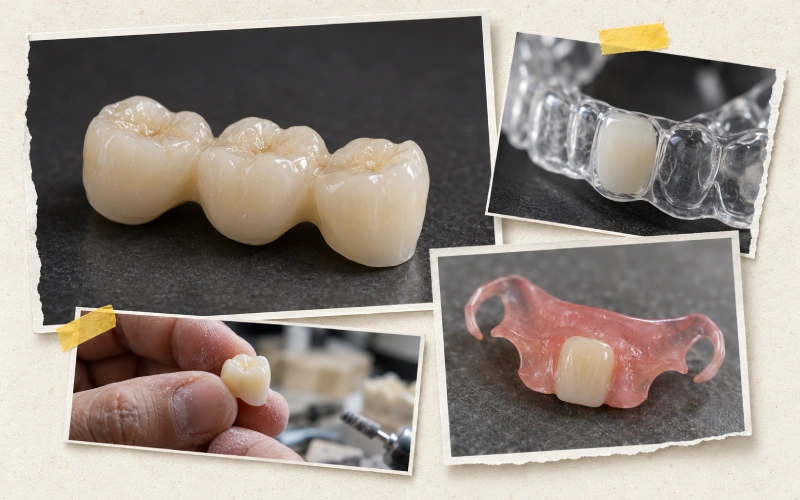
An acrylic partial denture is a removable prosthesis with a polymethyl methacrylate (PMMA) resin base carrying the artificial teeth, retained by wrought-wire clasps or by a cast-metal framework that carries an acrylic saddle. Acrylic dentures come in a well-defined family, and it matters that a supplier does not mix the family up:
- Flipper / stayplate — usually one or two teeth, minimal or no clasps, for short-term or immediate use.
- Treatment partial (transitional) — a resin partial used while tissues settle, or while planning a longer-term option.
- Definitive acrylic removable partial denture — a resin-base partial designed as the intended final prosthesis at that stage, for carefully selected patients and case designs, following the framing set out by Wilson on acrylic partials as interim or permanent prostheses.
- Cast-metal framework with acrylic saddles — cobalt-chromium framework carrying rests, connectors and clasps, with an acrylic saddle for the tissue-borne areas.
2. Acrylic removable partial denture specifications
2.1 Base resin — chemistry and processing
- High-end acrylic base: Lucitone 199 (Dentsply Sirona), high-impact PMMA denture base, heat-cured. We use this line by default for the acrylic partial denture built as a definitive or long-service prosthesis.
- Standard acrylic base: conventional heat-cured PMMA, plus an in-house “impact resin” line for cost-sensitive orders on acrylic dentures.
- Processing options: heat-cured (water-bath, the traditional route, lower cost but with more porosity risk), injection-molded (better dimensional stability, tighter tissue adaptation), and milled from a pre-polymerized PMMA blank (best repeatability for digital workflows, weaker at reproducing very fine soft-tissue detail). We state the processing method on every quotation. We do not use auto-polymerizing (cold-cure) resin for the finished base of an acrylic partial denture; auto-polymerizing resin is used only for repairs and additions.
2.2 Teeth, clasps, connectors
- Teeth: VITA, Ivoclar and Shofu acrylic tooth lines are standard; composite teeth on request. Plastic denture teeth fall under 21 CFR 872.3590 (product code ELM) as a separate FDA category.
- Clasps: wrought-wire clasps on abutment teeth by default; cast clasps and precision attachments when the case is a cast-metal + acrylic build. C-clasps on premolars engage a defined undercut, not just the height of contour.
- Connectors and rests: on cast-metal builds we lay out major connector, minor connector and rest seats on the surveyed cast, and the design goes back to you before we cut anything.
- Metal statement: we always state on the invoice whether the finished appliance contains metal. We do not use the wording “metal-free” without that disclosure, because a wrought-wire clasp inside a resin base is still metal.
2.3 Minimum thicknesses and geometry
- Anterior thickness range 0.5 – 1.5 mm and posterior 0.8 – 2.0 mm, depending on the tooth material chosen.
- Cast-metal connectors and rest seats are laid out to the material vendor’s minimum cross-section; we ask you to confirm before milling if the residual space is tight.
2.4 Case types we build in a routine turnaround
Acrylic flipper (1–2 teeth) · Acrylic dentures with wrought-wire clasps · Immediate acrylic partial · Definitive acrylic removable partial denture · Cast-metal framework with acrylic saddles · Wax try-in cases · Cases where the acrylic partial denture rides on cast rests and a surveyed path of insertion · Reline (chairside or laboratory-processed) · Repair (fracture, tooth addition, clasp addition/replacement).
3. Why choose this acrylic partial denture from ASD
- One factory, one team, one workflow. From CAD through CAM, mill, injection or heat-cure, waxing, teeth setting, polishing, QC and packaging — everything sits inside ASD. Nothing gets sent to a third-party lab. That gives us a shorter feedback loop when a case needs to be checked, and it keeps the material chain on acrylic dentures traceable end to end.
- Scale. Our removable department alone has about 55 technicians. Normal-season removable output is around 4,000 cases per month, peak-season output around 6,500 cases per month, and we keep about 50 trained backup workers for surge periods.
- Registered lab. ASD holds an ISO 13485 quality-system registration, plus FDA establishment registration, an EU MDR Annex XIII custom-device notification route for custom-made prosthetics, and MHRA registration for the UK. The custom-device notification covers custom crowns, bridges, inlays, onlays, veneers, full and partial dentures, and custom implant super-structures.
- Case-level traceability. Every case gets a unique ID. The system stores which technician touched the acrylic partial denture, which machine ran it, which lot of resin and which lot of teeth went in, and which QC checkpoint signed it off. Records are archived; three months is our default retention, and we can extend on request in a written agreement.
- Documentation on request. Material declarations, lot certificates, biocompatibility statements (materials under the ISO 10993 series) and custom-device declarations in English — we hand these over per case or per contract.
4. Our fabrication process
We run two workflows in parallel on acrylic dentures, and we tell you which one your case is on before we start.
4.1 Analog workflow (physical impression or model)
- Case receiving — package opening in a dedicated area, physical decontamination, damage log, case ID assignment.
- Model pour or model verification if you sent your own cast; photo feedback if the model has bubbles, defects, warping, cracks or unstable occlusion.
- Surveying and design; Kennedy / Applegate classification and design pattern locked in for the acrylic partial denture or the cast-framework build.
- Wax-up and try-in shipment if you have requested one (adds 1–2 working days).
- Flasking, packing, polymerization (heat-cure water bath or injection molding, per the quote).
- Deflasking, finishing and polishing.
- Multi-stage QC: model check → wax check → teeth-setting check → post-processing final check.
- Packaging with case ID, shipping notification with a tracking number.
4.2 Digital workflow (scan-in)
- STL / PLY / OBJ / DCM (3Shape native) or CAD-native file receiving; exocad and 3Shape editable design files accepted.
- Scan integrity check — holes, overlap, broken triangles, mesh errors. The CAD lead flags problems back to you before we touch the case.
- Virtual surveying, path of insertion, CAD design, then sent back for approval on demand.
- Milling from a pre-polymerized PMMA disc, or 3D printing of the try-in model, then injection or heat-cure of the finished base.
- Same QC ladder as analog.
Both workflows use industrial-grade dental scanners, dental CAD software, dental milling stations, zirconia sintering furnaces (for the crown side of the order), and dental resin printers. Equipment is on a scheduled calibration and maintenance log; instruments that fall out of calibration are pulled off the line until a re-check passes.
4.3 CAD/CAM vs manual — what happens where
CAD/CAM handles scan-in, virtual survey, design, milling or 3D printing of blanks. Manual work handles teeth setting, waxing, cast finishing, porcelain layering on the crown side, polishing, and the acrylic packing and finishing on the removable side of acrylic dentures.
5. Cooperation workflow — how a clinic or lab opens an account with us
- Sales contact. Ask for the current catalogue and the B2B rate card by email or on WhatsApp; the sales manager sends the current documents.
- Paperwork. NDA, quality agreement and supplier agreement are all available. You can also require an English-language custom-device declaration; we provide it per case.
- Case account. Each clinic or lab gets a case account, a work-order template and a shared communication group. Multi-clinic accounts can carry per-dentist preferences inside our removable system — no need to resend the preferences for every acrylic partial denture order.
- Prescription. We follow the ACP dentist-laboratory relationship guidance. A signed prescription with arch and tooth numbers, appliance type and intended duration, requested material and brand, clasp/rest/connector design, path of insertion or surveyed cast, opposing impressions or scans, jaw relation, tooth mould/shade and gingival shade, photos where esthetics matter, allergy notes, immediate status, try-in request and delivery date — all of that goes onto the work order.
- Data files. STL, PLY, OBJ, DCM plus exocad and 3Shape editable files are accepted. Design-only, CAM-only or full-service orders are all available.
- Turnaround. Our routine in-lab time for an acrylic partial denture is quoted in working days, and it excludes weekends, Chinese public holidays, inbound and outbound shipping, customs clearance, requested try-ins, and time spent waiting on missing information. Complex implant or full-arch orders quote 7–10 working days including all internal steps. We say this out loud because “days” without a definition is a common source of dispute.
- QC gate. First-pass QC-release rate on final inspection sits around 95%. Independent QC signs the release, not the technician who built the case.
- Shipping. You can use the ASD factory courier account, or your own. Outbound shipping is customer paid by default; when a case comes back for warranty rework above a certain package value, we cover the return leg.
- Rework. Free rework covers, on the removable side, non-seating acrylic dentures, warping, unreasonable clasp design, poor bite and unacceptable gingival shade; on the crown side it covers open margin, open contact, high bite, non-seating crown or bridge, incorrect shade and obvious esthetic defects. Rework does not cover changes the clinic makes to shade, material or design after approval, or cases where the impression was marked “please do your best” before we started. Rework is prioritized and typically ships in 3–5 days over the original build time.
Questions clinics ask before placing a first order
Every quotation for acrylic dentures names one of the four families. We do not lump them.
Named on the quotation. Default lines are Lucitone 199 (Dentsply Sirona) and our impact resin line. Lot numbers are recorded per case in the traceability system.
Named on the quotation. For an acrylic partial denture the base is PMMA; if you want a flexible partial that is a separate order and a separate quote.
Stated explicitly on the invoice. Wrought-wire clasps are metal; we say so.
Denture-base resin falls under 21 CFR 872.3760, Class II, product code EBI. Denture teeth fall under 21 CFR 872.3590, product code ELM. Product-specific 510(k) numbers are named per resin on request.
Where we use the term on acrylic dentures, we name the test method and the comparison. If we cannot, we do not use the term.
VITA, Ivoclar or Shofu acrylic teeth by default; composite teeth on request. VITA and Ivoclar shade systems are standard.
Two wrought-wire clasps and a duplicate model are commonly included in the base price of an acrylic partial denture; additional clasps, cast rests and precision attachments are line items. The line items are visible on the quotation.
Is the appliance intended as interim, transitional or definitive? What design features support that?
Named on the work order. Immediate and transitional builds are flagged as such. A definitive acrylic removable partial denture documents the design features that support the definitive framing.
Line items. Wax try-in adds 1–2 working days. Characterization is a paid option. Shipping is separate by default.
Signed prescription; opposing arch scan or impression; jaw relation; surveyed cast for cast-metal builds; photos where esthetics matter; shade and mould; allergy notes; extraction/immediate status; requested try-in; requested delivery date.
Yes. Our CAD leads handle path of insertion and undercut selection inside the design software. Cases with tight residual space are flagged before milling.
Free rework on acrylic dentures covers non-seating, warping, unreasonable clasp design, poor bite and unacceptable gingival shade; on the crown side, open margin, open contact, high bite, non-seating and obvious esthetic defects. Excluded: clinic-side changes to shade, material or design after approval, and cases where the impression was marked “please do your best” and the clinic accepted the risk in writing.
Yes on all four. Hard reline, chairside reline, tooth addition, clasp addition and clasp replacement are supported lines. Materials used for repair are selected to match the original base type. This is a real advantage of an acrylic removable partial denture over a flexible-nylon partial — the flexible base usually has to be remade rather than relined
Named on the current rate card; ask the sales manager. Free rework is separate from paid additions or paid remakes.
Fabrication is at ASD’s own factories in Shenzhen and Huizhou. Design, milling, printing, injection, heat-cure, packing and QC all happen inside those two sites.
Alcohol-based cleaners, boiling water, abrasive toothpaste and undiluted household bleach are contraindicated for acrylic dentures. Guidance follows the ADA MouthHealthy partial-denture guidance for patient-side care.
Comparative survival evidence for the acrylic removable partial denture versus cast-metal RPD sits at a population median of 45 vs 73 months in Ahmed et al.. A national average acrylic-partial lifespan is not established in the literature — we present the Ahmed figure as comparative evidence, not as a per-patient warranty. Wilson’s framing on interim vs definitive use is available here.
Erleben Sie schnellere Durchlaufzeiten mit unserer hochmodernen Technologie
< class="ct-module-title">
Jetzt im Trend