Metal Free Partial Dentures: Materials, Clasps and Design Options
When a patient needs to replace missing teeth, you’ve heard the same question a hundred times: “Can I get partials without those metal wires showing?” The answer isn’t simple. Choosing between metal free partial dentures and traditional cast frameworks goes beyond appearance — it’s biomechanics, patient habits, case complexity, and the willingness to set realistic expectations about what happens three years out.
Cast cobalt-chromium frameworks versus partial dentures without metal clasps (flexible nylon, acetal, PEEK, and precision attachments) — retention force, material families, breakdown patterns, and lab prescription requirements all factor into which design survives first contact with the patient’s actual chewing habits.
Indholdsfortegnelse
Metal vs Metal-Free Partial Dentures: Key Differences
Cast Metal Frameworks (Co-Cr)
A traditional cobalt-chromium RPD has:
- Cast Co-Cr framework with major/minor connectors
- Metal clasps engaging tooth undercuts
- Occlusal or cingulum rests for vertical support
- Acrylic resin base and denture teeth
The framework does more than hold teeth — it distributes chewing forces through abutment teeth and tissues. That’s the biomechanical win.
When metal makes sense:
- Long-span posterior replacements
- Patients who need to chew tough food
- Cases where you want to add teeth later or reline
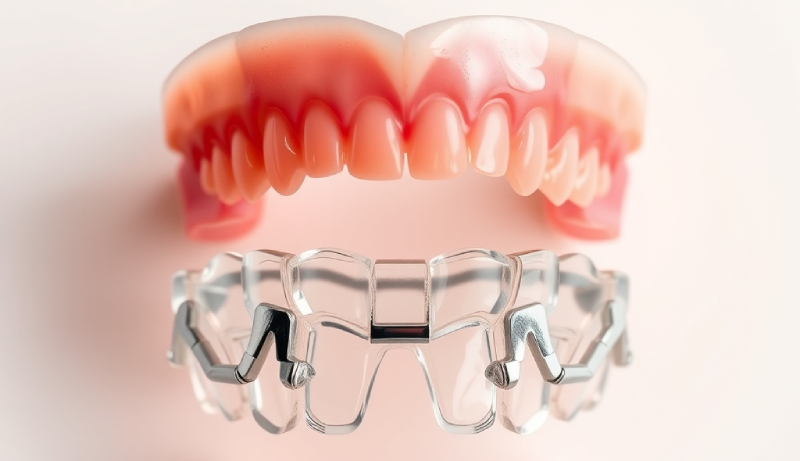
Partial Dentures Without Metal Clasps: Material and Design Options
“Metal-free” isn’t one thing — it’s a family:
| Materialetype | Eksempler | Manufacturing | Bedst til |
| Flexible Thermoplastic | Valplast, Flexite, Duraflex, Sunflex | Injection molding | Small tooth-bounded spaces, anterior esthetics, interim cases |
| Rigid Acetal Resin | POM clasps + acrylic base | Injection-molded clasps, conventional base | Tooth-colored clasps, moderate-span cases |
| High-Performance Polymer | PEEK, Ultaire AKP | CAD/CAM milling | Metal replacement with rigid framework |
| Precision Attachments | Hidden internal connectors | Milled components + acrylic | High-end esthetics, no visible retention |
The catch with “metal-free” as a label: it describes what the framework is made of, not how it performs. Retention force, repairability, and service life are separate questions, and they don’t track neatly with metal content.
Retention Strength of Metal and Metal-Free Denture Clasps
Retention force decides whether the appliance stays put during function. A 2025 systematic review of flexible and acetal RPDs found:
- Co-Cr clasps: retention force around 2.91 N
- Acetal clasps: retention force 1.08–1.74 N
That’s less than half. Another study comparing acetal to cast metal showed:
- Acetal clasps: 2.7–3.4 N
- Co-Cr clasps: 7.2–8.4 N
The difference isn’t trivial. After 12 months, 55% of flexible partials showed decreased retention. The nylon gets softer, the clasps lose grip, and patients start using more adhesive.
Numbers like these are why the same material can be a win in one mouth and a callback in another. Load direction and span length decide whether a flexible clasp holds or slowly gives up.
Materials Used in Metal-Free Partial Dentures
Valplast dominates brand recognition, but three distinct material families exist, each with different mechanical properties.
Nylon-Based (Polyamide)
Brands: Valplast, Flexite MP, Sunflex, Bayflex\ Mærk efter: Soft, flexible, gum-colored\ Fordele: Lightweight, comfortable, blends with tissue\ Ulemper: Softens under load, ages visibly, limited repairability\ FDA clearance: K123220 (Valplast)
Polyolefin-Based
Brands: Duraflex, Visiclear, Flexite T-VAL, iFlex\ Mærk efter: Semi-rigid, translucent to opaque\ Fordele: Slightly stiffer than nylon, better stain resistance\ Ulemper: Still soft under load, same repairability limits
High-Performance Polymers (PAEK Family)
Brands: PEEK, Ultaire AKP, Pekkton\ Mærk efter: Rigid, tooth-supported framework\ Fordele: Can be designed like metal, CAD/CAM precision, biocompatible and lightweight\ Ulemper: Needs digital workflow, higher lab cost, newer clinical track record\ FDA clearance: K160498, K160918
Limitations of Metal-Free and Cast Metal Partial Dentures
Flexible Nylon Limitations
- Can’t add teeth. The nylon base can’t be chemically bonded after it’s cured, so losing another tooth means fabricating an entirely new appliance.
- Can’t reline. Tissue resorption = loose fit. Patients report discomfort after 18–24 months.
- Stains and discolors. Coffee, red wine, tobacco = visible aging. The pink turns gray-ish.
- Retention drops. Nylon softens under repeated flex cycles. After 3–5 years, many patients switch to adhesive.
- Not for heavy occlusion. Posterior long-span or bruxers? It’ll crack or deform.
Metal Limitations
- Visible clasps. Anterior teeth = esthetics problem.
- Weight. Co-Cr is denser than nylon, though some patients like the “solid” feel.
- Nickel allergy. Rare (1–2% of patients), but if they react, you’re starting over.
Flexible looks better on day one. Metal functions better on year three. PEEK tries to split the difference.
Case Selection Matrix
| Patient Profile | Recommended Option | Hvorfor? |
| Few anterior teeth missing, high esthetic concern, light function | Flexible nylon (Valplast) | Looks great, comfortable, affordable |
| Posterior span, normal occlusion, patient wants tooth-colored | Acetal clasps + acrylic base | Balance of esthetics and function |
| Distal-extension, heavy chewer, wants long-term durability | Cast Co-Cr | Best retention and long-term biomechanics |
| High esthetic demand, willing to pay premium, no clasp visibility | Precision attachments | Hidden retention, premium look |
| Metal allergy or intolerance, posterior span, digital workflow available | PEEK/Ultaire framework | Rigid metal replacement without allergy risk |
| Immediate post-extraction, healing phase, temporary use | Acrylic flipper | Cheap, fast, replaced later |
How to Write a Clean Lab Prescription
Prescription clarity drives remake rates. The lab slip needs:
Must-Have Info
- Material choice: “Valplast” / “Acetal clasps with acrylic base” / “Co-Cr cast framework” / “PEEK framework”
- Clasp design: Which teeth get clasps, where (buccal/lingual), and undercut preference
- Shade: For flexible bases, specify gum shade (light/medium/dark pink). For acetal clasps, match adjacent teeth.
- Rest seats: Mark where you prepped occlusal or cingulum rests.
- Major connector preference: Palatal strap, horseshoe, lingual bar — tell us what fits the case.
Common Mistakes
- Writing “metal-free” without specifying nylon vs. acetal vs. PEEK
- Not marking rest seats (we design clasps where there’s no vertical support)
- Ordering “flexible partial” for a Kennedy Class I (it won’t retain)
Pro tip from our CAD team: If you send an intraoral scan, we can design digitally and show you a preview before fabrication. Cuts remake rate by ~40%.
Partial Dentures Without Wires: Available Design Options
When patients say “no wires,” they usually mean partial dentures without wires — that is, partial dentures without metal clasps showing on front teeth. The phrase is doing more work than it sounds, because three different designs can satisfy it, and they trade off differently against each other.
Nylon clasps wrap around the tooth in gum color, so nothing metallic shows at all. Retention comes from the flexible arms gripping undercuts rather than from a discrete clasp tip, which is why the measured retention force sits below cast metal.
Acetal clasps are rigid and tooth-colored. They read as part of the tooth rather than a wire, and they hold better than nylon — though still below Co-Cr.
Precision attachments remove the visible component entirely. Retention moves inside the crown, which means the abutment teeth need prep and often a crown, and the case carries the highest fabrication cost of the three.
“No wires” is doable, but invisible retention and strong retention are different requirements. Precision attachments or a rigid polymer framework are what actually deliver both.
How Long Do Metal-Free Partial Dentures Last?
ACP guidelines recommend replacing RPDs every 5-7 år due to tissue changes, wear, and occlusal drift. Real-world:
- Cast metal: 7–10+ years with relines
- Flexible nylon: 3–5 years before retention loss or staining makes replacement necessary
- Acetal: 5-7 år
- PEEK: Clinical data is shorter (material introduced ~2015), but early studies show comparable wear to metal
Maintenance tip: Tissue-borne partials need an annual reline check. Flexible bases sit outside that cycle — when they lose retention, they get replaced, not adjusted.
When Flexible Partial Dentures Are Not the Best Choice
Flexible partials are easier and faster for labs. Injection molding beats casting for turnaround, and there’s no surveying or complex clasp bending. Some labs default to “flexible” for every metal-free request — not because it’s wrong, but because it’s the path of least resistance.
Two scenarios where that default costs you:
- A distal-extension case sent as “flexible.” The appliance loads the tissue instead of the abutments. The patient chews, the base sinks, and the fit changes faster than it would with a rigid framework.
- A patient who’s already had one flexible partial fail. If the last one went loose, cracked, or stained, repeating the same design without changing something is a predictable outcome.
Bring us the case details — span, load, and what happened last time — and we’ll tell you if flexible is genuinely the right tool. Honest conversation up front beats a remake six months later.
Ofte stillede spørgsmål
A patient wants to switch from metal to flexible. How do I handle that conversation?
It’s a trade, not an upgrade. The patient is exchanging retention strength and service life for appearance, and they should hear it framed that way before they say yes. Document the discussion and keep the conversation tied to their specific case rather than the material in general.
Do flexible partials really cause bone loss?
Some studies suggest that lack of rigid support can accelerate resorption in distal-extension cases. The appliance moves more under load → more stress on underlying tissue. Not a dealbreaker for short-span cases, but a real concern for Kennedy Class I.
What’s the difference between Valplast and “generic flexible”?
Valplast is a brand name (specific nylon formulation, proprietary injection system). Generic flexible partials use similar thermoplastics but may have different flex properties, stain resistance, or longevity. Quality varies by lab and material supplier. At ASD, we use Valplast-certified materials or equivalent polyamide resins that meet the same biocompatibility standards.
Is PEEK worth the cost?
If the patient wants metal-free AND long-term durability, yes. PEEK gives you a rigid, tooth-supported framework with mechanical properties closer to Co-Cr. The trade-off is cost (600–1,200 lab fee vs. 250–400 for flexible) and the need for a digital workflow.
Final Takeaway
No universal best partial denture exists — only the right design for the case. The framework material, the clasp design, and the lab all factor into whether the appliance survives the patient’s actual chewing habits.
Prescription accuracy matters. Get it right, and the case comes back once. Get it wrong, and you’ll see the patient twice.
Need a quote or case consultation? Reach out to our team. We’ll walk through material options, design feasibility, and turnaround for your specific case load.