Flexible Upper Partial Dentures — An Anterior, Metal-Free Case from Our Lab


🕢 [ Udfyld formularen, så svarer vi inden for 30 minutter! ].
This is one case we fabricated in our own lab: a short, bounded anterior span in the upper arch, in a situation where no metal could be visible and the ridge had resorbed after earlier tooth loss. Below is the situation as presented, the design the prescribing clinician specified, what we returned, and how it performed after delivery.
The situation as presented
A patient presented with three missing upper anterior teeth — the central incisor and both lateral incisors — and a long-standing concern about the appearance of the front of the mouth when smiling or speaking.
The clinical picture:
- Den two adjacent canines remained in the arch and had been restored with porcelain-fused-to-metal crowns several years earlier. Both crowns now showed marginal recession with a thin gingival margin, so a band of crown margin was exposed on the facial surface and the gum line sat lower than the crown margin.
- Den anterior ridge had resorbed visibly after the earlier tooth loss and now presented a concave profile. Bone height was insufficient for predictable implant placement without grafting, and the patient was not willing to undergo a surgical procedure at that time.
- The patient’s smile line was high, bringing the gingival third of the anterior teeth into full view during speech and when smiling.
- The patient reported a previous soft-tissue reaction til a base-metal (nickel-containing) component in an earlier restoration, so any metal in the visible zone was ruled out from the start.
- A conventional acrylic removable partial had been made by another provider approximately two years earlier. The patient wore it for less than a month and then stopped. The patient stated that den palatal coverage made it difficult to taste food and interfered with speech, and that the metal clasps were visible when smiling.
The patient asked whether anything could be done that would not show metal, would not cover the palate, and would stay in place without visible clasps at the gum line.
Why the other pathways were set aside
The prescribing clinician reviewed the available options with the patient:
| Pathway considered | Why it was set aside in this case |
| Implant-supported crowns | The resorbed anterior ridge would first require bone grafting, with at least two additional surgical stages. The patient declined that route. |
| Fixed bridge | Both canines carried existing crowns with marginal issues; a multi-unit fixed bridge would have required preparing and rebuilding those abutments and loading them as terminal abutments for a three-unit span. The clinician felt that rebuilding those abutments introduced more risk than benefit in this case. |
| A removable appliance | Remained workable — provided it carried no visible metal at the gingival margin, no bulky palatal coverage, and enough retention against the resorbed ridge. |
Because the span was short and bounded, in the anterior aesthetic zone, and not a load-bearing segment, a flexible (metal-free) thermoplastic partial met the case requirements.
Design Challenges for Flexible Upper Partial Dentures
| Constraint | Implication for the design |
| Resorbed anterior ridge | Retention must come from the remaining undercuts with a full peripheral extension. |
| High smile line + recessive gingival margin on both canines | Any clasp at the gingival third would be visible; the appliance must not cover the free gingival margin of the canines. |
| Previous reaction to a base-metal component | The appliance must be completely metal-free. |
| A rejected acrylic partial | No full palatal plate; keep the design as open and bounded as the span allows. |
| Limited interocclusal space | Vertical clearance was verified to be at least 5 mm before the design was finalized. |
What the prescribing clinician specified
The clinician sent a written case specification with the impression and records:
- No visible metal at or near the gingival margin of the canines.
- No full palatal coverage — keep the base bounded and open.
- Do not cover the free gingival margin of either canine.
- Build retention into the base, not into clasps — capture the undercuts accurately for that reason.
- Shade-match both the replacement teeth and the gingival portion of the base.
- Confirm the vertical clearance before fabrication — if it had come in under 5 mm, contact the office before processing.
- Mechanically lock the denture teeth into the base using T-shaped retention holes (diatorics).
Records submitted:
- A full-arch impression on a custom tray recording the vestibular extensions
- A high-flow alginate impression material suitable for moist tissue
- En opposing model, a bite record in centric relation, and the requested shade
Flexible Upper Denture Design and Fabrication
We processed the case in-house — nothing was outsourced.
- Base material: flexible thermoplastic (nylon-based), completely metal-free.
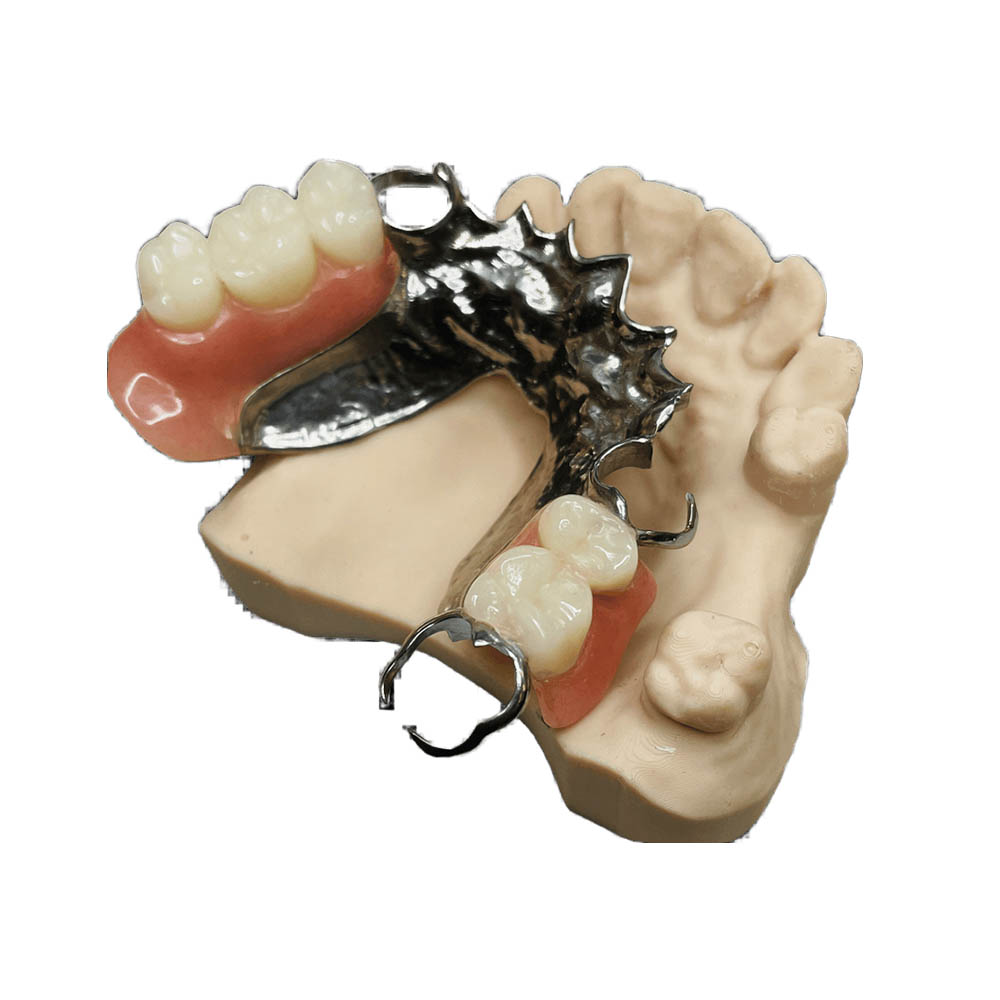
- Design: a bounded anterior horseshoe that stops short of the free gingival margin on both canines and leaves the palate open. The base captured the residual undercuts in the labial and buccal vestibule for retention — no metal rests, no clasps.
- Teeth: acrylic teeth with T-shaped diatorics, shade-matched to the adjacent natural teeth. The gingival portion of the base was tinted to match the surrounding tissue.
- Clearance check: interocclusal space measured on the mounted diagnostic casts and verified to exceed 5 mm, so the case was cleared for processing.
- Processing: the material was plasticized and injected at 550–560 °F under ~100 psi, held under pressure for 3–5 minutes, and bench-cooled for 15–20 minutes before deflasking.
- Finishing: the base was polished to a smooth, stain-resistant surface. A rough or under-polished flexible appliance collects plaque and stains quickly, so we gave this step extra attention.
Delivery, fit, and initial adjustment
The appliance was delivered at a single appointment. On seating:
- No metal was visible at the smile line or the gingival margin.
- The appliance seated fully and stayed in place when the patient spoke and smiled — the retention came entirely from the accurate capture of the undercuts in the impression.
- No palatal coverage, so the patient reported that speech felt normal and that tasting food was unaffected.
- The patient could insert and remove the appliance without difficulty and without a chairside tool.
Minor occlusal adjustment was needed on the lingual surface of one replacement tooth — a brief adjustment with a slow-speed acrylic bur. After that, the patient reported that the bite felt balanced and that nothing was hitting early.
The clinician instructed the patient to remove the appliance at night, clean it daily with a soft brush and a denture cleaner formulated for flexible materials - ikke an ordinary denture cleaner, which can degrade the thermoplastic over time — and to return in two weeks for a follow-up check.
Patient and clinician feedback after two weeks
At the two-week follow-up appointment, the patient reported:
- No soreness or pressure spots on the ridge or the gingival margins of the canines.
- No visible clasps — the appliance remained invisible at the gum line when smiling.
- No difficulty with speech or eating — the patient had worn the appliance daily since delivery and said it stayed in place during normal function.
- The patient was particularly relieved that the palate was open — the patient said that had been the main reason for rejecting the earlier acrylic partial.
The patient stated: “I wore it every day. I can smile without covering my mouth. It stays in when I talk, and I don’t even think about it anymore. The first day it felt a little tight, but after that it was fine.”
The clinician examined the appliance and the tissue and found:
- No pressure spots or blanching on the residual ridge or the gingival margins of the canines.
- No visible displacement when the patient smiled or spoke — the appliance stayed seated.
- The gingival margins of both canines remained healthy, with no signs of irritation or inflammation from the appliance.
- Oral hygiene was good — the patient was following the cleaning instructions, and there was no visible plaque or staining on the appliance.
The clinician noted in the chart: “Patient very satisfied. No adjustment needed. Retention adequate. Tissue response normal. Will continue to monitor.”
Indications and Limitations of Flexible Upper Dentures
To keep the case honest, we state the boundary plainly:
This was a short, bounded, anterior, non-load-bearing span. Flexible material is chosen for exactly this kind of case.
It is ikke indicated for:
- Distal-extension (free-end) cases, where the posterior teeth are missing and there is no posterior abutment.
- Immediate or post-extraction placement, where the ridge has not yet healed.
- Load-bearing posterior segments, especially in patients with heavy occlusal force or parafunctional habits.
This type of appliance cannot be relined, and teeth cannot be added to it. If the ridge changes or another tooth is lost, the appliance must be re-made, not adjusted. The clinician and the patient both understood this before the case started.
Useful service life is typically around five years with normal wear and proper care — in some cases, up to seven or eight years when hygiene is excellent and the appliance is handled carefully — which is shorter than a cast-metal framework.
What to send us
The result above came from records that arrived accurate and complete on the first submission. For this kind of case, we ask for:
- A full-arch impression on a custom tray, extended wide and deep enough to record the vestibular undercuts — that is where the retention comes from.
- A high-flow alginate or polyvinyl siloxane (PVS) impression material, suitable for capturing detail in moist tissue.
- En opposing model, a bite record in centric relation, and the requested shade for both the teeth and the gingival portion.
- Accurate capture of the undercuts — the appliance has no metal clasps, so retention depends entirely on how well the impression recorded the available undercuts.
The quality of the data you send determines the result. A partial that seats in one visit and requires only minor adjustment starts with an impression that was right the first time.
Work with our lab
If you have a comparable case — a short, bounded anterior span where metal cannot show and the ridge has resorbed — send us the records above and we will quote it.
Every case we publish was fabricated in our own facility; nothing is outsourced. Our lab maintains a dedicated Removable Denture Department with approximately 55 trained technicians, and our monthly production capacity for removable cases ranges from 4,000 to 6,500 units depending on seasonal demand. We serve over 50 dental laboratories, 100 clinicsog 400 dentists across the United States and Europe.
Contact us to discuss your case.