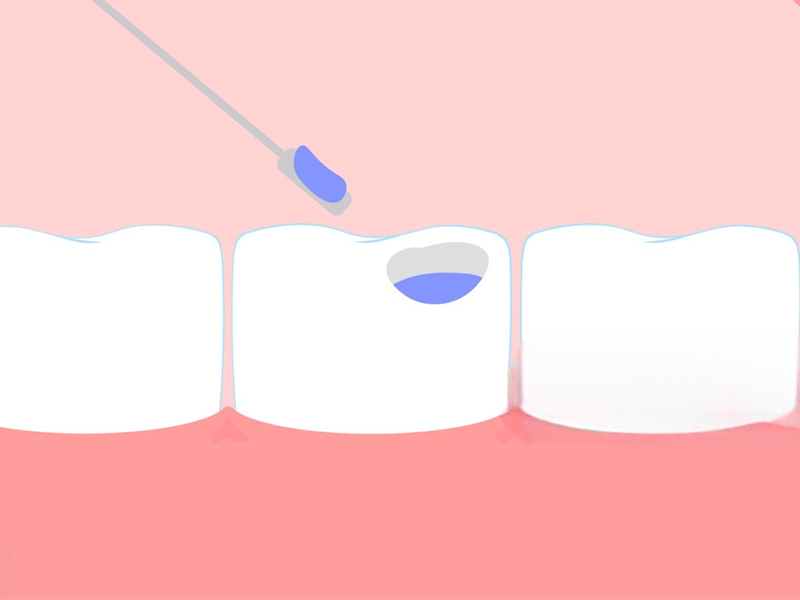
Zirconia Crown Finishing and Care — Complete Lab-to-Chair Guide
A zirconia crown doesn’t finish itself. What happens between the sintering furnace and your patient’s mouth determines whether that restoration lasts 2 years or 15.
This guide covers the entire finishing workflow — glazing, polishing, staining, chairside adjustments — and walks through what keeps a crown looking and functioning as it should after delivery. Every recommendation is grounded in measured data and real-world feedback from clinicians and lab technicians.
Съдържание
Why finishing matters more than you think
Surface roughness directly affects opposing enamel wear. A poorly finished zirconia crown can wear down natural teeth faster than the crown itself wears out.
The choice between glazing and polishing isn’t about aesthetics alone — it’s about managing friction, plaque adhesion, and long-term stability. Glazed surfaces measure around 81.87 μm of wear after 12 months, while properly polished surfaces stay closer to 71.43 μm under the same load.
Polishing is the default for functional surfaces. Glazing is for aesthetics — gingival thirds, buccal embrasures, areas the patient sees. Not occlusal tables.
Finishing options: glaze, polish, or stain
Glazing
Glazing means applying a thin glass layer to the zirconia surface and firing it in a porcelain oven. This step:
- Smooths micro-irregularities left by milling
- Adds translucency to mimic natural enamel
- Seals surface porosity
- Produces a highly reflective finish
Glaze thickness typically ranges between 20–50 μm. Too thick and it chips under occlusal load. Too thin and it wears through in months.
When to glaze:
- Pre-shaded blanks that need a final luster
- Layered restorations (glaze over porcelain)
- Aesthetic zones where light reflection matters
- Cases where the opposing arch is a full denture (lower occlusal load)
When not to glaze:
- Functional contact areas (cusps, fossa, incisal edges)
- Cases with heavy bruxism
- Surfaces that will need chairside adjustment
Glaze wears. When it does, the underlying zirconia — which is rougher — becomes the contact surface. That’s when opposing enamel wear accelerates. If you’re going to glaze functional surfaces, plan to re-glaze or convert to polish after any adjustment.
Полиране
Polishing uses sequential abrasives (silicon carbide, diamond paste, felt wheels) to bring zirconia to a mirror finish without adding a glaze layer.
Advantages:
- No additional firing step
- Can be re-polished chairside after adjustments
- Polished zirconia shows less plaque accumulation than glazed zirconia after glaze wear-through
- Lower surface roughness when done correctly
Polishing sequence (measured values from clinical studies):
- Green stone or coarse diamond — remove milling marks, roughness ~500 μm
- Medium-grit rubber wheels — intermediate smoothing, roughness ~100 μm
- Fine-grit silicone polishers — pre-polish, roughness ~44 μm
- Diamond paste (6 μm → 3 μm → 1 μm) on felt wheel — final polish, roughness ~42.50 μm
The step most labs skip is #4. Without diamond paste, you’re leaving the surface at 44 μm instead of sub-43 μm, which doubles plaque retention.
Оцветяване
Staining is for characterization — replicating the yellow-orange tones in cervical thirds, white spots, microcracks. Stains sit on the surface and must be sealed with glaze or they wash off.
Stain + glaze combinations let you match:
- Tetracycline banding
- Fluorosis spots
- Age-related translucency loss in dentin
- Incisal mamelon structures
- Hypocalcification zones
Technique notes:
- Always build stain in layers. One thick coat cracks during firing.
- Dilute stain liquid 1:1 with modeling liquid for the first pass
- Fire each stain layer before adding the next
- Final glaze goes over all stain work
Most mis-shaded crowns fail during staining, not at the blank selection stage. Stain pigments concentrate during firing — what looks like a subtle orange wash becomes a dark band at 880°C.
Pre-shaded blanks vs white blanks
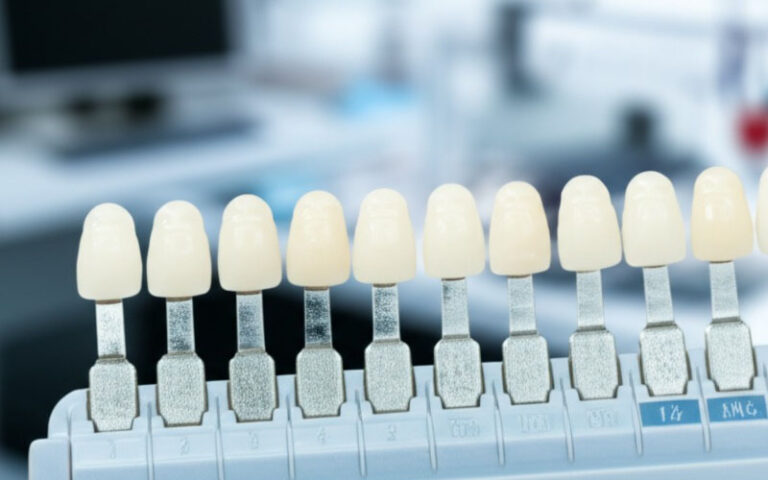
Pre-shaded zirconia blanks (multilayer, gradient) have color baked into the material. White blanks need external staining to match.
| Blank type | Suitable for | Requires staining? |
| White zirconia | Posterior single crowns, cases where exact shade match isn’t critical | Yes, for aesthetic cases |
| Pre-shaded (single shade) | Anterior single crowns, predictable shade match | Optional (characterization only) |
| Multilayer gradient | Anterior work, cases where you need natural translucency transition | Минимален |
Lab workflow consideration: Pre-shaded blanks skip 1–2 staining cycles, cutting 3–4 hours off turnaround time. For high-volume labs, that’s the difference between a 3-day and 5-day delivery.
ASD processes both workflows in-house — CAD design, milling, sintering, staining (if needed), glazing or polishing, and final QC. Regular cases take 3 days in-lab. Full turnaround including international shipping averages 7 days.
What happens when you adjust a crown chairside
Adjustments are inevitable. Bite is high, contact is tight, margin needs relief. The moment a bur touches a finished crown, you’ve removed the glaze or disrupted the polished surface.
Unpolished adjustment sites have surface roughness values above 500 μm — that’s 10× rougher than a properly finished surface.
If the crown was glazed:
- The glaze layer is gone at the adjustment site
- Underlying zirconia is now exposed and rough
- Options: send it back for re-glaze, or polish the adjustment in-office
If the crown was polished:
- Polish the adjustment site with the same sequence: coarse → medium → fine → diamond paste
- Match the original finish level
- Re-check occlusion after polishing (you’ve removed 20–50 μm of material)
Most common mistake: adjusting with a coarse diamond and leaving it there. That surface will stain within 6 months and wear the opposing tooth.
ASD’s standing policy: if a case requires a remake due to fit or shade mismatch, we remake it at no charge and expedite the new case. See the remake terms in your case submission.
Marginal fit and cementation
Margin design affects finishing. A feather-edge margin is harder to polish than a chamfer. Zirconia margins under 0.3 mm thickness are prone to chipping during try-in.
Margin finish checklist:
- No glaze on the internal surface or margins (glaze increases seating resistance)
- Polish margins to remove sintering artifacts
- Margins should feel smooth to a #23 explorer
- Check for overhangs — zirconia overhangs don’t “flow” like composite; they stay sharp
Cement shade influence:
Cement color shows through high-translucency zirconia. A white cement under a BL2 crown will look a half-shade lighter than the tab. Opaque cements reduce this by 20–30%, but block more light.
If the tooth is severely discolored (tetracycline, metal post, endodontic stain), plan for:
- Opaque cement or opaquer liner
- Lower-translucency zirconia (3Y-TZP instead of 5Y)
- Layered porcelain buccal to mask the darkness
You can’t whiten a crown after it’s made. Zirconia is non-porous — bleaching agents don’t penetrate. If a patient wants whiter teeth, whiten before you take the shade.
Maintenance: what to tell your patients
Почистване
Zirconia crowns don’t stain the way natural enamel does, but the cement margin can. Patients should:
- Brush twice daily with a soft-bristle brush
- Floss daily (zirconia won’t fray floss, but the margin will collect debris)
- Avoid abrasive whitening toothpastes (they won’t whiten the crown, but they will scratch it)
Plaque adhesion to polished zirconia is 40% lower than to worn glaze. Once the glaze wears through, plaque retention increases.
What wears out first
Zirconia itself is stable. What fails is:
- The glaze layer — wears through in 12–24 months on functional surfaces
- The cement seal — micro-leakage at margins, especially if the crown was under-prepped or over-contoured
- Opposing enamel — if the crown surface is rough or the occlusion is heavy
Patients can’t see #1 or #2 until it’s too late. That’s why recall exams matter.
Longevity factors
Hydrothermal aging — exposure to water and masticatory stress over time — gradually degrades zirconia’s fracture resistance. 3Y-TZP zirconia (the most common type) is more resistant to this than 5Y.
Factors that extend service life:
- Proper occlusion (no heavy excursive contacts)
- Adequate thickness (minimum 0.5 mm at margins, 0.8 mm occlusally)
- Polished or intact glaze (roughness <50 μm)
- Good oral hygiene
- No untreated bruxism
Factors that shorten it:
- Thin margins (chipping risk)
- Rough surface finish (accelerates plaque and wear)
- Heavy bruxism without a night guard
- Poor cement seal
You’ll see claims of “10-year” or “15-year” crowns. Those numbers come from cohort studies with controlled variables. Real-world longevity depends on the variables above. We can’t give a number — we can give you the conditions that maximize it.
Quality control at ASD
Every zirconia case goes through 11 inspection checkpoints before it ships:
- Digital design review (margin, contour, contact, occlusion)
- Pre-mill blank verification (correct shade, no cracks)
- Post-mill dimension check
- Pre-sintering thickness measurement
- Post-sintering fit check on printed model
- Shade verification under daylight lamp
- Surface finish inspection (glaze integrity or polish uniformity)
- Occlusal contact marking
- Margin continuity check
- Final cleaning (no dust, fingerprints, or residue)
- Secure packaging
If any checkpoint fails, the case goes back to the responsible department. We don’t ship “good enough.”
Cases that require staining and glazing add 1–2 additional QC steps: stain layer inspection and post-glaze crack check.
Common finishing mistakes (and how to avoid them)
Mistake 1: Glazing occlusal surfaces on a bruxer
What happens: Glaze wears through in 3–6 months. Underlying rough zirconia now contacts opposing enamel. Patient comes back with sensitivity or visible wear on natural teeth.
Поправка: Polish functional surfaces. Reserve glaze for buccal aesthetics only.
Mistake 2: Skipping the fine-grit polishing step
What happens: Crown looks shiny but still measures 100+ μm roughness. Plaque sticks. Gingiva stays inflamed.
Поправка: Use the 4-step sequence. Green stone → rubber → silicone → diamond paste. No shortcuts.
Mistake 3: Not re-finishing after adjustment
What happens: Dentist adjusts high spot with a coarse bur, crown goes in as-is. Adjustment site stays rough, stains dark brown within months.
Поправка: Any chairside adjustment must be re-polished. If that’s not possible in-office, document it and schedule a re-polish at the next visit.
Mistake 4: Over-contouring to “play it safe”
What happens: Bulky contour forces the dentist to reduce more. More reduction = more surface area to re-finish, higher chance of uneven polish.
Поправка: Design to emergence profile. Slight under-contouring is easier to correct than over-contouring.
Mistake 5: Using glaze as a shortcut for poor surface prep
What happens: Milling marks still visible, tech applies glaze to “hide” them. Glaze can’t fill deep scratches — it just makes them shiny. First bite and the glaze cracks along the scratch lines.
Поправка: Glaze goes on smooth surfaces only. If the pre-glaze surface isn’t smooth enough to polish, it’s not smooth enough to glaze.
Technical standards and regulatory notes
ASD’s zirconia restorations are processed under ISO 13356 (implant-supported crowns and bridges) и ISO 6872 (dental ceramics) guidelines.
Material traceability: every blank batch is logged with supplier, lot number, sintering parameters, and final dimensional verification. If a case fails, we can trace it back to the blank.
Certifications in place:
- FDA registration for U.S. export
- CE marking for European markets
- ISO 13485 quality management system
Regulatory disclaimer: Zirconia crowns are medical devices. Finishing procedures should follow manufacturer guidelines for the specific material being used. This guide provides general technical information and is not a substitute for material-specific IFU (Instructions for Use).
Frequently asked questions
Can you re-glaze a zirconia crown?
Yes. Strip the old glaze with a coarse diamond, clean the surface, apply fresh glaze powder or paste, and fire according to the manufacturer’s schedule. Most glaze systems fire at 750–880°C for 1–3 minutes.
If the crown has been in the patient’s mouth, clean it thoroughly with steam and ultrasonic before re-glazing. Saliva proteins will carbonize in the furnace and discolor the glaze.
How long does a glaze layer last?
On functional surfaces (occlusal contacts, incisal edges): 12-24 месеца under normal load. On non-functional surfaces (buccal, lingual smooth areas): 5+ години.
Can you polish a crown that was originally glazed?
Yes. Remove all glaze residue first (it will load your polishing wheels otherwise). Then follow the standard polishing sequence. The underlying zirconia is the same whether it was glazed or not.
What’s the roughness threshold for plaque adhesion?
Surfaces below 200 nm (0.2 μm) Ra show minimal bacterial adhesion. Properly polished zirconia measures 20–50 nm. Worn glaze or poorly polished zirconia can exceed 1000 nm.
Why does my whitened patient’s new crown look yellow?
You took the shade before whitening. Zirconia can’t be whitened after fabrication — it’s non-porous. Best practice: complete whitening first, wait 2 weeks for shade stabilization, then take the final shade.
If the case is already made, options are:
1. Remake to a lighter shade (ASD policy: we remake shade mismatches at no charge)
2. Continue whitening and accept the mismatch
3. Place veneers over anterior teeth to match the crown
Can zirconia crowns discolor over time?
The zirconia itself won’t discolor, but:
1. Cement margins can stain (extrinsic stain from coffee, tea, tobacco)
2. If the internal surface wasn’t cleaned properly before cementation, residue can show through high-translucency zirconia
3. Surface scratches accumulate stain faster than smooth areas
Regular prophylaxis removes extrinsic stain. Intrinsic discoloration (from cement show-through) can’t be cleaned — that’s a remake.
What if the crown fractures?
Full-contour zirconia rarely fractures unless there’s insufficient thickness or the patient has severe bruxism. Layered zirconia (porcelain over zirconia) can chip at the porcelain layer.
If a case fractures within the first 6 months, contact your lab. Most fractures trace back to design (under 0.5 mm thickness somewhere) or occlusion (unrelieved excursive contact).
ASD evaluates fracture cases individually. If the fracture is material- or processing-related, we remake it.
Final notes
Finishing is where technical skill becomes clinical success. A well-designed, well-milled zirconia crown can still fail if the finishing step is rushed.
Polish for longevity. Glaze for aesthetics. Re-finish after every adjustment. And don’t expect the crown to stay pristine forever — plan for maintenance, just like you would for a natural tooth.
For case submissions, questions, or technical support: Свържете се с ASD Dental Lab