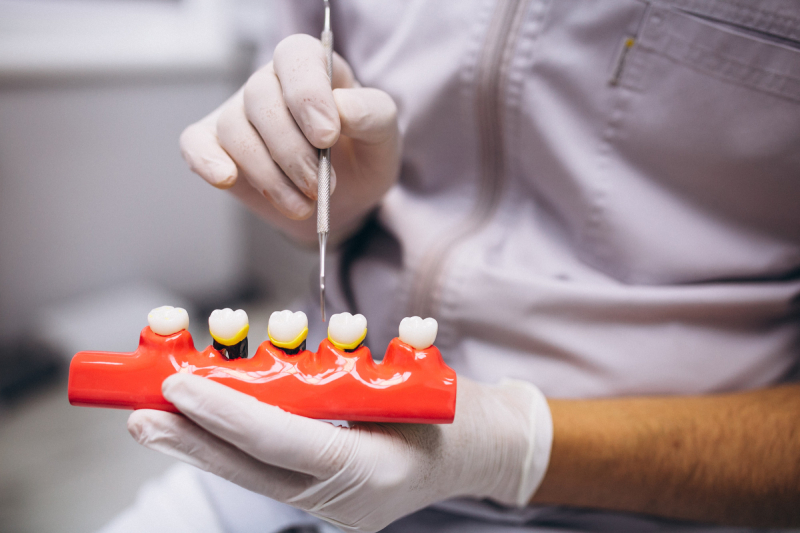
Upper Valplast Partial Denture: Anterior Case Study


🕢 [ Попълнете формуляра и ние ще ви отговорим в рамките на 30 минути! ]
1. The Clinical Brief
Patient Context:
The patient was an adult in their late 30s working in a client-facing professional role that required frequent public speaking and high-visibility meetings. Missing upper anterior teeth (#7, #8, #9) following extraction had left a conspicuous gap in the smile line — a concern the patient described as “the first thing people notice when I talk.”
The patient had previously worn a conventional heat-polymerized acrylic partial denture for approximately 18 months. That appliance had two documented problems: visible metal clasps that caught light during presentations, and recurring tissue irritation attributed to acrylic monomer sensitivity confirmed in the clinical history. The patient reported removing the appliance before meetings “because the clasps were too obvious” — which defeated the prosthetic purpose entirely.
When the referring clinician proposed a metal-free alternative, the patient’s first question was: “Will this move when I talk?” That concern wasn’t abstract. The previous acrylic partial had exhibited slight anterior mobility during function, and the patient associated flexible materials with instability. The clinician’s response centered on retention design: unlike the cast clasp system, the proposed nylon partial would engage bilateral undercuts with retentive finger projections, eliminating metal while maintaining mechanical lock.
Why the Clinician Recommended a Valplast Partial:
Given the documented monomer sensitivity, the aesthetic priority in a high-visibility occupation, and the patient’s negative experience with visible metal clasps, the clinician proposed a thermoplastic nylon-based partial as the appropriate alternative. The clinical rationale rested on three factors: eliminating allergenic methacrylate exposure, replacing visible metal with tissue-toned retention, and offering a lighter anterior restoration that would address both comfort and confidence.
Clinical Situation:
- Arch: Maxillary
- Edentulous span: Anterior (three consecutive teeth)
- Abutments: Bilateral posterior teeth present and periodontally stable
- Ridge condition: Mature post-extraction ridge, adequate vertical height for prosthetic support
- Occlusion: Adequate interarch clearance (measured >5 mm at rest in the anterior region)
- Patient constraints: Documented acrylic monomer sensitivity; professional requirement for metal-free aesthetics; prior negative experience with anterior partial mobility
Why This Case Fits:
- Short unilateral span (3 adjacent teeth, anterior region) — tissue-supported design works when the span is bounded and load is distributed over soft tissue rather than leveraging distant abutments.
- Deep undercuts on abutments — instead of surgical preprosthetic correction, we use flexible clasping arms that engage these undercuts without visible metal.
- Allergy & aesthetic demand — nylon-based thermoplastic resin contains no residual monomer and no metal components (MDPI Prosthesis 2024; 7(6):169), making it suitable for patients who cannot tolerate conventional acrylic or cast clasps.
2. What the Clinician Specified
Every upper valplast partial work order splits into three parts: what goes in the mouth, what we are told to avoid, and what happens if something needs adjusting later.
The clinician’s work order included:
- Shade & mold selection — cross-referenced to remaining natural teeth and provided with digital shade photos.
- Clasp design approval — we flagged I-bar retentive arms on the mesial aspects of #6 and #10, shown on the digital design with exact undercut engagement depth. The clinician confirmed placement before we moved to injection molding.
- What to avoid — no metal framework, no visible clasps in the smile zone, and no modification that would require reshaping the flexible base after polymerization (since trimming nylon with heat-generating burs can distort the thin margins).
Per our routine (internal design approval workflow G269), we mark clasp type (I-bar / C-clasp), rest position (none in this tissue-borne design), connector dimensions, and any mesh reinforcement zones on the CAD file, then send it for approval. Fabrication starts only after written sign-off.
3. Upper Valplast Partial Design and Fabrication
For an upper valplast partial, the fabrication stage is where most of the quiet failures happen. Nothing here is exotic — it’s a short list of checkpoints we don’t skip. These checkpoints apply to every upper valplast partial we fabricate.
3.1 Tooth Retention Isn’t Chemical — It’s Mechanical
Nylon resin doesn’t bond to denture teeth the way acrylic does. We drill T-shaped retention holes (diatorics) into the ridge-lap of each denture tooth. When the molten nylon flows in under pressure, it locks into these undercuts and forms a mechanical lock — an arrangement the trade literature calls a “Retento-Grip.”
But there’s a catch: nylon shrinks roughly 2.5% as it cools, against about 0.9% for heat-polymerized acrylic. That shrinkage chips away at the mechanical lock if the tooth isn’t prepped correctly or if the injection timing is off. (That figure comes from material testing cited in the flexible-denture literature rather than from a standard we can link you to — read it as a working number, not a specification.) So we:
- Use dedicated diatomic burs to cut retention features to a consistent depth.
- Preheat the denture teeth in the flask to reduce thermal shock.
- Inject within 60 seconds of reaching cartridge temperature (550–560°F), holding pressure at ≥75 psi throughout the 3–5 minute hold phase (Valplast Clinical Techniques).
3.2 Thickness & Fit Checkpoints
Target thickness: under 2 mm and uniform across the saddle — that’s the figure the injection-molding literature keeps repeating for nylon bases. We check it at two stages:
- Post-injection, using a digital caliper at five reference points (mesial/distal saddle borders, midpalatal, and both flange peaks).
- Post-deflasking, we inspect for internal voids and bubbles using transillumination (internal QC protocol P204) — any void larger than 1 mm diameter gets the appliance remade, because it becomes a crack initiation site.
If thickness varies more than 0.3 mm within the saddle, the appliance will be stiff in one area and floppy in another. Even fit is non-negotiable.
3.3 Finishing Without Heat Damage
Nylon softens at relatively low temperatures. If you use a conventional acrylic-polishing lathe, frictional heat deforms the tissue-contacting surface and changes the border seal.
Our protocol (internal finishing protocol P205):
- Dedicated carbide burs and valonite finishing stones — run at <15,000 RPM with intermittent contact.
- Wet polishing only — continuous water spray to dissipate heat.
- No buffing wheels — they generate the exact kind of sustained friction that warps thin nylon.
- Final inspection: we hold the finished appliance against the master cast under task light. Any blanching or gap >0.2 mm at the borders means we redid the polish.
4. What We Delivered — And What We Told the Patient
An upper valplast partial is only finished when the patient knows how to live with it. That part is easy to skip and hard to walk back.
4.1 Delivery Protocol
The appliance was shipped with a one-page patient instruction sheet. Key points:
- Hot-water insertion — the clinician places the prosthesis in 60°C water for 10–15 seconds before seating. The softened nylon conforms to undercuts and tissue anatomy, then regains rigidity as it cools in the mouth. This reduces initial pressure points.
- Initial soreness — common for the first 3–5 days as periosteum adapts to the new load. If pain persists beyond one week or if sharp spots develop, the patient should return for adjustment (but adjustment must be done by heating and bending, not by grinding).
4.2 What Can — And Can’t — Be Fixed Later
Based on our repair policy aligned with available evidence (internal repair policy G271):
| Scenario | Feasible? | Method | Обръщане |
| Single clasp breaks | ✅ Yes | Remake clasp, inject fresh nylon into prepped slot | 3–5 business days |
| One saddle area needs relining | ✅ Yes | Injectable reline material (localized) | 3–5 business days |
| Add a tooth to existing denture | ⚠️ Conditional | Requires bonding/injection step; bond strength not guaranteed due to nylon’s low surface energy | 7–10 business days + trial fit recommended |
| Whole-base distortion or saddle detachment | ❌ No | Remake from new impression — attempting to reline an entire base introduces dimensional instability | Full remake cycle |
We don’t promise what we can’t deliver. If the case comes back with a completely loosened saddle, it’s a remake, not a reline.
4.3 What We Tell the Patient Upfront
No surprises. Before delivery of any upper valplast partial, we list these upfront:
- You can’t get teeth added easily — unlike acrylic, which can be chemically bonded to itself, nylon additions require mechanical bonding and may fail. Plan the tooth setup right the first time.
- We can’t tighten clasps — nylon clasps don’t work like cast metal. Once they fatigue and lose grip, the clasp needs to be remade, not bent.
- It will pick up some staining — coffee, tea, and red wine will tint the resin over time. Not dramatically, but noticeably after 12–18 months.
- You’ll feel slight movement when chewing — that’s the tissue-borne design working as intended. The base compresses soft tissue slightly, then rebounds. It’s not “loose” — it’s load distribution.
- The gums underneath may stay redder than usual — thermoplastic bases don’t polish to the same glassy smoothness as acrylic, so microbial film attaches a bit more readily. Good hygiene mitigates this (MDPI Prosthesis 2024; 7(6):169).
5. Follow-Up & Longevity
No upper valplast partial leaves our bench with a lifetime figure attached, because the evidence base does not support one yet. We requested a 6-month post-delivery check. At that visit:
- No fractures — the base and clasps remained intact.
- Mild tissue hyperemia under the saddle — the clinician reinforced oral hygiene and scheduled the patient for a follow-up cleaning. The redness resolved.
- Minor staining at the anterior saddle margin — cosmetically acceptable to the patient; no intervention requested.
How long will it last?
We’ve seen upper valplast partial cases in service for 5+ years with proper care. But the academic literature is honest: current evidence supporting long-term use of nylon RPDs remains extremely limited (MDPI Prosthesis 2024; 7(6):169). We don’t call it a “permanent solution.” We call it a well-fitted prosthesis that meets the patient’s immediate needs and can be maintained with realistic expectations.
6. Patient & Clinician Feedback After Try-In
This section documents subjective responses following initial insertion of this upper valplast partial — the patient’s adaptation experience and the clinician’s immediate clinical assessment. These observations represent one case and do not constitute outcome claims.
Patient-Reported Experience (First 72 Hours):
The patient returned for a 72-hour follow-up and reported the following:
- Initial awareness: “I could feel it for the first day — not painful, just present. Like wearing a retainer again.” The sensation diminished after 48 hours as periosteal tissues adapted to the distributed load.
- Speech adjustment: Minimal lisping on sibilants (s, z sounds) during the first 24 hours, self-resolved by day two without clinical intervention. The patient noted the thin anterior profile helped — “much less bulky than the old acrylic partial.”
- Function during meals: The patient tested the appliance with soft foods on day one, progressing to normal diet by day three. No reports of anterior dislodgement during mastication. One observation: “I noticed slight give when biting into something firm, but it didn’t come loose.” That compressive behavior is inherent to tissue-borne design.
- Aesthetic satisfaction: The patient’s primary concern — visibility during speaking — was resolved. Direct quote: “No one has asked if I’m wearing anything. That’s exactly what I wanted.”
Clinician’s Clinical Assessment at Try-In:
The referring clinician documented the following observations during the insertion appointment:
- Retention check: The appliance seated with firm finger pressure and required deliberate dislodging force to remove. Both I-bar retentive arms engaged the mesial undercuts on #6 and #10 without visible blanching of adjacent soft tissue — indicating appropriate clasp tension without overengagement.
- Occlusal evaluation: No premature contacts in centric occlusion or lateral movements. The nylon base exhibited slight deformation under digital pressure (expected behavior), returning to shape immediately upon release.
- Tissue response: No immediate pressure spots, no blanching along the peripheral seal. The clinician applied disclosing wax to the intaglio surface and reseated the appliance — uniform contact confirmed across the entire saddle area.
- Patient education reinforcement: The clinician reiterated hot-water insertion technique for future self-placement and scheduled the 72-hour follow-up to monitor early adaptation. The patient was instructed to remove the appliance nightly and clean with non-abrasive soap and lukewarm water (no hot water, no denture cleaner containing bleach or alcohol).
The clinician’s final note: “Patient expressed confidence in the aesthetics. Will monitor tissue response at 72-hour and 2-week checkpoints.”
7. Valplast Partial Denture Quality Control and Traceability
Every upper valplast partial we make is tracked:
- Batch ID — linked to the specific cartridge lot of Valplast resin, with certificate of analysis on file.
- Technical documentation — design files, flask records, injection parameters, and quality checkpoint photos, retained for 10 years per EU MDR Annex XIII.
- Annex XIII statement — for EU-destined cases, we issue the custom-made device declaration naming the responsible clinician, patient (anonymized ID), and confirming conformity to MDR Annex I general safety and performance requirements.
- Quality system — our lab operates under ISO 13485:2016, the medical device quality management standard, with documented procedures for material traceability, post-market surveillance, and corrective action.
- Person Responsible for Regulatory Compliance (PRRC) — designated per MDR Article 15, holds the required medical device expertise and signs off on all CMD declarations.
If a case needs to be investigated later — whether for a patient concern or a regulatory audit — we can pull the full record in under 24 hours.
9. Related Resources
Sources behind the upper valplast partial fabrication process described above, if you want to read further:
- ISO 13485:2016 — Medical devices Quality management systems
- EU MDR (EU) 2017/745 — Annex XIII: Custom-made devices
- MDPI Prosthesis 2024; 7(6):169 — Systematic Review of Nylon-Based RPDs
- Valplast Clinical Techniques
- Internal Knowledge Base: Denture / Partial Denture / Denture Repair — 27 questions on case intake, fabrication control, and post-delivery service
This case profile represents our approach to upper valplast partial fabrication. It is not a patient testimonial, outcome guarantee, or clinical recommendation. All clinical decisions remain the responsibility of the clinician. For case consultation or to submit a work order, contact our lab directly.
По-кратки срокове за изпълнение на поръчките благодарение на нашата най-съвременна технология
Препоръчителен