Smile Makeover with Cosmetic Veneers: A Real Case from Our Dental Lab
🕢 [ Попълнете формуляра и ние ще ви отговорим в рамките на 30 минути! ]
Cosmetic veneers can change how a smile looks and feels—often in ways patients don’t expect. Here’s a real case where the dentist’s plan, the patient’s goals, and our lab’s full-service workflow came together for a natural result that lasted.
Patient Profile & What They Wanted to Fix
Възраст: Late 30s
Main concerns:
- Uneven color and visible staining that didn’t respond to whitening
- Chipped front tooth edges from years of wear
- Slight spacing that made the smile look less put-together
The patient worked in client-facing roles. They wanted a smile that looked polished and natural—not fake-bright or overly perfect.
What the Dentist Asked For
The dentist sent us a detailed case prescription with intraoral photos, shade references, and digital scans. Here’s what mattered most:
- Shade matching to the patient’s natural teeth
Only the upper six anterior teeth were getting veneers. The new restorations needed to blend seamlessly with the untreated neighboring teeth—matching color, translucency, and surface texture. The ADA’s guide to veneers notes that natural-looking results depend heavily on this kind of careful shade and translucency matching. - Minimal prep, maximum strength
The dentist chose литиев дисиликат (E.max) veneers for the combination of durability and aesthetics. Thin enough to save tooth structure, strong enough to last. Minimally invasive veneer designs are well-documented in the clinical literature on current practice. - Custom surface characterization
The patient didn’t want a flat “Chiclet” look. The dentist requested subtle texture, varied translucency at the cutting edge, and micro-anatomy that mimics real enamel. - Precise fit and passive seating
Veneers are thin and depend on bonding. Edge accuracy and internal surface quality had to be spot-on—any gap or mismatch would weaken the bond or show at the margins.
How ASD Delivered on Every Cosmetic Veneers Requirement
1. Full In-House Workflow for Consistency
Unlike trading companies or labs that outsource steps to third parties, ASD completes the entire veneer workflow under one roof—from CAD design to milling, crystallization, staining, and final quality check.
For this case, the process looked like this:
- Digital design by experienced CAD technicians who specialize in anterior aesthetics
- Milling on calibrated 5-axis equipment using genuine E.max blanks
- Crystallization in verified furnaces with locked temperature curves to ensure material strength
- Custom staining and glazing by ceramic specialists who work exclusively on high-aesthetic cases
- Quality inspection under magnification to verify edge seal, surface finish, and shade accuracy
Because every step happens in-house, there’s no risk of miscommunication, material substitution, or delays from third-party subcontractors. Our design team, milling department, and ceramic specialists sit in the same facility—if an issue comes up, we catch and fix it before the case ships.
2. Specialized Technician Team for Anterior Aesthetic Cases
Not every technician handles every case. At ASD, anterior aesthetic restorations like veneers are assigned to senior technicians who have years of experience in shade matching, translucency layering, and surface characterization.
For this case:
- The CAD designer referenced the patient’s pre-op photos, shade guide images, and the dentist’s notes on desired tooth shape
- The ceramist used multiple stain layers to replicate the color gradient from cervical to incisal—warmer near the gumline, cooler and more translucent at the edge
- Surface texture was hand-finished to match the patient’s natural enamel, including subtle ridges and variation in light reflection
3. Rigorous Shade Verification Process
Matching veneers to natural teeth is one of the hardest parts of cosmetic dentistry. Even a small color mismatch stands out under different lighting.
Here’s how we handled it for this case:
- The dentist provided shade reference photos with the patient’s natural teeth and a shade guide in the same frame
- Our quality team cross-checked the fired veneers against the reference photos under standardized 5500K dental lighting
- We documented the shade verification and included close-up images in the case shipment so the dentist could review before try-in
4. Edge Accuracy & Internal Fit
Veneers rely on adhesive bonding, not mechanical retention. That means marginal accuracy and internal surface quality directly affect bond strength and longevity.
Our quality control process for this case included:
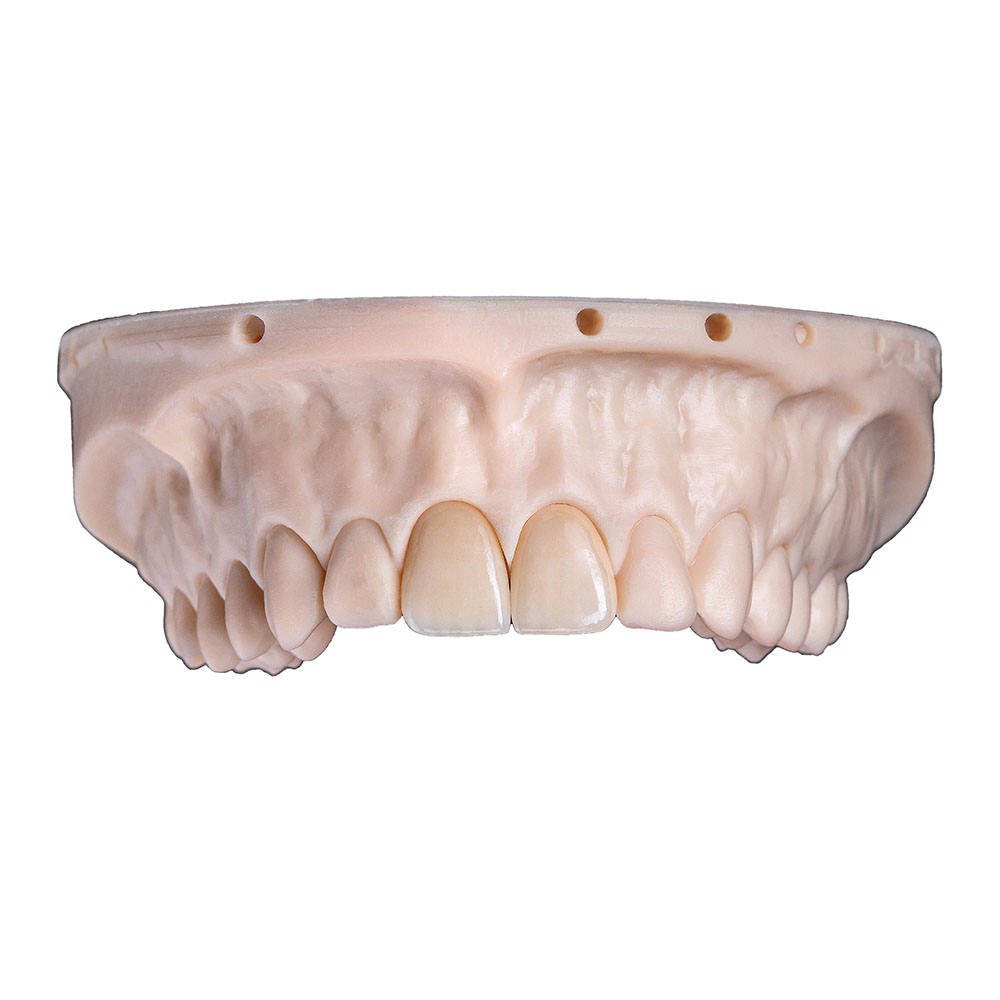
- Marginal integrity check on the stone model: uniform edge seal with no lifting, chipping, or overhang
- Internal surface inspection under magnification: smooth, defect-free bonding surface with no voids, roughness, or contamination
- Passive seating verification: veneers seated on the model without external force, no rocking or gaps
5. Material Quality & Traceability
Използваме genuine IPS E.max blanks from Ivoclar for lithium disilicate cases, not generic substitutes. Every material batch is logged, and furnace parameters are locked to manufacturer specifications.
For this case:
- E.max HT (high translucency) blanks were selected for a natural translucent effect
- Crystallization was performed at verified temperature curves with documented furnace logs
- Shrinkage compensation was calibrated using standard test blocks to ensure dimensional accuracy
Final Result: Natural Smile, Confident Patient
The veneers were delivered to the dentist within 5 business days from digital scan receipt. At try-in, the shade, translucency, and surface texture matched the natural dentition so closely that the patient’s friends couldn’t tell which teeth were treated.
Key outcomes:
- Seamless color blend with adjacent untreated teeth
- Natural translucency gradient from cervical to incisal
- Durable, chip-resistant E.max construction
- Confident, professional smile the patient was proud to show
The dentist bonded all six veneers in one appointment with no adjustments needed. The patient reported feeling “like myself again, but better.”
Why This Case Worked: Lab Capability Met Clinical Precision
Success in cosmetic veneer cases comes down to three things:
- Detailed communication between the dentist and the lab
- Experienced technicians who understand anterior aesthetics, not just technical specs
- Full-service in-house production that eliminates outsourcing risk and maintains quality control at every step
At ASD, we’ve completed thousands of cosmetic veneer cases for dentists and labs across the US and Europe. Our 460-person team includes dedicated CAD designers, milling specialists, and ceramic technicians who focus exclusively on high-aesthetic anterior work.
We don’t outsource any production steps. We don’t substitute materials. And we don’t treat veneer cases like commodity work—because we know that when a patient smiles, your reputation is on the line.
Ready to Start Your Next Veneer Case?
If you’re looking for a dental lab that handles cosmetic veneers with in-house production, experienced anterior specialists, and reliable turnaround times, we’d love to work with you.
Свържете се с нас to discuss your case requirements, request a trial case, or schedule a factory tour (Shenzhen / Huizhou, China).
По-кратки срокове за изпълнение на поръчките благодарение на нашата най-съвременна технология
Препоръчителен