High Noble PFM Crown — Porcelain Fused to High Noble Metal


A precise porcelain fused to high noble metal restoration fabricated in-house at ASD 치과 연구소
What Makes a PFM Crown “High Noble”
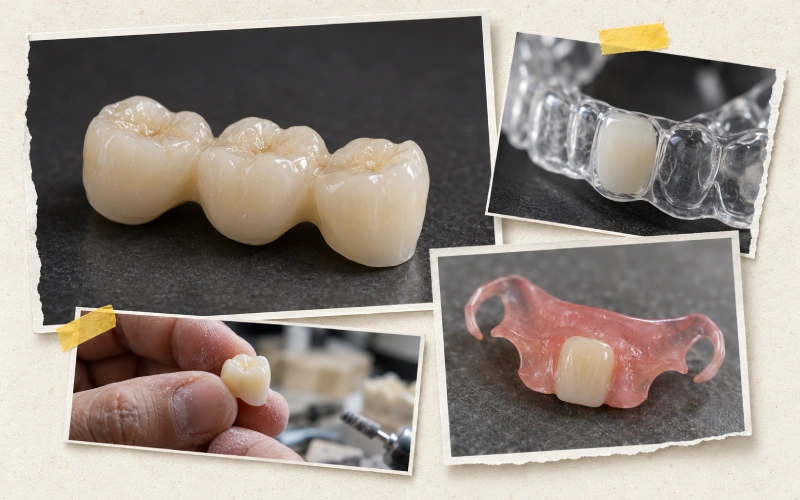
A porcelain fused to high noble metal crown is one specific category of metal-ceramic restoration — and the name is a technical classification, not marketing. The 미국 치과 협회(ADA) defines a high-noble alloy by a specific precious-metal threshold: the metal substructure must contain at least 60% noble metals (gold, platinum, and palladium combined), with at least 40% of that being gold.
For the dentist choosing materials, this matters because high noble alloys resist corrosion better, bond predictably with dental porcelain, and show strong long-term biocompatibility. They are not the cheapest option, but for cases where durability and tissue response both matter, the alloy specification does real work.
At a glance:
- Restoration type: crown PFM high noble (metal-ceramic, single unit or bridge span)
- Metal framework: Gold-platinum-palladium alloy (≥60% noble content, ≥40% gold)
- Porcelain veneer: Feldspathic or leucite-reinforced ceramic (Ivoclar, Shofu, or Noritake systems available)
- Indicated for: Single crowns, fixed bridges, posterior restorations under high occlusal load
- CDT codes: D2750 (single crown, high noble), D2751 (3/4 crown, high noble), D2752 (3/4 crown, noble metal). All three use a high-noble alloy specification under ISO 22674 Type 4.
A porcelain fused to high noble metal crown is therefore more restrictive than a generic “PFM” — the alloy has to clear the ADA’s precious-metal threshold, which is what justifies the price difference relative to base-metal PFMs.
Why Dental Labs Still Make PFM 크라운
You might wonder: with 올-지르코니아 그리고 리튬 디실리케이트 options available, why does any 치과 기공소 still produce metal-ceramic work?
Because a porcelain fused to high noble metal crown solves problems those materials don’t. When occlusal forces are high, preparation space is tight, or a patient’s parafunctional habits (bruxism, clenching) put ceramic at risk of fracture, the metal substructure becomes load-bearing insurance. A five-year survival rate around 95% — five-year survival rate around 95% — has been reproduced across multiple systematic reviews of conventionally cemented metal-ceramic restorations.
The durability comes from the metal doing what metal does: absorbing stress without catastrophic failure. Porcelain can chip, but the framework underneath keeps the restoration serviceable. That is fundamentally different from monolithic ceramics, where a fracture can compromise the entire unit and force a redo.
When a crown PFM high noble makes sense:
- Posterior teeth with limited interocclusal clearance (1.5–2.0 mm is workable)
- Patients with heavy occlusal forces or confirmed bruxism
- Bridge pontics spanning edentulous areas (metal framework prevents flexural failure)
- Cost-sensitive cases where aesthetics must still meet clinical standards
When it doesn’t:
- Anterior maxillary restorations with thin tissue biotype (gingival margin may show a gray line over time as tissue recedes)
- Cases where the occlusal plane allows full-contour zirconia at adequate thickness
- Patients with documented gold allergy (rare but real — verify alloy composition against the patient’s chart)
How ASD Dental Lab Builds a Porcelain Fused to High Noble Metal Crown
We are a full-service dental laboratory — meaning the entire workflow happens inside our Shenzhen and Huizhou facilities, not outsourced to third-party workshops. For a porcelain fused to high noble metal crown case, the path is:
1. Case Data Review & Planning
Your impression (physical or digital intraoral scan) comes in. Our case coordinator checks:
- Margin design (we work with chamfer, shoulder, or feather-edge; chamfer is most forgiving for PFM marginal fit)
- Occlusal clearance (minimum 1.5 mm recommended; we’ll flag if it’s borderline)
- Shade selection and adjacent-tooth reference photos
- Whether the prep has any feature that would compromise the alloy or porcelain layering
If anything is unclear — say, an undercut we can’t path around, or occlusal space that won’t support adequate porcelain thickness — we contact you before fabrication begins. Not after.
2. Metal Framework Casting
당사는 다음을 사용합니다. Bego precious-metal alloys for our crown PFM high noble units. The wax-up is invested, cast under argon atmosphere, and devested. Then:
- Airborne-particle abrasion (aluminum oxide, 50–110 μm) to roughen the bonding surface
- Ultrasonic cleaning to remove residual investment and surface oils
- Pre-oxidation in a controlled-atmosphere furnace (this thin oxide layer is what the porcelain chemically bonds to)
3. Porcelain Layering
Our ceramists use Ivoclar, Shofu, or Noritake porcelain systems (you can specify a preference on the Rx form). Layering is done in multiple firings:
- Opaque layer to mask the metal and establish base color
- Dentin porcelain for bulk and chroma
- Enamel and incisal porcelain for translucency and surface characterization
- Glaze firing for final surface smoothness and stain resistance
CTE matching: We select porcelain with a thermal expansion coefficient slightly lower than the metal (typically 0.5–1.0 × 10⁻⁶/°C below the alloy), so on cooling the porcelain goes into slight compression. That compressive state is what prevents the veneer from cracking under long-term function.
4. Finishing & Quality Check
- Occlusal contacts adjusted on a semi-adjustable articulator against the opposing cast
- Proximal contacts verified with 25-micron shim stock
- Margins inspected under stereomicroscopy (no flash, no gap wider than 100 μm)
- Post-glaze re-check of occlusion (glaze firing can cause minor dimensional change)
What Sets ASD Apart as a Dental Laboratory
In-house production: All nine fabrication steps — from wax-up to final polish — happen inside ASD’s facilities. We do not subcontract casting to one shop and porcelain to another. When a crown PFM high noble case needs modification, the same technician who layered it makes the adjustment. Communication is direct, not routed through middlemen.
Experienced team: PFM work at ASD is handled by technicians with 10+ years in metal-ceramic fabrication. This is not entry-level work — margin adaptation, porcelain thickness control, and shade matching all require trained judgment. We staff accordingly, and we keep dedicated bench space and kiln schedules reserved for these restorations even as our zirconia volume has grown.
Production capacity: Normal-season capacity is approximately 2,000 bridge cases and 8,000 single zirconia crowns per month. PFM units are a smaller fraction of that, but they are a stable, scheduled line. Peak-season capacity scales to roughly 150% of baseline without outsourcing.
Material sourcing: We use supplier-direct precious-metal alloys and porcelains — Bego (alloy), Ivoclar, Shofu, Noritake — not repackaged generics. When your Rx specifies “Ivoclar IPS d.SIGN,” that is the system the technician opens. Material substitution only happens with your written approval.
Traceability on request: Records of the alloy batch number, porcelain lot, and shade log are kept on file for every case. If you need to identify what materials were used in a specific restoration — for a patient record, an insurance request, or a remake years later — we can pull that information from our internal files. We do not, however, ship a per-batch alloy certificate of analysis with each case unless specifically contracted; that level of documentation is available on request for partner laboratories that need it for their records.
Preparation Requirements
- Occlusal reduction: 1.5–2.0 mm (posterior), 1.2–1.5 mm (anterior incisal)
- Axial reduction: 1.0–1.5 mm (uniform circumferential)
- Margin design: Chamfer (most forgiving for a porcelain fused to high noble metal crown), shoulder, or feather-edge (requires porcelain butt margin)
- Finish line: Supragingival or equigingival preferred; we can work with slightly subgingival margins if visibility is confirmed in the impression
If your prep does not meet these minimums, we will flag it on case review. Under-reduced preps force us to either make the crown too thin (fracture risk) or too bulky (emergence profile problem). It is better to know before fabrication than after seating.
Quality Assurance & Remakes
Pre-delivery QC for every porcelain fused to high noble metal crown:
- Dimensional check on the master model (margin gaps measured, not eyeballed)
- Occlusal contact verification on an articulator with the opposing cast
- Porcelain surface inspection for cracks, voids, or contamination
- Shade match against adjacent teeth (if photos provided) or Vita guide (if not)
Remake policy: If a restoration does not seat, has porcelain fracture out of the box, or fails shade match due to lab error, we remake it at no charge. Turnaround for remakes is typically 3–5 business days, prioritized over new cases.
What is not covered: Remake requests due to prep modification after the impression, patient shade preference change after try-in, or damage during chairside handling. Those are billed as new cases. We state this upfront because ambiguity helps no one.
How to Order a Crown PFM High Noble
Required:
- Impression or digital intraoral scan (STL/PLY, .dcm acceptable)
- Opposing arch and bite registration
- Shade selection (Vita guide or a clear photo of adjacent teeth)
- Margin design preference (chamfer / shoulder / feather-edge)
- Delivery date (standard turnaround: 10 business days; rush available)
Optional but helpful:
- Photos of the patient smiling (for anterior cases)
- Notes on any special considerations (for example, “patient is a known bruxer” or “tissue biotype is thin”)
- Porcelain system preference if you have a house standard (Ivoclar IPS d.SIGN vs. Noritake, etc.)
Rx form: We provide a digital case-submission form; you can also email scans and instructions directly to your account manager. Case coordinators respond within 24 hours on any clarification questions.
Common Questions from Dentists
Q: Can I get a metal occlusal surface with porcelain on the facial only?
Yes. Specify “porcelain facial, metal occlusal” on the Rx. This is common for lower molars where aesthetics matter less and you want maximum occlusal durability. The result is still classified as a porcelain fused to high noble metal crown under CDT D2750.
Q: What if my patient has a nickel allergy?
High-noble alloys in the Au–Pt–Pd system are typically nickel-free. If you want explicit confirmation, request the batch composition sheet when placing the order; we can pull it from the supplier documentation on file.
Q: How much prep reduction do I really need for a crown PFM high noble?
Absolute minimum: 1.0 mm axial, 1.5 mm occlusal. Ideal: 1.2–1.5 mm axial, 2.0 mm occlusal. If you are under 1.0 mm anywhere, we will likely ask you to re-prep or accept a thinner restoration with a higher fracture risk over time.
Q: Can you match a photo instead of a Vita shade?
Yes, but photos vary with lighting. Best practice is to send both a Vita shade tab AND a photo. If the two conflict, we will ask which to prioritize before firing the ceramic.
Q: What is your turnaround for a 3-unit PFM bridge?
Standard: 10 business days. Rush (20% fee): 5 business days. We do not offer same-day or 24-hour PFM; the multi-stage porcelain firing cycle cannot be safely compressed below that.