Emax Dental Crowns, Bridges & IPS e.max Crown Restorations From Our Own Factory
Looking to source emax dental crowns, short-span emax dental bridge work, or IPS e.max crown restorations for your practice or partner lab? We press and mill them in-house — no trading company in the middle, no outsourced case. Below is the product line, the way we make it, the way we work with you, and the case types we routinely deliver.

We are ASD 치과 연구소, a full-service dental laboratory with our own manufacturing facilities in Shenzhen and Huizhou, China. We have been running the IPS e.max Press and IPS e.max CAD workflows since 2012, and we currently ship to clinics, DSOs and partner labs in the United States, the United Kingdom, Germany, France, the Netherlands, Belgium, Austria, Luxembourg, Switzerland and other European markets. We are FDA-registered, MHRA-registered, MDR-notified (custom-made device route under Annex XIII), and our lab operates under ISO 13485.
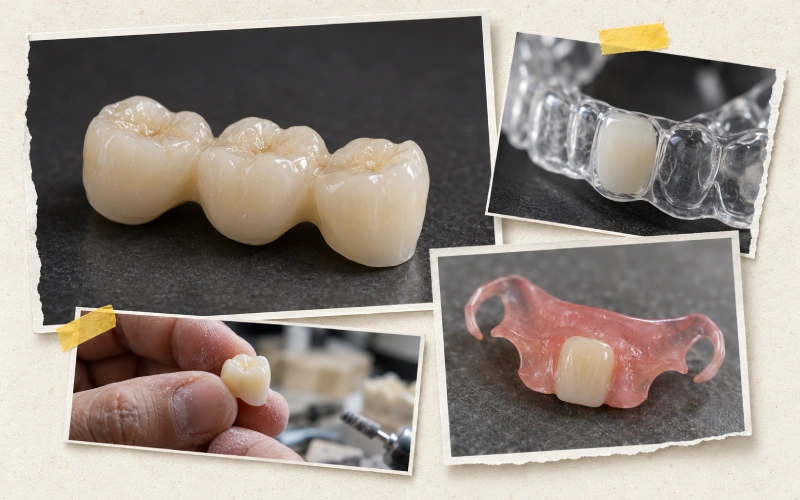
1. Product Collection — What We Actually Make in Lithium Disilicate
Everything on this page is lithium-disilicate glass-ceramic manufactured from Ivoclar’s IPS e.max product family. If a case needs a longer-span framework we route it to zirconia (also in-house), but the six line items below are the products this page is about.
# | 제품 | Route we use | Typical indication | Lab time |
1 | Single emax dental crown, monolithic | IPS e.max CAD block, milled + crystallized | Anterior or posterior single-tooth restoration, retentive prep, ≥1.5 mm occlusal clearance | 2–3 working days |
2 | Single IPS e.max crown, cut-back + layered | IPS e.max Press ingot, cut back and layered with IPS e.max Ceram | High-esthetic anterior single crown, characterization required | 3–4 working days |
3 | Emax dental bridge, three-unit, one pontic | IPS e.max Press ingot | Anterior or premolar-to-premolar FDP, terminal abutment ≤ second premolar | 3–4 working days |
4 | IPS e.max veneer | Press or CAD, HT / LT / MO | Anterior veneer, minimum-prep or no-prep case | 3–4 working days |
5 | IPS e.max inlay / onlay / partial crown | Press or CAD | Adhesively bonded posterior partial restoration | 2–3 working days |
6 | IPS e.max screw-retained single implant crown | Press or CAD over a titanium base | Single-tooth implant restoration, screw-retained or cement-retained | 3–4 working days |
For a longer-span FDP we route it to IPS e.max ZirCAD (zirconium oxide) with e.max Ceram layering — that is a zirconia-framework product, not lithium disilicate, and the material physics are different.
2. Why Choose Us for emax dental crowns, emax dental bridges and IPS e.max crown Work
The bullet list below is the short version. The rest of this page is the long version.
- We are the factory, not a broker. ASD is a direct manufacturing facility, not a trading company. Every case is produced inside our Shenzhen and Huizhou facilities; we do not outsource to third-party laboratories.
- Authentic Ivoclar material, batch-traceable. Every emax dental crown or IPS e.max crown we deliver is milled from a genuine Ivoclar block or pressed from a genuine Ivoclar ingot. We can supply the batch number, brand, country of origin and material certificate for the specific case on request.
- In-house team of ~460, no seasonal collapse. We staff roughly 100 CAD designers, 70 milling technicians, 70 ceramic-and-metal technicians, 25 QC, and 40 case-coordination staff, plus about 50 trained backup technicians for peak season. Our normal-season capacity is ~8,000 zirconia single crowns / month and ~2,000 zirconia bridge cases / month; peak capacity is 15,000 / 3,000. e.max Press and CAD run on dedicated lines inside the same facilities.
- Regulatory posture stated correctly. FDA-registered, FDA-listed for custom crowns / fixed bridges / inlays-onlays / veneers / custom abutments / superstructures / dentures; MHRA-registered; EU MDR custom-made-device notification filed via an EU authorized representative; lab under ISO 13485. Custom restorations under MDR are notified via Annex XIII, not CE-marked — we do not call a notification “FDA approval” or “CE certification” and we do not encourage any partner to.
- Every case is traceable. Each case gets a unique ID linked to the technician, the equipment, the material batch and the QC records. We keep the record for 3 months by default and can extend on request.
- Cooperation is flexible. We work with dentists, dental clinics, DSOs and partner dental laboratories. We accept single-case trials, offer private-label (unbranded packaging, prescription pads, labels, and communications), and support factory visits or full video walk-throughs in Shenzhen or Huizhou.
- First-pass QC through-put ~95%. This is our internally measured first-time-pass rate — the proportion of cases that clear final inspection on the first attempt (not counting cases passed after remake). Our overall remake rate runs at 2–3%.
3. Our Manufacturing Workflow — What Happens After the Case Lands With Us
Every emax dental crown or IPS e.max crown case we deliver goes through the same in-house steps, in this order. Nothing on this list is farmed out.
- Case intake and data verification. Digital scan (STL / PLY / OBJ / DCM native) or physical impression / poured model. Our case-coordination team validates prep margins, occlusal clearance, adjacent-tooth data, opposing arch coverage, and shade / translucency information before the case is released to design. We reply within one business day on scan validity.
- CAD design. Restoration is designed in a professional dental CAD suite by our design department (about 100 designers). One free design + two free revisions per case. Preview screenshots or the STL are sent for approval on group chat or email when the case asks for it (implant, full-arch, high-esthetic anterior).
- Route split — Press or CAD.
- Press route (IPS e.max Press): wax pattern → invest → burn-out → press → divest → glaze / stain, or cut back + layer with IPS e.max Ceram.
- CAD route (IPS e.max CAD): mill in the blue state on a dental CNC → crystallize in a dedicated furnace on a locked temperature curve → glaze / stain, or cut back + layer.
- Crystallization / firing. The crystallization curve for IPS e.max CAD and the pressing curve for IPS e.max Press are locked in our furnaces. Curves are recorded per firing and cross-checked against test coupons on new material batches, so shrinkage compensation stays stable.
- Finishing. Occlusal contacts, proximal contacts, marginal integrity and axial contour are hand-finished by the ceramic technician. High-esthetic anterior cases go through a senior technician.
- Quality control. Marginal fit, internal fit, seating, proximal contact tightness, centric / protrusive / lateral occlusion, form and polish are checked against the approved design. Digital measurement and magnification are used where indicated.
- Packaging. Each restoration is placed in a case-specific box, cushioned with anti-vibration wrap, and labeled with the case ID (or unbranded, if you asked for private-label).
- Shipping. DHL, FedEx, UPS, or SPIDER (for France). We can ship on our courier account with our negotiated volume discount, or on your account.
Equipment. Industrial-grade optical scanners for physical models; multiple dental CNC mills; dedicated zirconia and glass-ceramic furnaces; dental-grade DLP 3D printers for models and try-in wax-ups. Full equipment brand list available on request. All equipment is on a calibration + preventive-maintenance schedule with a written log.
Compatibility. We accept scans from 3Shape TRIOS, Medit, iTero, CEREC (Sirona), Shining3D Aoralscan, Planmeca — any scanner that exports open files. File formats accepted: STL, PLY (color), OBJ, 3Shape DCM native. STL single-arch recommended <150 MB; PLY (color) <300 MB. We can also work from exocad or 3Shape editable design files, or take the case as CAD-only, CAM-only, or full-service.
4. Cooperation Flow — From First Case to Repeat Order
You send us the case, we send you the restoration. Here is what happens between those two steps and what we expect from the Rx.
4.1 Onboarding
- Sign-up: email your business contact and shipping address to sales; we send a fee schedule and a mutual NDA (a written confidentiality agreement) if you want private-label from day one.
- First trial case: we accept a single case as a trial. Digital: send the file. Physical: we can issue a prepaid inbound label or you ship to our address and forward the tracking number.
- Long-term terms: dentist accounts with low volume can cooperate as long as you cover freight. Partner-lab accounts are expected to reach ~US$500 / month in lab fees to make the freight economics work. New accounts start on prepayment; after we have a working history, one-month payment terms are available. Payment via bank transfer or PayPal; payment-processing fees are on the sender; FX conversion uses the day’s rate.
4.2 What we need on the Rx
At minimum:
- Clinic, dentist, patient reference, and the requested delivery date.
- Restoration list: which tooth number, which product (emax dental crown, IPS e.max crown, veneer, inlay, onlay, three-unit emax dental bridge), monolithic vs cut-back + layered, and the shade + translucency grade (HT / MT / LT / MO / HO). VITA shade tab or a shade photograph is fine.
- Prep information: finish line type (shoulder, chamfer), supragingival / subgingival extent in mm, and — on a scan — the margin line drawn by hand instead of relying on the software auto-detect.
- For a three-unit emax dental bridge: which teeth are the abutments, which site is the pontic, the pontic width in mm, and any special connector-form requirement. See §7 for the geometry rules.
- For an implant crown: implant brand, platform, connection, diameter, and scan-body label / photo. Original-manufacturer parts are priced at manufacturer cost plus manual assembly; compatible parts are priced lower — you choose.
- Occlusal-space warning: if remaining occlusal clearance is <1.5 mm, tell us in writing. We will either propose a thinner material class, more reduction, or a redesign — we will not silently mill through the minimum.
- Photographs (anterior esthetic case): ring or dual-head macro flash, ~5500 K, ISO 100, shutter 1/125–1/200 s, aperture f/22 for intra-oral. Full-face + retracted + shade tab photo covers most cases.
4.3 Lead time, Rush and communication
- Emax dental crown / IPS e.max crown, single unit: 2–3 working days lab time.
- Three-unit emax dental bridge: 3–4 working days lab time.
- Working days only. Weekends and China public holidays do not count. Waiting on the dentist to approve a design does not count either — the clock re-starts on approval.
- Rush case: available on all case types. Under 10 rush units per month, we do not charge extra.
- Status notifications at intake, design complete, milling / pressing complete, QC, and shipment with tracking. Communication runs through email, WhatsApp group chat, or your existing lab portal.
- International shipping does not include customs clearance or remote-area delivery time. Solid impressions to countries that restrict biological material (US, Canada, Australia, New Zealand, most of the EU) must be disinfected and declared per bio-sample rules — email us if you are not sure.
4.4 Warranty, remake and complaint handling
- Free remake (our fault): open margin, open proximal contact, high occlusion, seating failure, wrong shade, obvious esthetic defect, or clear form problem — free. Fixed prosthesis and removable have the same rule.
- Not free: dentist-driven changes to the Rx (shade change, material change, redesign requested after approval), remake on a case where we already warned in writing that the impression / scan was inadequate but you asked us to try anyway, or issues traceable to the clinician’s chairside adjustment / cementation.
- Documentation for a complaint: patient reference, case number, restoration description, complaint reason, and photographs. We prefer them dropped into the working WhatsApp group or emailed to your case coordinator.
- Investigation timeline: for a major complaint, our production department starts an internal review within 3–4 hours and issues a written resolution within 24 hours.
- Physical remake: the original restoration is shipped back for physical cases; digital cases can send the STL and photos and we redo from data. Return freight and any implant components are not included in a free remake unless we agreed otherwise up front.
- Priority: remakes are prioritized; expected turnaround is your normal lab time + 3–5 working days.
- No industry-wide mandatory warranty term exists for e.max lithium disilicate. Ivoclar publishes its own manufacturer guarantee. Our own written warranty ships with the fee schedule.
4.5 Private-label and confidentiality
- Packaging, prescription pad, label and case-communication documents can be unbranded on request.
- We can co-sign an NDA covering pricing, brand identity, customer relationships and case data. Data ownership stays with your clinic / lab; we retain a working copy for the duration of production only and delete on the agreed timeline.
5. Case Examples — By Indication, Not By Testimonial
We do not publish patient photos we cannot verify with informed consent. The case types below are what we routinely deliver in the emax family, with the design decisions that separate them.
5.1 Single anterior emax dental crown, cut-back + layered
- Setup: upper central incisor, patient with characterization requirements (halo, incisal translucency, subtle mamelons), adjacent tooth reference photograph provided.
- Route: IPS e.max Press, HT ingot, cut back on the incisal third, layered with IPS e.max Ceram.
- Design decisions: proximal contact tightness matched to floss-passage feedback; incisal edge thickness ≥1.5 mm; palatal contour finished for canine-protected occlusion.
- Handoff: design preview + intra-oral photograph in the working group; two free revisions if you want the layering tuned.
5.2 Single posterior IPS e.max crown, monolithic
- Setup: lower first molar, ≥1.5 mm occlusal clearance, retentive prep with a rounded shoulder, no bruxism history.
- Route: IPS e.max CAD, MT block, monolithic.
- Design decisions: minimum 1.5 mm occlusal thickness locked in the design; central fossa contour adjusted so the antagonist meets the flat portion of the fossa, not the marginal ridge.
- Handoff: cemented with resin-modified glass-ionomer or self-adhesive resin cement per the current Ivoclar CAD IFU when the prep is retentive and adequately thick.
5.3 Three-unit anterior emax dental bridge (canine-to-canine, one pontic)
- Setup: upper lateral incisor site, canine and central abutments, no parafunction, pontic width 8 mm.
- Route: IPS e.max Press ingot, cut back + layered.
- Design decisions: connector cross-section ≥16 mm² by current conservative rule (older rule 12 mm² anterior); connector height ≥ connector width; sanitary pontic contour with cleaning space.
- Rx checkpoint: we needed the abutment / pontic tooth numbers and the pontic width in mm on the Rx before design started. This is not a case we would begin without that information.
5.4 Screw-retained single implant crown, IPS e.max
- Setup: upper premolar, single implant, screw access angulated palatally — screw-retained is possible without an angulated screw channel.
- Route: IPS e.max Press over a titanium base (Ti-base). Bonding face on the Ti-base is protected at the platform, sandblasted with 50 μm alumina on the bonding surface, ultrasonic-cleaned, dried, coated with an MDP metal primer, and bonded with a dual-cure resin cement under 20–50 μm cement space. Excess cement is removed at the gel stage and photo-polymerized. Screw channel is sealed after seating.
- Design decisions: emergence profile designed from the scan-body and soft-tissue data provided by the clinician; digital preview is sent for approval before we mill.
- Torque: we follow the implant manufacturer’s own torque specification.
5.5 IPS e.max veneer, minimum-prep anterior
- Setup: upper anterior, minimum prep on facial only, chameleon-effect required against dark substrate.
- Route: IPS e.max Press, HT or LT depending on substrate shade; PLY (color) scan requested so we can capture stump shade and gingival colour reference.
- Design decisions: minimum thickness respected per IFU; incisal edge geometry finished by hand.
- Cementation: adhesive protocol — hydrofluoric acid 5% for 20 s, rinsed, dried, silane coupling, then light-cure or dual-cure resin cement (PubMed 25535784 — adhesive bonding protocol).
5.6 IPS e.max inlay / onlay / partial crown
- Setup: posterior tooth, cusp coverage on functional cusps, adhesive design.
- Route: IPS e.max CAD or Press, MT / LT block, monolithic.
- Design decisions: proximal box design with internal-line-angle rounding; minimum isthmus width preserved; margin outside the contact area where possible.
6. Product-Usage Rules — Because This Page Should Not Send You a Restoration You Cannot Cement
The material has geometry limits. If a case falls outside them, we will tell you before we start.
6.1 Where an emax dental crown or IPS e.max crown is well-supported
- Single anterior or posterior crown, retentive prep, ≥1.5 mm occlusal clearance.
- Adhesively bonded veneer, inlay, onlay, partial crown.
- Post-endodontic restoration on a tooth with adequate remaining coronal structure.
- Single-tooth screw-retained implant crown over a titanium base.
6.2 Where the emax dental bridge is well-supported
- Three units, one pontic.
- Pontic width ≤11 mm anterior, ≤9 mm from canine to second premolar.
- Terminal abutment ≤ second premolar — no bridges spanning to the molars.
- Connector cross-section ≥12 mm² anterior (older Ivoclar rule) or ≥16 mm² anterior (current conservative rule); ≥16 mm² posterior. Height ≥ width, with rounded internal geometry.
- Cited authority: Ivoclar — Press product page; Wolfart et al., 8-year Kaplan–Meier 93% on 36 three-unit e.max Press FDPs.
자주 묻는 질문
Same material family. “IPS e.max” is Ivoclar’s brand and clinical name; “emax dental crown” is the everyday shorthand used by dentists and labs. Both refer to lithium-disilicate glass-ceramic milled from IPS e.max CAD blocks or pressed from IPS e.max Press ingots.
Not safely. A three-unit emax dental bridge is geometrically constrained (pontic width, connector cross-section, terminal abutment position). We need the abutment tooth numbers, the pontic site, the pontic width and the connector design before we can start. We will not begin a three-unit bridge case without that information.
Both are clinically acceptable. Press is a fully crystallized ingot pressed by lost-wax and is often chosen when you want hand-stacked layering. CAD is a partially crystallized block milled in the blue state and crystallized in a furnace — faster, fully digital, and typical for monolithic restorations. Manufacturer-published flexural strength is ~400 MPa for Press and ~530 MPa for CAD.
CAD offers HT, MT, LT and MO. Press offers HT, LT, MO and HO. Anterior work usually calls for HT or LT. HO is for masking severely discolored preparations, metal posts, or implant abutments. Send the target shade (VITA A2, B1, etc.) plus the grade.
No. Lithium disilicate has high strength for a glass-ceramic — the published 5- and 10-year single-crown survival is ~97.8% and ~96.7% respectively — but it can bulk-fracture, chip, or debond, and single-crown survival is not the same as “cannot fail” (PubMed 24674802 — systematic review).
On request, we supply the case-specific batch number, brand, country of origin and material certificate. For sensitive accounts, we can retain a photograph of the block or ingot barcode with the case record. Compatible blocks from other manufacturers exist and are legal; we do not substitute unless you asked for a specific alternative in writing.
IPS e.max CAD is cleared under 510(k) record K051705. That is a market-clearance route — the 510(k) pathway does not carry the meaning of an FDA endorsement of the device, and it is not the same term as the FDA uses for its premarket-approval pathway. In your marketing, “FDA-cleared material” or “510(k) K051705” is accurate; wording that upgrades a 510(k) clearance into an FDA endorsement is not (FDA 510(k) K051705 record).
No. Custom-made dental restorations are handled through the MDR Annex XIII custom-made-device route — a written declaration and EUDAMED notification, not a CE mark on the device itself (MDCG 2021-3 guidance (PDF)).
Same material family, different workflow. A chairside CEREC crown is milled and crystallized at the chair on a smaller CAD block set; a lab crown from us goes through a full CAD design review, senior-technician finishing, dedicated crystallization curves, and a QC pass before it ships. Chairside is faster for the patient; a lab route lets you get cut-back + layering, HO ingots, or high-esthetic anterior work that a chairside block set does not offer.
Emax dental crown / IPS e.max crown single unit: 2–3 working days. Three-unit emax dental bridge: 3–4 working days. Peak season we run about 15,000 zirconia single crowns and 3,000 bridge cases per month at our maximum with ~50 trained backup technicians on rotation, so lead time stays inside the window — but customs and remote-area delivery on top of that is not something we control.
Roughly: unit count is the base, material class fixes the base price, implant components / design complexity add on top. For a single emax dental crown, the four buckets are (1) material (block or ingot + block-brand tier), (2) technician labour (mill + crystallize + finish + QC for monolithic; add layering time for cut-back), (3) equipment amortization (mill burs, firing pins, furnace curves), and (4) inbound / outbound freight. Our written fee schedule breaks these out; ask sales.