E.max Bridge Case — Anterior Single Pontic with Night Clenching and a Discoloured Abutment


🕢 [ Попълнете формуляра и ние ще ви отговорим в рамките на 30 минути! ]
One case, four constraints, and the design decisions that came out of them. Connector cross-section, shade strategy over a dark substrate, and what shipped alongside the bridge.
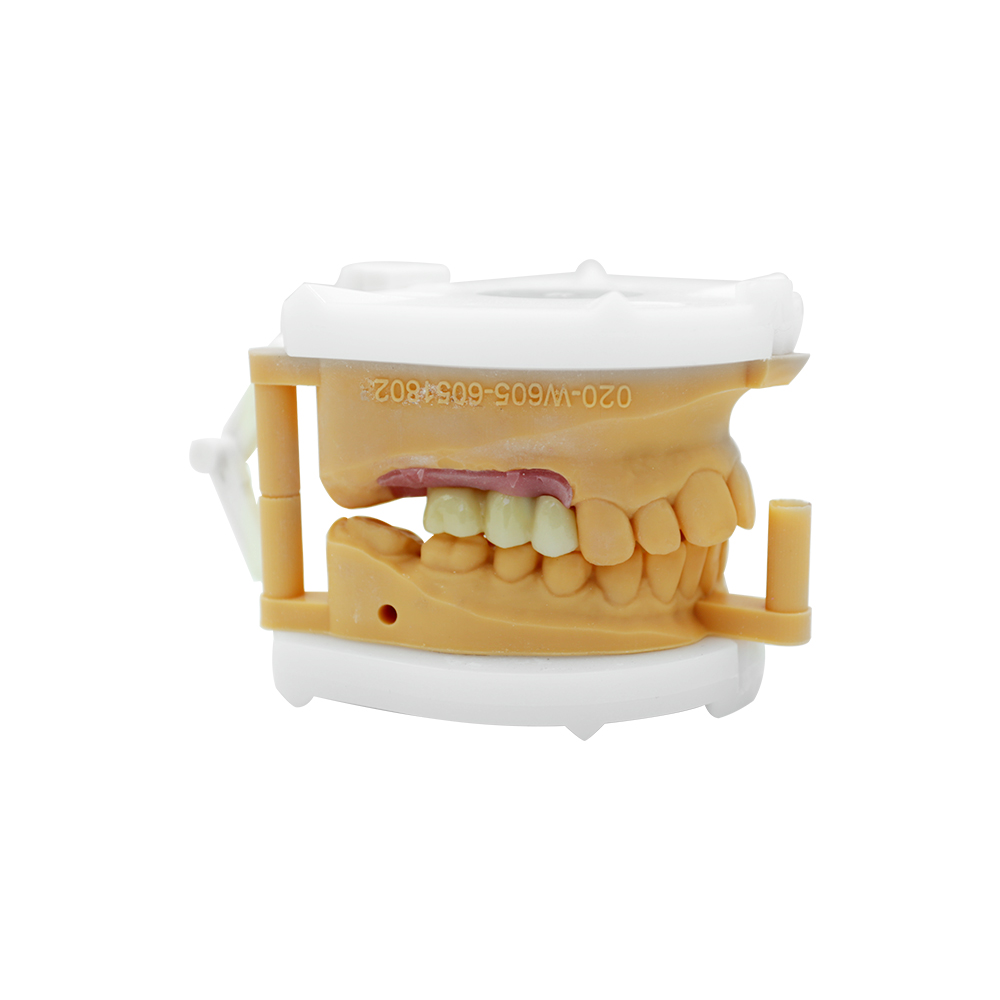
A three-unit anterior bridge where the connector had to be built vertically rather than buccolingually, and where one abutment needed a different translucency than the other two.
The case
Patient situation
34-year-old patient, missing FDI 11 (upper right central incisor), wearing a removable partial for seven months. Both adjacent abutments unrestored, periodontal support stable, no active caries in the arch.
Four findings turned this from a routine three-unit bridge into a case that needed decisions before anyone picked up a bur.
Night clenching, documented. He reported grinding hard enough to wake himself, and showed visible wear facets on the posterior teeth. He had already worn through two hard acrylic guards in four years, both split at the canine region.
A discoloured substrate. Abutment FDI 21 (upper left central incisor) carried a shade of Vita C3 after previous endodontic treatment, showing grey at the cervical third.
Tight space. Mesiodistal room at the pontic site measured 10.4 mm mesiodistal at the edentulous site, which put the connector calculation somewhere uncomfortable.
A patient who had read things. He had read online that e.max bridges break, particularly the connector between the pontic and the abutments — worth addressing before the case was seated, not after.
What the dentist asked for
The case arrived with digital scans, a bite registration, intraoral photographs with shade tabs, and a prescription addressing each constraint in writing.
| Line on the Rx | Specification | Why it was specified |
| Connector | Minimum 16 mm², extend incisocervically if buccolingual space is tight | Published CAD guidance gives the bridge connector requirement, and the connector is the most highly stressed part of the restoration |
| Pontic form | Modified ridge lap, light tissue contact, zero occlusal contact in centric and all excursions | Keeps masticatory load off the connector during clenching cycles |
| Pontic width | Not to exceed 11 mm anterior | Clinical guidance lists approximately 11 mm anterior and 9 mm premolar as the commonly used maxima |
| Material route | IPS e.max, full-contour monolithic, stained and glazed | A bilayered build carries more chipping risk than a full-contour one |
| Abutment masking | Mask Vita C3 to A1 on the discoloured abutment only | Masking evaluation shows final colour comes from substrate, ceramic thickness and cement shade together, not from the shade label alone |
| Cement | Adhesive resin | Preferred where retention is limited, where shade matters, and on translucent anterior work — manufacturer guidance |
| Occlusal appliance | Hard full-coverage guard, delivered with the bridge | Parafunction appears among the listed causes of connector fracture in failure analysis |
One further line sat at the bottom of the prescription, typed rather than dictated: patient has read online that e max bridges break. Please address this before we seat it. That answer went into the delivery note, not into a reassurance at the front desk.
How we met each requirement
Connector. Buccolingual space was the binding constraint, not vertical room. The buccolingual dimension went to its maximum achievable value after finish-line placement, then incisocervical height was added until the cross-section cleared the requirement with margin. Achieved: 17.2 mm², with the calculation attached to the design approval sheet so it could be checked rather than taken on trust.
The same sheet carried a do-not-do line: no separating disc, no aggressive grinding at the connector. Finishing is where a 16 mm² requirement quietly becomes 12 mm², and the failure literature lists reduction at the connector among the causes of early fracture.
Occlusion. Zero contact on the pontic in maximum intercuspation and in both excursions; guidance stayed on the natural teeth. A contact map went out with the design. A pontic that takes load in excursion behaves like a third abutment, and that is load the connector was not sized for.
Masking the dark abutment. High-translucency material transmits a grey or brown substrate, so it was the wrong choice on that one abutment and the right choice everywhere else. A more opaque ingot ran on the discoloured crown only, high translucency stayed on the pontic and the sound abutment, ceramic thickness increased labially on the discoloured side to buy masking without overcontouring the emergence profile, and the transition was hand-stained so the two materials did not read as a seam.
The trade-off is real, and it was raised before pressing rather than after delivery: opacity and translucency pull against each other. Raising opacity improves masking and costs vitality (the masking data). On a bridge running from a bright abutment to a masked one, someone has to give — and it should be the abutment that needs it.
Pontic optics. A pontic has no dentin and no enamel beneath it, so light behaves differently there than under either crown. A single shade label across a three-unit anterior bridge is usually not enough, so intraoral shade photographs and video were requested from the dentist’s own camera, and the pontic was matched to the adjacent tooth rather than to the average of the two abutments.
Guard as a delivery item. Fabricated in parallel and shipped in the same package. Not a recommendation in a discharge packet — a physical object in the box, listed on the delivery note.
What happened at the chair
Seated passively on the first try. Contacts clear on both sides, no binding. The discoloured abutment read as a match at the cervical third where the grey had shown through on the temporary. Zero contact on the pontic in centric and in both excursions, confirmed with articulating ribbon and again after cementation.
At six months, the dentist reported: restoration intact, no chipping, no sensitivity, gingival margins clean, and the patient wearing the guard nightly.
A single case at six months is an anecdote, and anecdotes are not evidence. The published numbers for this material sit far apart — roughly 78% five-year survival for fixed prostheses and about 71% at ten years in one systematic review, 93% at eight years in a prospective eight-year series, and 48.6% at fifteen years in a fifteen-year study, where the restorations were mostly molars. Same material, three very different numbers, which is why the molar question below is not a formality.
The numbers this bridge was built to
If a design cannot hold these, the design changes or the material does.
| Parameter | Anterior | Premolar | Basis |
| Connector cross-section | 16 mm² minimum, roughly 4 × 4 mm | 16 mm² minimum | Manufacturer requirement |
| Maximum pontic width | ~11 mm | ~9 mm | Clinical guidance |
| Ceramic thickness, minimum | 1.2 mm circumferential, 1.5 mm incisal | 1.5 mm | CAD guidance |
| Reduction at prep | 1.5–2.0 mm occlusal or incisal, ~1.5 mm axial | Същото | Preparation guidance |
| Finish line | Continuous 1.0 mm rounded shoulder or deep chamfer | Същото | Preparation guidance |
| Span / most distal abutment | One pontic, no further back than the second premolar | Същото | Conservative indication |
Smaller connector figures quoted in generic all-ceramic guides belong to other ceramic systems and do not transfer to a lithium disilicate three-unit bridge. The 16 mm² manufacturer figure is the one a design gets built to.
Achieved on this case: connector 17.2 mm² · pontic width 10.4 mm · incisal thickness 1.9 mm.
Cementation and adjustment
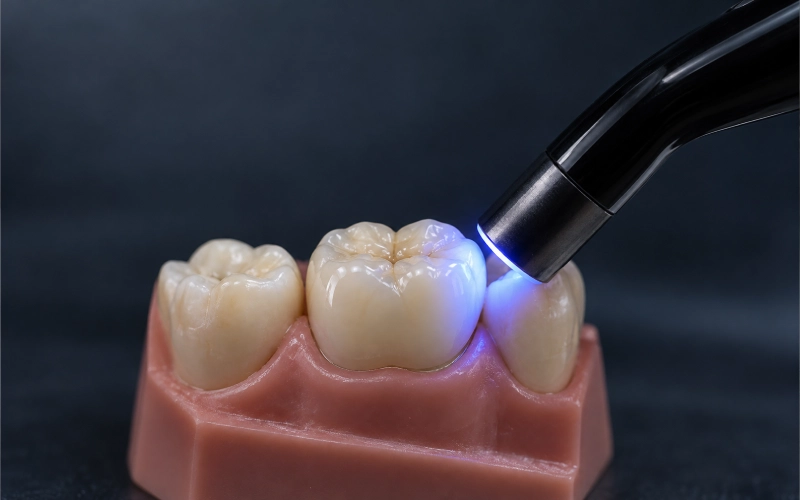
The sequence that applies to lithium disilicate, written down because it gets done wrong often enough to matter. Try-in with a water-soluble paste when shade is critical. Clean the restoration after try-in with a proper cleaning agent rather than defaulting to re-sandblasting an already conditioned surface (Ivoclar’s surface pre-treatment guidance). Treat the internal surface with roughly 5% hydrofluoric acid for 20 seconds, rinse, dry, then silane for about 60 seconds and air disperse — or use a combined etch-and-prime product on its own instructions (Monobond Etch & Prime). Etch enamel and dentin per the adhesive system, seat with a compatible resin cement, clear the contacts, cure, and block air at the margins before final cure.
Two hard rules. Hydrofluoric acid is extraoral only, never intraoral. And lithium disilicate is not treated like zirconia — routine aggressive alumina sandblasting can initiate cracks in glass ceramic.
If the restoration is adjusted at the chair, re-polish it. Adjustment damages the glazed surface and dedicated ceramic polishing systems are the way back to a smooth finish (preparation and finishing guidance). Delivered with this case: connector value, achieved thicknesses, ingot and translucency selection, fit and occlusion note, and this cementation sequence.
When this is the wrong choice
Said before the case is ordered rather than after the remake:
- The bridge includes a molar — loads no lithium disilicate connector is sized for.
- Two or more adjacent teeth are missing — a four-unit span, outside the conservative indication.
- The patient clenches and will not wear a guard — parafunction is among the listed causes of connector fracture (the failure analysis).
- Occlusal space too tight to hold minimum thickness and still make the connector — a thin core under layering ceramic appears among the listed causes of framework fracture (the instructions for use).
- A dark metallic core that cannot be masked — opacity buys masking at the cost of translucency (the masking data).
- Preparation too short to give the connector its height (the material overview).
For most of those, zirconia is the better call. A narrative review concluded that zirconia remains the more conservative choice for many three- and four-unit fixed dental prostheses, largely because the bridge evidence base for lithium disilicate is less consistent.
Questions this case raises
What is the minimum connector size for an emax bridge?
16 mm², roughly 4 × 4 mm, for a conventional three-unit e.max bridge (Published CAD guidance). When buccolingual space is tight, add incisocervical height rather than accepting a narrower connector.
How many units can an e max bridge have?
Three — one pontic, two abutments. Four units and beyond sits outside the conservative indication for this material.
How much does an emax dental bridge cost?
No published fee schedule. What moves a lithium disilicate bridge quote is span, material route, translucency selection, whether a custom shade appointment is involved, and urgency. Send the prescription and the specific case gets quoted.
How long does an emax dental bridge last?
It depends on design, site and case selection, and the published numbers sit far apart — 78% at five years in one systematic review (one systematic review), 93% at eight years in a prospective series of short-span pressed bridges (a prospective eight-year series), 48.6% at fifteen years on mostly molar sites (a fifteen-year study). Tooth-supported prostheses across the literature report survival from 48.6% to 100% (the survival review), which is a fair summary of how much design and case selection matter.
Does a night guard actually matter?
Yes, and it is the cheapest variable in the case. A guard does not change the connector dimension. It changes how much load reaches it.
The lab
ASD Dental Lab is a full-service dental laboratory and direct manufacturing facility founded in 2012, in Shenzhen and Huizhou, China — a manufacturer, not a trading company. Roughly 460 staff, including about 25 in quality control, plus around 50 trained backup workers for peak season. Case intake, design, milling, pressing, processing, polishing, inspection, packing and shipping all happen inside our own facilities.
Turnaround runs from the day a complete, acceptable case arrives: 3 to 5 working days for standard full-contour fixed work, 5 to 7 for full-arch, pressed and custom-shade bridges quoted per case. Rush is available on essentially any case. Those schedules hold because the work stays in-house — ten steps, one floor, no hand-off to a third-party lab.
We work with clinics, laboratories and dentists across the United States, the Netherlands, Germany, France, Belgium, Austria, the United Kingdom, Luxembourg, Switzerland and other markets. Clinics, labs and partners can arrange a factory visit, a production line tour, or a video inspection.